Specialist Photography Portfolio Pre-Launch & Coming Soon Website Template
Shutter is a razor-sharp architectural photographer landing page built for specialists who photograph twelve buildings a year and mean it. The one page template combines a manifesto-driven scroll, translucent overlapping panels, parallax depth, and a waitlist call to action that turns scarcity into craft. Architecture firms, developers, and editorial clients discover exactly why they should reserve a shoot window before the quarter fills.
by Rocket studio
Quick summary
Shutter is a single-page, overlap-layered website template built exclusively for architectural photography professionals. It pairs a full-bleed atrium hero with sequential manifesto panels that slide in at offset angles over deep architectural photographs. The page closes on a waitlist form that converts browsers into committed clients through quiet, earned authority rather than loud sales tactics.
Who this template is for
This template is purpose-built for a specialized type of practitioner: the architectural photographer whose client list is selective, whose calendar fills by reputation, and whose work appears in publications rather than on social feeds. It is not a general photography portfolio starter. It is a declaration.
- Architecture firms preparing portfolio documentation and Archdaily submissions who need hero images that hold up at full resolution.
- Property developers sourcing pre-sale photography and design magazine editors hunting editorial cover photographs that stop a scroll.
- Freelance photographers ready to position scarcity as a feature of their photography business and attract clients who value craft over volume.
What problem this template solves
Most photography templates treat the photographer's site like an online photo album: a gallery grid, a contact page, a price list. That approach fails the architectural photographer because it commoditizes the work and crowds potential clients who already know what they want. The visitor arrives, sees pictures, and leaves. Nothing earns the ask.
- Generic photography website layouts bury the photographer's conviction under navigation menus and thumbnail grids, diluting the first impression that converts new clients.
- Standard one page templates lack the layered depth and scroll-linked motion that mirrors how architectural photography itself works: structure, light, and time stacked together.
- A flat site matches no particular audience, so it reaches none effectively. Shutter solves this by making the page itself feel like moving through a building.
What you get with this template
You get a complete, ready-to-customize one page landing page structured around five deliberate sections, each serving a specific conversion purpose. The template ships with all layout panels, typography pairings, color tokens, animation hooks, and the waitlist form component pre-configured. You do not need to assemble the creative direction from scratch.
- A full-bleed hero section, three sequential manifesto panels with translucent overlapping backgrounds, a waitlist call-to-action section with project-type toggle and live slot counter, and an ultra-minimal footer.
- A pre-set Monochrome Steel color system with four defined tokens, two typeface roles, and a laser-blue accent reserved for interactive hover states and the primary call to action.
- Scroll-linked parallax layers, panel offset animations, a letter-by-letter name reveal on the home page hero, and a GPU-accelerated motion system built for desktop-first presentation with mobile parity.
Feature list
This template ships with a focused set of powerful features matched to the needs of a working architectural photographer who wants professional results without overbuilding the site.
Full-Bleed Parallax Hero
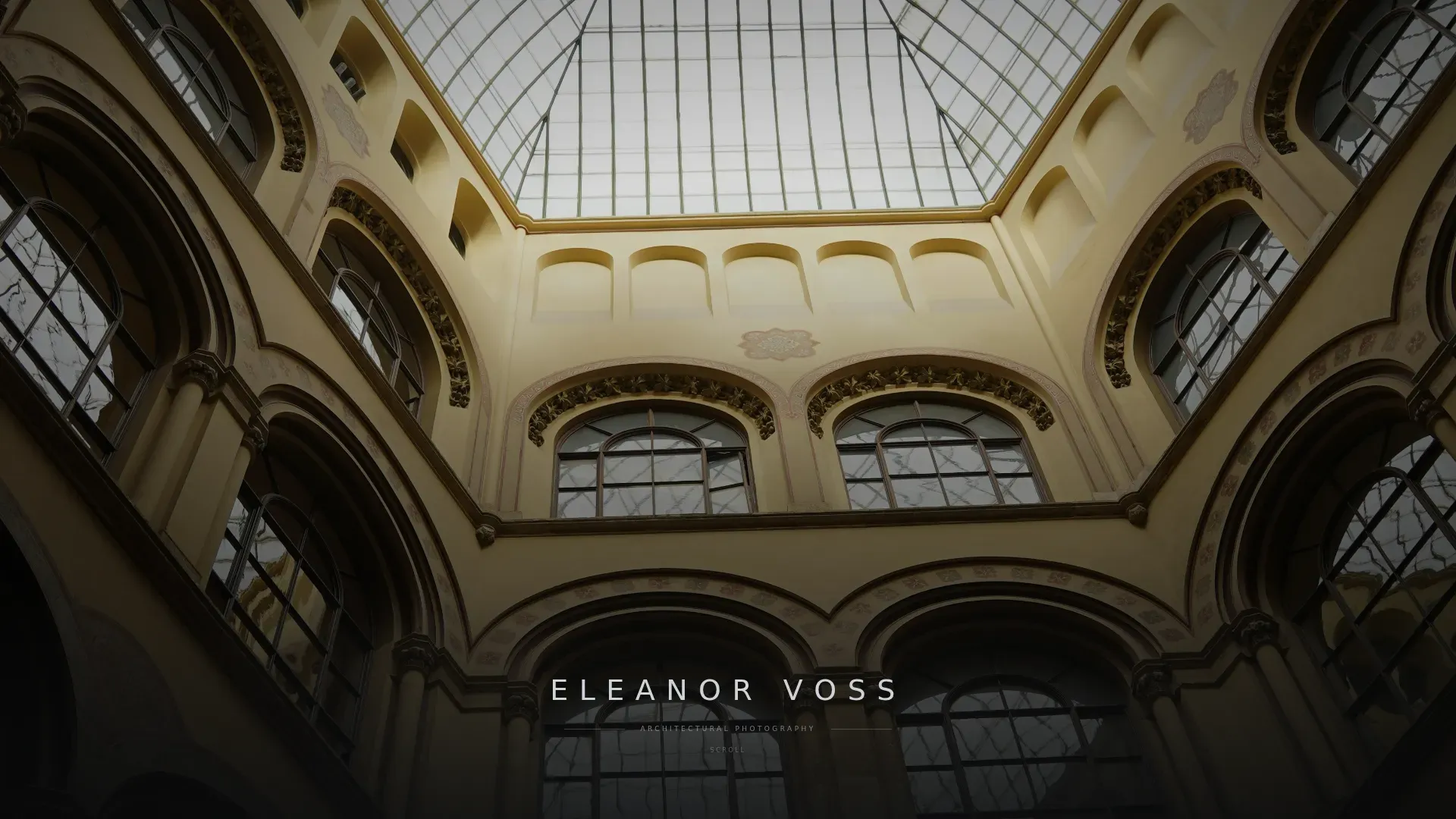
The hero section occupies the entire viewport with a single architectural photograph. No logo, no navigation bar, no visual competition. The photographer's name appears in thin tracked-out type, letter by letter, like a camera shutter cycling open. This opening creates the strong first impression that connects with potential clients before a single word of copy has been read. High quality images load with priority so the first render lands clean and sharp.
Scroll-Linked Manifesto Panels
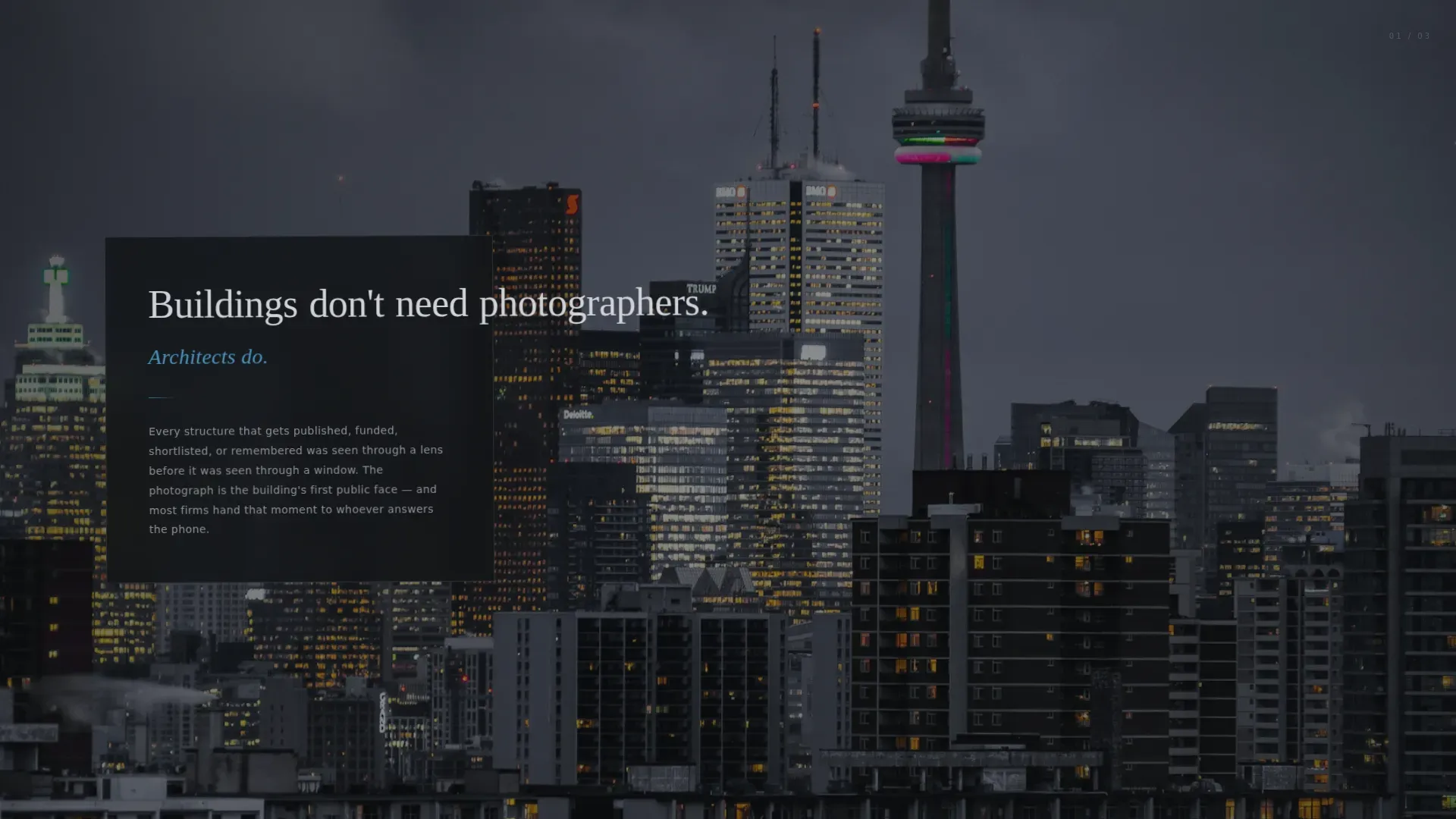
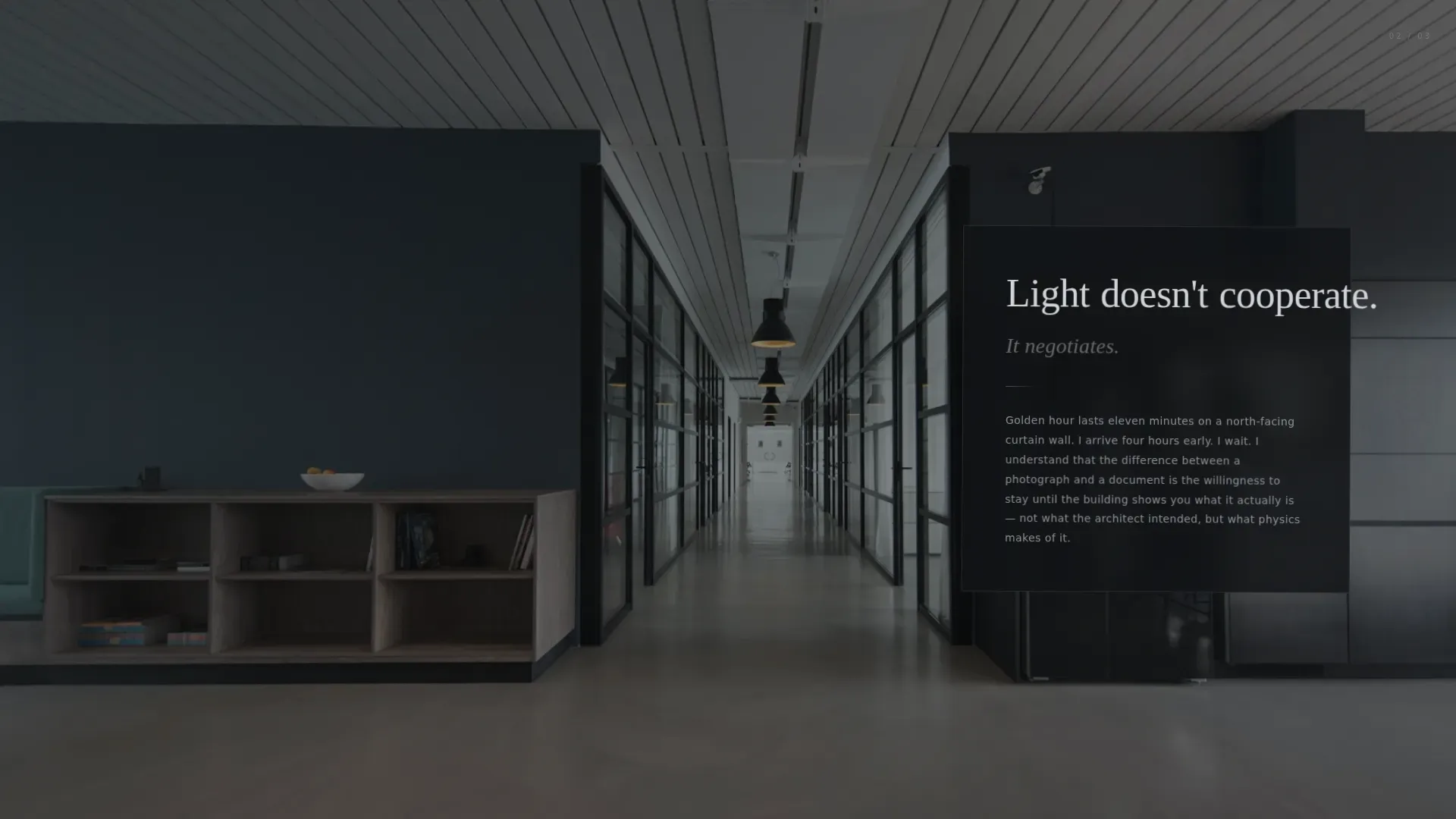
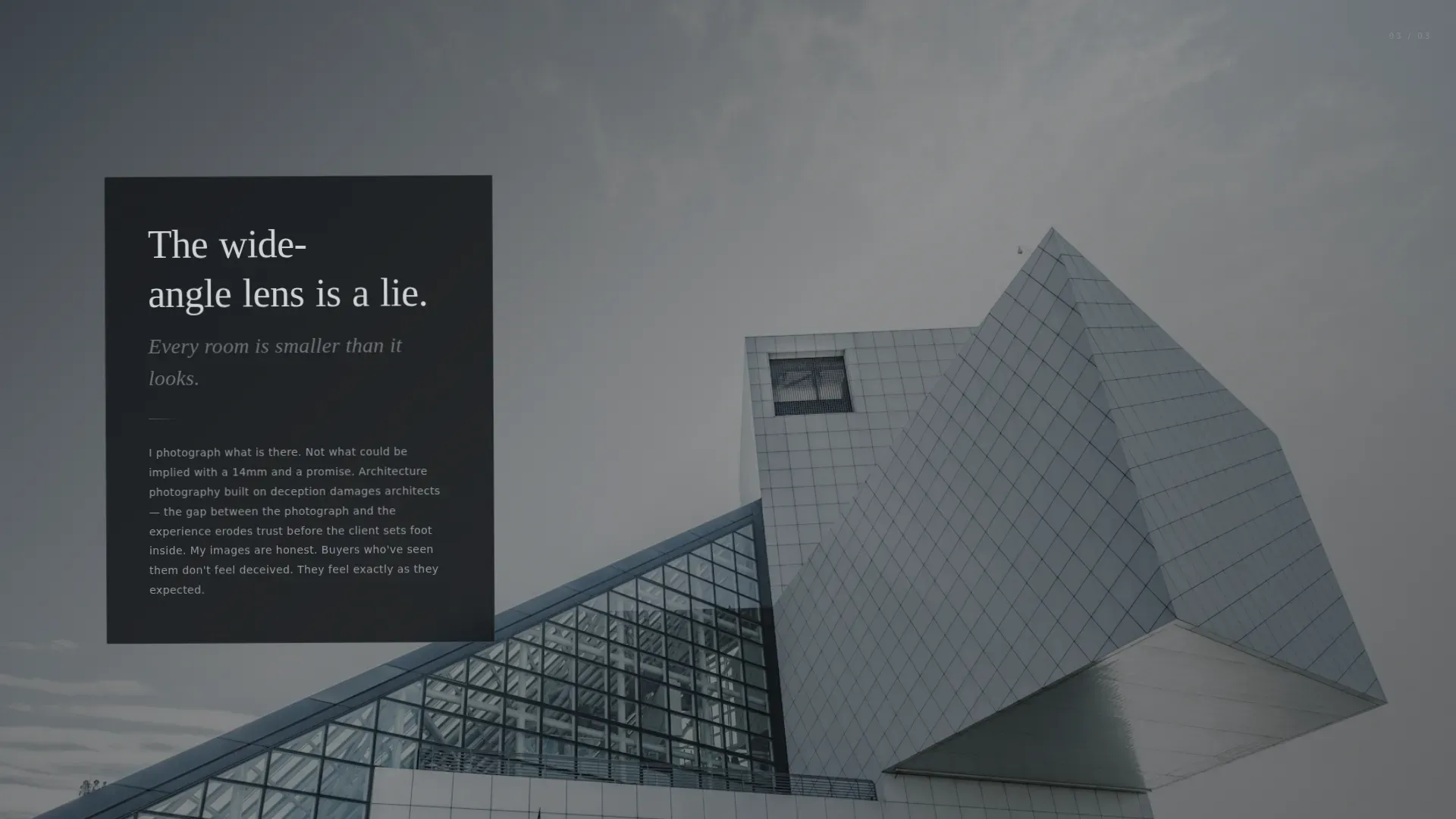
Three sequential manifesto sections layer translucent panels over full architectural photographs at offset angles. Each panel slides in as the visitor scrolls, creating genuine visual depth. The panels shift at different speeds, so both the experience of reading and the experience of scrolling feel like moving through a building. Leading lines within each photograph draw the viewer's eye toward the main subject of each conviction statement. This approach to visual storytelling turns casual browsers into engaged clients because the narrative builds with each scroll step.
Waitlist Call to Action with Slot Counter
The call-to-action section includes a single email input, a project-type toggle with three options (commercial, residential, and editorial), and a live counter showing remaining shoot slots for the current booking quarter. This combination communicates genuine scarcity without manufactured urgency. The "Reserve Your Shoot Window" button renders in the laser-blue accent color on interaction, directing the visitor's focus precisely where it matters. A strategic call to action placed this clearly is the difference between a photography website that showcases work and one that actually books shoots.
Overlap and Layered Layout System
The entire page is built on an overlap and layered template style. Panels sit at deliberate offsets, photographs bleed beneath translucent foreground layers, and the stack of content creates the impression of architectural drawings pinned over each other on a studio wall. This layout keeps the background photographs always present, always part of the reading experience, rather than decorating blank space. The result is a page with clean lines and structural logic that mirrors the subject matter of the photography itself.
Monochrome Steel Color and Type System
The template arrives with a four-token color system: deep gunmetal (#1B1F23) for the primary background, polished chromium (#D0D3D8) for body text and secondary surfaces, matte carbon (#3A3F47) for panel layers, and laser-blue (#4DA8DA) reserved strictly for interactive states and the primary call-to-action button. Two typeface roles ship pre-assigned: an editorial serif for headlines and a clean geometric sans-serif for body and user interface text. Swapping your own images and text into this system takes minutes, not days.
Mobile-Ready Responsive Layout
Although the template is designed desktop-first to match how architecture firms and developers review work, the layout adapts gracefully to smaller screens. Parallax depth simplifies on mobile devices, ensuring the page remains readable and visually coherent without breaking the layered composition. Photographs are never automatically cropped, preserving exact vertical lines and specific framing that architectural composition requires.
Page sections overview
| Section | Purpose |
|---|---|
| Full-Bleed Hero | Opens with an architectural atrium photograph; delivers the letter-by-letter name reveal |
| Manifesto Panel I | States the core provocation: "Buildings don't need photographers. Architects do." |
| Manifesto Panel II | Argues the case for light: golden-hour geometry layered over a photograph proving it |
| Manifesto Panel III | Argues the case for patience and the limits of the wide-angle lens |
| Waitlist Call to Action | Captures email, project type, and displays the live remaining-slot counter |
| Ultra-Minimal Footer | Closes the page with a single quiet line and minimal social media icons |
Design & branding system
The visual identity follows a Tech Glass aesthetic: metallic, monastic, and disciplined. Every surface earns its place through restraint. The palette reads like brushed steel in a high-modernist corridor, and the typographic system keeps hierarchy razor-sharp without competing with the photographs.
- Color tokens: gunmetal (#1B1F23) as the deep primary background, chromium (#D0D3D8) for text and surface contrast, carbon (#3A3F47) for translucent panel layers, and laser-blue (#4DA8DA) used exclusively for hover states and the waitlist call to action.
- Typography: an editorial serif typeface handles manifesto headlines and the hero name reveal; a clean geometric sans-serif handles body copy, form labels, and the project-type toggle, ensuring the page feels both editorial and functional.
Mobile & speed optimization
The template is designed desktop-first because architecture firms and property developers typically review photography work on large screens. Mobile parity is built in, however, ensuring the page works cleanly across all devices without losing compositional integrity.
- Parallax and panel offset animations simplify on mobile devices to preserve readability; photographs are never cropped automatically, maintaining the exact vertical lines and framing that architectural photography demands.
- The hero image loads with priority rendering, and GPU-accelerated transforms handle all motion effects, keeping the visual experience smooth as visitors scroll through the manifesto panels.
How this template helps you convert
A photographer landing page succeeds when the visitor finishes reading and feels they have discovered someone before the rest of the industry catches on. Shutter is engineered for that specific emotional outcome.
- The manifesto structure builds authority across three escalating conviction statements before the call to action appears. By the time the visitor reaches "Reserve Your Shoot Window," they have been persuaded by photographs and words together, not by a price list. This narrative arc is what turns a portfolio visit into a waitlist signup.
- The live slot counter and project-type toggle make the conversion step feel specific rather than generic. The visitor is not filling in a contact form. They are selecting a project category and reserving one of a finite number of shoot windows, which reflects real scarcity and earns the click.
Other information about this template
This template fits naturally within a broader ecosystem of photography templates and professional photography website tools. Understanding where Shutter sits relative to other options helps you decide whether it is the right template for your work online.
- Shutter is a specialized type of one page photography website template. Unlike general-purpose photography templates that serve landscape photography, portrait photography, food photography, corporate headshots, or mini sessions with equal indifference, Shutter is built for a single discipline: architectural photography.
- Photographers who also need a blog, an e-commerce section for selling prints, or a multi-project gallery with photo album organization will need to evaluate whether the one page structure fits their broader photography business goals. Shutter is built for conviction and scarcity, not catalog depth.
- For photographers who want to work online under a custom domain, this template can be deployed to any hosting environment that supports standard web builds. A custom domain keeps your photography website professional and ensures your site matches your brand identity consistently.
- The template does not include drag-and-drop editing. Customization is handled directly in the template files, which gives developers and technically comfortable photographers full control over every detail of the layout, color, and motion system.
- Social media icons appear in the minimal footer, keeping the page's focus on the waitlist conversion while still offering visitors a path to follow the photographer's work across other platforms. Including social media icons in this position follows best practice: they are present but never competing with the primary call to action.
- Because Shutter is a one page template, all photography portfolio content lives in the manifesto panels rather than in a traditional gallery. Other photographers using multi-page templates will showcase their portfolio differently. Shutter makes the deliberate trade: depth of conviction over breadth of catalog.
- Photography skills and technical craft are implied by the photographs themselves. The manifesto copy does the job of explaining the photographer's point of view on light, patience, and camera discipline, referencing the kind of care that longer shutter speeds, low ISO settings, and tripod-mounted stability require in real architectural shoots.
- A full frame camera and a sturdy tripod are the tools of the trade that this template's visual language reflects. The design assumes the photographer's camera body produces images sharp enough to fill a viewport at full resolution without degradation, because the hero section presents images at exactly that scale.
- The template is a great idea for any architectural photographer who has already built a reputation through word of mouth and is ready to translate that reputation into a waiting list. It is not designed to attract clients cold. It is designed to close clients who already know they want the best shots and are deciding between the few photographers who can deliver them.
- Affordable cameras and entry-level gear are not the implied context here. This template is built for professional results and the clients who expect them.
- Fine art architectural photography, where buildings are treated as subjects worthy of contemplative long-exposure work rather than quick documentation, is the sensibility that the manifesto panels and the overall design both project.
- The page's white background is absent by design. The deep gunmetal base keeps all attention on the photographs and on the text, preventing visual clutter from reducing the impact of each image.
- A stunning portfolio is not built by showing every photograph. Shutter proves this by giving the manifesto panels only the photographs that earn their position through argument, not quantity.
- Both the experience of reading the manifesto and the experience of scrolling through the parallax layers are designed to feel inseparable. The page does not separate content from design. They are the same thing.
- For photographers evaluating e-commerce features: Shutter does not include an e-commerce storefront. If selling prints is a primary business goal alongside waitlist capture, a supplementary tool would be needed for that workflow.
Theme
Tech Glass
Creative direction
Manifesto
Color system
Monochrome Steel
Style
Overlap/Layered
Direction
Waitlist/Coming Soon
Page Sections
Full-bleed Parallax Hero with Name Reveal
Scroll-linked Manifesto Panel System
Waitlist Form with Project Toggle and Slot Counter
Overlap and Layered Page Architecture
Monochrome Steel Color and Type System
Responsive Layout with Composition Preservation
Related questions
Is this template suitable for photographers outside architectural photography?
Can I add a blog or gallery section to this template?
Does the template support a custom domain?
How does the live slot counter work?
Does this template include e-commerce or print-selling features?