Middle Eastern Cuisine & Dining Specialist Blog Website Template
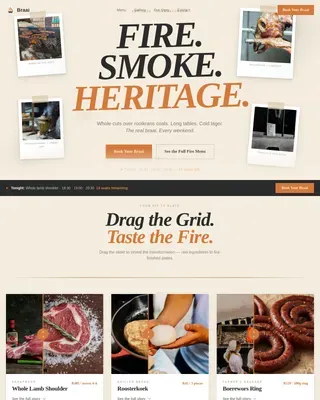
Sofra is a masonry-style landing page template built for artisan Lebanese casual dining restaurants. It guides visitors through a sensory day-in-the-life scroll, from dawn bread-baking to candlelit evening mezza, using a warm Agrarian Root color system, editorial photography composition, and clear click-through calls to action that move hungry guests straight to your menu or reservation page.
by Rocket studio
Quick summary
Sofra is a single-page masonry landing page template crafted for Lebanese casual dining restaurants that want to turn a first-time visitor into a hungry, ready-to-book guest. The scroll follows one full restaurant day, flour-dusted hands at dawn, the lunchtime pass at full heat, and candle-warm evening tables, building appetite tile by tile before the call to action lands.
Who this template is for
This template speaks directly to restaurant owners and operators who take their food seriously. It is built for the kind of establishment where the chef still pounds the garlic sauce by hand and the bread is blistered over real flame every morning. If your dining room serves communal mezza spreads on Friday nights and fattoush bowls to young professionals at lunch, this layout was designed around you.
- Restaurant owners in the Lebanese and broader Mediterranean dining space who want a landing page that feels as warm and alive as their dining room.
- Creative directors, designers, and hospitality professionals building or refreshing a restaurant's digital presence with strong visual storytelling.
- Food and beverage business operators who need a fast, focused click-through page that drives table reservations or online menu views without complex forms.
What problem this template solves
Most restaurant landing pages fail because they look like every other restaurant page on the internet. They lead with a logo, a navigation bar, and a PDF menu link. Visitors scroll once, feel nothing, and leave. The Sofra template solves this by replacing passive design with active sensory storytelling. The masonry grid does not just display food, it recreates the feeling of being inside the restaurant before a guest ever walks through the door.
- Generic restaurant pages do not communicate craft. Sofra's day-in-the-life visual narrative shows the cook at work from 6 AM, earning trust through process before the first dish is even named.
- Static layouts fail to build appetite. The staggered masonry grid and scroll-linked tile reveals create a rhythm of discovery that keeps visitors engaged from the hero image all the way to the closing call to action.
- Weak click-through pages bury the action. Sofra places a prominent "See the Menu" call to action above the fold, repeats it mid-page as a full-width terracotta band, and closes with a dual-path action pairing it with "Reserve a Table."
What you get with this template
You get a fully structured, single-page masonry landing page that is ready to be customized with your restaurant's photography, name, and links. Every section is pre-composed. The layout logic, color system, and typographic hierarchy are already solved. You plug in your images, your restaurant name, and your menu or booking link, and the page does the rest.
- A complete set of pre-built page sections spanning hero, dawn masonry grid, mid-morning prep tiles, a terracotta call-to-action band, an evening glow section, and a minimal footer.
- A coded Agrarian Root visual identity system using the Sunset Mesa color palette, terracotta, za'atar green, wheat cream, and soil brown, paired with Fraunces serif headlines and DM Sans body text.
- Scroll-linked animations including staggered masonry entrance, parallax hero movement, fixed call-to-action fade-in, and hover states on every tile that reveal warm overlays and caption text.
Feature list
This template is built on a set of deliberate design and functional features. Each one is grounded in the restaurant's day-in-the-life creative direction and the click-through conversion goal.
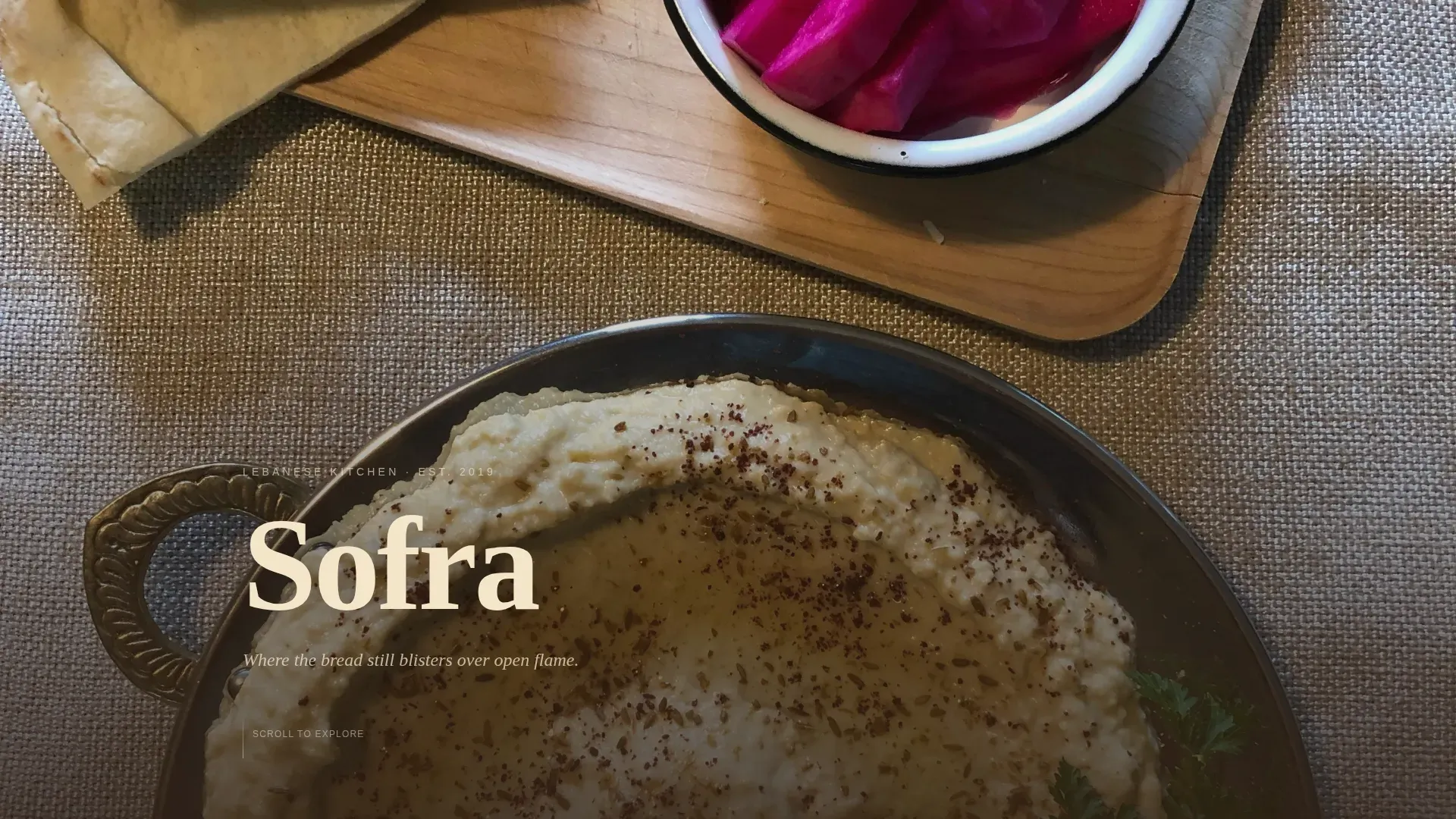
Full-Bleed Overhead Hero with Serif Title
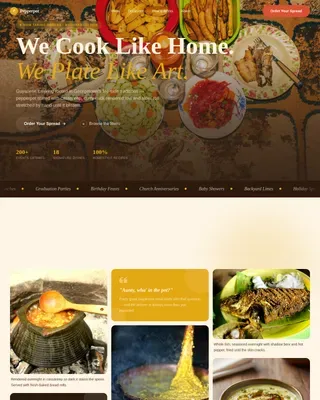
The hero opens with a full-bleed overhead table photograph. The image fills the entire viewport, no navigation bar, no logo competing for attention. Hands reach into the frame from three sides across a spread of hummus, charred kofta, torn khubz, pickled turnips, and olives. Late-afternoon window light casts long shadows across the table. The restaurant name rises in a massive Fraunces serif over the image only after the scene has already pulled the visitor in. A fixed "See the Menu" button in soil brown fades in as the hero section scrolls out of view, placing a prominent call-to-action above the fold so visitors can act immediately.
Masonry Grid with Day-in-the-Life Tile Sequence
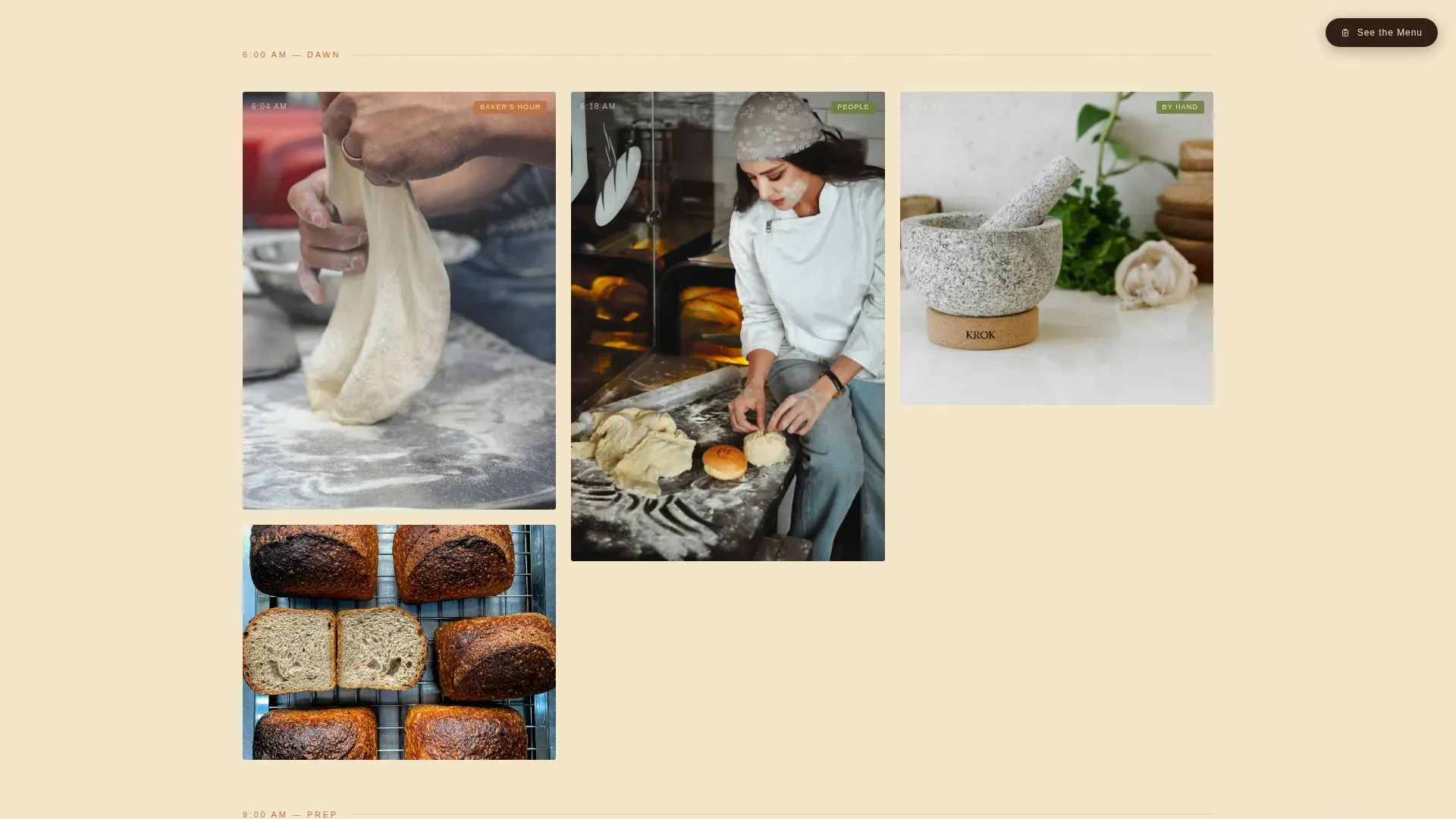
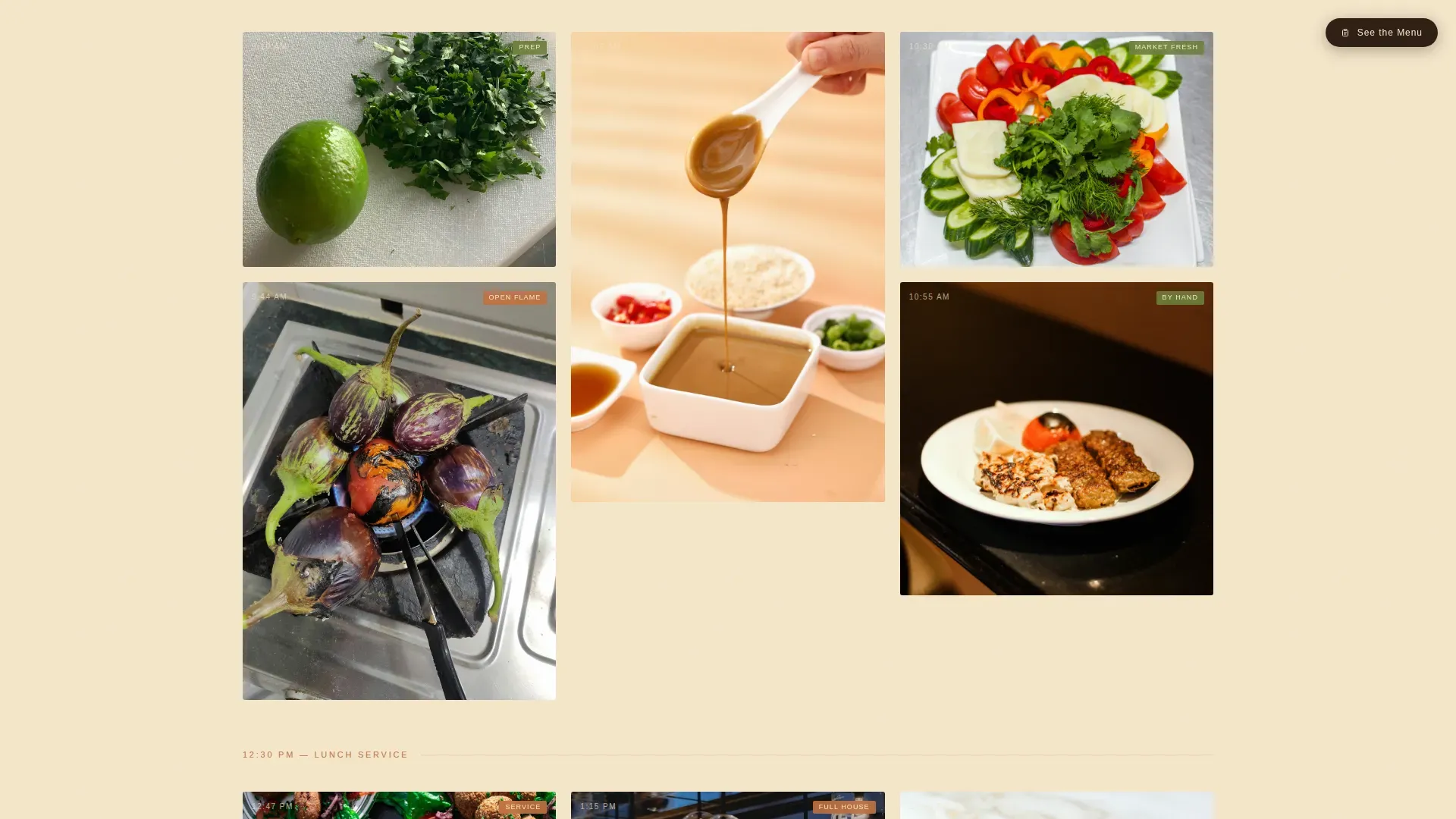
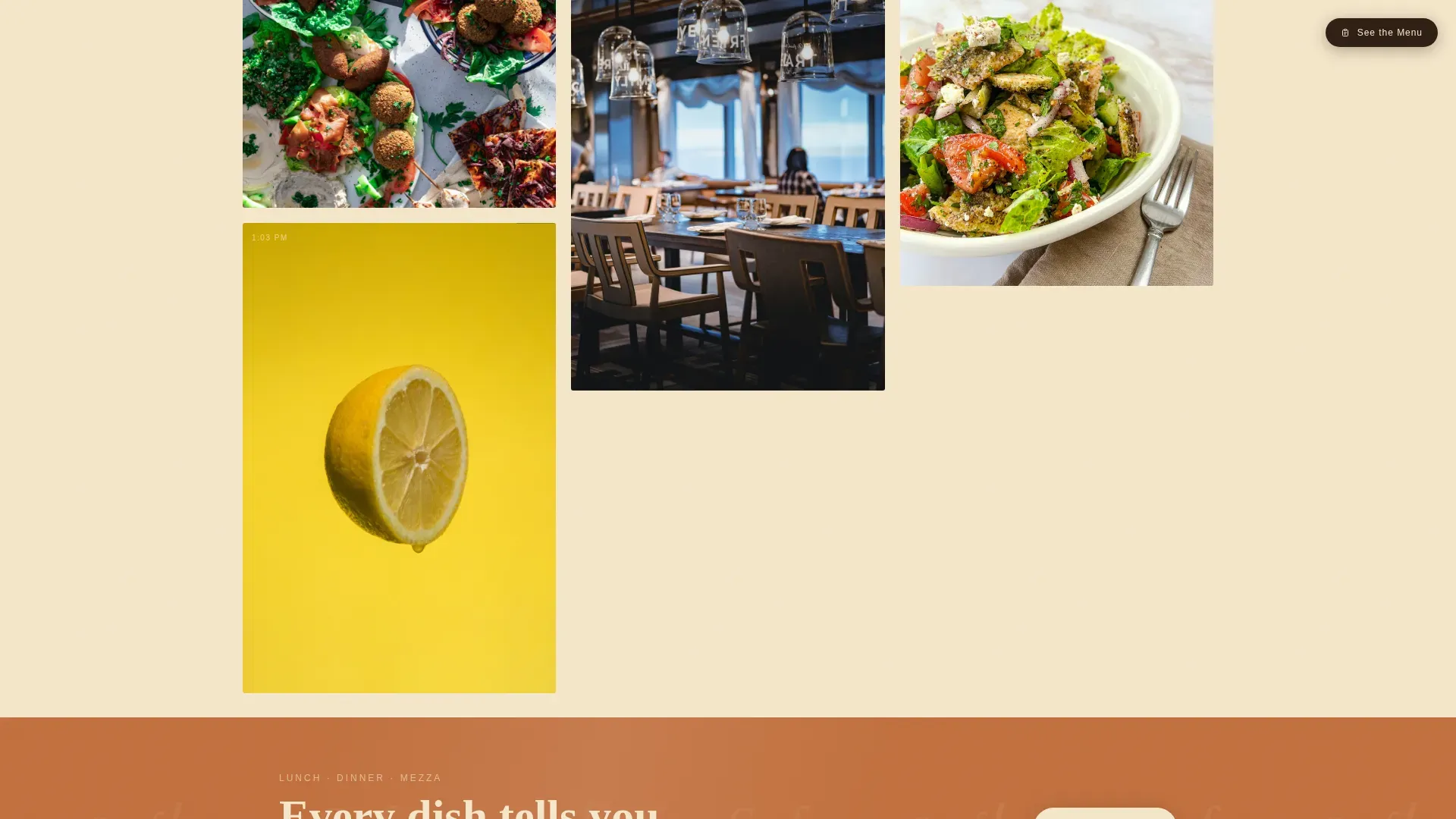
The masonry grid is the heart of the template. Tiles are deliberately varied in size, staggered in entrance timing, and sequenced to follow one restaurant day from dawn to close. Early tiles show flour-dusted hands stretching dough, a line cook lit by oven glow at 6 AM, and parsley mountains being chopped. Mid-section tiles move into lunch service, plates crossing the pass, a squeeze of lemon caught mid-air, a packed dining room viewed from the kitchen window. Afternoon detail shots follow: a coffee finjan, a worn recipe card, stacked chairs in slanted light. Evening tiles warm to candlelight, wine glasses catching terracotta reflections, and a family laughing over a decimated mezza spread. Each tile has a hover state that overlays a warm tone and reveals a short caption, making every image feel like a story fragment the visitor wants to read.
Triple-Stage Call-to-Action Architecture
The template places its primary call to action at three deliberate moments in the scroll. The first appearance is a subtle fixed button in soil brown that fades into view after the hero clears, keeping the action available throughout the entire masonry experience. The second is a full-width terracotta band that interrupts the grid after the lunch-service tiles, bold, warm, and impossible to miss. The third is the closing section, where "See the Menu" appears alongside "Reserve a Table" as a secondary path, giving visitors who are ready to book a direct route without leaving the page. No form appears anywhere on this page. The masonry scroll itself is the persuasion.
Agrarian Root Color and Typography System
The Sunset Mesa color system is applied with clear hierarchy. Wheat cream dominates the background, feeling like unbleached linen. Terracotta warms every section break, call-to-action band, and hover state. Za'atar green marks ingredient details, caption accents, and fresh-food tile overlays. Soil brown anchors every headline and grounds the typographic weight of the page. Fraunces is used for display headlines at massive weight, evoking the gravitas of a handwritten recipe card. DM Sans handles captions and body text in a clean, readable style that does not compete with the photography.
Scroll-Linked Animation and Interaction System
The template includes a medium-to-high animation system built entirely on native scroll behavior and the Intersection Observer application programming interface (API). Tiles enter the viewport with a staggered reveal, no tile appears at the same moment as its neighbor. The hero has a parallax movement layer that adds depth as the visitor scrolls down. The fixed call-to-action button uses a smooth fade-in rather than an abrupt pop-in. Hover states on masonry tiles combine a warm color overlay with a caption slide-up, rewarding slow, curious browsing. The closing call-to-action button uses a magnetic hover effect that draws the cursor slightly toward it.
Minimal Superhuman Footer Pattern
The footer follows Pattern 4 of the Superhuman Extreme Minimal system. It is intentionally sparse, carrying only the essential contact details a restaurant needs to display: name, location, hours of operation, and the two closing call-to-action buttons. There is no clutter, no secondary navigation, and no competing links. The minimal footer ensures the visitor's last impression before clicking through is clean, confident, and branded to the same soil-and-terracotta palette as the rest of the page.
Page sections overview
| Section | Purpose |
|---|---|
| Full-Bleed Hero | Opens with overhead table photo; restaurant name rises in serif over the image |
| Fixed call to action Button | Soil-brown "See the Menu" button fades in after hero scrolls clear |
| Dawn Masonry Grid | Flour-dusted hands, baker at oven glow, dough stretching at 6 AM |
| Mid-Morning Prep Tiles | Parsley chopped, eggplants over flame, tahini swirling into hummus |
| Lunch Service Grid | Plates at the pass, lemon mid-squeeze, dining room from kitchen window |
| Terracotta call to action Band | Full-width "See the Menu" interrupt after lunch-service section |
| Afternoon Detail Tiles | Coffee finjan, worn recipe card, stacked chairs in slanted light |
| Evening Glow Grid | Candles, wine glasses, family over mezza at warm terracotta light |
| Closing call to action Section | "See the Menu" primary + "Reserve a Table" secondary, side by side |
| Minimal Footer | Contact details, hours, and location; no secondary navigation |
Design & branding system
The Sofra template uses the Sunset Mesa color system inside an Agrarian Root visual theme. The palette was chosen to feel like a wooden table set outdoors at golden hour on a Lebanese mountainside, dusty, abundant, and alive with color drawn from the earth rather than a screen. The design does not impose a style on the food. It recedes to let the photography lead, then steps forward in structure at exactly the right moments to move a visitor toward action.
- Colors: Sunbaked terracotta (#C2703E) for section breaks, call-to-action elements, and hover overlays. Dried za'atar green (#6B7F3B) for ingredient accents and caption details. Warm wheat field cream (#F5E6CA) as the dominant background. Deep fertile soil (#2E1F14) for all headline text and anchoring elements.
- Typography: Fraunces serif at massive display weight for the restaurant name and section headlines. DM Sans for all body text, captions, and call-to-action button labels. The pairing creates a warm editorial photography zine aesthetic.
- Visual style: Agrarian Root with a warm editorial zine feel. Every tile in the masonry grid is a different size. Photography composition favors late-afternoon natural light, overhead food shots, hands in motion, and close-up spice and herb textures that give the page its handmade, living quality.
Mobile & speed optimization
The Sofra template is designed desktop-first, with the masonry grid built to reflow intelligently for smaller screens. The grid columns collapse and restack so the day-in-the-life sequence remains coherent on mobile without losing the variety of tile sizes that makes the desktop experience feel like a photographer's contact sheet. Given that over 70 percent of restaurant searches happen on mobile devices, this reflow behavior ensures no visitor is left with a broken or cramped layout regardless of their screen size.
- Images are lazy-loaded: tiles outside the current viewport do not load until the visitor scrolls toward them, keeping initial page weight low and reducing the risk of slow first renders.
- Scroll behavior uses native CSS scroll properties and Intersection Observer for tile reveals, avoiding heavy JavaScript libraries that can slow mobile performance and add unnecessary page weight.
- The fixed call-to-action button and the closing dual-button section are both touch-friendly, with adequate tap target sizing so mobile visitors can act without zooming or mis-tapping.
How this template helps you convert
The entire masonry experience is structured as a single persuasion arc. There is no form on this page, no email capture interrupting the scroll, and no pop-up competing with the food. The template's conversion logic is built on one principle: build enough sensory hunger tile by tile that clicking through to the menu or booking a table feels less like a decision and more like an appetite responding to what it has already seen.
- The fixed "See the Menu" call-to-action button appears above the fold as soon as the hero clears and stays available for the entire scroll, so visitors who are already convinced can act at any point without waiting for the page to end.
- The full-width terracotta call-to-action band after the lunch-service section intercepts visitors at peak visual engagement, the moment when the mid-day cooking energy is highest and the desire to taste something is most acute.
- The closing section offers two clear paths side by side: view the menu or reserve a table. Both actions lead off-page to wherever the restaurant's ordering or booking system lives, keeping the landing page itself clean and focused on one job.
Other information about this template
This section covers additional context, culinary reference points, and practical information that helps restaurant owners and designers understand the full scope and cultural grounding of the Sofra template.
The Lebanese casual dining space is experiencing genuine momentum right now. The restaurant scene in Boston is seeing a wave of new Mediterranean-inspired openings. Albi Restaurant, which opened in February 2020 in the Navy Yard neighborhood of Washington, DC, drew inspiration from Levantine traditions and a coal-fired, hearth-focused approach, and was named one of the ten best new restaurants in America by Robb Report before receiving a Michelin star in May 2022. New Mediterranean restaurants across mid-Atlantic cities and beyond are competing on authentic flavors and innovative cooking techniques. In cities like San Francisco, fast casual Lebanese and Mediterranean concepts are growing rapidly alongside more formal dining rooms. This template is built to help any restaurant in this wave stand out immediately.
The Sofra template is a strong fit for a restaurant that is self-described as rooted in tradition but modern in its dining room energy. It suits the kind of place where the opening menu changes with what is seasonal and fresh, where the chef might fold in sweet corn in summer, swiss chard through winter, or roasted red pepper across the whole year depending on what arrived that morning. The masonry grid's day-in-the-life structure can showcase any of these ingredient stories without requiring a menu redesign. Tiles can simply be swapped as the menu evolves.
From a culinary storytelling perspective, the template is also suited to restaurants that offer more than a single dining mode. If your restaurant moves between light snacks at the bar in the early afternoon, a full small plates mezza service for dinner, and a curated tasting menu on weekend evenings, the tile sequence can hold all of those moments. A chef's table experience, a dedicated wine bar, or a cocktails-forward late-night bar program all have natural visual language inside the masonry format. The template does not restrict you to one dining identity, it gives you the visual vocabulary to layer several.
The template also works well alongside a restaurant's broader brand ecosystem. If your concept has a bakery component, selling baked goods, baked bread, or sweet pastry items, the dawn tiles already show the bakery side of the kitchen at work. Restaurants that serve breakfast, run a weekend brunch, or offer to-go baked goods from a front counter will find that the early-morning masonry tiles communicate this naturally. A pastry chef's work has its own visual language, the laminated dough, the dusted counter, the cooling rack, and the masonry format gives it full tile space rather than burying it in a footnote.
For operators interested in extending guest engagement beyond the dining room, the template's visual style and brand identity are strong foundations for promoting cooking classes. All cooking classes at Sofra are held in their Allston location and are demonstration-style. Participants in Sofra's cooking classes get to do the eating and drinking and receive all of the recipes from each class. Sofra offers a variety of cooking classes focused on Lebanese and Mediterranean cuisine. Tickets for cooking classes range from $75 to $180 depending on the class. Classes are non-refundable but may be transferred to another recipient upon request. If participants have any allergies, they should inform Sofra in advance by emailing classes@sofrabakery.com. Sofra also provides class vouchers for those who want to gift a cooking class experience to someone else.
The culinary detail embedded in this template is deliberately specific. The masonry grid references pine nuts scattered over a hummus bowl, olive oil poured in a slow green river, lemon squeezed mid-air during lunch service, fresh herbs chopped into parsley mountains, and feta crumbled over a fattoush. These are not decorative details. They are the specific flavor language of Lebanese cuisine, the same spice notes, lemon brightness, and herb freshness that Lebanese diaspora guests are chasing when they walk through the door. The template communicates this specificity visually before a single word of menu copy is read.
- This template is a click-through page: it does not host a menu, a booking form, or an ordering system. It links out to wherever those live.
- The masonry grid tiles are fully swappable: replace photography to shift the seasonal story without rebuilding the layout.
- The footer follows Pattern 4 of the Superhuman Extreme Minimal system, keeping the closing impression clean and focused.
- The page works equally well for fast casual Lebanese formats and sit-down dinner restaurants: the tile density and caption length can be adjusted to suit either.
- Brand terms and restaurant names, including the Sofra artisan Lebanese casual dining landing page template itself, appear in this section as reference context for designers and operators researching the template for their specific use case.
- Restaurants in mid-Atlantic markets, San Francisco, Boston, and other urban centers with active Lebanese and Mediterranean dining communities will find the template's visual language and communal dining emphasis immediately resonant with their local audience.
- The template's visual identity can support a wine bar, a cocktails-led bar program, or a beer and drink menu equally well: the evening tile section is warm enough to hold any beverage story.
- Other goodies in the template system include the hover caption overlay, the magnetic closing call to action, the parallax hero layer, and the staggered tile entrance timing, all pre-coded and ready to customize.
- Designers can adapt the tile sequence to feature side dishes, desserts, rice preparations, roasted vegetables, grilled chicken or beef dishes, shrimp plates, and other goodies that define the restaurant's specific menu identity.
- If the restaurant serves ice cream, sweet desserts, or a distinct desserts course, including anything from a traditional Lebanese rice pudding to a more contemporary pastry chef creation, the afternoon or evening tiles are the natural home for those moments in the grid.
Theme
Agrarian Root
Creative direction
Day-in-the-Life
Color system
Sunset Mesa
Style
Masonry/Pinterest
Direction
Click-Through
Page Sections
Full-bleed Overhead Hero with Parallax Depth
Day-in-the-life Masonry Grid Sequence
Triple-stage Click-through Call to Action Architecture
Sunset Mesa Color and Typography System
Scroll-linked Animation and Hover Interaction
Minimal Superhuman Footer Pattern
Related questions
Can I use this template if my restaurant is not strictly Lebanese?
Does this template include a menu or booking system?
How does the masonry grid handle mobile screen sizes?
Can the tile images be swapped seasonally without rebuilding the layout?
Is this template suitable for a restaurant that also runs cooking classes or a bakery?