Fund the Next Mile, Public Works Landing Page Template
The Levee - Fund The Next Mile public works landing page template is built for federal infrastructure agencies raising philanthropic and institutional funding. It maps every dollar to a physical output, turning abstract generosity into pourable, measurable results. The hub and spoke anchor-nav layout guides engineers, disaster-relief donors, and corporate giving directors from a metrics wall header through cause statements to a three-step donation form.
by Rocket studio
Quick summary
This template gives a public works federal agency a mission-control-grade fundraising presence. It opens with a full-viewport metrics wall, escalates through cause-driven spoke sections, and closes with a progressive donation form that converts institutional visitors into committed contributors. Every dollar is mapped to a physical output so no gift feels abstract.
Who this template is for
This template serves organizations working at the intersection of civil infrastructure and donor conversion. It is purpose-built for agencies, foundations, and advocacy groups that need credibility before they can ask for a contribution.
- Retired civil engineers and infrastructure-aware donors who read project updates and want verifiable numbers before giving
- Corporate social responsibility directors managing six-figure philanthropic budgets who require auditable impact per dollar for board documentation
- Disaster-relief fundraisers responding to hurricane or flood event cycles who need a page that earns trust fast
What problem this template solves
Levee funding campaigns face a specific credibility gap. Property owners, civic leaders, and institutional donors all want to know their contribution physically moves something, not just funds a line item. Generic donation pages fail because they cannot answer the question: what does my money actually build?
- Donors abandon pages that show vague mission statements without linking cost to construction output
- Corporate giving teams cannot approve grants without a documented funding breakdown showing total estimated cost, secured funds, and the gap remaining
- Communities affected by flooding need to see interactive maps and before-and-after visuals to trust that the project is real and progress is being made
What you get with this template
You get a fully structured, single-page hub and spoke layout anchored by a persistent navigation bar that keeps the primary call to action visible at every scroll depth. The design system, copy structure, and interactive components are all pre-configured for a public works fundraising context.
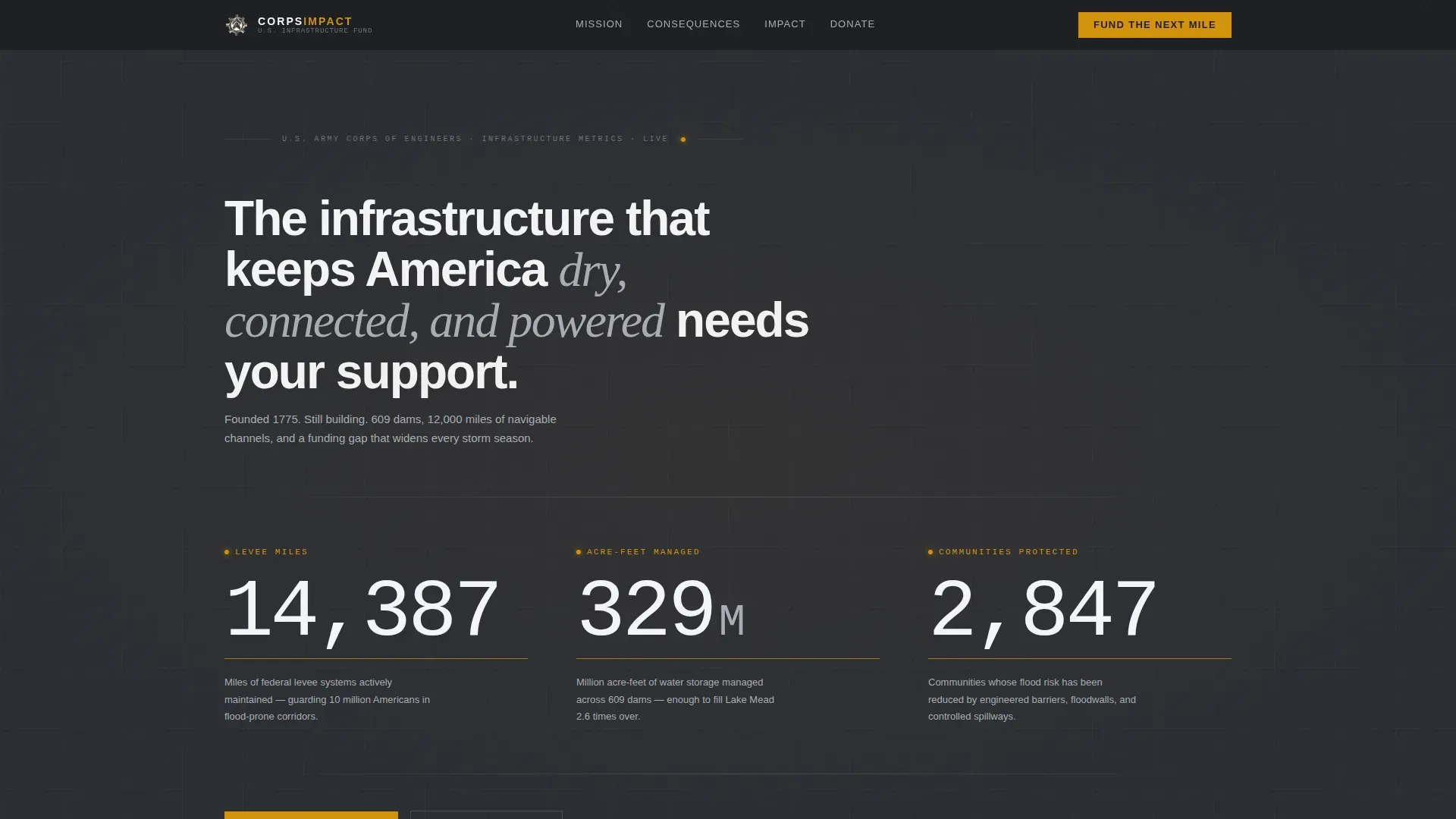
- A full-viewport metrics wall header with three live-ticking counters for miles of levee maintained, acre-feet of water managed, and communities protected
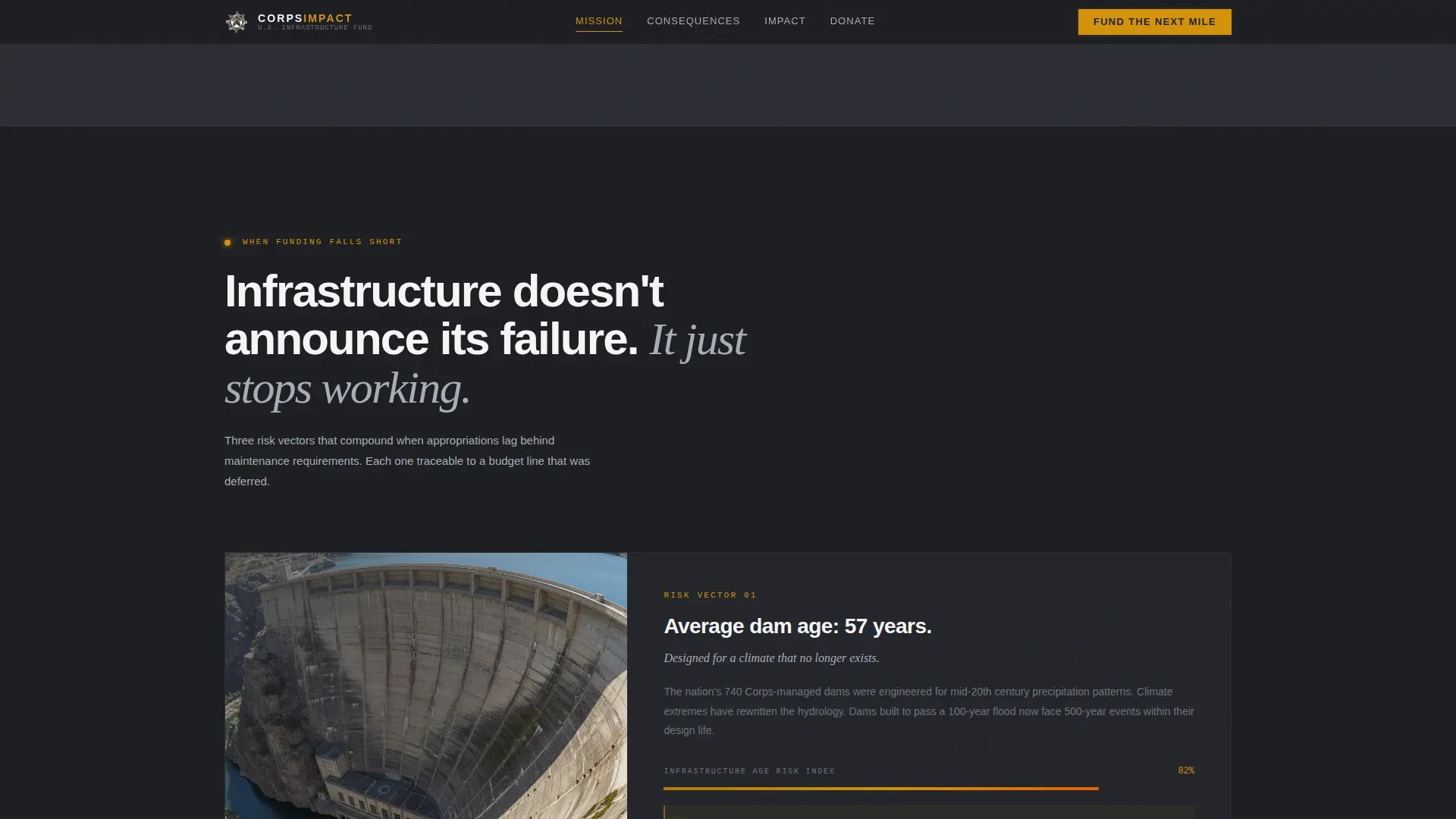
- Five thematic spoke sections covering mission, consequences of funding shortfalls, dollar-to-output impact equivalencies, a three-step progressive donation form, and a secondary lead-capture path for institutional donors
- A Monochrome Steel visual identity using structural charcoal, brushed aluminum, reinforced white, and safety-signal amber reserved exclusively for calls to action and active navigation states
Feature list
This template includes six engineered components that work together to move a first-time visitor from curiosity to commitment.
Live-Ticking Metrics Wall Header
The header replaces a hero image with data. Three oversized counters tick upward using GSAP ScrollTrigger animations, each connected by a thin amber underline to a single-sentence descriptor. The numbers represent miles of levee maintained, acre-feet of water managed, and communities protected. The effect puts visitors inside a mission control dashboard the moment they arrive.
Hub and Spoke Anchor Navigation
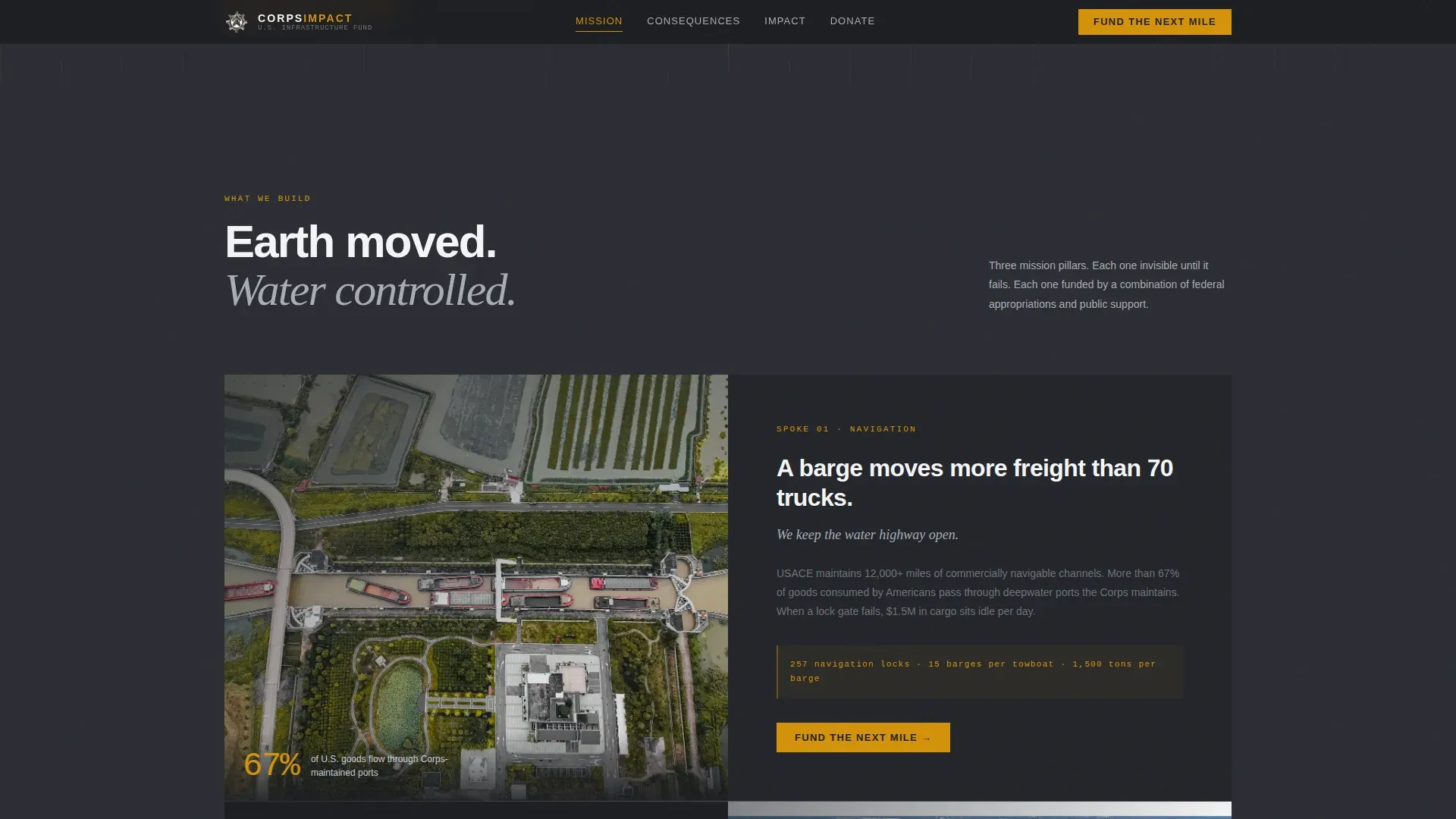
A persistent anchor navigation bar sits at the top of every viewport position. The primary "Fund the Next Mile" button appears in safety amber and stays visible throughout the entire scroll journey. Active navigation states highlight in amber so visitors always know where they are within the page structure.
Looping Aerial Video Spokes
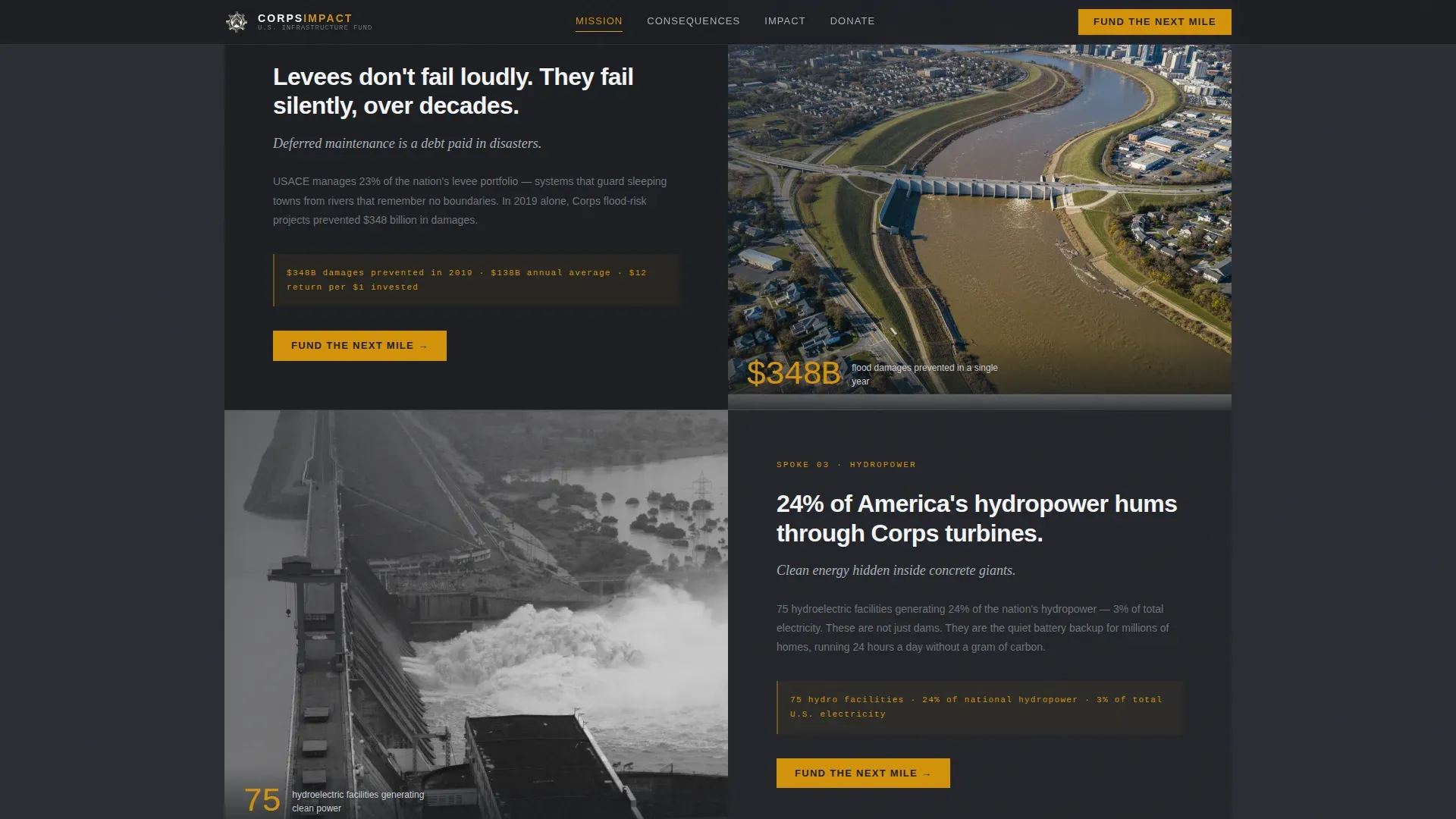
Each spoke section opens with a short looping aerial clip, a barge transiting a lock, floodgates releasing controlled flow, or engineers surveying post-disaster terrain. The clip freezes into a still frame as the visitor's eye lands on the cause statement beside it. This Movement and Cause creative direction keeps the narrative engaging without distracting from the donation path.
Dollar-to-Output Impact Calculator
The impact section presents four pre-set donation amounts: $50, $150, $500, and $1,000. Each amount is paired with a physical-output equivalency, for example, "$50 pours 12 linear feet of floodwall." This approach transforms abstract generosity into a measurable construction contribution and directly addresses the accountability needs of institutional donors and grants committees.
Three-Step Progressive Donation Form
The donation form uses a three-step flow. Step one presents the four pre-set amounts with physical equivalencies. Step two captures name, email, and an optional corporate-match checkbox. Step three handles payment. The progressive structure reduces form fatigue and keeps the path to completion short and clear.
Impact Report Lead Capture
A secondary conversion path labeled "Download the Impact Report" captures institutional leads who need board-level documentation before committing larger gifts. This path runs parallel to the primary donation flow and serves corporate social responsibility directors, grants officers, and local agencies reviewing project feasibility before allocating funds.
Page sections overview
| Section | Purpose |
|---|---|
| Metrics Wall Header | Display live counters and anchor nav |
| Mission: What We Build | Aerial visuals and cause statements |
| Consequences of Underfunding | Risk escalation narrative |
| Dollar-to-Output Impact | Physical equivalency calculator |
| Three-Step Donation Form | Primary and secondary conversion |
| Linear Single-Row Footer | Contact and compliance information |
Design & branding system
The visual identity follows a Corporate Precision theme built around a Monochrome Steel color system. The palette is deliberately austere, like the interior of a hydroelectric control room, with single amber indicator lights telling visitors exactly where to look.
- Colors: structural charcoal (#2B2D33) for primary backgrounds, brushed aluminum (#A8ADB5) for secondary surfaces and divider lines, reinforced white (#F4F5F7) for content panels, and safety amber (#D4920B) reserved exclusively for calls to action, active navigation states, and urgent callouts
- Typography: DM Sans for engineered tight-tracking body and navigation text, paired with Fraunces serif for cause statements that need emotional weight
- Motion: GSAP ScrollTrigger counter animations, parallax depth layers, amber pulse effects on call-to-action buttons, and reveal animations as each spoke section enters the viewport
Mobile & speed optimization
The template is built desktop-first to serve the primary audience of corporate social responsibility directors and engineers working at workstations. Full mobile responsiveness is included so residents and field-based donors can access project updates on smartphones and tablets without losing layout integrity.
- Server Components handle static sections to keep initial load fast; Client Components are scoped to the live counters and interactive donation form
- The persistent anchor navigation collapses cleanly on smaller screens so the "Fund the Next Mile" amber button remains tappable at every breakpoint
- Interactive maps and before-and-after visuals scale responsively so property owners and community members can engage with flood risk detail on any device
How this template helps you convert
A public works landing page for levee funding requires a precise balance of urgency, technical credibility, and community benefit. This template achieves that balance through three overlapping conversion mechanisms.
- The metrics wall and physical-output equivalencies answer the first question every serious donor asks: what does this money actually build? By linking cost directly to construction progress, the page earns the click before the donation form even appears.
- The localized impact metric at the end of every spoke section, for example "$500 places one 8-foot section of earthen embankment," keeps the scroll converting. Each section ends with a clear amber call to action so the decision to give is always one tap away.
- The "Download the Impact Report" secondary path captures institutional leads who are not ready to donate today but need board-level documentation. These leads re-enter the funnel through direct outreach, making the page valuable beyond the immediate transaction.
Other information about this template
This template draws on the real history and documented scale of U.S. levee and flood protection infrastructure to make every section feel grounded and credible. The copy framework references verified project contexts that donors, engineers, and grants officers will recognize.
- New Orleans was founded in 1718 at the natural levee embankment on the lower Mississippi River. The city's flood protection system now spans over 350 miles of levees, with 133 miles newly strengthened after Hurricane Katrina, and relies on a network of pumps to manage surface runoff across its canal system. The system is designed to protect against events comparable to a Category 3 hurricane and guards the city from Lake Pontchartrain, the Mississippi River, and surrounding canal corridors.
- The St. Charles parishes and adjacent bernard parish areas along the west bank of the river demonstrate the scale of ongoing infrastructure need. Protection systems in these southeast Louisiana communities must address storm surge, river flooding, and marsh restoration simultaneously.
- Levee fund projects often operate on a cost-share basis, requiring local applicants to provide a matching contribution, commonly a 20 percent match. Accreditation assistance from a levee fund helps local agencies secure the FEMA data needed to remove mandatory flood insurance requirements for protected residents and businesses.
- A levee fund is a dedicated financial mechanism designed to support the maintenance, improvement, and certification of levee systems. Fund definitions can include financing for raising an earthen levee, installing new seepage walls, or completing engineering studies required for formal accreditation.
- The Army Corps of Engineers and local agencies continue to collaborate on projects like the Wharton separable element, which consists of approximately 35,600 feet of levees and 2,300 feet of floodwalls to reduce risk from the Colorado River. The design aims to maximize benefits while minimizing impact to the surrounding area.
- Levee setback feasibility studies examine how setback levee features can provide increased flood storage, improve fish habitat, and benefit the natural environment by reconnecting the levee toe area to the river channel. Setbacks can also create more reliable access to roads and reduce flooding of developed areas, including schools and residential property.
- Interactive maps within the page let property owners and residents see how levee improvements interact with their specific location. Visuals including before-and-after photos and detailed flood maps are essential for communicating risk and building community support for construction funding.
- The template is designed to support the full donor journey: from awareness through a credibility-building metrics wall, to emotional engagement through aerial spoke visuals, to commitment through a frictionless three-step form. Grants officers, corporate east-coast and west-coast giving programs, and individual donors located north or south of a project footprint can all find their entry point within the same page structure.
Theme
Corporate Precision
Creative direction
Movement & Cause
Color system
Monochrome Steel
Style
Hub & Spoke (Anchor Nav)
Direction
Donation/Fundraising
Page Sections
Live Metrics Wall with Animated Counters
Persistent Amber Anchor Navigation
Movement and Cause Aerial Video Spokes
Dollar-to-output Impact Calculator
Three-step Progressive Donation Form
Impact Report Secondary Conversion Path
Related questions
Who is this template designed for?
Can the donation amounts and physical equivalencies be customized?
Does the template include the secondary lead-capture path for institutional donors?
How does the hub and spoke layout work?
Is the page layout suitable for mobile users?