Business Coach Booking Website Template
The Leverage Founder Bottleneck Diagnostic landing page template is built for serious coaching practices that want to earn trust before asking for a booking. It combines animated outcome counters, before-and-after comparison tables, three escalating founder case studies, a gated diagnostic PDF form, and a Calendly teardown call embed into one authoritative, conversion-focused landing page experience.
by Rocket studio
Quick summary
This template delivers a full-length, one-page coaching experience designed around analytical depth and earned trust. The landing page opens with animated amber counters on a command navy field, moves through three structured founder case studies with comparison tables, gates a downloadable Growth Audit Framework behind a short form, and closes with a teardown call booking embed. It is built for coaches whose clients make decisions with data, not emotion.
Who this template is for
This landing page template fits coaching practices that serve founder-level clients who respect specificity over spectacle. It is the right tool when your value proposition is diagnostic precision, not motivational energy. The template is not for generalist life coaches or broad self-help brands. It speaks directly to the kind of operator who reads a spreadsheet before returning a call.
The target audience for this template includes:
- Series A founders burning runway on misaligned hires and unclear decision rights
- Solo consultants who have hit a revenue ceiling around the $15,000 per month plateau and need to break free from repeatable tasks that block growth
- Second-generation family business owners managing inherited process debt they cannot name or price
What problem this template solves
Most coaching landing pages lead with a headshot and a quote. They perform warmth and hope. The problem is that the founders, operators, and consultants who most need structured coaching are exactly the people who distrust that approach. They have seen enough of the founder's paradox played out in their own businesses to know that enthusiasm without rigor is just another cost center. Decision velocity slows when there is no system to support it. The team waits for the founder to weigh in on everything, from pricing to hiring to which product lines to sunset. The result is a growing company that runs at the speed of one person.
This template solves the trust and conversion problem for high-end business coaching practices by:
- Replacing ego-led hero sections with signal-led outcome data, so the landing page earns credibility in the first five seconds
- Structuring three founder case studies as before-and-after comparison tables that let each visitor self-select into the story that reflects their own ceiling
- Gating the primary offer behind a short, low-friction form that qualifies leads before a single call is booked
What you get with this template
You get a complete, ready-to-customize landing page built around the Leverage coaching methodology. Every section is pre-structured with a defined purpose. The layout handles the heavy lifting of persuasion architecture so you can focus on populating it with your real numbers, real client stories, and real diagnostic frameworks. This is not a blank canvas. It is a pre-wired system that reflects how serious coaching engagements are actually sold.
The template includes:
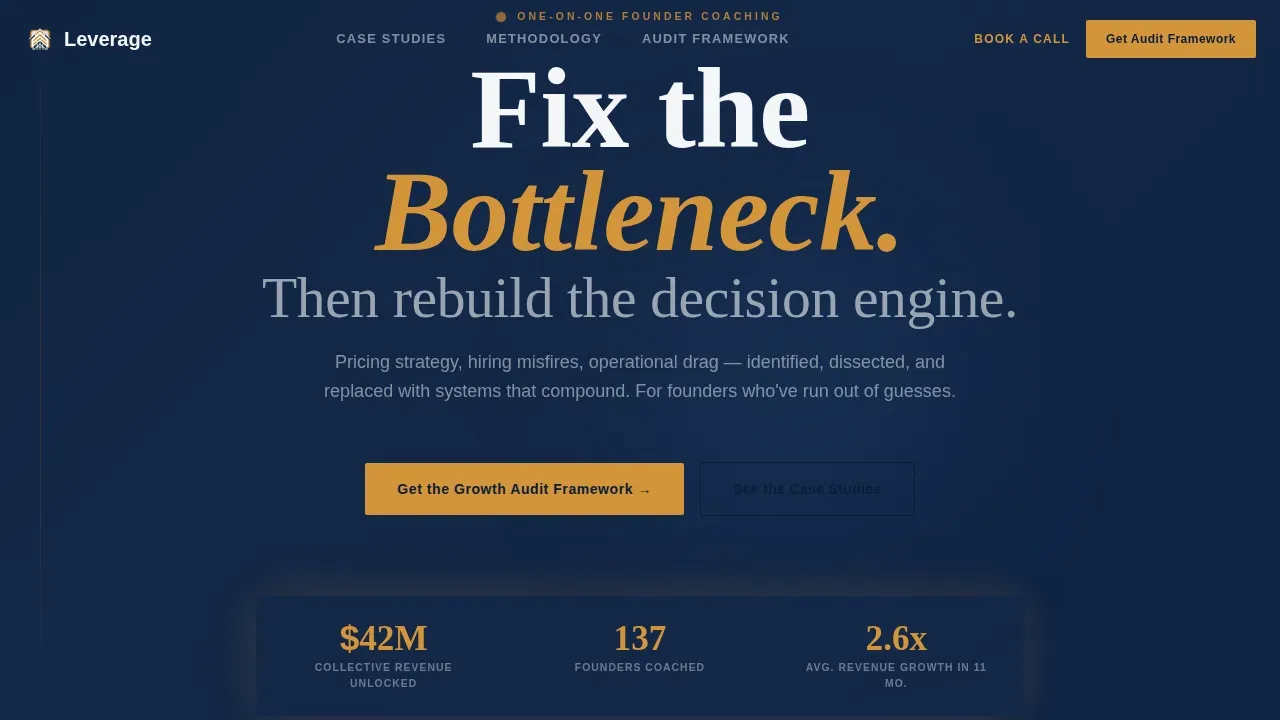
- A hero section with an animated counter block displaying three outcome metrics on a navy field with amber typography
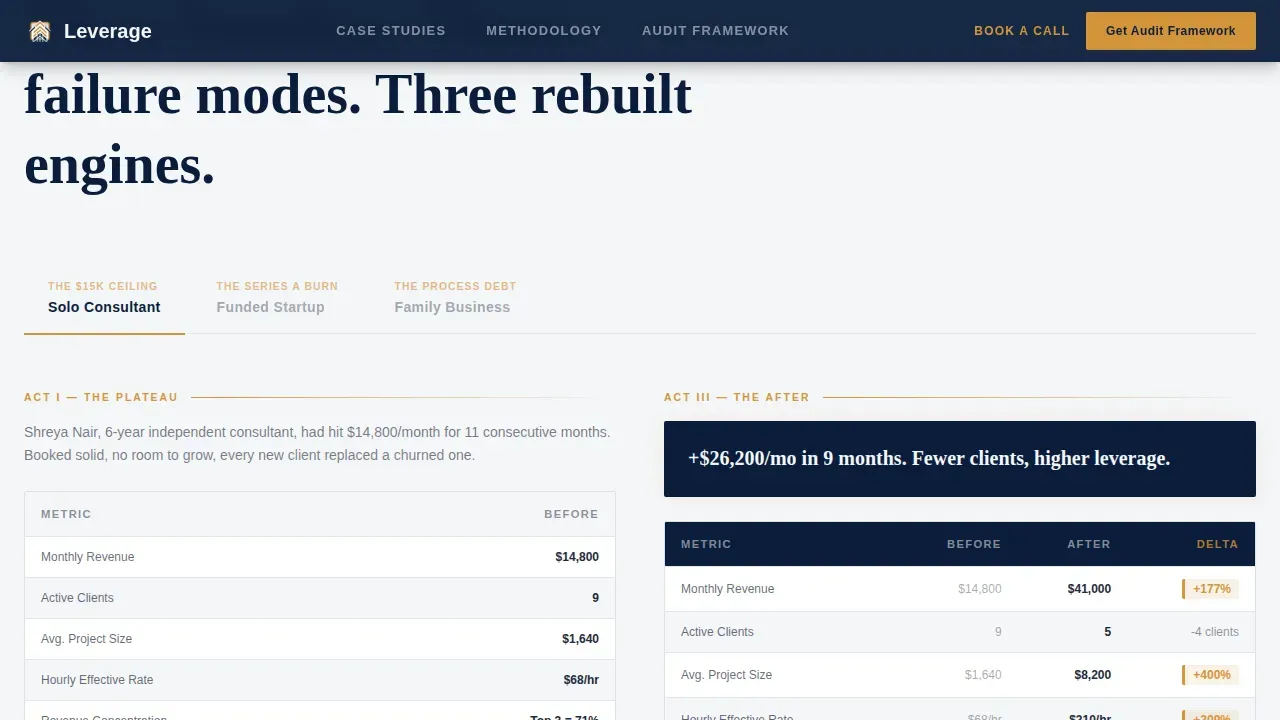
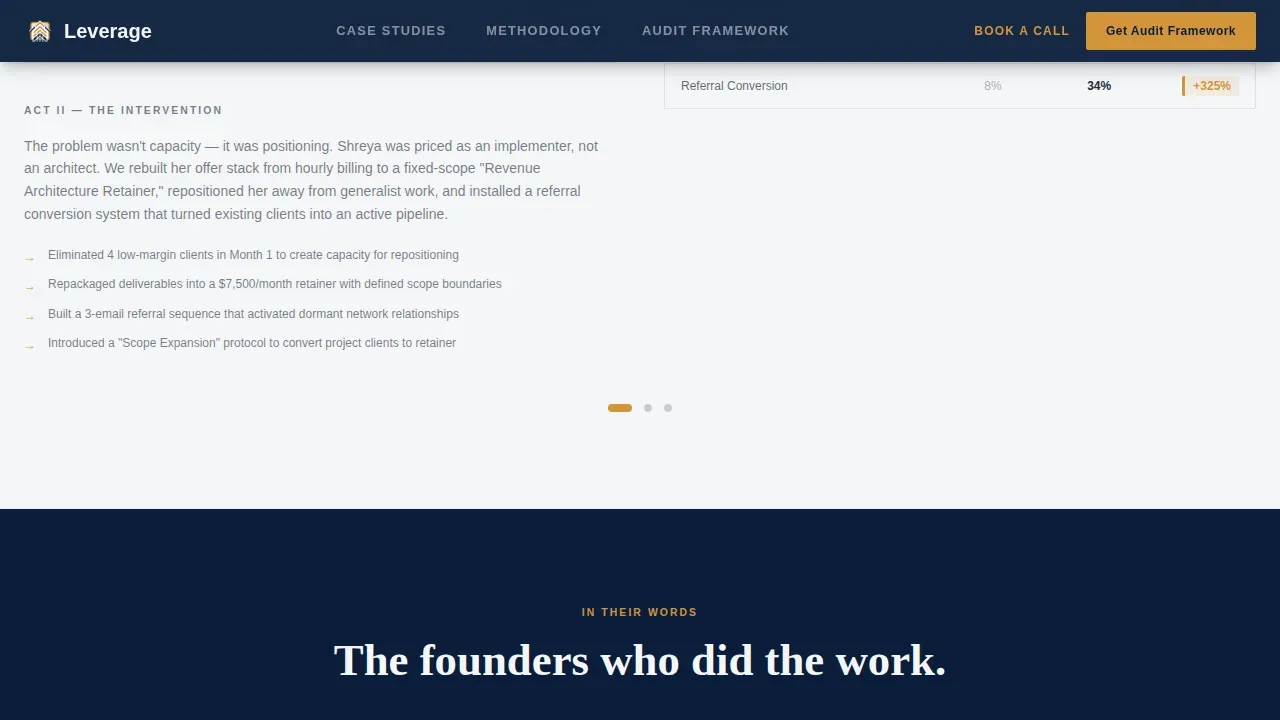
- Three full case study blocks, each containing a before comparison table, a coach intervention narrative, and an after comparison table with amber delta highlights
- A gated lead generation form with three fields, a downloadable diagnostic PDF call to action, and a secondary Calendly embed for teardown call booking
Feature list
This template was designed with a specific set of structural and visual capabilities drawn directly from the Leverage coaching brief. Each feature serves a conversion or trust function. Nothing is decorative without purpose.
Animated Outcome Counter Hero
The hero section opens with three animated counters displaying aggregate coaching outcomes in decision-point amber against a command navy background. Each counter arrives with a single-line context sentence beneath it in white. The effect communicates analytical authority immediately, without a portrait, a logo wall, or a motivational headline. This is the landing page equivalent of showing your work before asking for attention. The structure gives the visitor immediate action triggers based on real signal, not generic claims.
Three-Act Founder Case Study Blocks
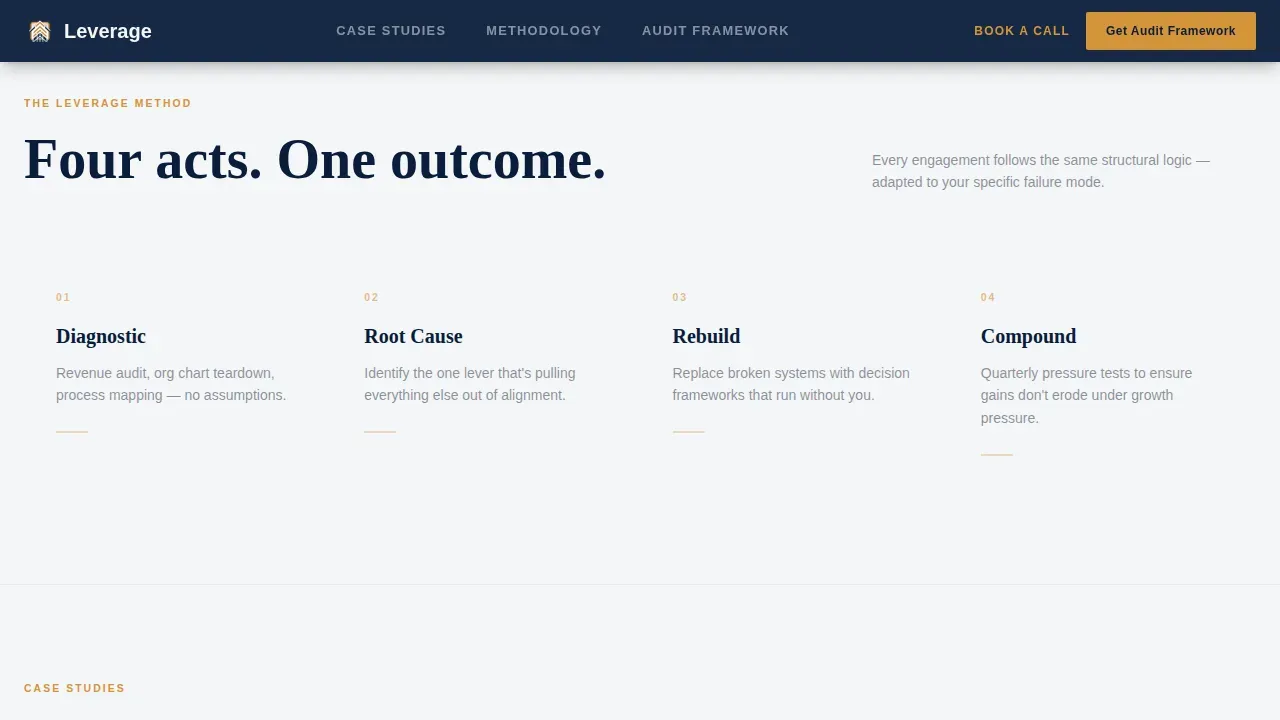
Each of the three case study sections follows the same structure: a before-state comparison table, a plain-language coach intervention narrative, and an after-state comparison table. The tables show metrics, team size, and the core problem in flat rows. Amber highlights appear on the delta values in the after-table. The three case studies escalate in complexity from solo consultant to funded startup to eight-figure family operation, which means the landing page does the qualification work for you. Each visitor finds their own ceiling reflected in one of the three stories.
Gated Growth Audit Framework Form
The primary call to action on this landing page is not a booking link. It is a downloadable diagnostic PDF called the Growth Audit Framework. Visitors access it through a three-field lead generation form: first name, business type as a dropdown with solo, funded, and established options, and current monthly revenue range. This approach converts visitors into qualified leads before any sales conversation begins. The form keeps friction low by collecting only what is necessary to deliver value and segment the lead.
Teardown Call Booking Embed
After the third case study, a secondary call to action links to a Calendly embed. The embed includes a single qualifying question, which keeps the booking process efficient and ensures that only relevant prospects reach the calendar. The teardown call section is positioned after the visitor has already processed three rounds of the coach's analytical thinking applied to businesses like their own. By that point, the booking decision is informed, not impulsive.
Credibility Bar with Methodology Snapshot
A credibility bar section sits between the case studies and the audit form. It is designed to display trust signals such as logos, trust marks, and a brief methodology snapshot. This section supports thought leadership positioning by giving the landing page a factual backbone beyond the case study narratives. It is the moment the page shifts from storytelling to structural proof.
Linear Single-Row Footer
The footer follows a Pattern 1 linear single-row layout. It is compact by design, carrying only what is necessary for the visitor who reaches the bottom of the page: contact details, essential links, and a final call to action that mirrors the primary offer above. No clutter, no secondary navigation, nothing that competes with the conversion path.
Page sections overview
| Section | Purpose |
|---|---|
| Hero Counter Block | Opens with animated amber outcome metrics on navy to establish immediate analytical authority |
| Case Study One | Before-and-after comparison table for solo consultant founder story |
| Case Study Two | Before-and-after comparison table for funded startup founder story |
| Case Study Three | Before-and-after comparison table for eight-figure family business story |
| Audit Form Section | Gated three-field lead generation form delivering the Growth Audit Framework PDF |
| Teardown Call Embed | Secondary call to action with Calendly booking embed and qualifying question |
| Credibility Bar | Trust signals, methodology snapshot, and logo or trust mark display |
| Linear Footer | Contact details, essential links, and final call to action in single-row layout |
Design & branding system
The visual identity follows a Service Utility theme that feels like a well-worn Moleskine opened on a mahogany desk at 6 AM. The Navy Authority color system dominates the layout. It is serious without being sterile and authoritative without performing authority. The typography pairing uses Fraunces as the serif display face for headings and Manrope as the body typeface, creating a contrast between commanding presence and readable structure.
The key design decisions in this template include:
- Command navy (#0B1D3A) as the dominant field color in the hero, case study backgrounds, and section dividers, establishing authority above the fold and throughout the scroll
- Decision-point amber (#D4943A) reserved exclusively for calls to action, animated counter figures, and numeric deltas in after-tables, ensuring the visitor's eye is always drawn to the most actionable element
- Clean brief white (#F4F6F8) used to open breathing room between case study sections and in supporting body text, preventing the layout from feeling closed or heavy
Mobile & speed optimization
The template is designed desktop-first, recognizing that founder decision-makers are most often reviewing this kind of landing page during focused work sessions on a laptop or workstation. Desktop-first does not mean mobile-hostile. The layout is built to be responsive, and every structural element scales appropriately across screen sizes. Mobile optimization matters here because diagnostic data from lead generation landing pages can be skewed by poor mobile rendering if the form fields or comparison tables break on smaller screens.
The key optimization decisions include:
- GSAP scroll reveals and counter animations are handled as client-side components, while static structural elements use server-side rendering to keep the initial load clean and fast
- Comparison tables and the three-field form are structured to remain legible and functional on mobile viewports without horizontal scrolling or field truncation
How this template helps you convert
This landing page is built around a deliberate persuasion sequence. Every section earns the next click. The logic is not manipulative. It is architectural. The visitor moves from signal to proof to value to action in a sequence that makes the final call to action feel obvious rather than pressured. Converting visitors from passive readers to qualified leads happens because the page builds a case before it makes an ask.
- The animated counter hero establishes analytical credibility in the first five seconds, so the visitor decides immediately that this practice is worth their focus time rather than bouncing to a competitor
- The three escalating case study blocks, each with before-and-after comparison tables, allow the visitor to self-identify with a specific founder profile, creating personal relevance that a generic value proposition could never achieve
- The gated Growth Audit Framework form gives the visitor something actionable before they ever book a call, which means the lead generation form converts visitors who are not yet ready to commit to a paid engagement but are ready to engage with the coach's thinking
Other information about this template
This template functions equally as a lead generation landing page and as a thought leadership asset. The page does not just sell a coaching service. It demonstrates how the coach thinks. By the time a visitor completes the three-field form, they have already seen the coach's analytical process applied to three different business types. That exposure creates informed decisions rather than impulse bookings. The result is a higher-quality lead pipeline and a shorter sales cycle for the coach.
Understanding the broader context of this template helps you get more from it:
- The founder bottleneck is a well-documented pattern where a company's progress depends heavily on the founder's involvement, slowing decision making and limiting growth across the organization. Control creates short-term certainty but long-term fragility, as teams adapt to waiting for approval rather than acting with confidence. Over control at the founder level means decision velocity slows across every function. This template is built to communicate that the coach understands this pattern precisely, which is the value proposition that converts the right clients.
- The founder's paradox is that the very capabilities that made the founder successful in the early stages become the ceiling that stops the company grows phase from reaching scale. Many founders recognize the control trap intellectually but have not yet built the system or process to exit it. This template addresses that gap by showing, through case study evidence, how the coaching intervention works in practice.
- Effective delegation is essential for leadership scalability, and the template's case study narratives are designed to show delegation in action, not as a concept, but as a measurable shift in team performance metrics. A culture of autonomy allows teams to make decisions without constant oversight from the founder. When the team executes with clear decision rights, the founder steps into strategy rather than operations.
- Delegation should be structured so that ownership is clear and responsibilities are defined. The ability to delegate effectively is a sign of mature leadership. Founders must transition from being the primary decision-maker to creating systems that empower others to lead. Building a self-managing team is crucial for scaling a business without the founder's constant involvement.
- Scalable business systems allow a company to operate independently of the founder's constant involvement. A business that runs without the founder does not happen by accident. It is built through deliberate authority distribution and defined boundaries. Operational independence is achieved when a company continues functioning at full speed without requiring the founder's constant oversight. Delegated authority refers to the intentional transfer of decision power from the founder to the team in a structured and accountable way. Systems thinking for founders means analysing the company as an interconnected structure rather than a series of isolated tasks. Trust architecture is the deliberate design of an environment where people can act with confidence, clarity, and autonomy. A leadership ecosystem is the structure that allows your organisation to operate smoothly even when you are no longer directing its movement. Organisation learns to self-govern only when the founder has embedded the right principles and decision frameworks at every level. The measure of legacy is whether the organisation can grow without you and still reflect the values you embedded. Freedom arrives when the company no longer requires constant supervision to behave well. This freedom is earned through restraint, clear ownership, and the courage to let others make decisions. Real freedom in business begins when the founder has created a system that runs on principles rather than approval. Freedom begins with building repeatable systems that replace personal judgment on routine decisions.
- This template is classified as a Comparison Table template style within the Professional Services category. It sits under the Business Coach Online Presence subcategory and is specifically built for the Business Coach Booking Page niche. The intersection of Case Study Narrative creative direction, Data Storytelling header concept, Content/Resource landing page direction, and Service Utility theme is what gives this template its specific character. It is not trying to be everything to every coach. It is optimized for the analytical, evidence-led practice.
- The landing page is built with GSAP for high-fidelity scroll reveals, counter animations, and staggered entrance effects. Interactive elements include case study tabs, hover states on comparison table rows, and the embedded Calendly booking flow. These choices reflect a desktop-first approach while maintaining responsive behavior across device sizes.
- Lead generation landing pages are most effective when they reduce friction for potential leads while still collecting enough information to qualify them. This template achieves that balance through a three-field form rather than a lengthy intake survey. A multi-step form approach or a short assessment can increase engagement compared to simple email captures, and the dropdown field for business type in this template achieves a lightweight version of that segmentation without adding form length.
- Using testimonials focusing on before and after results increases social proof effectiveness on the landing page. The comparison tables in this template serve exactly that function, presenting before-and-after results in a structured, scannable format that supports trust signals more effectively than written quotes alone. Social proof here is quantitative and specific.
- A well-structured lead generation landing page can significantly increase the number of leads captured compared to a standard landing page. The overall goal of the lead generation effort here is to convert visitors into leads by offering the Growth Audit Framework as a tangible, immediate value exchange. Lead generation landing pages focus on building a lasting connection with visitors, nurturing leads over time for future conversions. Effective lead generation landing pages often include clear calls-to-action, trust signals, and social proof to enhance conversion rates. This template covers all three with deliberate placement and visual hierarchy.
- AI-powered templates automate content creation, layout, and optimization, enabling fast, effective landing page creation without technical skills. The use of pre-built section blocks means you can create content and populate this template quickly, even without a design background. Automation and AI can help improve business efficiency by handling repeatable tasks, and within the context of this template, that means the layout, visual system, and persuasion architecture are already resolved. You focus on your real client data and let the system do the structural heavy lifting.
- Page loading speed is critical for landing pages because high bounce rates can undermine the diagnostic work the page is designed to do. High abandonment points indicate that the bottleneck may be in the trust signals or the sales process, rather than marketing effectiveness. If visitors spend time on the page but do not convert, the copy is likely too complex, indicating a clarity bottleneck. This template is structured to avoid that problem by presenting information in clearly separated, visually distinct sections that make progress feel effortless.
- The use of A/B testing on landing pages can help optimize conversion rates by determining which elements perform best. While this template provides the structural foundation, coaches are encouraged to test headline variants, counter metric phrasing, and call to action copy to identify what resonates most with their specific target audience. Analyzing tools and heatmaps can help identify where visitors are dropping off and which sections are generating the most engagement.
- Implementing no-code diagnostic tools can expedite the creation of interactive assessments for landing pages. Using a landing page template as a diagnostic tool can help identify which of a founder's responsibilities is the true growth constraint. Transitioning from a standard sales layout to a consulting-style assessment framework enhances the effectiveness of a diagnostic landing page. Key elements to optimize include a compelling, persona-focused headline, a simplified diagnostic tool, and emotional hooks that resonate with the specific founder profile being addressed.
- The hidden cost of being indispensable is that it disguises incompetence within the organization while convincing the founder they are performing at their highest level. A company becomes resilient when it no longer relies on a single source of strategic judgment. The transition from operator to architect is essential for founders to build a company that can function independently of their constant involvement. Leadership at scale means making yourself strategically optional in daily execution while remaining essential in direction and doctrine. These are the insights this landing page is built to communicate through evidence, not assertion.
- When trust is high, friction drops, decisions accelerate, and you see a measurable impact on your financial results. Trust is built through clarity of mission, simplicity of rules, and reliability of follow-through, which accelerates execution. A culture that does not need permission is built on principles and frameworks, allowing people to act decisively without constant approval. The template's case study structure is designed to demonstrate exactly that kind of trust architecture in a way that is concrete and believable for skeptical, data-oriented founders.
- Well known brands use before-and-after case study formats to demonstrate value proposition in professional services contexts because numbers tell a more convincing story than testimonials alone. This template adopts that convention and applies it specifically to founder coaching. The visual identity reinforces it. Well known brands in the analytics and financial data space use dark, data-dense interfaces to signal precision. This template borrows that visual grammar for a coaching context, making the practice feel more like a strategic advisory firm than a solo coach with a calendar link. Well known brands earn trust through signal, not noise. That is the core design philosophy here.
- Part ii of the conversion path on this landing page is the teardown call. It appears after the third case study, positioned precisely at the moment when the visitor has the most context about the coach's method. The call to action for the teardown call is supported by a Calendly embed with a single qualifying question, which keeps the booking flow fast and friction-free. The contact details and final call in the footer mirror the primary offer and ensure that visitors who scroll to the bottom still have a clear path to action.
- Stop letting the landing page do too little. The most common failure mode for coaching landing pages is that they ask for a booking before they have earned the trust that justifies one. This template inverts that sequence. It earns trust first through three layers of evidence, then presents the booking opportunity as a natural next step. By that point, the visitor is not being sold to. They are making an informed decision.
- Cognitive flexibility is a measurable outcome of effective coaching, and this landing page template is designed to surface that shift in the case study narratives. When a founder's identity stops being tied to the bottleneck role, the whole organization moves differently. Teams respond faster. Decision flows improve across functions. The company learns to operate at scale. The template captures that transformation in a format that is specific enough to be believable and structured enough to be trusted.
- Thought leadership in the coaching space is often asserted and rarely demonstrated. This template changes that by making the demonstration the landing page itself. The case study format, the before-and-after tables, and the gated diagnostic framework all function as thought leadership artifacts. They show how the coach thinks, not just what the coach charges. Create content that teaches before it sells. That is the philosophy embedded in every section of this landing page. Create leverage by publishing your method before the client pays for it. Create content around frameworks and the clients who most need those frameworks will self-select into your pipeline.
- The value of this template extends beyond the first campaign. The landing page structure can be updated as new case studies are completed, as the aggregate outcome metrics grow, and as the diagnostic framework evolves. Each update makes the social proof stronger and the lead generation more targeted. The system improves with use, which is exactly the point.
- For coaches who are breaking free from generic landing page builders and looking to position a premium practice, this template provides a starting point that already reflects the authority and structure that the most serious clients expect. Breaking free from the default coaching page format is itself a signal to sophisticated prospects that this practice operates at a different level. Breaking free from the noise of generic coaching marketing means committing to a specific, evidence-led format. Breaking free from short-term certainty in design choices means investing in a structure that earns compound trust over time. Breaking free from the approval-seeking aesthetic of most coaching pages means choosing a data-first visual language that respects the visitor's intelligence. Breaking free from vague value propositions means replacing them with before-and-after numbers that speak for themselves. Breaking free from the control trap of trying to do everything yourself, including your own landing page design, starts with a template that handles the structural decisions so you can focus on the content.
- Without losing conversion momentum, the template maintains a clear visual hierarchy from the hero counter block all the way through to the footer. Without losing the analytical tone, it introduces human context through the case study narratives. Without losing trust signals at any point in the scroll, the credibility bar section anchors the midpoint of the page with methodology proof. Without losing the ability to qualify leads before a call, the form collects just enough information to segment by business type and revenue range.
- More clarity in the coaching offer leads to more qualified leads in the pipeline. The template is designed to produce that clarity by making the value proposition specific, the process visible, and the expected outcome measurable. More clarity at the form stage means better-fit clients in the teardown call queue. More clarity in the case study tables means the visitor can assess their own situation in comparison to the stories presented, which is a more powerful conversion mechanism than any testimonial quote.
Theme
Service Utility
Creative direction
Case Study Narrative
Color system
Navy Authority
Style
Comparison Table
Direction
Content/Resource
Page Sections
Animated Outcome Counter Hero Section
Three-act Founder Case Study Blocks
Gated Growth Audit Framework Form
Teardown Call Booking Embed
Credibility Bar with Methodology Snapshot
Linear Single-row Footer
Related questions
What type of coaching practice is this landing page template designed for?
Can I update the animated counter metrics and case study tables with my own numbers?
How does the gated form support lead generation without discouraging serious prospects?
Is the Calendly teardown call embed included in the template structure?
Does this template work for coaches who are just starting to build an online presence?