Lineworker (Power Line) Business Professional Website Template
Linework is a sidebar companion landing page template built for lineworker and power line service businesses. It follows a field-manual aesthetic with an Ink and Paper color system, a fixed table-of-contents sidebar, and chapter-by-chapter content sections. Municipal utilities, rural electric cooperatives, and specialty contractors will find it purpose-built to earn trust before asking for any contact details.
by Rocket studio
Quick summary
Linework is a single-page, sidebar companion template designed for professional power line and lineworker service businesses. The layout unfolds like a technical field manual, guiding utility managers and project contractors through crew capabilities, certifications, and mobilization details before presenting a clear call to action. Every design choice prioritizes authority and clarity over decoration.
Who this template is for
This template is built for established crews and service companies that operate in demanding, high-voltage environments. The language and structure speak directly to the professionals who evaluate and hire linework teams.
- Municipal utilities seeking storm-response and emergency repair partners
- Rural electric cooperatives expanding service territory or upgrading overhead infrastructure
- General contractors on solar or wind projects who need certified journeymen for grid interconnect work
What problem this template solves
Most linework service businesses rely on word-of-mouth or plain contact pages that tell a prospect almost nothing before asking for a call. That leaves qualified buyers with no reason to trust the crew. This template solves the credibility gap by teaching first.
- Prospects leave without understanding crew qualifications, voltage class experience, or mobilization timelines
- Utility managers and project engineers need technical detail to justify vendor approval, and a blank contact form does not provide it
- The template structures information so visitors self-qualify by depth of scroll, filtering serious buyers before the first conversation
What you get with this template
The template delivers a fully structured, content-led landing page with a fixed sidebar and a chapter-driven main column. Every section is ready to populate with your own crew details, certifications, and service scope.
- A sticky sidebar with a clickable table of contents, a "Download Our Service Capabilities Guide" call to action, and contextual spec sheet and certification badge slots
- Numbered chapter sections covering storm response, new construction, maintenance programs, safety record, and certifications, each with space for diagrams, clearance notes, and plain-language crew explanations
- Two distinct conversion paths: a capabilities guide download form asking for company name, role, and email, plus a "Request a Crew Estimate" scope form covering project type, voltage class, and county
Feature list
This template is built around the specific functional requirements of a lineworker service landing page. Each feature reflects a design or structural decision drawn directly from the source brief.
Fixed Sidebar Table of Contents
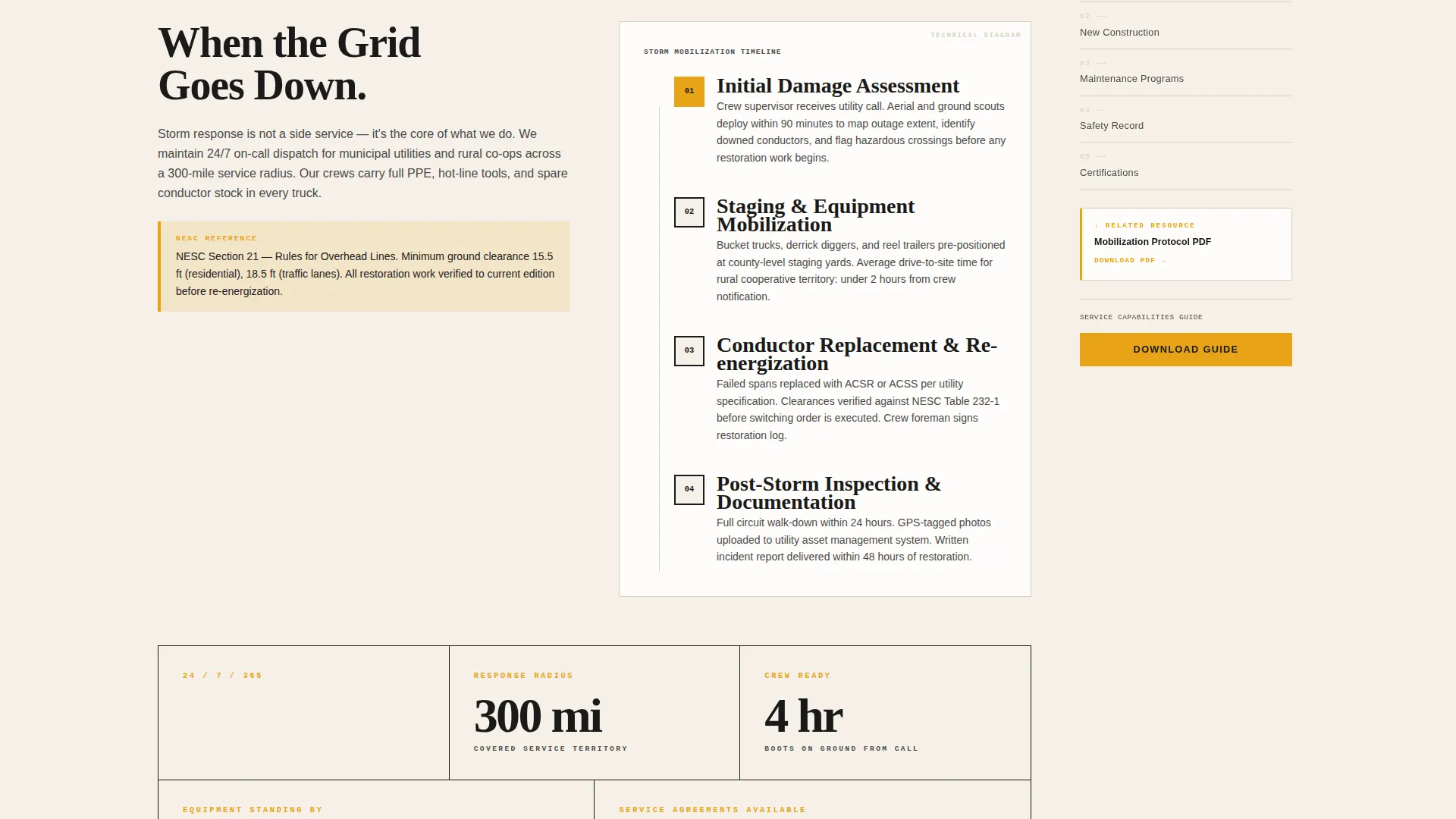
A persistent sidebar stays visible as the reader scrolls. It displays five named chapter links: Storm Response, New Construction, Maintenance Programs, Safety Record, and Certifications. An amber underline pulses beneath the active chapter link, giving the reader a clear sense of position without any extra user interface clutter.
Chapter-by-Chapter Scroll Structure
Each content section opens with a numbered step and a short, plain-language explanation of what the crew actually does. Complexity escalates naturally from basic service calls through multi-mile transmission builds. This structure lets utility managers and engineers self-qualify without being pushed toward a form too early.
Dual Conversion Path Layout
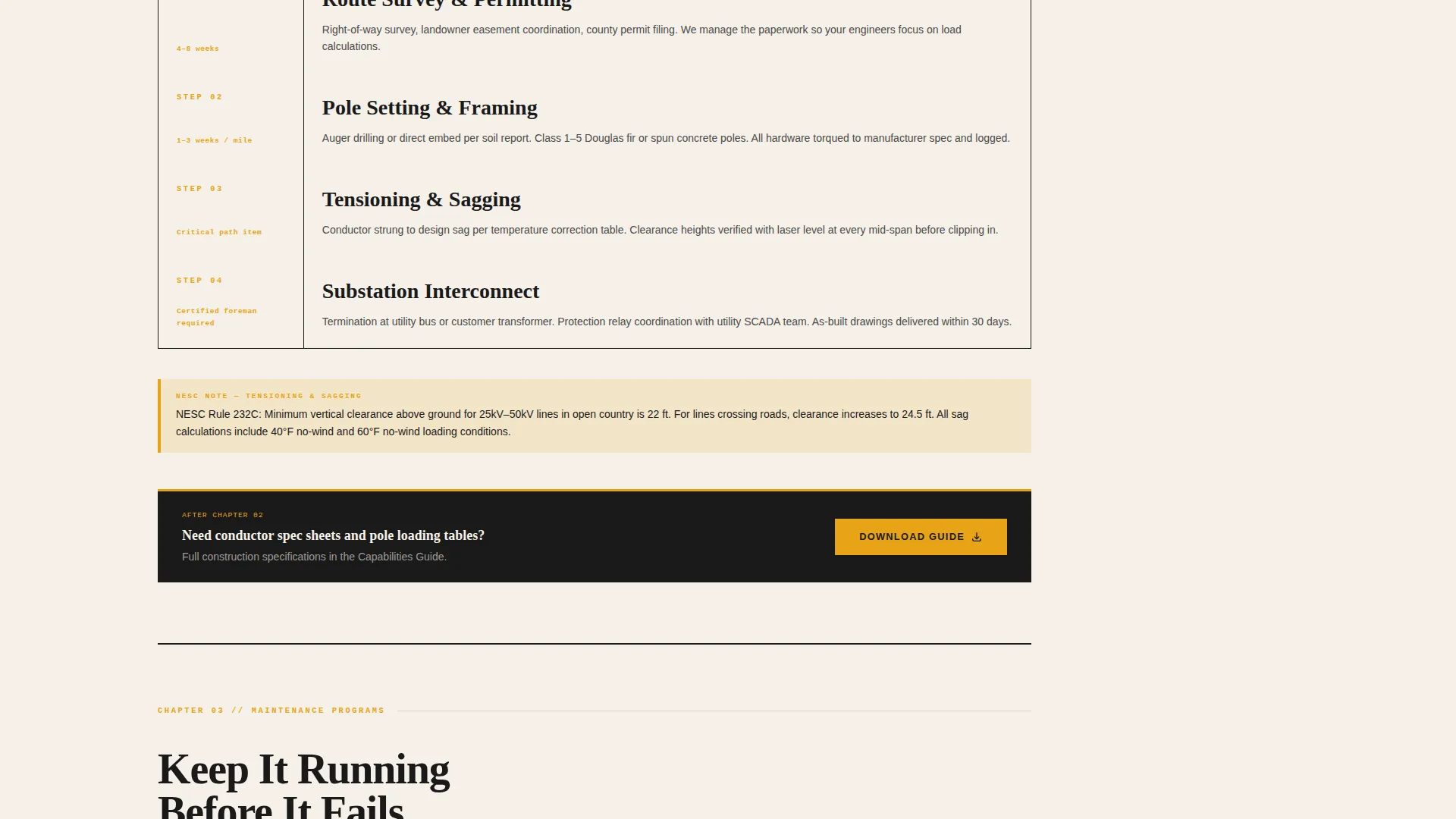
The template includes two separate conversion paths placed at strategic points. The primary path is a capabilities guide download, requiring only company name, role, and email. The secondary path is a crew estimate request form with fields for project type, voltage class, and county. Both paths appear in the sidebar and at chapter breaks.
Giant Headline Left Header
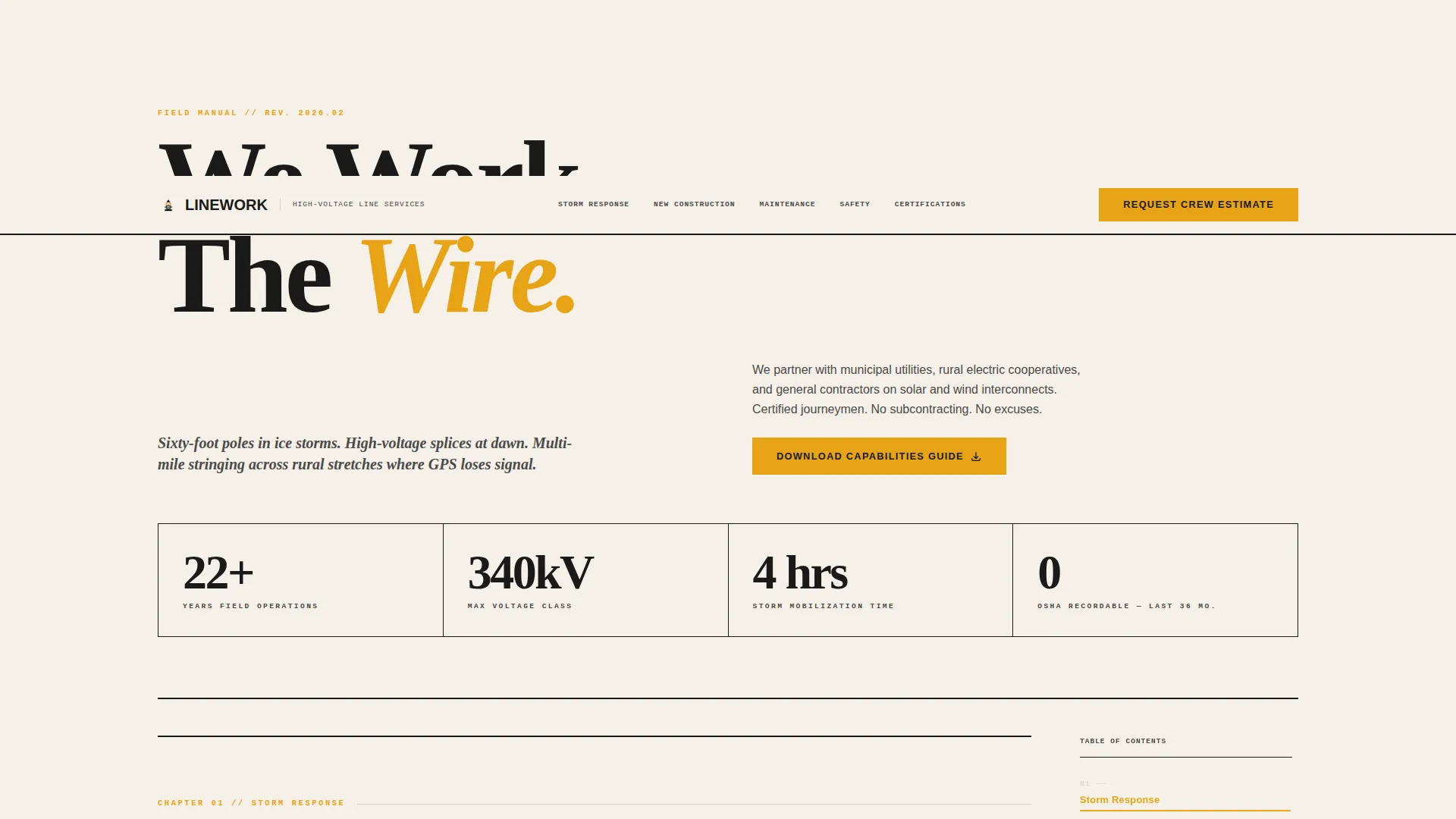
The header uses a heavy, oversized slab-serif headline set against the cream background. The design leaves the header free of any competing hero image, letting the typographic weight carry the authority of the page from the first second of loading.
Contextual Sidebar Content Slots
As the reader moves through chapters, the sidebar surfaces relevant supplementary material in designated slots: related PDFs, specification sheets, and crew certification badges. These slots are pre-positioned in the layout and ready for your own documentation assets.
Ink and Paper Visual System
The full color palette is applied consistently across headings, body copy, callout blocks, and interactive highlights. Deep utility black, lineman's graphite, weathered ledger cream, and safety-tape amber work together to create the technical diagram aesthetic of a journeyman's training binder.
Page sections overview
| Section | Purpose |
|---|---|
| Giant Headline Header | Opens the page with authoritative slab-serif type and no competing imagery |
| Fixed Sidebar Navigation | Provides a persistent table of contents and primary call-to-action access |
| Storm Response Chapter | Covers emergency crew deployment, ice storm operations, and transformer replacement |
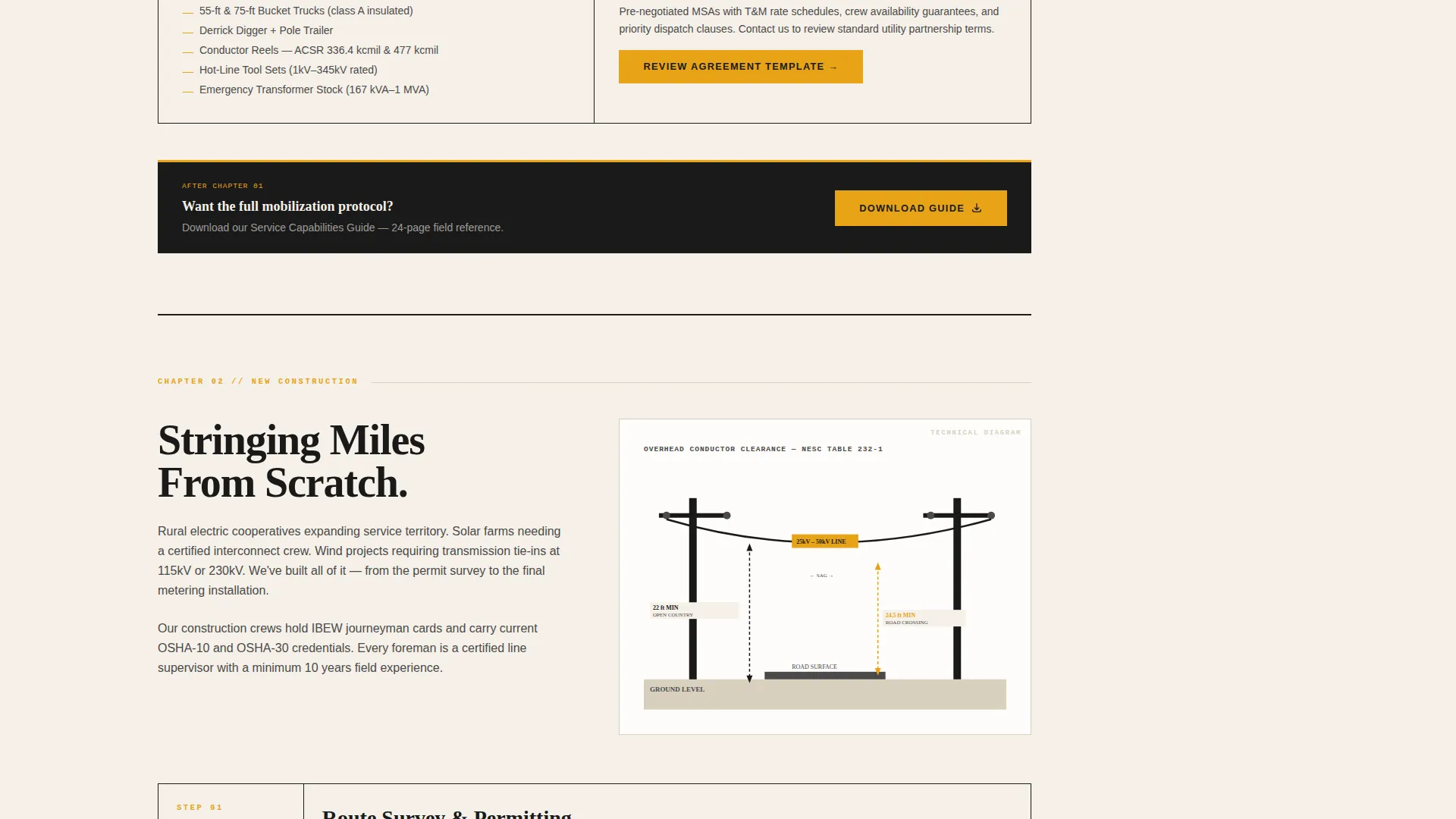
| New Construction Chapter | Details overhead line stringing, rural territory expansion, and multi-mile builds |
| Maintenance Programs Chapter | Explains scheduled inspection, conductor maintenance, and ongoing service agreements |
| Safety Record Chapter | Presents crew safety history, qualification breakdowns, and field protocol notes |
| Certifications Chapter | Lists journeyman certifications, voltage class approvals, and relevant code references |
| Capabilities Guide Form | Captures company name, role, and email for the downloadable service guide |
| Crew Estimate Request Form | Collects project type, voltage class, and county for a scoped crew estimate |
Design & branding system
The visual identity is built on an Ink and Paper color system that evokes a technical diagram photocopied from a journeyman's training binder. Every color has a defined role, and nothing is decorative.
- Deep utility black (#1A1A1A) for primary text and structural elements, lineman's graphite (#4A4A4A) for secondary copy and supporting details, and weathered ledger cream (#F5F0E8) as the page background
- Safety-tape amber (#E8A317) reserved strictly for callout blocks, interactive highlights, and the pulsing underline on the active sidebar link
- Typography uses a heavy oversized slab-serif for headings to create structural visual weight, paired with clean body type for plain-language technical explanations
Mobile & speed optimization
The template layout is designed to remain readable and functional across screen sizes. The sidebar companion structure adapts so that the fixed navigation and conversion paths remain accessible without crowding the main content column.
- The sidebar collapses cleanly on smaller screens, keeping the table of contents and call-to-action reachable without disrupting the scroll-driven chapter flow
- Chapter sections, diagrams, and form blocks are structured to stack vertically on narrow viewports, preserving the field-manual reading experience on any device
How this template helps you convert
The conversion strategy is built into the structure of the page itself. A visitor earns trust through content before they ever see a form, which means the people who reach either conversion path are already qualified and engaged.
- The chapter-by-chapter scroll teaches the visitor about crew capabilities, clearance standards, and mobilization timelines. By the time they reach a form, they have already built confidence in the crew's technical depth.
- The sidebar keeps the "Download Our Service Capabilities Guide" call to action visible at all times, and places the "Request a Crew Estimate" path at natural chapter breaks, so conversion opportunities appear at the moments of highest reader engagement.
Other information about this template
This template is categorized under Professional Services and is specifically designed for the lineworker power line service niche. A few additional details are worth noting for buyers evaluating the fit.
- The template style is Sidebar Companion, meaning the fixed sidebar is a structural feature, not an optional add-on. The layout is built around it.
- The Educational Guide theme and Transparent Process creative direction are expressed through numbered chapters and contextual sidebar content, not through decorative illustrations or stock imagery
- The page direction is Content and Resource delivery, meaning the primary goal is to earn trust through information before requesting contact details
- The template is ready to receive your own PDFs, specification sheets, crew certification badges, and clearance diagrams in the pre-positioned sidebar slots
- The header concept is Giant Headline Left, which means the typographic hierarchy is the first visual priority on the page
Theme
Educational Guide
Creative direction
Transparent Process
Color system
Ink & Paper
Style
Sidebar Companion
Direction
Content/Resource
Page Sections
Fixed Sidebar Table of Contents
Chapter-by-chapter Scroll Structure
Dual Conversion Path Layout
Giant Headline Left Header
Contextual Sidebar Content Slots
Ink and Paper Color System
Related questions
What types of businesses fit this template best?
Can I use this template if my crew handles both storm response and new construction?
What do the two conversion forms collect from visitors?
Does the sidebar stay visible while the visitor is scrolling?
Is this template suitable for a linework crew just starting out?