Fabric Mill Dashboard Landing Page Template
Loom is a dashboard-style landing page template built for fabric mills and precision textile manufacturers. It uses a Data Command theme with a Forest Trust color palette to present fiber sourcing data, weaving capacity dashboards, dyeing process controls, and quality assurance grids. The layout guides sourcing directors, procurement leads, and textile converters from raw-material proof points to a clear partnership inquiry form.
by Rocket studio
Quick summary
Loom is a single-page, data-driven landing page template for fabric mills. It presents the full production pipeline as a scrollable timeline, from raw fiber sourcing through quality assurance. Every section delivers measurable proof points before asking for a business commitment. The design balances industrial precision with organic visual warmth, making technical capability feel both credible and approachable.
Who this template is for
This template is built for fabric mills and textile manufacturers that sell to industrial or commercial buyers. It speaks directly to decision-makers who need data before they commit to a supplier relationship.
- Sourcing directors at apparel brands evaluating minimum order quantities and fiber specs
- Procurement leads at automotive original equipment manufacturers specifying flame-retardant or technical weaves
- Textile converters sourcing greige goods with consistent grams per square meter and zero selvedge defects
What problem this template solves
Fabric mills often struggle to communicate complex production capability to buyers who are evaluating multiple suppliers at once. A generic brochure page does not answer the questions a sourcing director actually has. This template replaces vague marketing copy with structured, verifiable data at every scroll step.
- Buyers need fiber denier, thread count, tensile strength, and colorfastness ratings, not just taglines
- Procurement teams require quality assurance data such as pilling resistance, shrinkage percentage, and Martindale abrasion cycles before shortlisting a mill
- Prospects need a low-friction secondary path if they are not ready to submit a formal specification request
What you get with this template
The template delivers a fully structured landing page that takes a buyer through the entire production journey before presenting a conversion form. Each section is purposefully sequenced to build confidence incrementally.
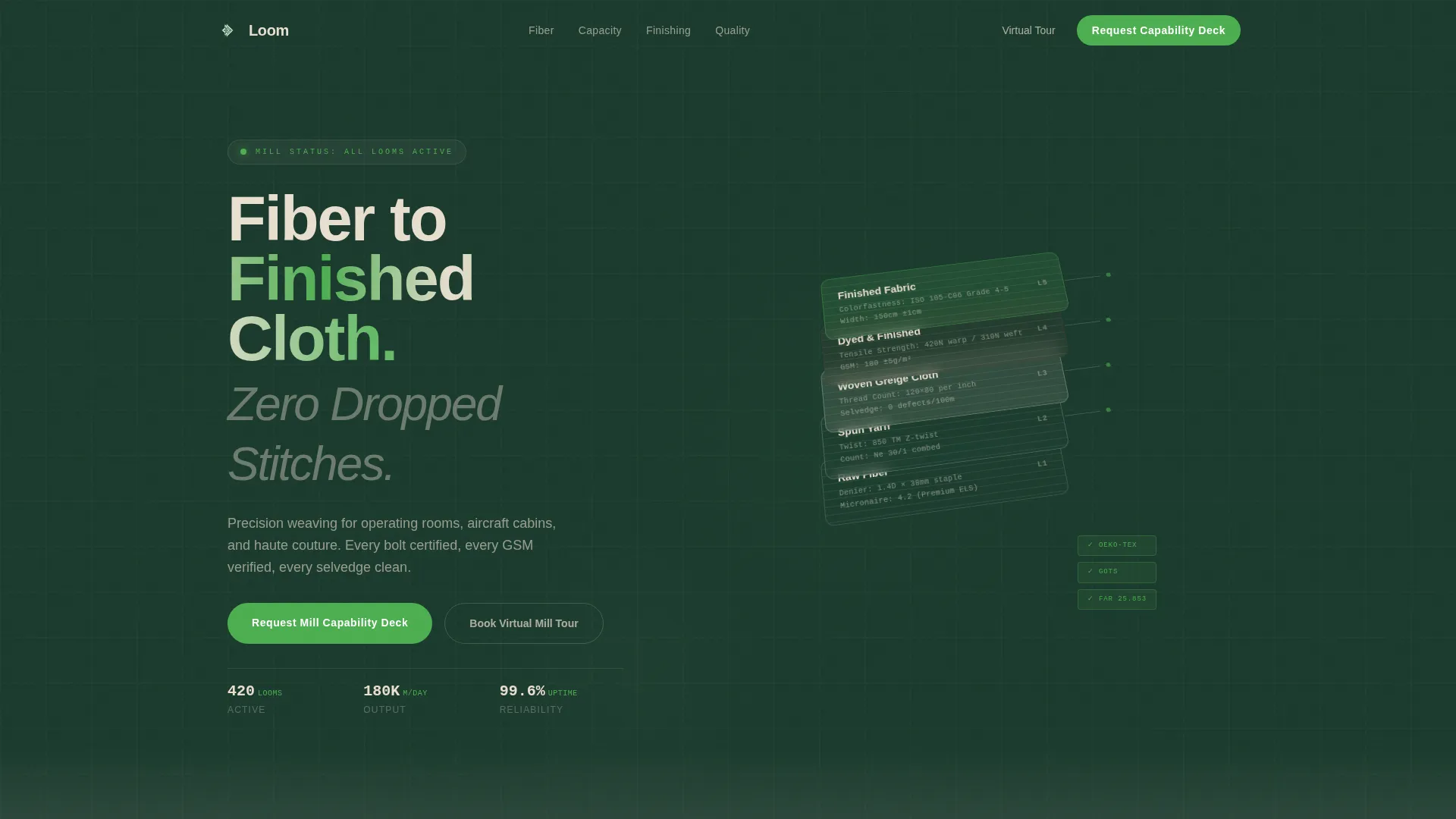
- An exploded-view header showing raw fiber, spun yarn, greige cloth, and finished fabric as labeled isometric layers with real technical specifications
- Four scrollable production pipeline sections covering fiber sourcing, weaving capacity, dyeing and finishing process controls, and quality assurance data grids
- A dual-conversion layout with a primary "Request a Mill Capability Deck" form and a secondary "Book a Virtual Mill Tour" path
Feature list
This template is built around a set of purposeful design and layout features. Each one is grounded in how industrial buyers actually evaluate a manufacturing partner.
Exploded View Header
The header deconstructs a bolt of fabric into four labeled isometric layers: raw fiber, spun yarn, woven greige cloth, and dyed finished fabric. Thin white leader lines connect each layer to its technical data tag, including fiber denier, thread count, tensile strength, and colorfastness rating. The composition is rendered against deep canopy green and reads like an engineering diagram with genuine visual impact.
Timeline Progression Layout
Scrolling moves the visitor forward through the mill's production pipeline in a logical sequence. Each section deepens the buyer's confidence by adding a new category of proof: sourcing data first, then capacity metrics, then process tolerances, then quality results. The cumulative effect makes the mill feel like a fully transparent and well-managed operation.
Weaving Capacity Dashboard
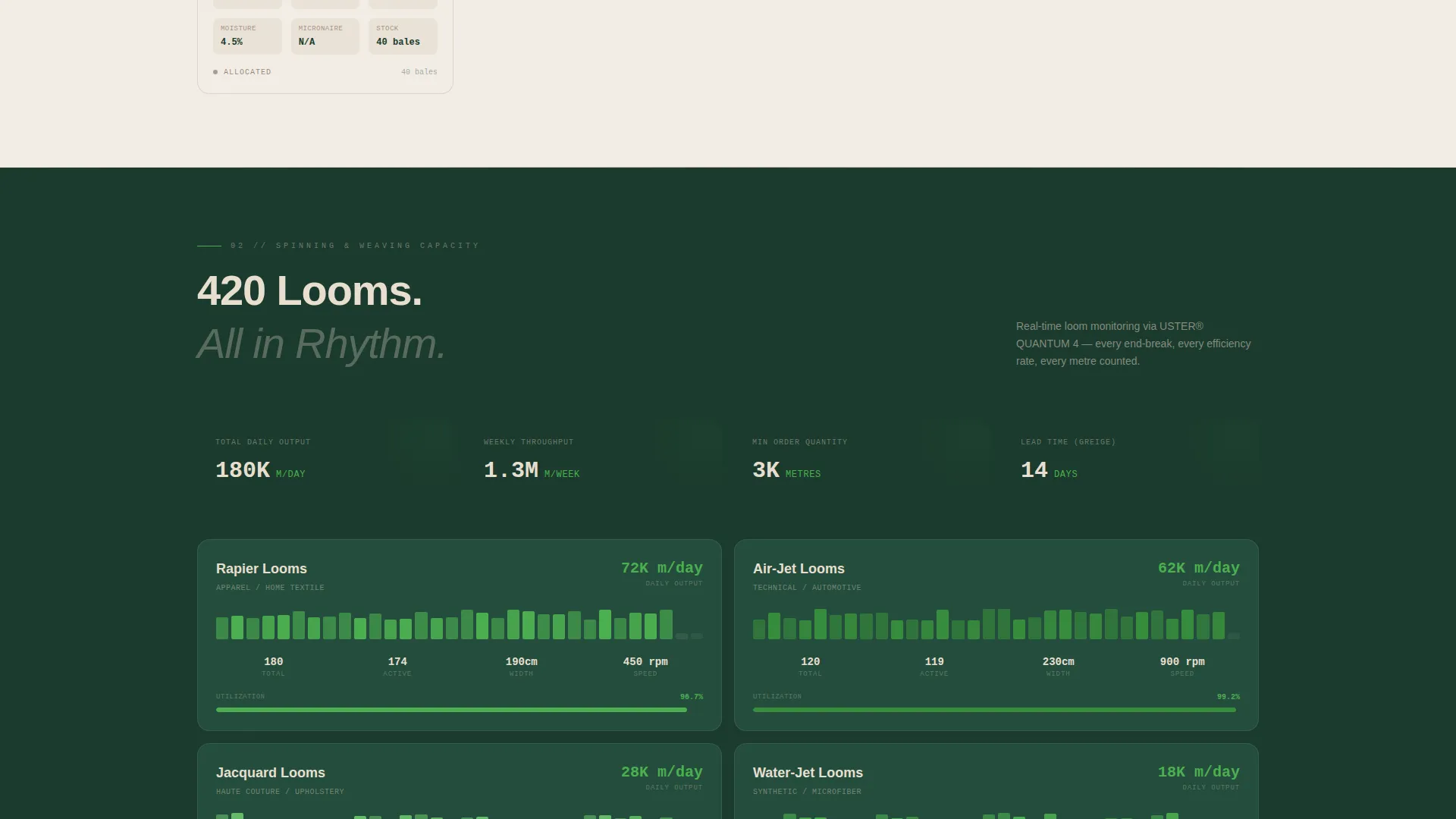
The second section presents spinning and weaving capacity as live-style dashboard panels, showing loom counts and output meters per day. This gives procurement leads a fast, scannable answer to the throughput question without requiring a phone call or document request.
Dyeing and Finishing Process Controls
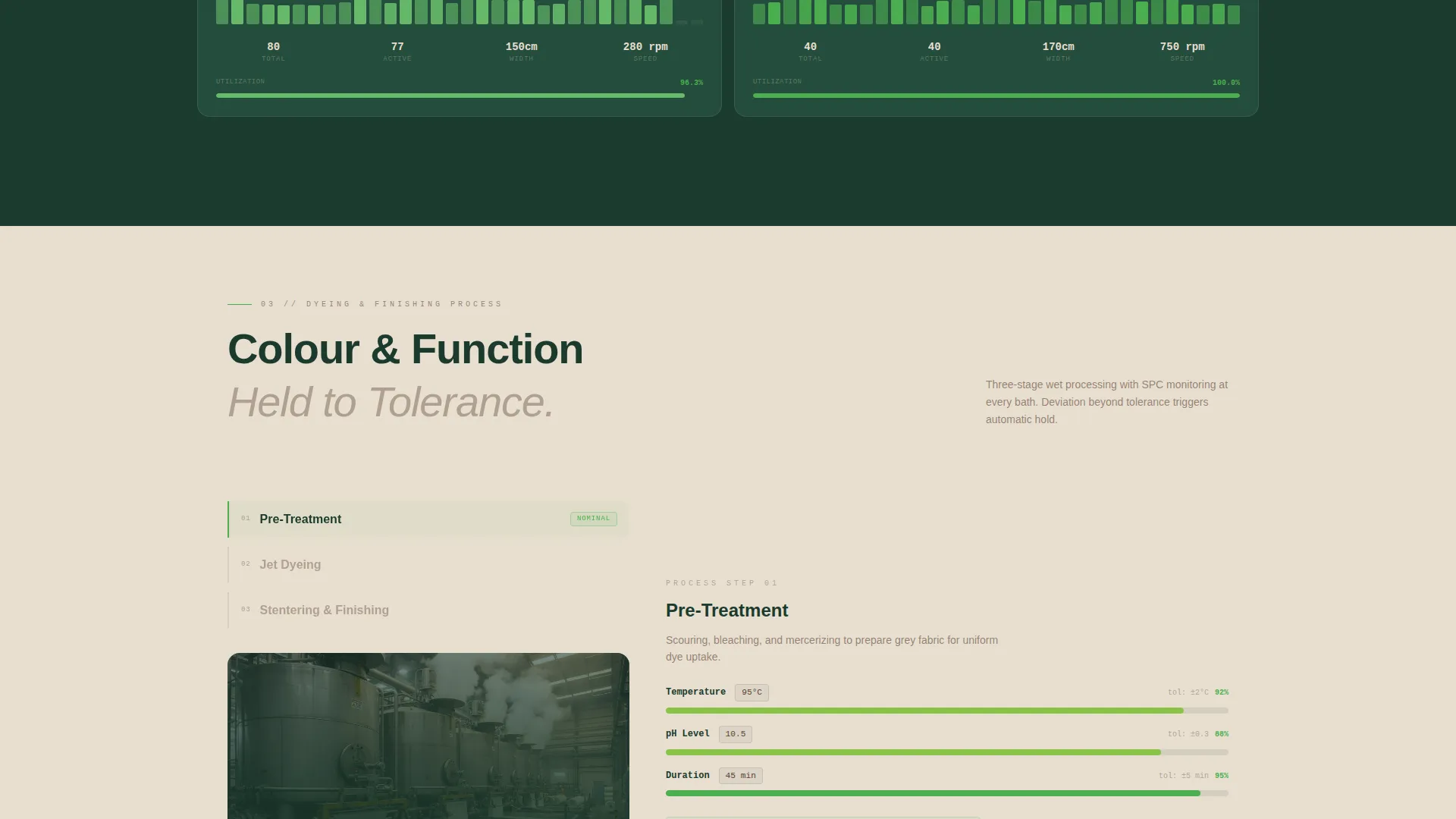
The third section displays dyeing and finishing parameters with tolerance ranges in a control-panel layout. This level of process detail is directly relevant to buyers specifying technical textiles for applications such as operating rooms, aircraft cabins, or automotive interiors.
Quality Assurance Data Grids
The fourth section presents quality metrics in sortable data table format. Pilling resistance, shrinkage percentage, and Martindale abrasion cycles are displayed as structured grids, giving buyers the verification data they need to move a mill from consideration to shortlist.
Dual-Path Conversion Design
The primary call to action, "Request a Mill Capability Deck," appears at the header fold and repeats as a sticky bar after the second section. A secondary path, "Book a Virtual Mill Tour," serves prospects who are not yet ready to submit a specification. The intake form captures company name, fabric application category, estimated annual yardage, and a free-text field for special finish or certification requirements such as OEKO-TEX, GOTS, or aerospace FAR 25.853.
Page sections overview
| Section | Purpose |
|---|---|
| Exploded View Header | Introduce mill capability with a layered technical illustration and primary call to action |
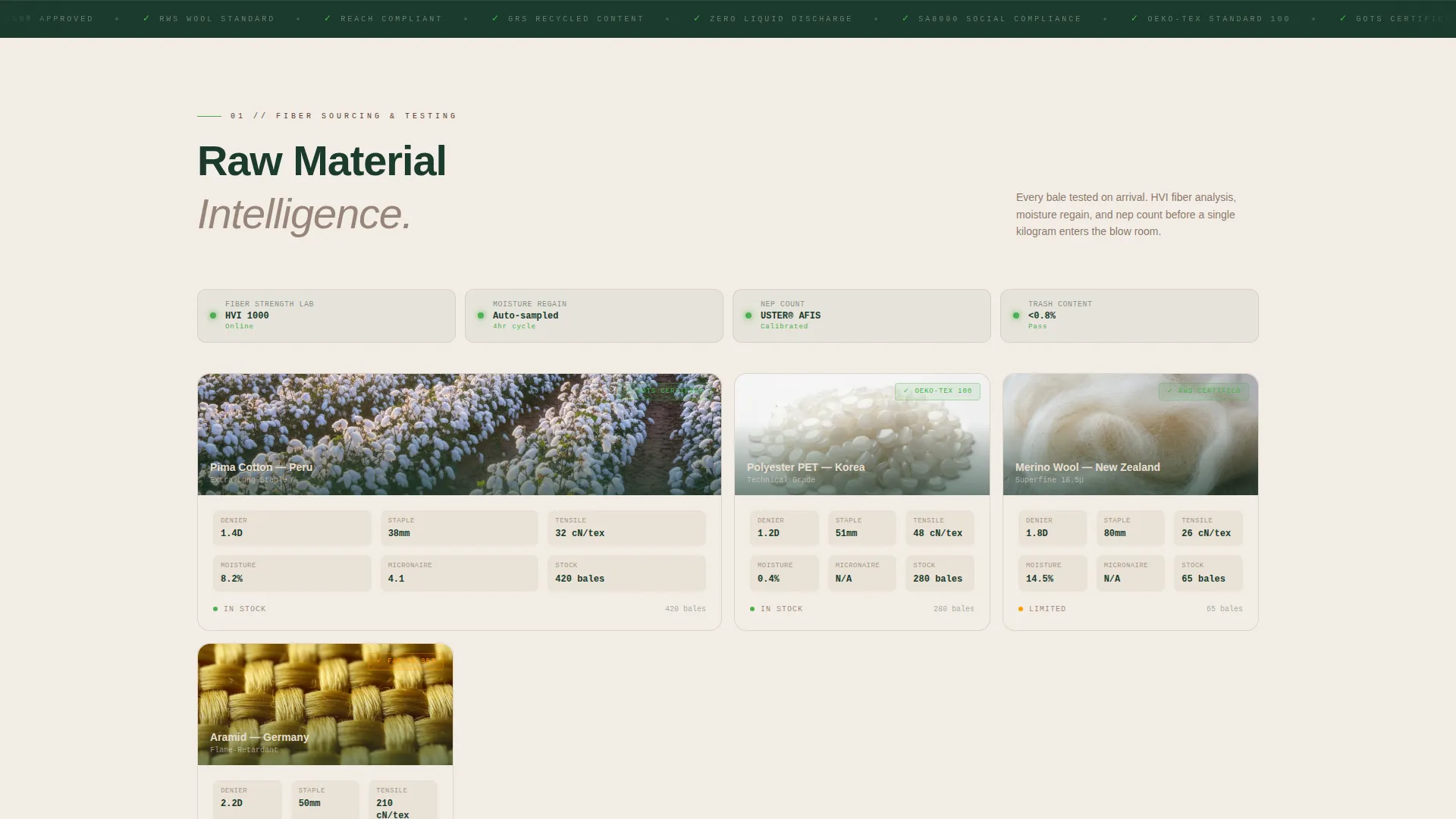
| Fiber Sourcing Cards | Present raw material sourcing data and fiber testing results |
| Weaving Capacity Dashboard | Show live-style loom counts and daily output metrics |
| Dyeing Process Controls | Display finishing parameters and tolerance ranges for technical buyers |
| Quality Assurance Grids | Deliver sortable pilling, shrinkage, and abrasion test data |
| Dual call to action Section | Capture partnership inquiries and virtual mill tour bookings |
Design & branding system
The visual identity uses a Forest Trust color system that feels like a forestry inventory ledger: rooted and organic in origin, but industrial in precision. Every color assignment has a structural purpose.
- Deep canopy green (#1B3A2D) anchors headers and primary backgrounds; heartwood brown (#5C4033) grounds secondary panels and divider lines; undyed linen (#E8DFD0) fills data cards and default surfaces
- Chlorophyll accent (#4CAF50) activates live data points, hover states, and call-to-action buttons, drawing the eye exactly where it needs to go next
Mobile & speed optimization
The template is structured for clarity on smaller screens without losing the data-rich density that industrial buyers expect. Dashboard panels and data grids are laid out to remain readable on a range of device sizes.
- Data cards and sortable grid sections are arranged in a responsive column structure that adapts from desktop to mobile without collapsing critical data
- The sticky call-to-action bar is designed to remain visible and accessible as the visitor scrolls through longer dashboard sections on any device
How this template helps you convert
This template is engineered around a single principle: earn the click by proving capability before asking for anything. The conversion architecture reflects how industrial buyers actually make decisions.
- The exploded-view header establishes technical authority immediately, giving sourcing directors a reason to keep scrolling rather than bouncing to a competitor's page.
- The sticky "Request a Mill Capability Deck" bar appears after the weaving capacity section, timed to the moment a buyer has already seen enough data to feel confident reaching out.
- The secondary "Book a Virtual Mill Tour" path removes friction for prospects who are still in the evaluation phase, keeping them engaged rather than letting them leave without converting.
Other information about this template
This template is part of the Manufacturing and Industrial category, specifically designed for the textile and garment factory subcategory with a fabric mill focus. It is well suited for mills serving diversified end markets.
- Fabric applications supported by the intake form include apparel, technical textiles, home textiles, and automotive, making the template relevant across a wide range of buyer types
- The certification requirements field in the form supports free-text entry for standards such as OEKO-TEX, GOTS, and aerospace FAR 25.853, accommodating buyers with highly specific compliance needs
- The Data Command theme and Dashboard/Data Grid template style make this layout a strong fit for any precision manufacturing business that needs to present process data as a primary trust signal
Theme
Data Command
Creative direction
Timeline Progression
Color system
Forest Trust
Style
Dashboard/Data Grid
Direction
Partnership/B2B
Page Sections
Exploded View Header with Technical Labels
Timeline Progression Scroll Layout
Weaving Capacity Dashboard Panels
Dyeing and Finishing Process Controls
Sortable Quality Assurance Data Grids
Dual-path Conversion Architecture
Related questions
Who is this landing page template designed for?
What conversion actions does this template include?
Can I adapt the quality assurance data grids to my own test results?
What fabric application categories does the intake form support?
Does the template include the sticky call-to-action bar?