Electronics Manufacturing Professional Website Template
Lumen is a single-column flow landing page template built for LED manufacturing operations. It pairs a monochrome steel visual identity with an engineering blueprint structure, guiding technical buyers through the full production process. A metrics-first header, annotated section reveals, an interactive product selector, and a gated engineering library download make it purpose-built for lighting OEMs, electrical engineers, and procurement professionals.
by Rocket studio
Quick summary
Lumen is a precision-crafted single-column landing page template for LED chip and module manufacturers. It opens with a bold metrics wall, walks visitors through each production stage in blueprint style, and closes with a gated engineering library download. The design speaks directly to technical buyers who need data before they trust a supplier.
Who this template is for
This template is built for manufacturers and technical teams in the LED and electronics manufacturing space. It assumes a sophisticated audience that reads datasheets before making sourcing decisions.
- Lighting OEMs sourcing reliable emitters at volume across multiple product lines
- Electrical engineers specifying components for municipal infrastructure and commercial bids
- Procurement managers at automotive Tier-1 suppliers evaluating binning consistency and component reliability
What problem this template solves
Most industrial landing pages either bury their technical data or present it without context. Buyers in LED manufacturing need to verify engineering depth before they commit to a supplier conversation. This template fixes that gap.
- It leads with verified production metrics so buyers immediately see scale and precision
- It organizes the manufacturing process as a visual walk-through, making technical specs feel earned rather than dumped
- It places the resource download after the proof, so the form feels like a natural next step rather than a barrier
What you get with this template
You get a fully structured single-column landing page designed around the LED manufacturing buyer journey. Every section has a defined purpose and a clear visual role.
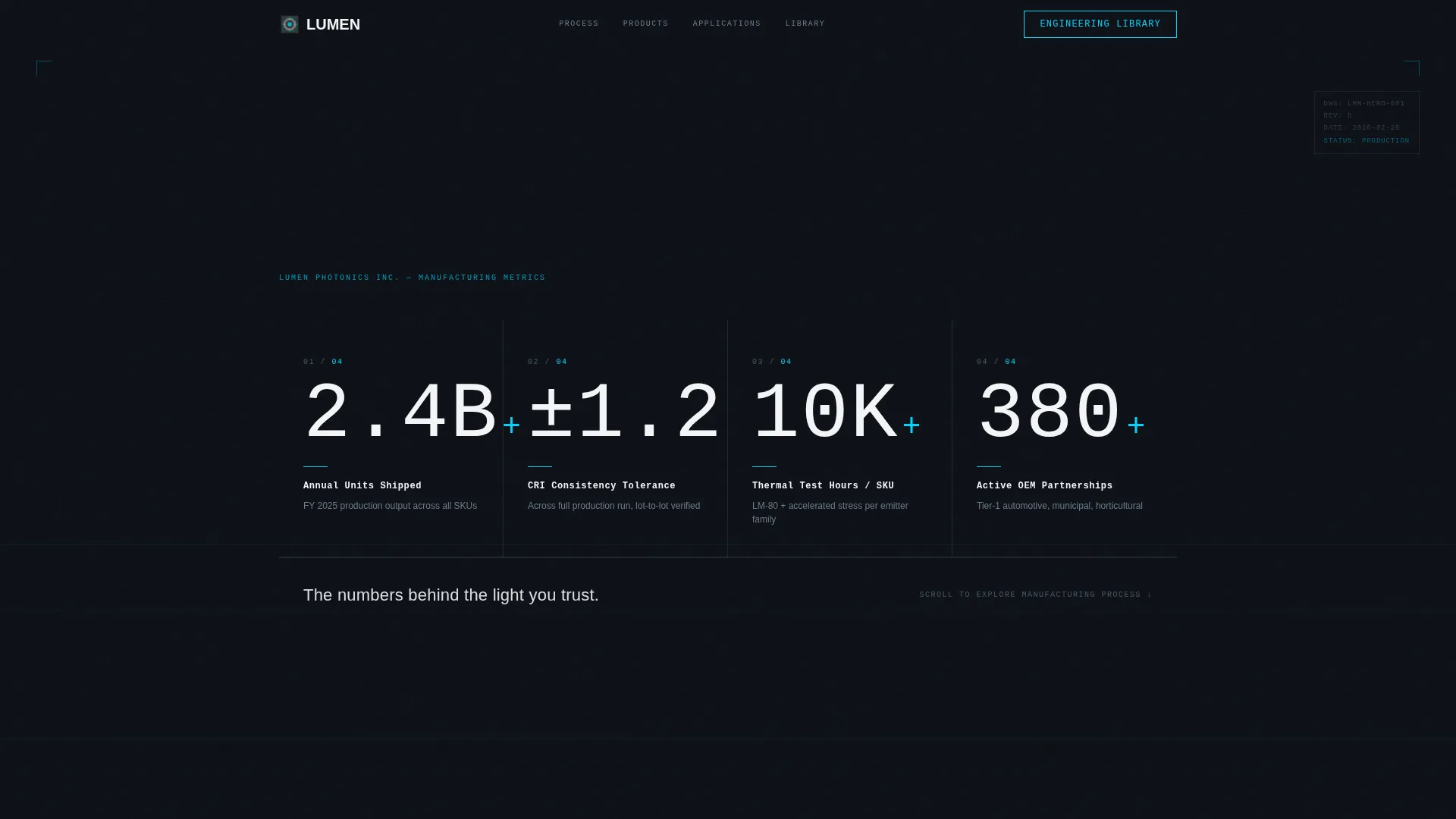
- A sequentially animated stats wall with four core production metrics rendered in monospaced type
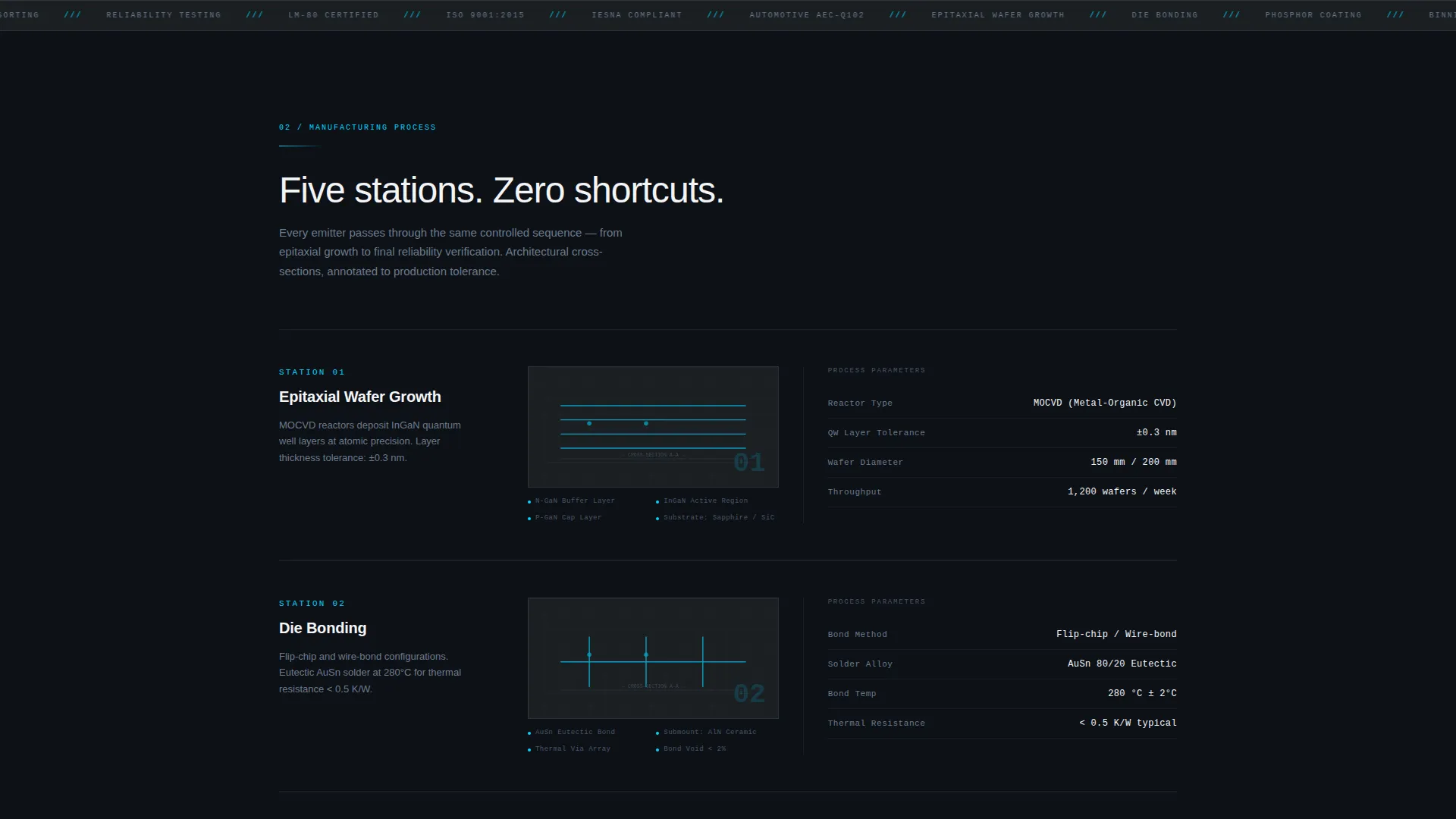
- A scroll-driven blueprint layout covering five manufacturing stations with annotated callout reveals
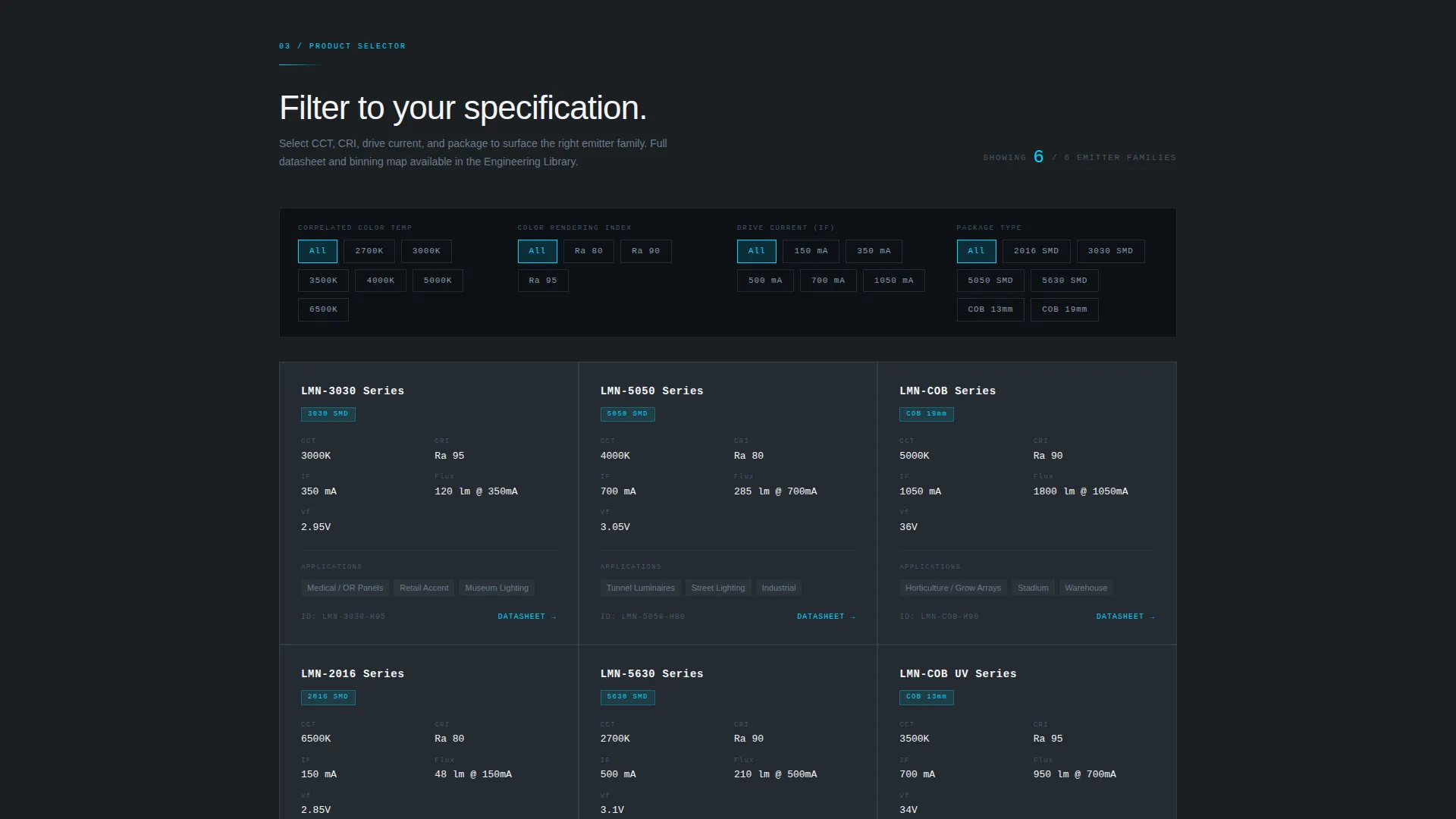
- A gated engineering library form and an ungated interactive product selector for engineers
Feature list
This template includes purpose-built sections and components that serve a technically demanding audience.
Sequential Metrics Header
Four production figures animate in one at a time, mimicking readings stabilizing on test equipment. The header displays annual units shipped, Color Rendering Index (CRI) consistency tolerance, thermal test hours per SKU, and active OEM partnerships. No image, no button, the data opens the conversation.
Blueprint-Style Manufacturing Walk-Through
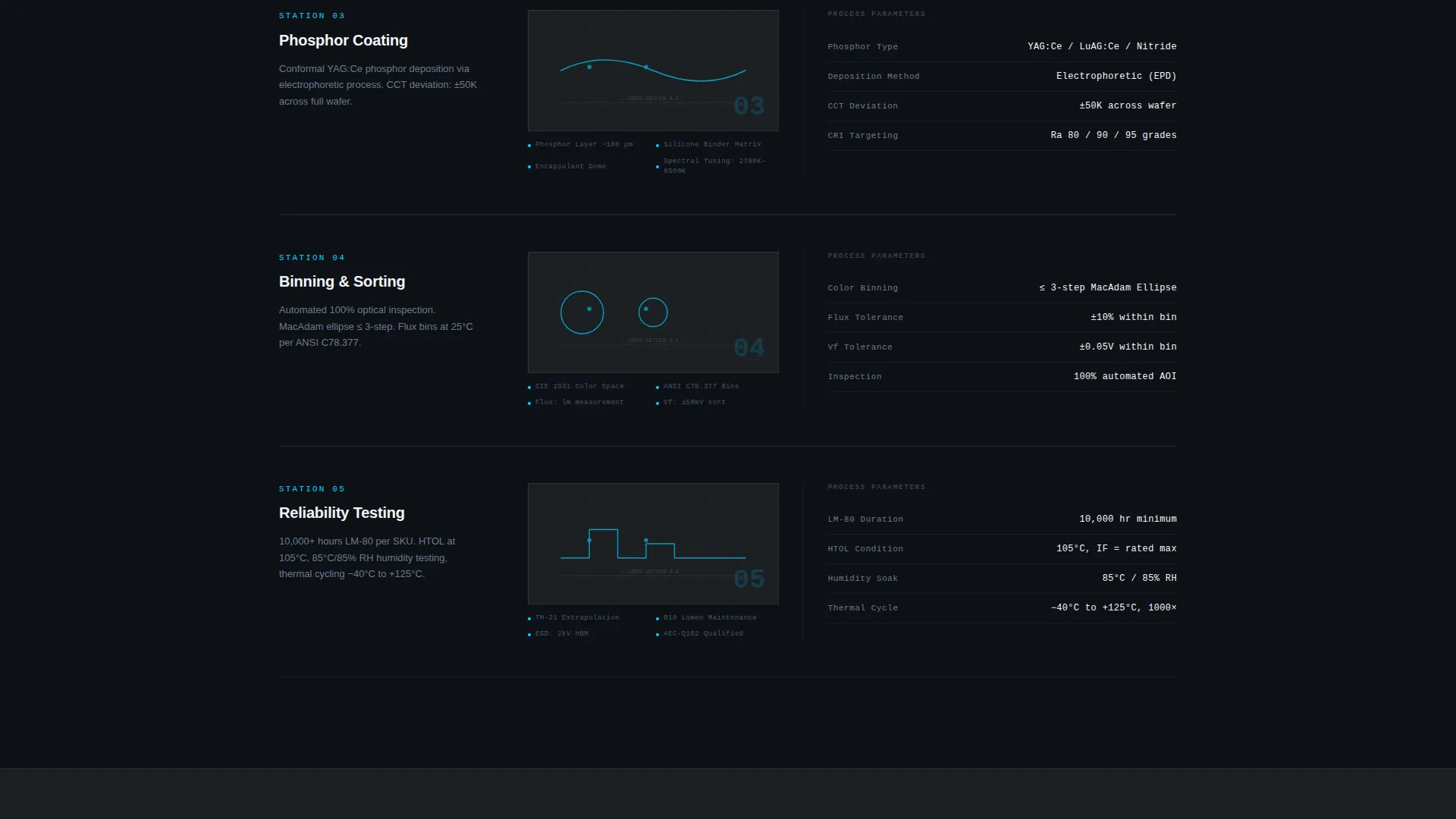
Each scroll section represents a station on the production line: epitaxial wafer growth, die bonding, phosphor coating, binning and sorting, and reliability testing. Sections are rendered as architectural cross-sections with annotated callouts that appear on scroll. Technical depth escalates naturally as the visitor moves down the page.
Gated Engineering Library Download
A short form collects work email, company name, and a checkbox grid for resource type. Resource options include product datasheets, LM-80 reports, binning maps, and IESNA (Illuminating Engineering Society of North America) files. The form appears only after the visitor has absorbed the technical content.
Interactive Product Selector
An ungated filter tool lets engineers narrow by correlated color temperature (CCT), CRI, drive current, and package type. It surfaces the right emitter family instantly without requiring a form submission. This gives technically confident buyers a direct path to the product they need.
Escalating Technical Data Sections
As the visitor scrolls deeper, content moves from surface-level specifications to spectral distribution charts, LM-80 extrapolation data, and thermal derating curves. The progressive depth structure respects the reader's expertise without overwhelming early visitors. Every data layer adds a reason to keep reading.
Monochrome Steel Visual System
The color palette uses deep shop-floor charcoal, brushed aluminum mid-tone, clean-room white, and laser-line cyan reserved for data highlights and interactive accents. Typography is thin and monospaced, consistent with technical drawing conventions. The result is a layout that communicates credibility through visual restraint.
Page sections overview
| Section | Purpose |
|---|---|
| Stats metrics wall | Opens with four animated production figures to establish technical scale |
| Epitaxial wafer growth | First manufacturing station with annotated blueprint cross-section |
| Die bonding station | Second production stage with scroll-triggered callout reveals |
| Phosphor coating station | Third stage detailing material application and precision specs |
| Binning and sorting | Fourth stage covering consistency tolerances and sorting methodology |
| Reliability testing station | Fifth stage presenting LM-80 data and thermal derating curves |
| Interactive product selector | Ungated filter tool for CCT, CRI, drive current, and package type |
| Engineering library form | Gated download with email, company name, and resource type checkboxes |
Design & branding system
The design follows an engineering blueprint theme built on a monochrome steel color system. Every visual choice is functional. Nothing in the layout exists purely for decoration.
- Color palette: deep charcoal (#1B1F23) for backgrounds, brushed aluminum (#6B7B8D) for supporting elements, clean-room white (#F4F5F7) for body text, and laser-line cyan (#00D4FF) reserved for data highlights, hover states, and interactive accents
- Typography is thin and monospaced throughout, consistent with CNC operator station displays and technical drawing standards
- The page narrows and widens subtly on scroll to mimic moving through cleanroom corridors, reinforcing the spatial and architectural creative direction
Mobile & speed optimization
The single-column flow structure adapts naturally to smaller screens without restructuring the visual hierarchy. The scroll-driven reveal system is designed to work within a linear layout.
- The single-column format ensures that annotated blueprint sections and metric figures stack cleanly on mobile viewports
- Scroll-triggered callout animations are built for a vertical reading experience, which suits both desktop and mobile interaction patterns
- The interactive product selector uses filter inputs that translate to touch-friendly controls on smaller devices
How this template helps you convert
This template earns the conversion before asking for it. Every section builds credibility so the download form feels like a logical conclusion rather than an interruption.
- The metrics wall qualifies the page immediately, visitors see scale and precision in seconds, which filters out casual traffic and keeps serious buyers engaged
- The manufacturing walk-through proves engineering depth section by section, giving procurement managers and electrical engineers the context they need to trust the source
- The product selector gives technically confident buyers a direct path to the right emitter family, reducing friction and shortening the time from interest to intent
Other information about this template
Lumen is designed for a niche where trust is built through data, not photography. A few additional details are worth knowing before you adapt this template for your operation.
- The template is categorized under Manufacturing and Industrial, specifically Electronics Manufacturing, with a focused application in LED manufacturing
- The landing page direction is Content and Resource, meaning the primary conversion goal is a high-value download rather than a direct sales inquiry
- The header concept is a Stats and Metrics wall, a deliberate choice for audiences who respond to verified figures over aspirational messaging
- All five manufacturing stations in the scroll walk-through are named and sequenced to reflect a real LED production process, from wafer growth through reliability testing
- The template style is Single Column Flow, which keeps the buyer journey linear and avoids navigation distractions on a technically dense page
Theme
Engineering Blueprint
Creative direction
Spatial & Architectural
Color system
Monochrome Steel
Style
Single Column Flow
Direction
Content/Resource
Page Sections
Sequential Animated Metrics Header
Blueprint Manufacturing Walk-through
Gated Engineering Library Form
Ungated Interactive Product Selector
Escalating Spectral and Thermal Data Sections
Monochrome Steel Color and Type System
Related questions
Who is this landing page template designed for?
What is the primary conversion goal of this template?
Can engineers find specific products without filling out a form?
How does the page present technical data without overwhelming early visitors?
Is this template suitable for a manufacturer supplying multiple end markets?