Artisan Violin Maker Landing Page Template
The Luthier landing page template is built for artisan violin makers who want their craft to speak before their prices do. It combines an editorial magazine layout with a deep charcoal and amber palette, guiding visitors through the making process chapter by chapter. A primary guide download and a persistent workshop-visit prompt work together to convert curious readers into genuine leads.
by Rocket studio
Quick summary
The Luthier template is a single-page editorial landing page for an artisan violin maker's portfolio and gallery. It teaches visitors about the craft through four content chapters, builds authority with a logo wall of orchestras and conservatories, and captures leads through a downloadable guide form and a persistent workshop-visit button.
Who this template is for
This template is built for makers whose work lives at the intersection of craft and fine art. It speaks to violin makers who need to justify a long price point and a longer waiting list.
- Artisan luthiers running independent workshops who want a portfolio presence that reflects the depth of their craft
- Violin makers targeting conservatory students, orchestral players, and serious collectors as primary clients
- Makers ready to use educational content as their main trust-building and lead-generation tool
What problem this template solves
Most professional service pages either overwhelm visitors with price or under-explain the value behind it. A violin maker's craft is invisible online unless the page actively reveals it.
- Visitors arrive without the vocabulary to evaluate a hand-made instrument, so they default to comparing prices rather than quality
- A generic portfolio page cannot communicate why months of varnish layering or a specific arching geometry makes a measurable difference to a player
- Without a structured conversion path, curious visitors leave without any contact, inquiry, or commitment
What you get with this template
You get a complete single-page layout structured as a magazine feature, not a brochure. Every section is designed to move the reader forward through understanding and desire.
- A giant headline header, a horizontal logo wall, four editorial content chapters, an inline lead-capture form, and a persistent secondary call to action
- Annotated chapter layouts covering wood selection, arching geometry, varnish chemistry, and three instrument profiles with embedded audio clip placeholders
- A Charcoal and Amber visual identity built around a nineteenth-century treatise aesthetic, with full typographic hierarchy and color role assignments
Feature list
This template delivers a purposeful set of built-in components, each grounded in the editorial and conversion strategy described in the brief.
Giant Headline Header with Artisan Photography
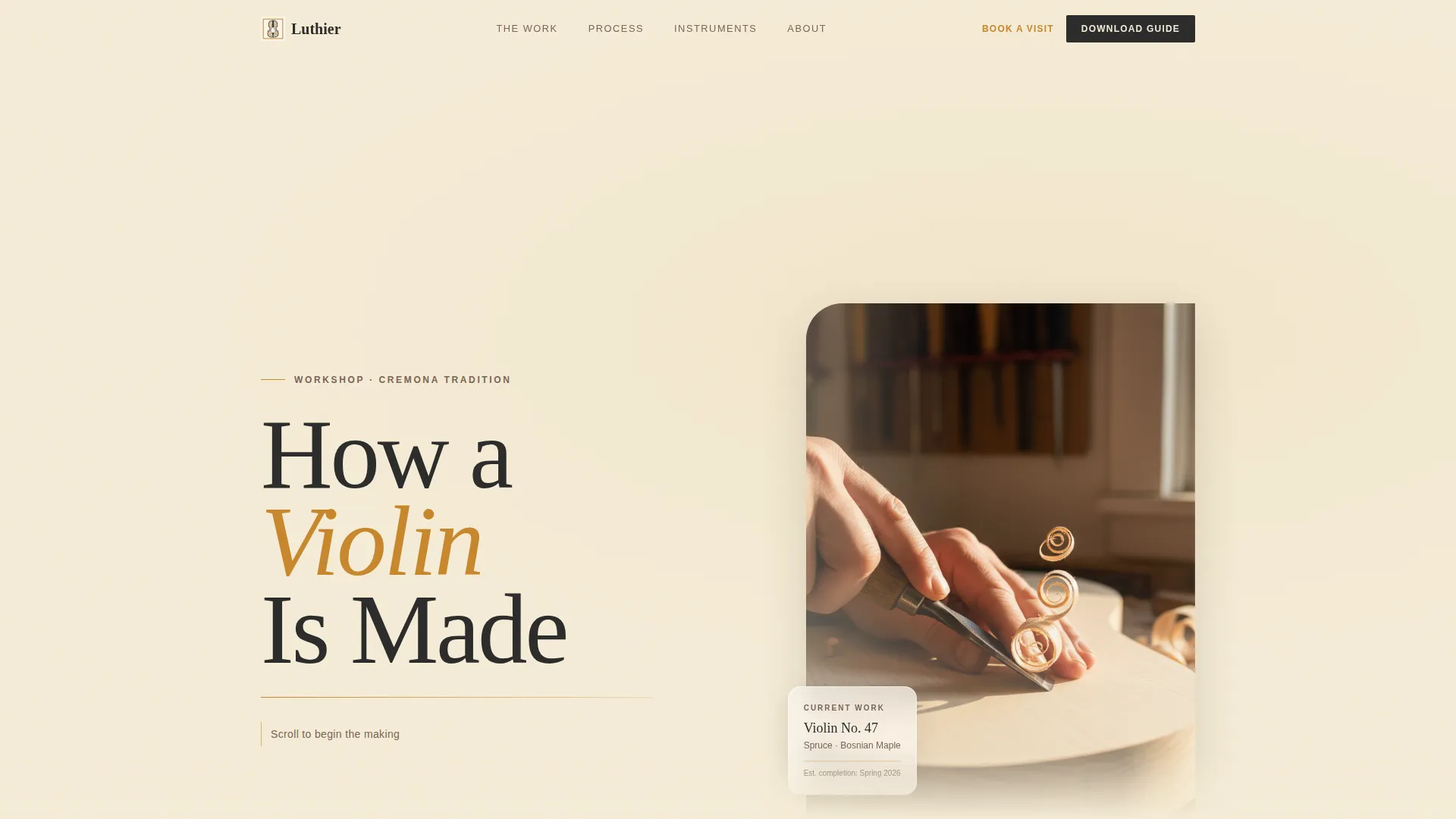
The header opens with a flush-left serif headline set at roughly 120-point equivalent, occupying sixty percent of the viewport. The remaining space holds a tightly cropped photograph of a maker's hands at work. A single thin amber rule separates the headline from the scroll prompt, keeping the entry moment clean and immediate.
Horizontal Logo Wall Authority Band
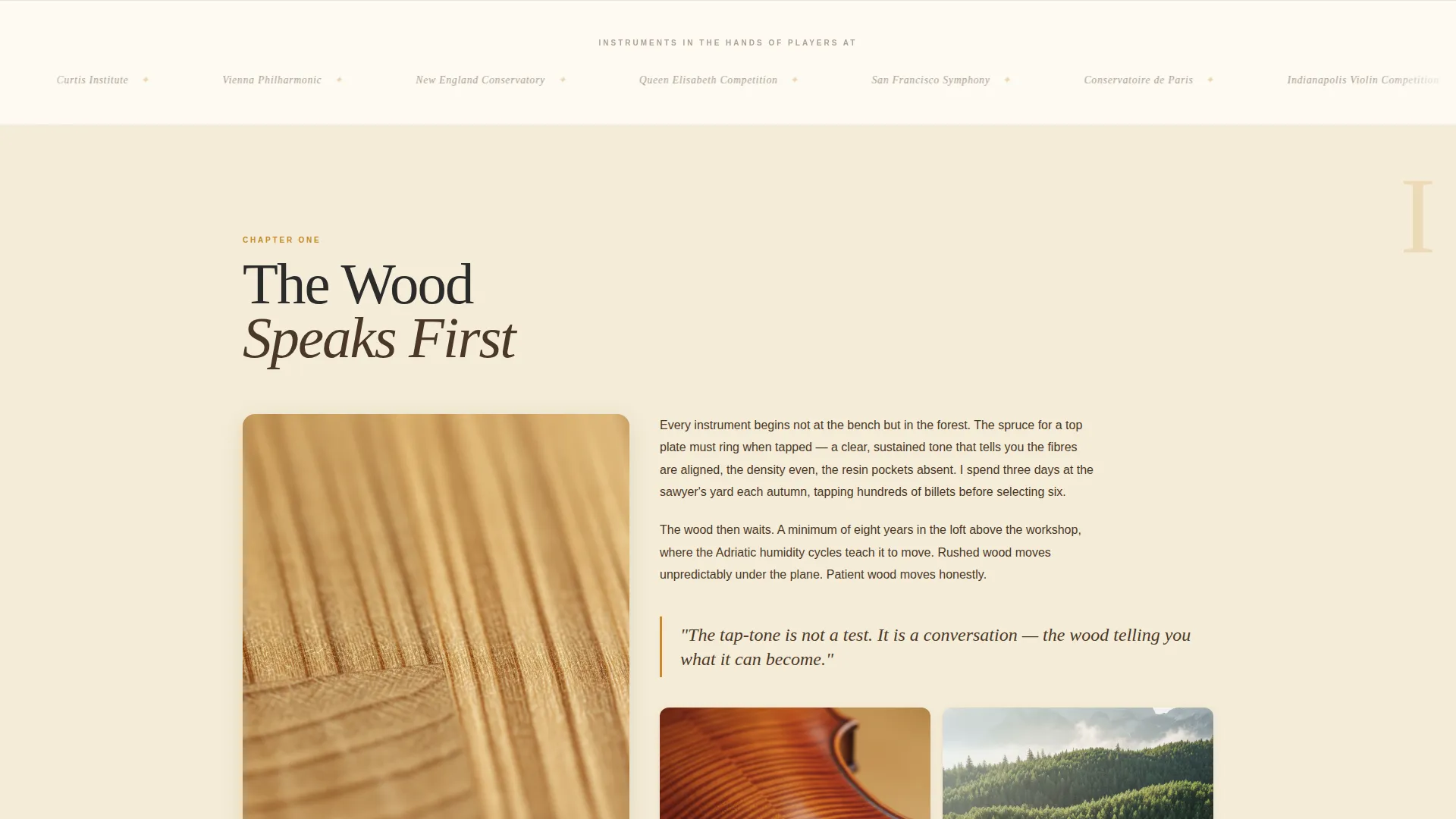
A full-width band of logos from orchestras, conservatories, and competition juries appears before any body content. This placement is deliberate. Credibility is established first so that the educational chapters that follow carry institutional weight.
Four Editorial Content Chapters
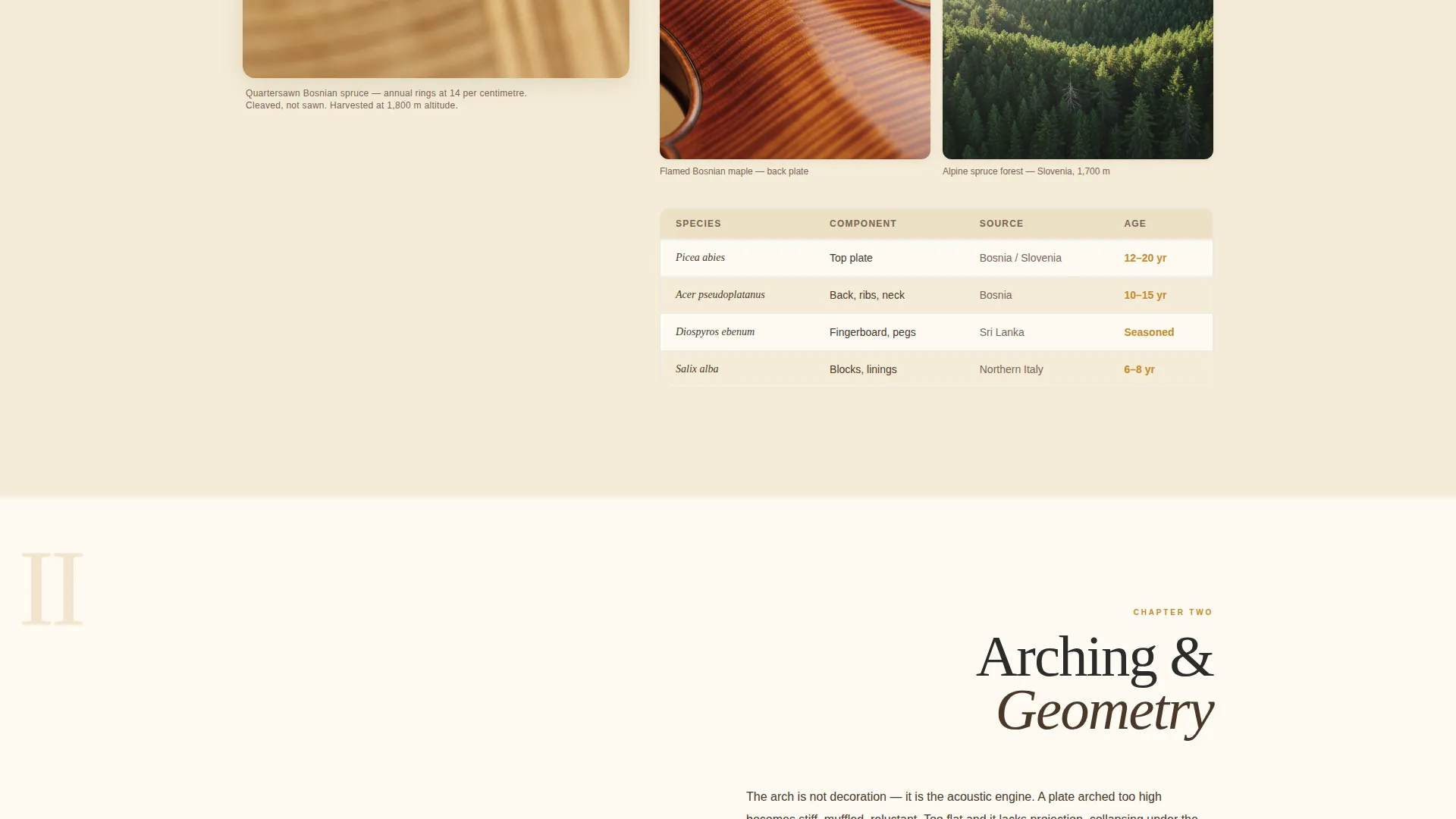
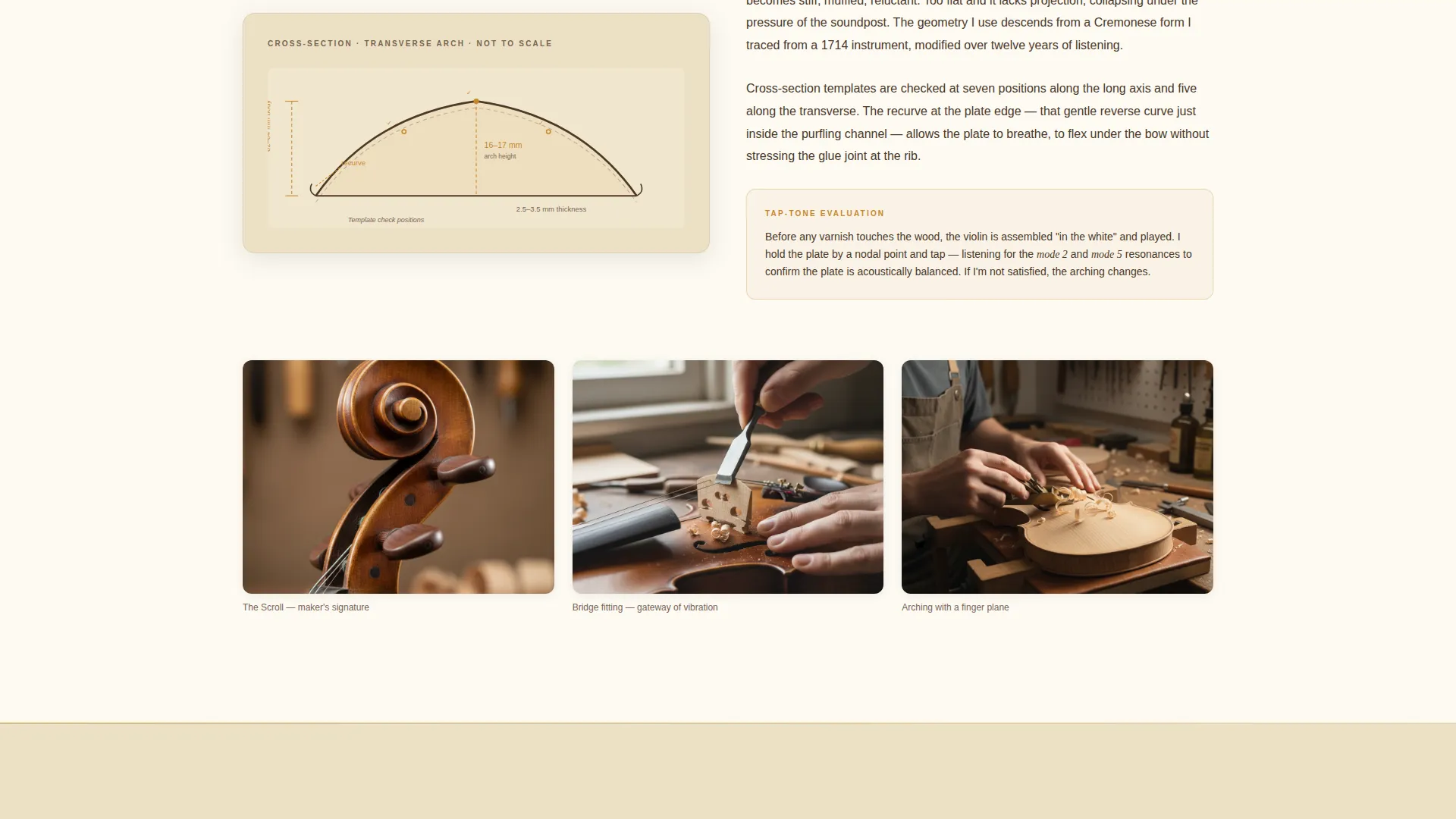
The page unfolds as four sequential chapters: wood selection with macro grain photography, arching geometry with annotated cross-section diagrams, varnish chemistry with layered translucent color swatches, and a closing instrument profile section. Each chapter is designed to increase the visitor's literacy and appreciation of the craft.
Inline Lead Capture Form with Guide Download
After the second chapter, an inline form invites visitors to download a Making Process Guide. The form requires only an email address and a single checkbox asking whether the visitor is a player, a collector, or a fellow maker. The low friction is intentional.
Persistent Workshop Visit Call to Action
A secondary conversion link runs along the right margin throughout the page. On mobile, it becomes a sticky button. It gives ready-to-commit visitors a direct path without interrupting readers who are still in the teaching sections.
Embedded Audio Clip Placeholders for Instrument Profiles
The closing chapter profiles three instruments and includes placeholders for embedded audio clips of each being played. This gives prospective clients a sensory reference point before they ever visit the workshop.
Page sections overview
| Section | Purpose |
|---|---|
| Giant Headline Header | Opens with bold serif headline and artisan hands photograph to anchor the editorial tone |
| Logo Wall Band | Displays orchestra, conservatory, and jury logos to establish authority before content begins |
| Wood Selection Chapter | Presents macro grain photography and copy explaining how spruce and maple are chosen |
| Arching Geometry Chapter | Uses annotated cross-section diagrams to explain how the carved arch shapes tone |
| Varnish Chemistry Chapter | Layers translucent color swatches with explanatory copy on the varnish-building process |
| Guide Download Form | Captures email and visitor type after curiosity peaks at the second chapter |
| Instrument Profile Chapter | Profiles three completed instruments with embedded audio clip placeholders |
| Persistent Visit Button | Keeps the workshop-visit call to action accessible as a margin link or mobile sticky button |
Design & branding system
The visual identity draws from a nineteenth-century instrument-making treatise. Every color and type choice serves the feeling of foxed pages, engraved plates, and gilt lettering on a leather spine.
- Color roles are clearly assigned: deep workshop charcoal (#2B2B2B) for headers and navigation, warm aged-maple amber (#C8872B) for interactive elements and pull quotes, parchment cream (#F5ECD7) for body backgrounds, and rosin-dark brown (#4A3728) for paragraph text
- Typography follows an Educational Guide theme, with a high-contrast serif at display scale and a legible body face sized for extended reading sessions
- Photography direction specifies warm, shallow depth-of-field images lit by a single north-facing window, keeping every image consistent with the workshop atmosphere
Mobile & speed optimization
The layout adapts the editorial chapter structure for smaller screens without losing the magazine quality. The persistent right-margin visit link becomes a sticky button on mobile, keeping the conversion path accessible at every scroll depth.
- The single-page structure keeps navigation simple and removes the need for multi-page loading on any device
- The sticky mobile call-to-action button ensures the workshop-visit prompt is never out of reach, even during long reading sessions
How this template helps you convert
The page earns the conversion by teaching generously before asking for anything. By the time a form appears, the visitor has already received real value.
- The logo wall and editorial chapters build progressive trust: the visitor moves from curious newcomer to informed admirer before reaching any call to action, making the email form feel like a natural next step rather than an interruption.
- The two-path conversion structure serves different buyer stages: the guide download captures early-stage readers who want to learn more, while the persistent workshop-visit button captures ready-to-commit visitors who already know what they want.
Other information about this template
This template is categorized under Professional Services and is designed specifically for the violin maker and luthier business niche. The editorial direction makes it equally suitable as a portfolio showcase, a craft education resource, and a lead generation page.
- The template style is built around an Educational Guide theme, which makes it a strong fit for any artisan or maker business that sells expertise alongside a physical product
- The Charcoal and Amber color system is pre-configured and works without modification for workshop-based professionals in fine instrument making, fine furniture, and related craft disciplines
- The intersection context positions this template for use by violin maker businesses seeking to present portfolio work, client testimonials, and process documentation within a single cohesive page
Theme
Corporate Precision
Creative direction
Case Study Narrative
Color system
Charcoal & Amber
Style
Comparison Table
Direction
Partnership/B2B
Page Sections
Giant Headline Header with Artisan Photography
Horizontal Logo Wall Authority Band
Four Sequential Editorial Chapters
Inline Guide Download Form
Persistent Workshop Visit Call to Action
Embedded Audio Clip Placeholders
Related questions
Who is this landing page template designed for?
Can I use this template to showcase instruments I have already made?
How does the lead capture work on this page?
Is this a single-page layout or a multi-page site?
Can I adapt the color system or typography to match my own branding?