Manufacturing Processes Professional Website Template
Mandrel is a zigzag landing page template built for filament winding service providers. It combines an Engineering Blueprint visual identity with a Charcoal and Amber color system to speak directly to propulsion engineers, oil-and-gas procurement leads, and defense program managers. The layout guides technical buyers from winding cell specs to qualification data, gating a Winding Design Guide behind a short lead-capture form.
by Rocket studio
Quick summary
Mandrel is a single-page, zigzag-layout template designed for filament winding facilities. It layers technical content from machine specifications to qualification test data in a spatial, walk-through flow. The Engineering Blueprint visual identity signals process depth immediately. A gated Design Guide and open-access material matrix work together to convert both first-time visitors and returning engineers with real RFQ intent.
Who this template is for
This template is built for businesses that manufacture precision composite parts using filament winding. It speaks the language of engineers and procurement professionals, not general consumers.
- Filament winding service providers making pressure vessels, rocket motor tubes, or composite drive shafts
- Defense and aerospace manufacturers who need to present ITAR-related compliance positioning and qualification data
- Oil-and-gas composite pipe suppliers replacing corroded steel with carbon fiber or glass roving alternatives
What problem this template solves
Technical buyers rarely trust a service provider based on general marketing copy. They need evidence: winding angles, material systems, burst pressure data, and traceable test reports. Most industrial landing pages fail to deliver that depth, and prospects leave to find a supplier who can.
- Lack of technical credibility in early-stage supplier evaluation drives high bounce rates among engineering audiences
- No clear content path forces qualified visitors to request information before they have enough context to commit
- Generic visual design signals that a provider does not truly understand composite manufacturing processes
What you get with this template
You get a fully structured, single-page layout that guides a technical buyer from first impression through to a qualified lead capture. Every section is purposeful and prompt-backed.
- A zigzag alternating content layout with isometric technical illustration in the header, winding cell specs, material system details, qualification data, and an industry application gallery
- A gated lead-capture form for the Winding Design Guide, collecting work email, company name, and a single dropdown asking what the visitor is winding
- An ungated open-access material compatibility matrix that delivers immediate value before any form commitment is required
Feature list
This section describes the core capabilities built into the Mandrel template.
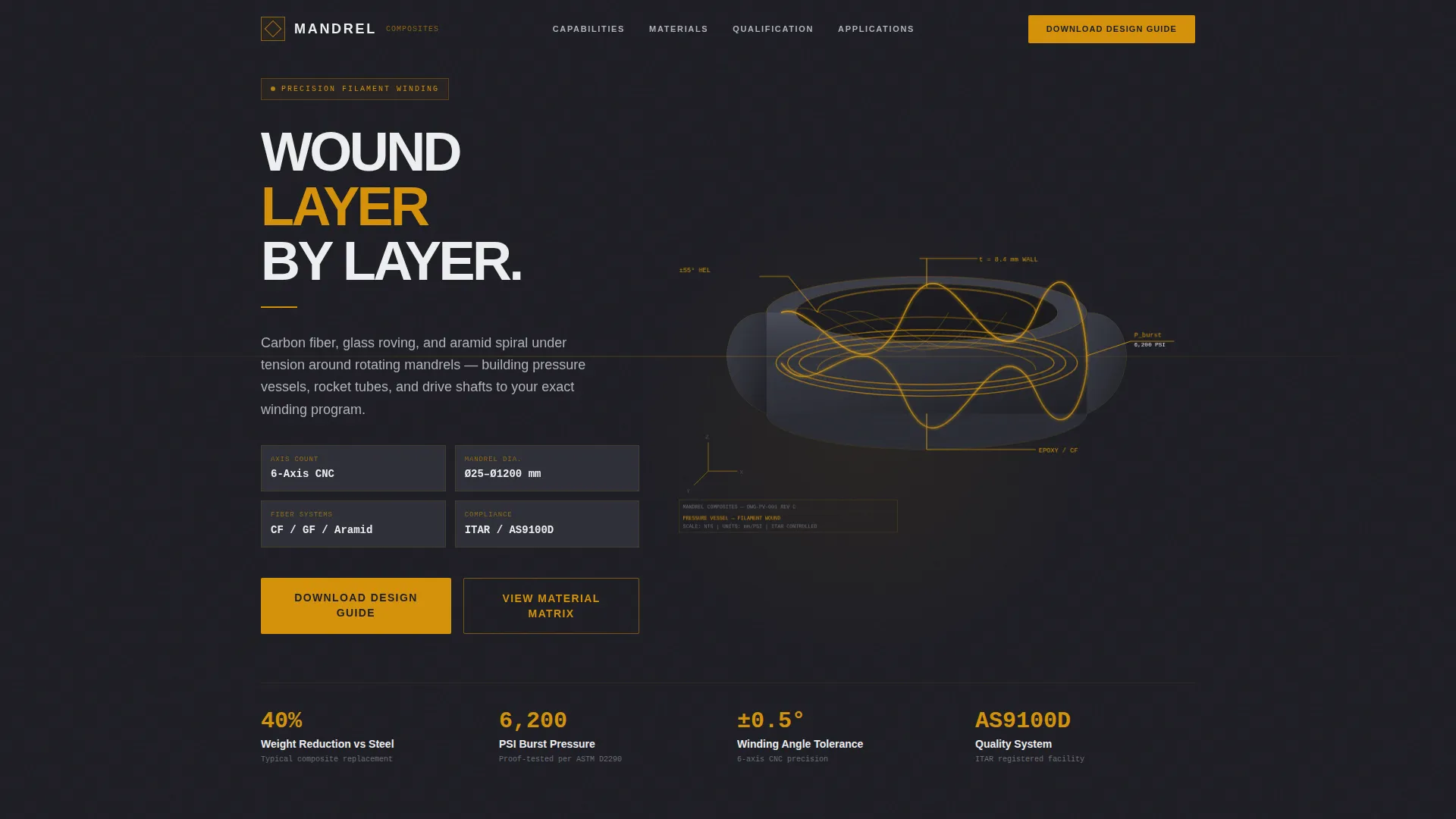
Isometric Header with Scroll Geometry
The header features a technical line-art cutaway of a filament-wound pressure vessel. Amber fiber paths wrap the mandrel at plus or minus 55-degree helical angles. Dimensional leaders call out wall thickness, burst pressure, and resin system. The geometry rotates subtly on scroll to reveal internal ply structure.
Zigzag Alternating Section Layout
Each content block alternates sides in a spatial, architectural flow. The scroll experience mirrors walking through a real facility, from the winding cell to the clean room. Deep graphite and technical-paper gray fills create visual separation between sections without breaking the engineering theme.
Gated Winding Design Guide Form
The primary call to action gates the Winding Design Guide behind a short three-field form. Visitors submit their work email, company name, and a dropdown selection for their application type. This captures high-intent leads from engineers who are actively sourcing.
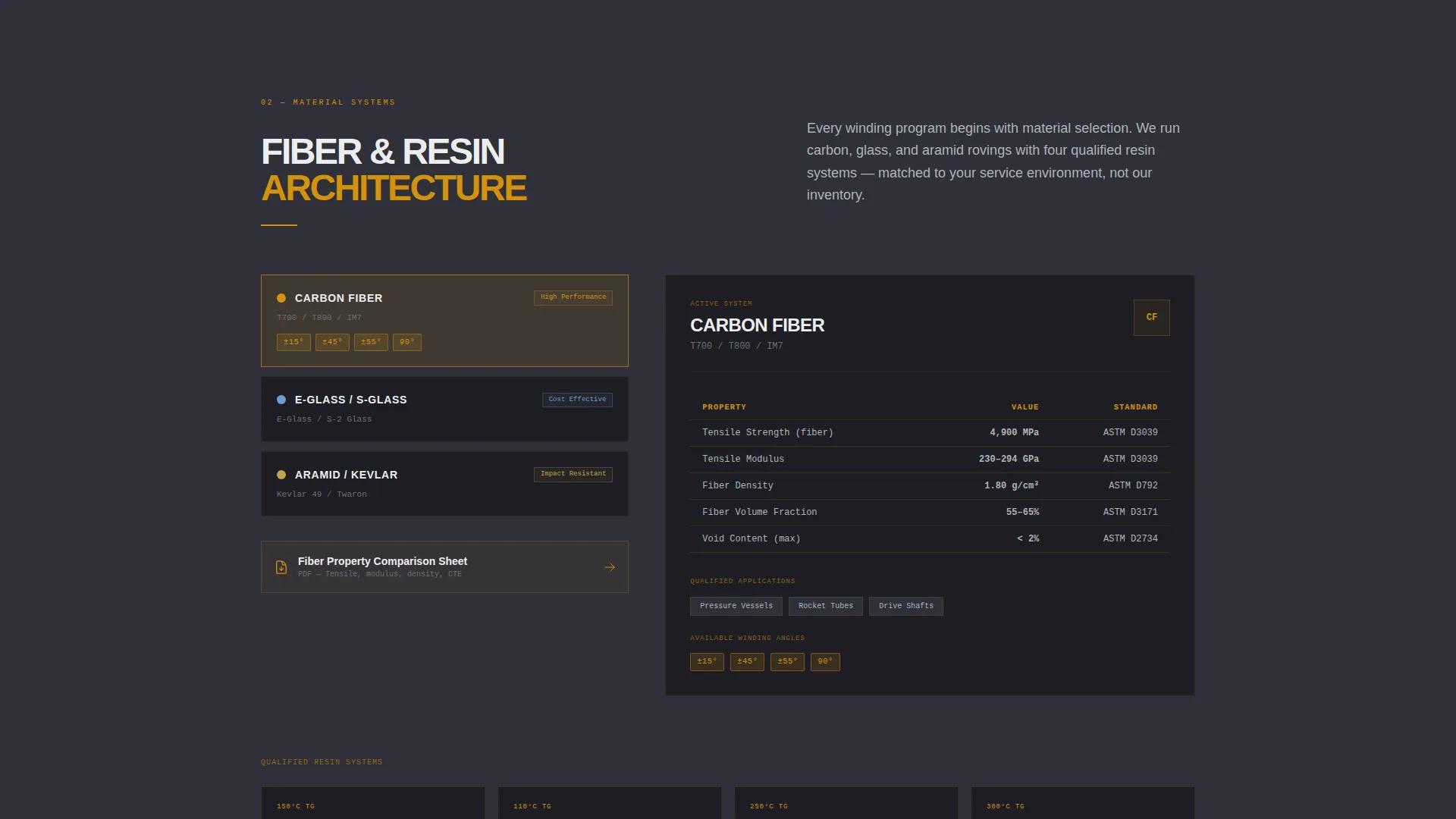
Open-Access Material Compatibility Matrix
First-time visitors receive immediate value through an ungated material compatibility matrix. This builds trust before any form is presented. It also gives procurement leads a concrete reference to share internally during supplier evaluation.
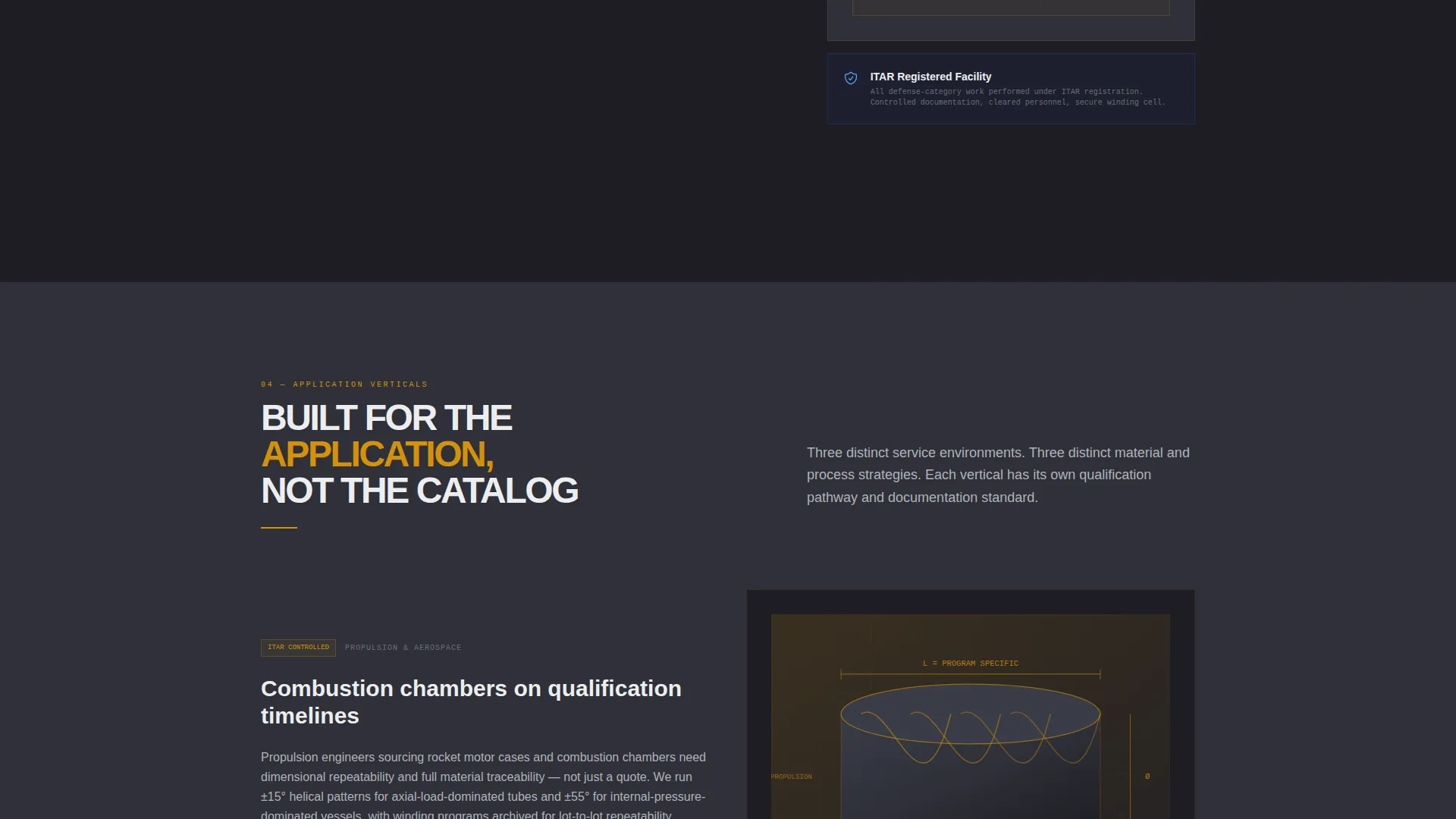
Industry Application Gallery
Application content is organized by industry vertical. Each thumbnail is an isometric part diagram that expands into a full case study in PDF format. Each case study includes its own micro call-to-action labeled "Get the Full Report" to build a returnable resource library.
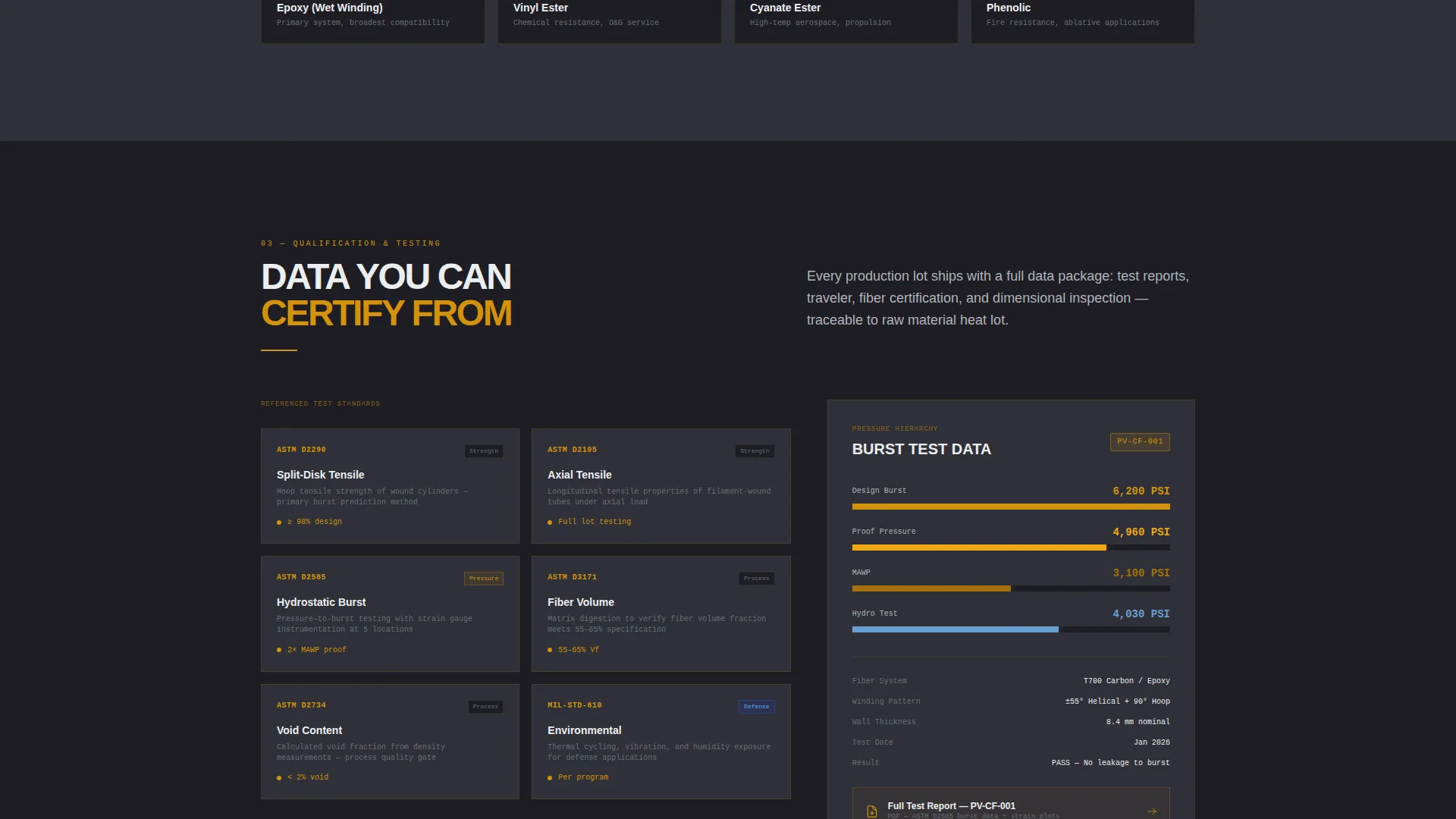
Qualification Data and Test Report Section
A dedicated section presents qualification data, ASTM cross-references (American Society for Testing and Materials), and test reports. This layer of technical evidence is positioned mid-scroll where a buyer's confidence is being built, not at the end after interest has faded.
Page sections overview
| Section | Purpose |
|---|---|
| Isometric Header | Establish technical credibility with cutaway vessel illustration |
| Winding Cell Specs | Present machine capabilities, axis count, and process parameters |
| Material Systems Block | Detail carbon, glass, and aramid fiber options with downloadable property sheets |
| Qualification Data | Display test reports and ASTM references to support supplier evaluation |
| Application Gallery | Organize industry verticals with isometric part thumbnails and case study PDFs |
| Design Guide Form | Capture qualified leads behind a short, low-friction gated form |
| Material Matrix | Deliver open-access compatibility data to ungated first-time visitors |
Design & branding system
The visual identity is built on an Engineering Blueprint theme. Every color and layout choice references the look of a technical drawing pulled from a shop floor clipboard.
- Color system uses deep graphite (#1E1E24) as the primary background, technical-paper gray (#2E3038) for alternating fills, hot filament amber (#D4920B) for callouts, hover states, and winding-path diagrams, and clean resin white (#EDEEF0) for body text and specification tables
- No stock photography is used anywhere in the template; the isometric line-art illustration serves as the primary visual credential, signaling that the team thinks in winding angles rather than marketing angles
- Amber dimension-line styling is applied to callouts, hover interactions, and fiber-path diagrams, reinforcing the engineering drawing aesthetic throughout the scroll experience
Mobile & speed optimization
The template is structured to remain readable and functional across screen sizes. Technical content like specification tables and isometric diagrams is designed to reflow cleanly at narrower viewports.
- Zigzag alternating blocks stack vertically on mobile without losing the spatial walk-through narrative or the section-to-section visual contrast
- The gated form and open-access matrix are each kept to minimal field counts and compact layouts, reducing friction for visitors on smaller screens
- Isometric header illustration and part-diagram thumbnails are sized for clarity at both desktop and mobile resolutions without relying on external image hosting
How this template helps you convert
The conversion strategy is built around two parallel paths: a gated high-value resource for serious buyers and an ungated reference tool for early-stage researchers.
- The Winding Design Guide form captures qualified leads by requiring only three fields, lowering the barrier while still identifying the visitor's application type through a single dropdown selection
- The open-access material compatibility matrix gives first-time visitors a concrete reason to stay and return, so that when an RFQ becomes real, your page is already bookmarked
- Each case study micro call-to-action labeled "Get the Full Report" turns the application gallery into an ongoing lead-generation library, rewarding the engineer who reads deeper into the page
Other information about this template
Mandrel is part of a focused set of industrial landing page templates designed for technically demanding service categories. A few additional details are worth noting.
- The template style is Zigzag/Alternating, and the creative direction is Spatial and Architectural, meaning each scroll step reveals a deeper layer of process information rather than repeating the same pitch
- The header concept is Isometric, using technical line art rather than photography, which is particularly effective for precision manufacturing niches where generic imagery reduces credibility
- The landing page direction is Content and Resource, making it suitable for facilities that want to build a returnable technical library rather than running a single campaign
- Category context is Manufacturing and Industrial, subcategory Manufacturing Processes, and the niche is Filament Winding Service Provider, so all design and copy decisions are grounded in that specific intersection
Theme
Engineering Blueprint
Creative direction
Spatial & Architectural
Color system
Charcoal & Amber
Style
Zigzag/Alternating
Direction
Content/Resource
Page Sections
Isometric Header with Scroll Geometry
Zigzag Alternating Content Layout
Gated Winding Design Guide Form
Open-access Material Compatibility Matrix
Industry Application Gallery with Case Studies
Qualification Data and Test Report Section
Related questions
Who is the Mandrel template designed for?
What is the primary call to action on this landing page?
Can I present qualification data and test reports through this template?
Does this template use photography?
Is this template suitable for defense or aerospace suppliers?