Middle Eastern Cuisine & Dining Complete Booking Website Template
The Mansaf authentic communal dining booking landing page template is built for Jordanian restaurants that want to turn cultural storytelling into confirmed reservations. A cinemagraph hero, staggered masonry grid, floating "Reserve Your Platter" button, and a slim reservation modal work together to move visitors from curiosity to booking without friction.
by Rocket studio
Quick summary
This landing page puts the national dish of Jordan at the center of every design decision. The template opens with a cinematic hero, unspools an origin story through a staggered masonry grid, and closes with a low-friction reservation modal. Every section earns the booking by making visitors feel the warmth of a shared mansaf meal before they ever see a form field.
Who this template is for
This template is built for restaurant owners and operators who serve mansaf and want their landing page to reflect the full cultural weight of the dish. It suits businesses where the food carries personal and communal meaning, and where the booking experience should feel as considered as the meal itself.
- Jordanian restaurant owners targeting diaspora families celebrating engagements, graduations, and other special occasions
- Chefs and hosts who want to share the history and philosophy of mansaf as part of the dining experience
- Food and hospitality businesses that rely on communal, platter-style service and need a booking flow designed around group dining
What problem this template solves
Most restaurant landing pages treat food as a product. Mansaf is not a product. It is the national dish of Jordan, a dish cooked in a large pot and served on a communal platter that carries decades of family memory. A generic booking page cannot hold that weight. This template solves the gap between cultural depth and conversion design.
- Visitors leave generic pages without booking because the emotional context is missing. This template builds that context first, then presents the reservation call to action.
- Communal dining has specific logistics. The booking modal is designed around group size, preferred timing, and an optional celebration note, so guests arrive with the right expectations.
- Diaspora audiences and food-curious guests need to trust authenticity before they commit. The masonry origin story and chef biography section build that trust visually and narratively.
What you get with this template
The template delivers a fully structured single-page layout with every section designed to carry the visitor from discovery to reservation. The visual system, animation behavior, section order, and call-to-action placement are all defined in the template so you can customize content without rebuilding structure.
- A cinemagraph hero section with a delayed headline reveal, a floating "Reserve Your Platter" button, and a staggered masonry grid that moves from origin story to present-day dining moments
- A reservation modal with party size, date and time fields, and an optional "Celebrating anything special?" prompt, plus a secondary "Send Mansaf as a Gift" conversion link
- Lemon-wash testimonial cards, a communal dining explainer section, and a footer in Arc Browser Split layout with logo and tagline on the left and navigation links on the right
Feature list
This template is built around five core capabilities that connect cultural storytelling to practical booking conversion.
Cinemagraph Hero with Delayed Headline Reveal
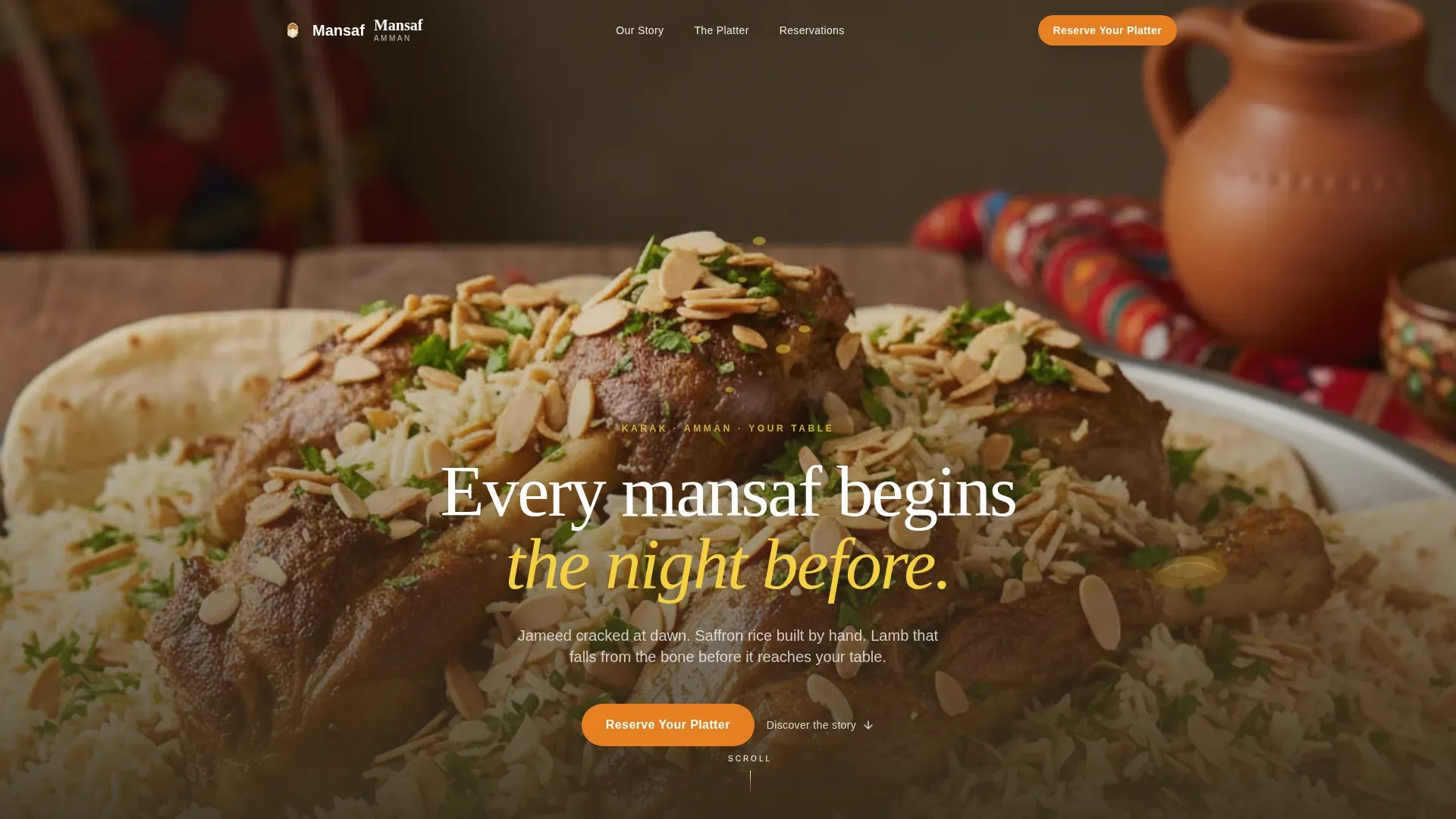
The hero opens on a perfectly still overhead shot of a dressed mansaf platter on hammered copper. Steam curls off the lamb and a single hand tears flatbread in a continuous loop. No headline appears for four full seconds. Then handset type fades in. The effect draws visitors into the mood before any selling begins.
Staggered Masonry Origin Story Grid
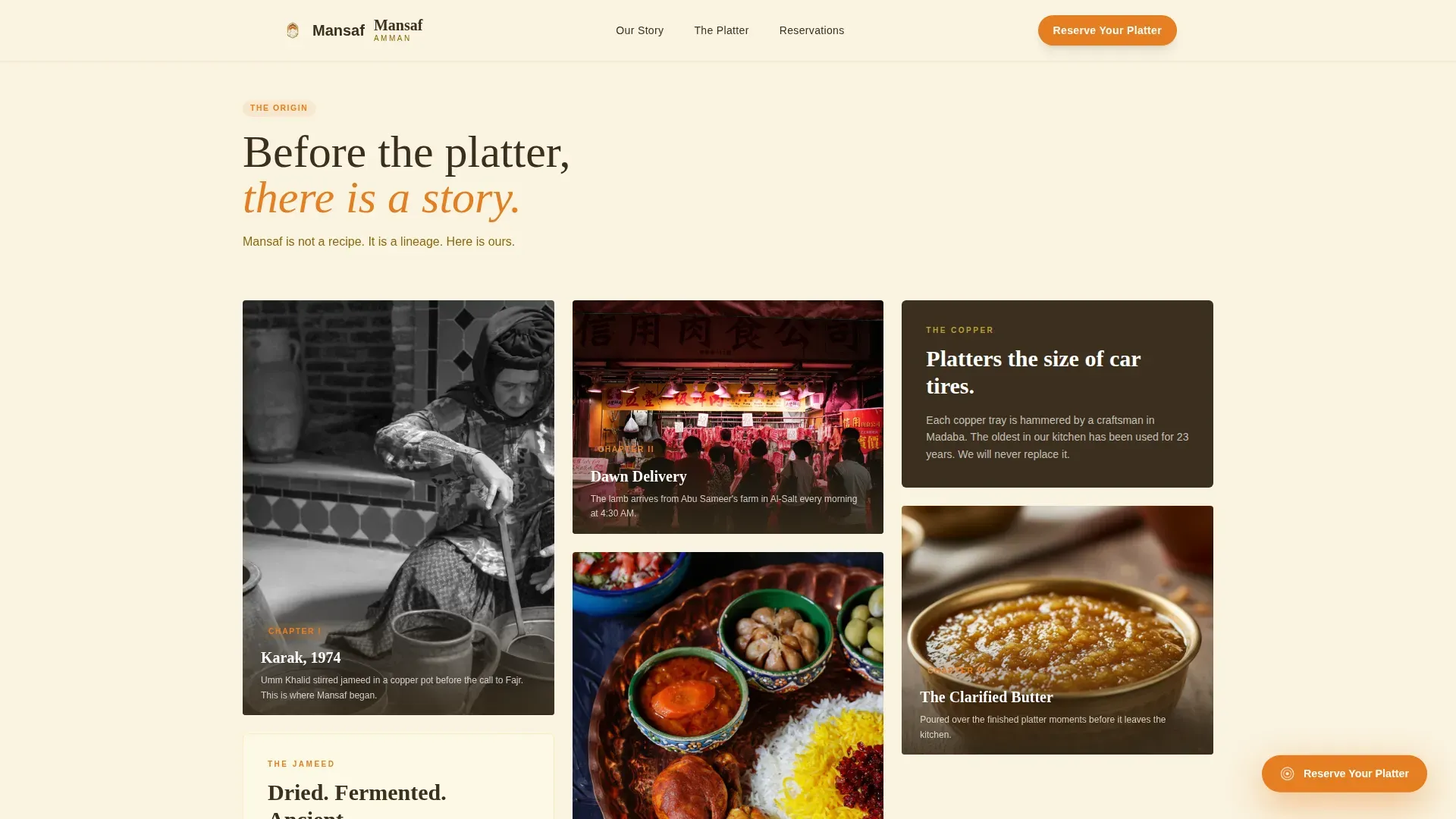
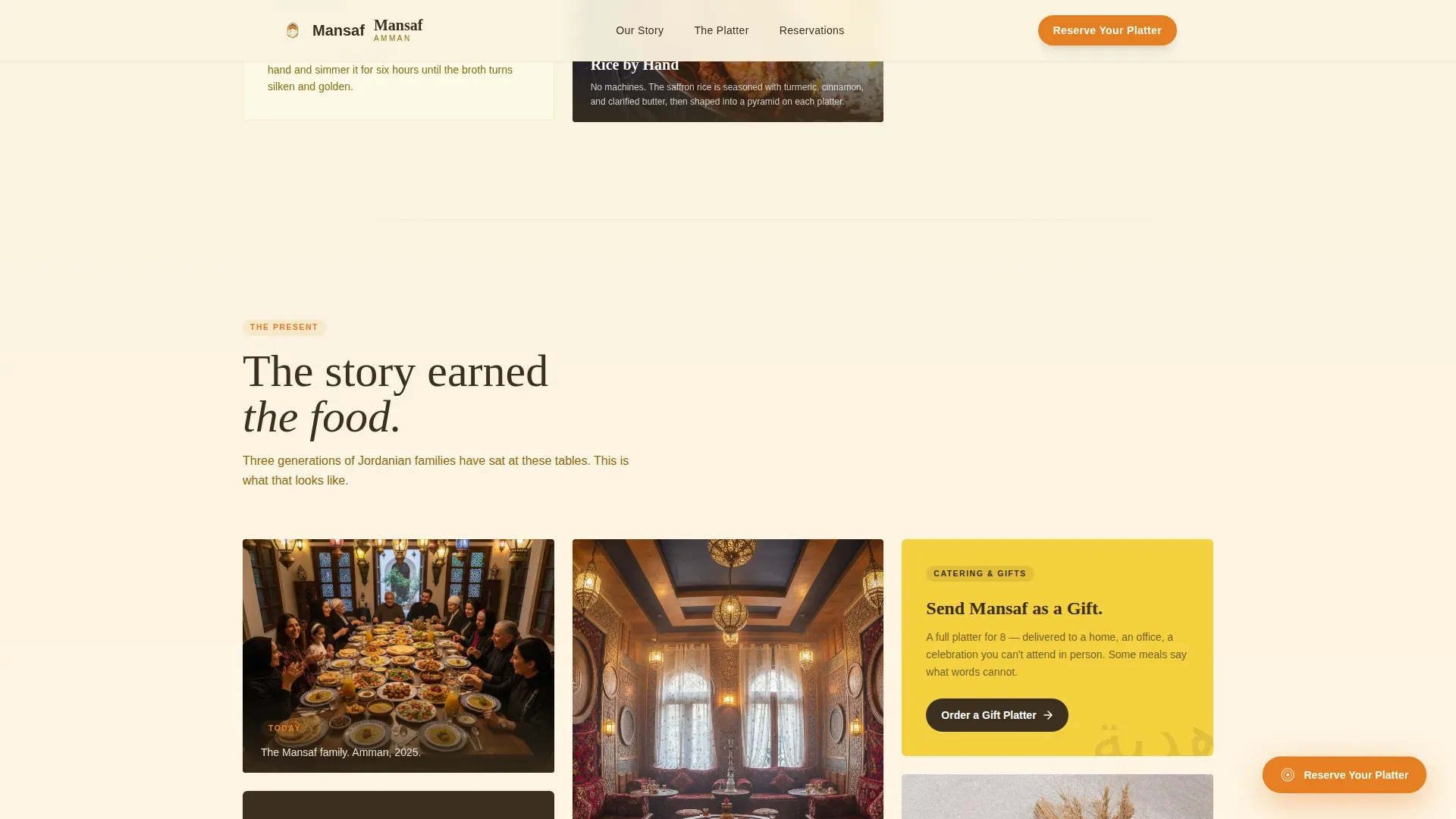
The masonry grid does not lead with menu items. It leads with moments: the founder's family, dawn rituals at the butcher, hands shaping rice over heat. Cards are staggered so the eye moves diagonally, and the grid shifts midway from origin to present, showing the dining room full of guests, a shared large platter, and the chef's expression. The story earns the food.
Floating Reservation Button and Slim Booking Modal
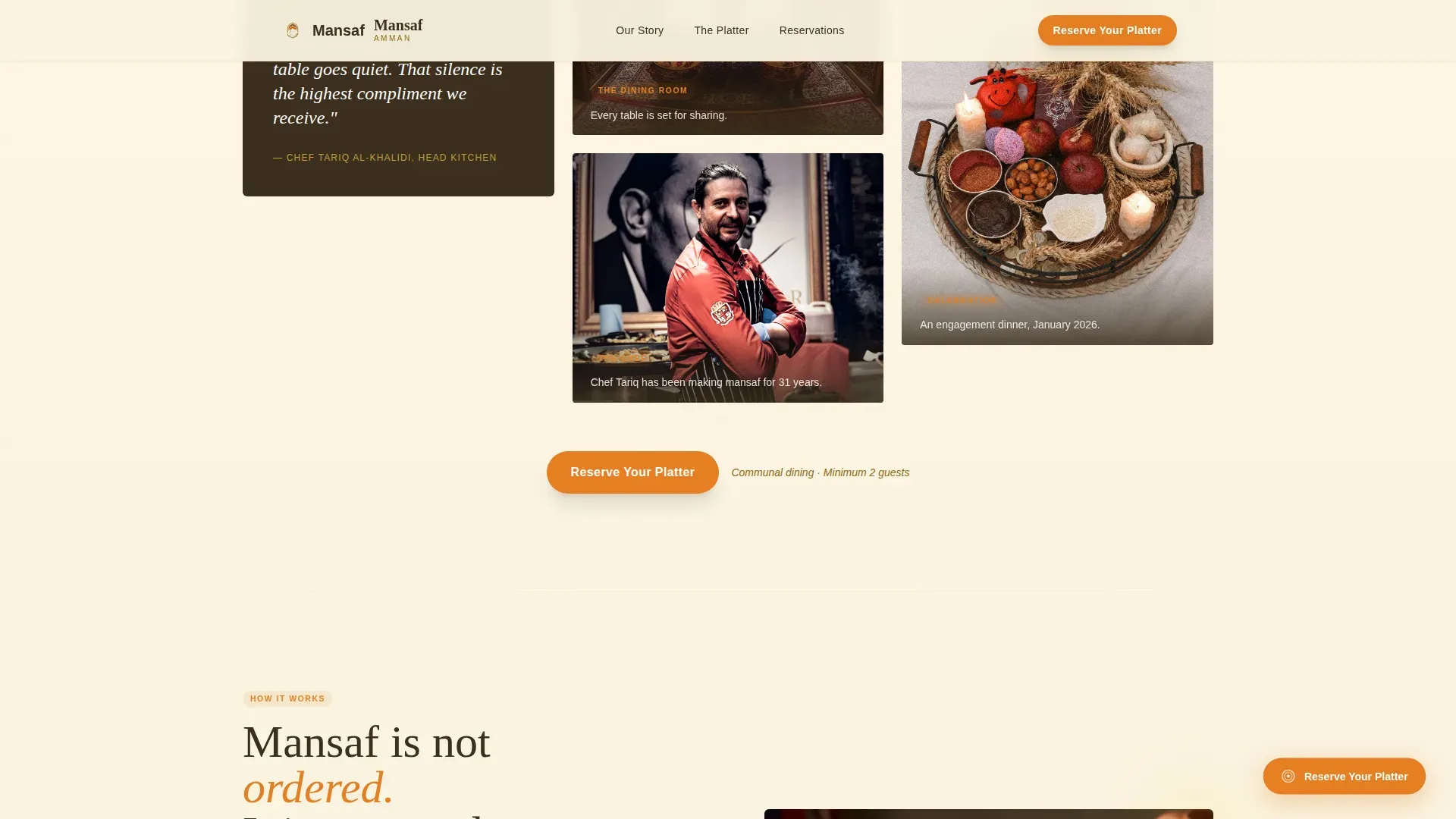
After the first scroll, a mandarin-orange "Reserve Your Platter" button pins to the viewport. Clicking it opens a slim modal that asks for party size (with a note that mansaf is served communal, minimum two participants), preferred date and time, and one optional field. The form is intentionally short to reduce friction for every group that wants to sit down together.
Secondary Gift Conversion Link
Beneath the family dining cards, a "Send Mansaf as a Gift" link appears in context. The placement is deliberate. Visitors who feel the emotional pull of the shared meal are most likely to consider a catering-sized platter as a gift. The link captures that moment without interrupting the primary booking flow.
Testimonial Cards with Lemon-Wash Background
Social proof is placed in lemon-wash cards that sit against the jameed-white background. Testimonials from Jordanian families, expat diners, and food writers cover the authenticity of the dish and the atmosphere of the experience. This section builds credibility for guests who are deciding whether the restaurant can deliver the real taste they are looking for.
Chef Biography Section
A photo and short biography of the chef or host appear within the template to humanize the dining experience. Sharing the chef's passion for authentic mansaf and connection to its history gives new guests a reason to trust the kitchen before they arrive.
Page sections overview
| Section | Purpose |
|---|---|
| Cinemagraph Hero | Opens with steam-loop visuals and a delayed headline to set the mood before any call to action appears |
| Origin Story Grid | Staggered masonry cards tell the family and culinary history before showing menu or pricing |
| Present Day Grid | Grid shifts to dining room moments, family laughter, and chef images to show the experience in action |
| Communal Dining Explainer | Describes how mansaf is served, eaten by hand from a shared platter, and what guests can expect |
| Testimonial Cards | Lemon-wash cards carry authentic voices from families, expats, and food media |
| Reservation Modal | Slim overlay collects party size, date, time, and an optional celebration note |
| Gift Catering Link | Secondary conversion placed beneath family dining cards for catering-sized platter gifting |
| Split Footer | Arc Browser Split layout with logo and tagline left, navigation links right |
Design & branding system
The visual identity follows a Pastoral Calm theme built on a Citrus Burst color system. The palette is warm and unhurried, referencing the colors of a Jordanian orchard in morning light rather than anything tropical or loud. Typography pairs Fraunces as the serif display face with DM Sans for body text, giving the page editorial weight and ease of reading.
- Colors: jameed-white (#FAF3E0) for backgrounds, za'atar earth (#3B2F1E) for all typography, sun-dried lemon (#F4D03F) behind testimonial cards, and fresh-squeezed mandarin (#E67E22) on hover states and reservation buttons
- Animation and interactivity: cinemagraph steam loop in the hero, staggered masonry reveal on scroll, floating call-to-action button after first scroll, modal overlay for reservations, and mandarin hover states across the grid
Mobile & speed optimization
The template is designed desktop-first to showcase large platter imagery and the full visual impact of the masonry grid. It is fully responsive so the layout adapts cleanly across screen sizes without losing the editorial feel or breaking the booking flow.
- CSS animations are used over JavaScript where possible to keep the cinemagraph loop and staggered reveal lightweight across devices
- The booking modal is mobile-friendly and requests only essential details, keeping the form short and easy to complete on a phone screen
How this template helps you convert
The template earns the reservation through sequence. It makes visitors hungry first, then homesick, then ready to book. Every design decision is oriented toward that emotional arc.
- The hero and masonry grid build desire and trust before any pricing or call to action appears, so visitors arrive at the reservation button already motivated rather than skeptical.
- The floating "Reserve Your Platter" button stays visible throughout the page, and the slim modal reduces booking friction by asking only for party size, date, time, and an optional celebration note, covering the minimum information needed to confirm a communal table.
Other information about this template
Mansaf is the national dish of Jordan and one of the most culturally significant dishes in the world of Levantine food. Understanding the dish helps any operator use this template well. Mansaf is a dish of rice, lamb, and a dry yogurt made into a sauce called jameed. The main components are cooked lamb pieces, saffron rice, and jameed sauce, all served on a bread base of thin bread called shrak or markouk. Lamb shoulder is the preferred cut because it has enough fat to stay tender through long cooking.
Jameed is a hard, dried yogurt made from goat or sheep milk. It is salty, tangy, and rich. The jameed sauce is prepared by dissolving dried jameed in warm water, then bringing it to a gentle boil and allowing it to reduce into a thick, salty broth. Cooks stir the sauce at medium heat to prevent it from breaking. Cornstarch is sometimes used to stabilize the yoghurt sauce so it does not split. The cooked lamb pieces are added to the jameed sauce and simmered until the meat is fall-apart tender and deeply flavored. Some recipes add turmeric and other spices to the rice at medium heat for color and depth. Parsley is often used as a fresh garnish over the finished platter.
The rice is cooked separately or in the lamb broth to absorb its flavor. Basmati is the preferred variety and should be soaked before cooking to achieve fluffy, separate grains. The finished rice is piled high on a large platter over the bread base, then the cooked lamb is placed on top. Toasted almonds and pine nuts are scattered across the dish. In the mid-1960s, toasted almonds and toasted pine nuts became standard toppings, adding golden brown color and texture. A drizzle of olive oil or clarified butter can finish the plate.
Originally, mansaf was built on bulgur wheat rather than rice. Rice became the standard around 1945. Before that, large pieces of khobz al-shrak bread were spread flat and topped with meat and clarified butter. The dish has evolved over time alongside economic and social changes in Jordan, but the communal spirit has not changed. Mansaf is still served on special occasions, from weddings to graduations to family celebrations. To eat mansaf, participants traditionally stand around the platter, roll rice and lamb into a ball with one hand, and eat without touching the lips to the fingers. A spoon is available for guests who prefer it.
The act of sharing mansaf reflects deep values of generosity and respect in Jordanian culture. A cup of hot tea is often served after the meal. The tradition of preparing mansaf in large copper cauldrons over open heat has shifted in many kitchens, but the dish remains a living connector of community and identity. Guests who come to eat mansaf are not just choosing a meal. They are choosing a tradition.
- Mansaf is served communal, minimum two guests, making the booking modal's party-size field particularly important for managing table logistics
- The "Send Mansaf as a Gift" link supports catering-sized platters, expanding revenue beyond dine-in reservations
- The testimonial section is designed to display authentic voices that cover the food's taste, the atmosphere, and the cultural experience
- The template is suitable for any Jordanian cuisine restaurant that centers mansaf as its signature dish and wants a landing page that reflects the full story of the food
Theme
Pastoral Calm
Creative direction
Origin Story
Color system
Citrus Burst
Style
Masonry/Pinterest
Direction
Booking/Scheduling
Page Sections
Cinemagraph Hero with Delayed Reveal
Staggered Masonry Origin Story Grid
Floating Reservation Button and Booking Modal
Secondary Gift Catering Conversion Link
Lemon-wash Testimonial Cards
Chef Biography and Credibility Section
Related questions
Who is this template designed for?
What does the reservation modal collect from guests?
Can this template support catering or gift platter orders?
Does the template explain how mansaf is served?
What kind of photos and videos work best with this template?