Premium Historic Restoration Landing Page Template
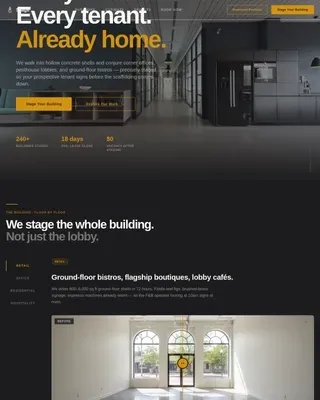
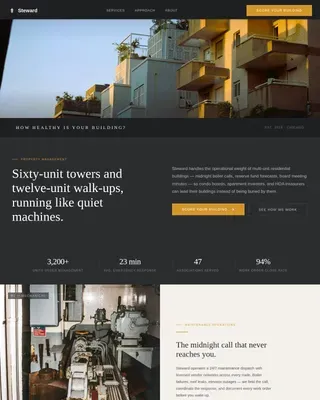
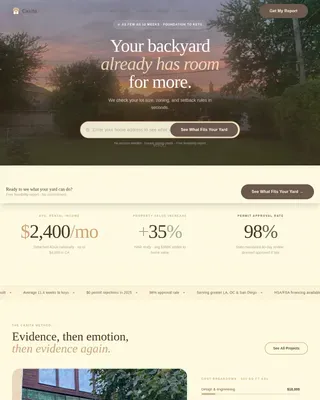
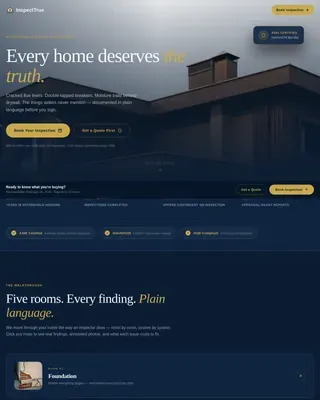
The Brownstone template is a dark-immersive, asymmetric 60/40 landing page built for gut-renovation rowhouse developers. It leads with cinematic hero imagery, instant credibility statistics, scroll-linked progress bars, and a five-step "Find Your Brownstone Match" quiz. Every section earns trust through data before delivering narrative, guiding buyers, investors, and families toward a private walkthrough booking.
by Rocket studio
Quick summary
This is a single-page, stats-first landing page template built for a gut-renovation specialist working in Brooklyn, Harlem, and surrounding NYC historic corridors. The asymmetric 60/40 grid alternates between cinematic imagery and hard data, culminating in a five-step interactive quiz that delivers personalized property matches. The design feels like a renovated parlor floor at dusk, all weight, warmth, and intention.
Who this template is for
This brownstone gut renovated rowhouse developer landing page template is purpose-built for high-end residential developers who gut-renovate historic row house inventory and need to convert qualified leads online. It is equally useful for boutique renovation firms, architects, and designers serving the NYC luxury market.
- Young professionals with an $800K to $2M budget who want a Brooklyn brownstone address with real square footage and original character
- Real estate investors focused on turnkey rental unit opportunities in historic corridors, targeting strong resale returns
- Families and growing family households who refuse to sacrifice a brownstone stoop for a modern floor plan
What problem this template solves
A standard real estate landing page fails gut-renovation developers. It cannot communicate the craft behind a full gut renovation, the neighborhood-by-neighborhood appreciation data, or the patience required to restore century-old house bones while threading in modern plumbing, radiant heat, and smart-home wiring. Buyers cannot feel the difference between a flipped house and a true architectural restoration through generic templates.
- Skeptical buyers need data before narrative, this layout leads every scroll with a number, then earns the story beneath it
- Investors need neighborhood-level proof, the template includes a dark-mode map section with brass pins showing appreciation by corridor
- Visitors waste time on irrelevant listings, the five-step quiz filters by buyer type, borough, budget, and renovation tolerance before revealing results
What you get with this template
You get a fully structured landing page that takes a visitor from first impression to qualified lead without friction. The template covers every stage of the decision journey, from market proof to project walkthrough to personalized property match. Each section is designed so architects, developers, and designers can configure the layout to their specific portfolio and location.
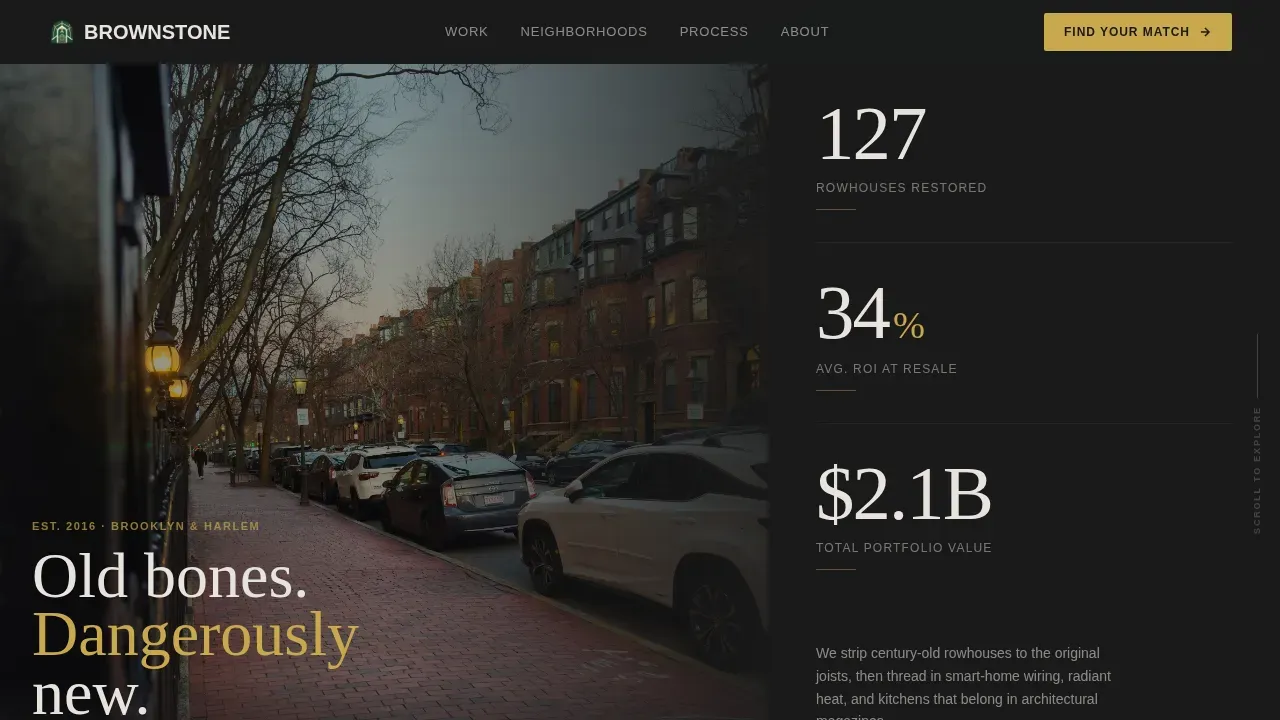
- A panoramic hero section with an instant 60/40 split showing a dusk-lit brownstone block alongside three credibility statistics already visible without scrolling
- Five sequential content sections covering market comparisons, renovation timelines, neighborhood maps, project walkthroughs, and the interactive quiz
- A five-step "Find Your Brownstone Match" assessment with a budget slider, borough selector, move-in timeline input, and renovation tolerance options that reveal a curated property shortlist
Feature list
The feature list below describes what is built into this template. Each capability comes directly from the design and interaction brief.
Asymmetric 60/40 Grid Layout
The page uses a 60/40 column split throughout. The wider column carries the cinematic imagery and the narrower column carries statistics, copy, or quiz cards. The grid alternates which side holds image versus text as the visitor scrolls, so the eye never settles into a predictable rhythm. This layout is especially effective for showcasing interior design details room by room.
Stats-First Scroll Storytelling
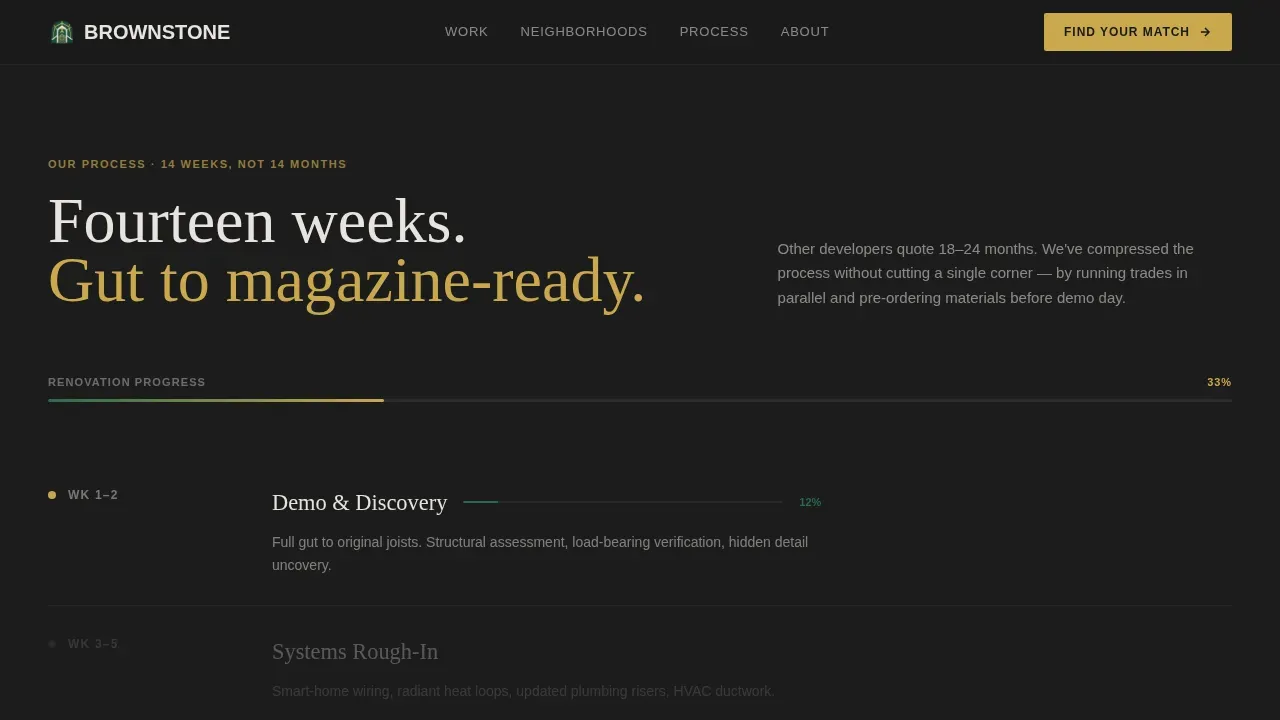
Every section transition leads with a number before the narrative. The hero floor already displays three large statistics, 127 rowhouses restored, average 34% return on investment at resale, and $2.1B total portfolio value, with no animation delay. Scroll-linked emerald progress bars in the renovation timeline section fill as the visitor moves down the page, acknowledging progress visually.
Five-Step Interactive Quiz
The "Find Your Brownstone Match" quiz sits in emerald-bordered cards against the dark background. Step one asks buyer or investor. Step two asks preferred borough and corridor. Step three presents a budget slider from $800K to $4M with a brass handle. Step four asks move-in timeline and step five asks renovation tolerance, turnkey, light-touch, or full gut. Results surface a curated shortlist with a "Schedule a Private Walkthrough" secondary call to action. Visitors submit their preferences before they submit their name and phone number.
Dark-Mode Neighborhood Map
Section four renders a dark-mode map of NYC corridors including Brooklyn, Harlem, Fort Greene, Bed-Stuy, and Park Slope. Brass pins mark each location and display neighborhood-level appreciation data on hover. This gives investors the corridor-by-corridor context they need to evaluate a property before reaching out.
Moody Editorial Photography Layout
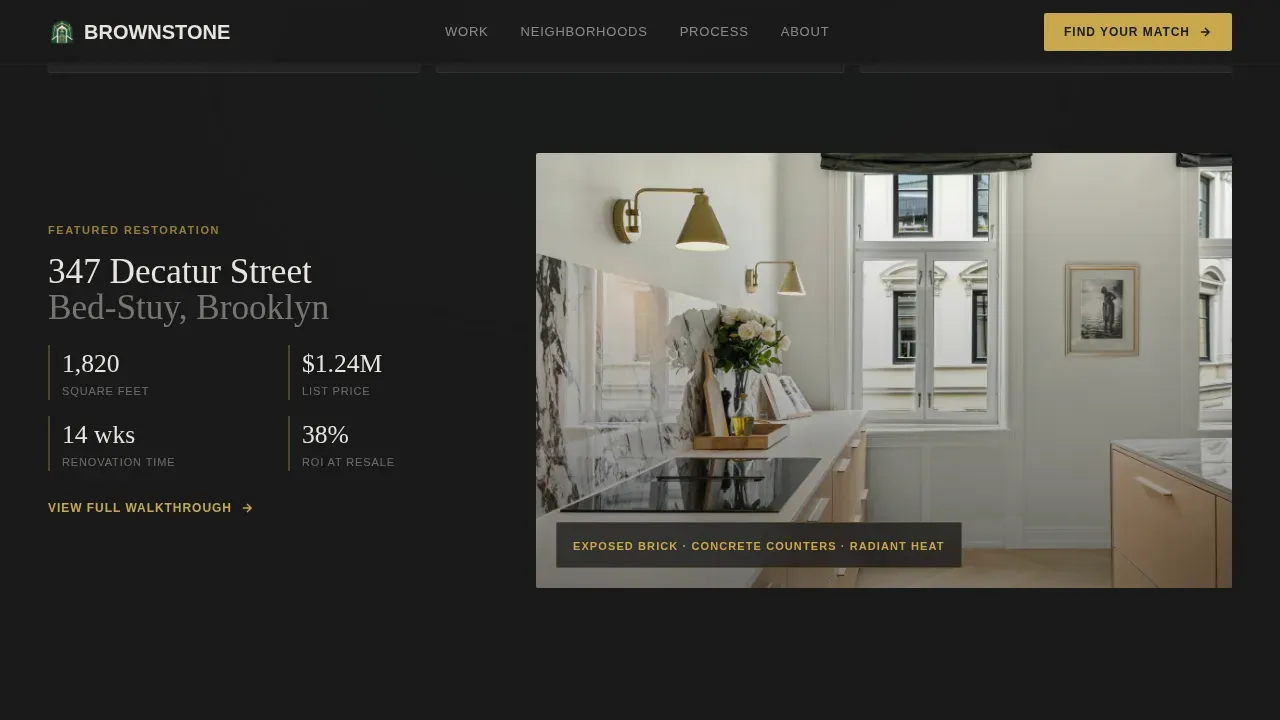
The template is structured around high-resolution, magazine-grade interior photography. Before-and-after image placement is supported across the project walkthrough section. The 60/40 grid creates natural space for large images of kitchens, bathrooms, parlor floor rooms, and rear garden walls without crowding the copy.
Single-Row Footer
The footer follows a linear single-row pattern. It keeps the page focused and avoids visual clutter after the quiz conversion moment. The design stays within the dark immersive system so the page ends with the same editorial feeling it opened with.
Page sections overview
| Section | Purpose |
|---|---|
| Panoramic Hero | Cinematic dusk block image with instant 60/40 stat display |
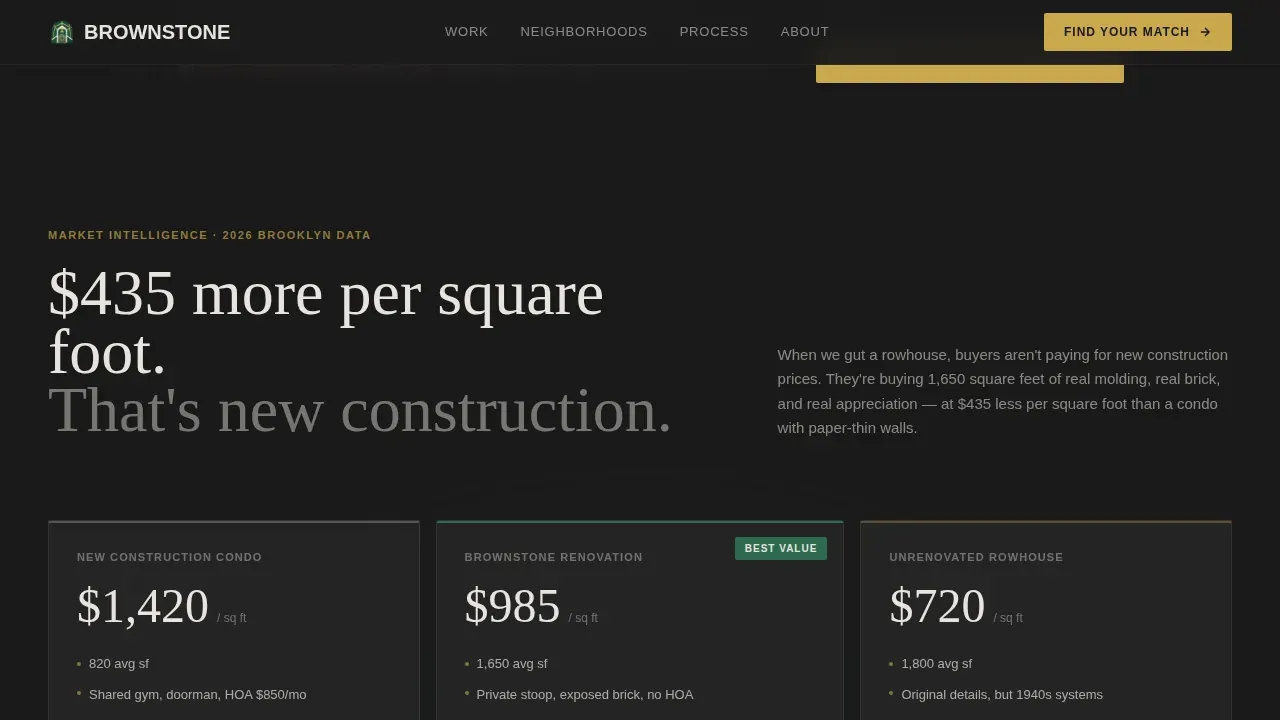
| Market Proof Cards | Price-per-square-foot comparison against new construction |
| Renovation Timeline | Scroll-linked emerald progress bars by project phase |
| Neighborhood Map | Dark-mode map with brass pins and appreciation data |
| Quiz Assessment | Five-step property match tool with curated results |
| Project Walkthroughs | Magazine-grade interior rooms and before-after layouts |
| Linear Footer | Single-row closing with contact and navigation links |
Design & branding system
The design follows a Dark Immersive visual identity built around a four-color system. The palette evokes a late-evening walk past lit house windows, the warm glow of brass sconces against ivy-dark facades, stone cooling underfoot. Typography pairs a serif display face with a clean sans-serif body face to balance elegance and readability.
- Background stays in the blackened range using deep brownstone black (#1A1A1A), with heritage emerald (#2D6A4F) reserved for hover states and progress bar fills
- Tarnished brass (#C9A84C) marks every interactive element, sliders, buttons, pin hover states, while limestone white (#E8E4DE) carries body text like freshly pointed mortar lines
- The overall aesthetic is cinematic and editorial, opposed to the bright white grids typical of standard real estate listing pages
Mobile & speed optimization
The template is built desktop-first to match the high-value real estate audience that typically browses on larger screens. Full mobile responsiveness is included, which matters because a large share of real estate traffic arrives on mobile devices. Scroll behavior uses native CSS smooth scrolling and Intersection Observer for the progress bars, avoiding heavy third-party libraries.
- Scroll-linked animations use lightweight Intersection Observer logic rather than large animation libraries, keeping the page feeling fast on all devices
- The five-step quiz uses vertical slide transitions that are smooth on both desktop and mobile without requiring additional dependencies
- The 60/40 grid stacks cleanly on narrow screens so rooms, kitchens, and key statistics remain readable at every viewport width
How this template helps you convert
Every design and layout decision in this template is focused on reducing hesitation and building trust before asking for contact information. The data-first flow means visitors arrive at the quiz already convinced by market proof, not just attracted by photography.
- The hero statistics create immediate credibility, a visitor sees portfolio scale before reading a single line of copy, which filters out unserious browsers and keeps focused buyers on the page longer
- The quiz earns the visitor's information by delivering a personalized property shortlist first, so submitting a name and phone number feels like a fair exchange rather than a cold form fill
- The "Schedule a Private Walkthrough" call to action appears after the quiz result reveal, when the visitor's intent is highest and they have already invested five steps of engagement
Other information about this template
This template is built specifically for the NYC gut-renovation market and reflects the real challenges developers face in this space. Renovating brownstones in NYC involves navigating complex building codes and zoning regulations, and buyers acknowledge this reality when evaluating a developer's credibility. A developer's landing page needs to address common pain points, renovation duration, costs, and processes like Landmarks Preservation Commission approvals, to keep serious buyers engaged.
- The template supports neighborhood-specific content blocks, making it straightforward to add corridor-level detail for Brooklyn, Bed-Stuy, Harlem, Fort Greene, and Park Slope locations
- Developers can configure the quiz steps and result cards to reflect their current available and upcoming inventory, so the page stays current as new projects are completed and published
- This template also suits markets beyond NYC, including developers working in Philadelphia, Chicago, and other cities with significant historic row house corridors where gut renovation demand is growing
- Trust signals such as portfolio statistics, testimonial quotes woven into property cards, and trade association credentials can all be added within the existing layout without restructuring the design
Theme
Dark Immersive
Creative direction
Stats-First Impact
Color system
Dark Emerald
Style
Asymmetric Grid (60/40)
Direction
Quiz/Assessment
Page Sections
Asymmetric 60/40 Editorial Grid
Stats-first Hero with Instant Credibility
Five-step Property Match Quiz
Scroll-linked Progress Bars
Dark-mode Neighborhood Map
Magazine-grade Interior Photo Layout
Related questions
Who is this template designed for?
Can I customize the quiz steps and results?
Does the template work for investors as well as homebuyers?
How does the dark color system affect readability?
Is this template suitable for a developer outside of New York City?