Progressive Skill Training Landing Page Template
Sculpt is a gallery and detail landing page template built for cryolipolysis training academies. It leads with a cinematic 3D product spin, front-loads graduate income statistics, and guides practitioners through a seasonal course calendar before presenting three inline booking tiers. The Cloud Canvas color palette and Organic Flow layout create a warm, clinical feel that earns trust before asking for commitment.
by Rocket studio
Quick summary
Sculpt is a single-page template designed for fat-freezing training academies that need to convert practitioners into paying students. It opens with a 3D applicator spin, moves through seasonal gallery rows that expand into full course detail, and closes with an inline booking panel. Every section is built to make the buy decision feel like arithmetic, not aspiration.
Who this template is for
This template speaks directly to aesthetic educators and clinic owners who want to sell professional cryolipolysis training online. It is designed for people who understand that their students are busy professionals researching a career investment, not impulse shoppers.
- Aesthetic training academies offering medical-grade cryolipolysis certification to nurses, therapists, and salon owners.
- Independent educators who want to present course tiers, dates, and pricing inside a single polished scene without building multiple pages.
- Salon and clinic owners who want to bring body-contouring services in-house and need a page that speaks to that specific story.
What problem this template solves
Most training academies lose potential students at the pricing screen. The visitor arrives curious, scrolls through generic course copy, hits a price card, and leaves before they understand why the investment makes sense. There is no story. There is no arithmetic. There is no image of life on the other side of the course.
- Students arrive at training pages without enough context to justify the spend, so they pause and never return.
- Academy owners struggle to communicate the difference between a Foundation course and a Masterclass in a way that feels clear rather than confusing.
- No seasonal rhythm exists on most pages, so practitioners who are actively planning their next upskill window do not see themselves reflected in the content.
What you get with this template
You get a fully structured gallery and detail landing page that moves visitors through a deliberate scroll journey. Every section has a defined role, a defined visual character, and a defined conversion intent. Nothing is decorative without purpose.
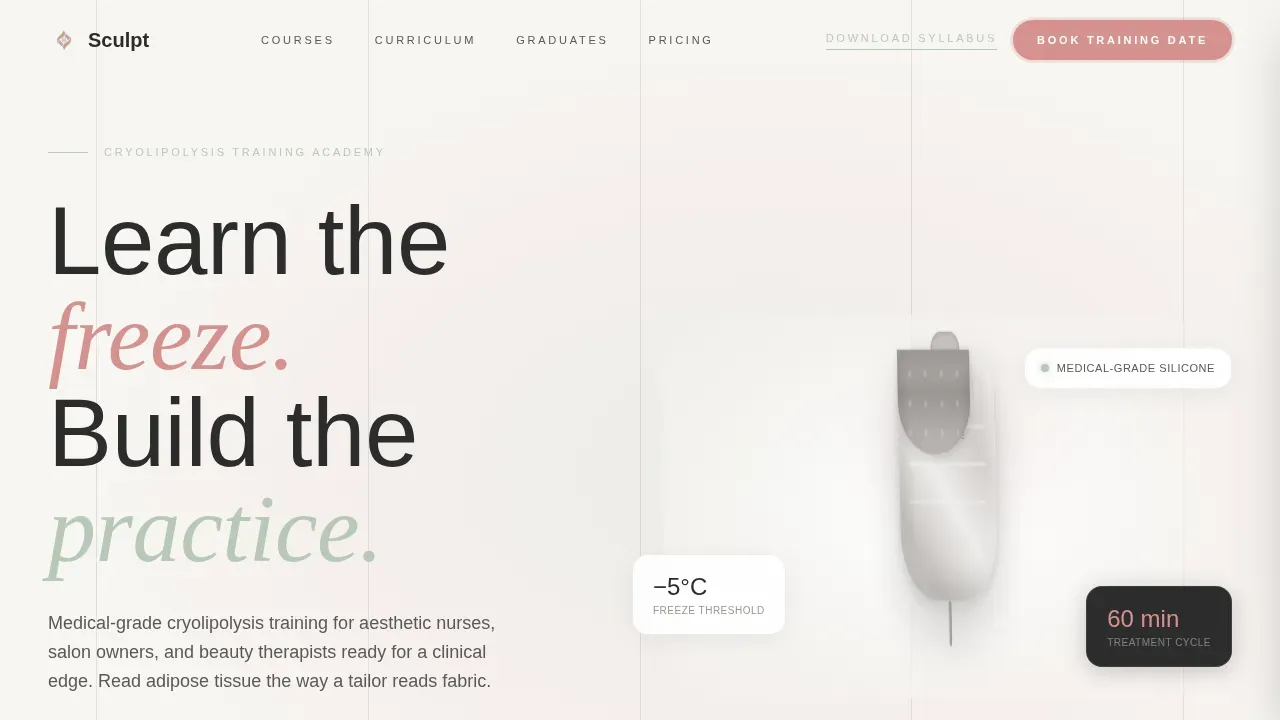
- A hero section with a CSS 3D applicator spin, a dual call to action, and the headline "Learn the freeze. Build the practice." rendered in wide-tracked thin sans-serif type.
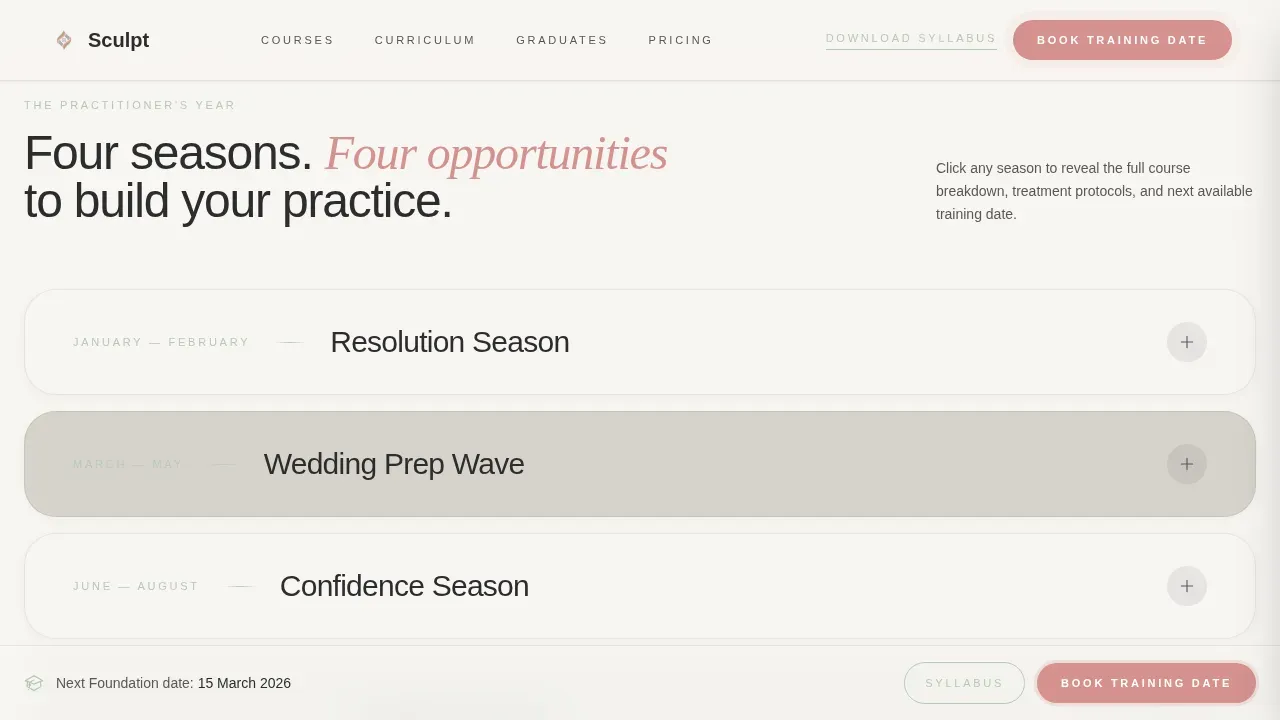
- A seasonal gallery system with four named periods (Resolution, Spring, Summer, Autumn) where each gallery row of three to four image frames expands into course detail, pricing, and graduate case studies on click.
- An inline booking panel with three course-tier cards (Foundation one-day, Advanced two-day, Masterclass with mentorship), each showing price in GBP, next available date in DD/MM/YYYY format, and a deposit reservation button.
Feature list
This section breaks down the core built-in components that define what the template does, how it feels, and why it works for a direct-sales training academy in the cryolipolysis niche.
Cinematic 3D Header Spin
The header opens on a CoolSculpting applicator rotating slowly on an invisible axis against a pure white void. The curve of every suction cup ridge catches soft directional light as the object completes one full rotation. The camera drifts forward until the medical-grade silicone texture fills the screen, then pulls back as the headline materialises. This is not a static image. It is a scene. It sets the tone before a single word is read, and it gives students a tangible sense of the tools they are about to learn to use. The motion is calm, almost meditative, and that calmness is deliberate. Visitors who feel calm, trust.
Seasonal Gallery with Expand-and-Collapse Detail
The scroll is structured around the practitioner calendar year. Four seasonal panels draw the visitor through the page: Resolution Season in January, Wedding Prep Wave in spring, Confidence Season in summer, and the Upskill Window in autumn. Each season is a gallery row of three to four image frames. Clicking any frame expands it into a full course breakdown, complete with treatment protocol detail for specific body areas (arms, flanks, submental fat), pricing, next available dates, and graduate case studies. This browse-then-dive rhythm is how practitioners actually research. The template matches that behavior instead of fighting it. Students who see their own planning story reflected in the content stay on the page longer and convert at a higher rate.
Front-Loaded Income Statistics Block
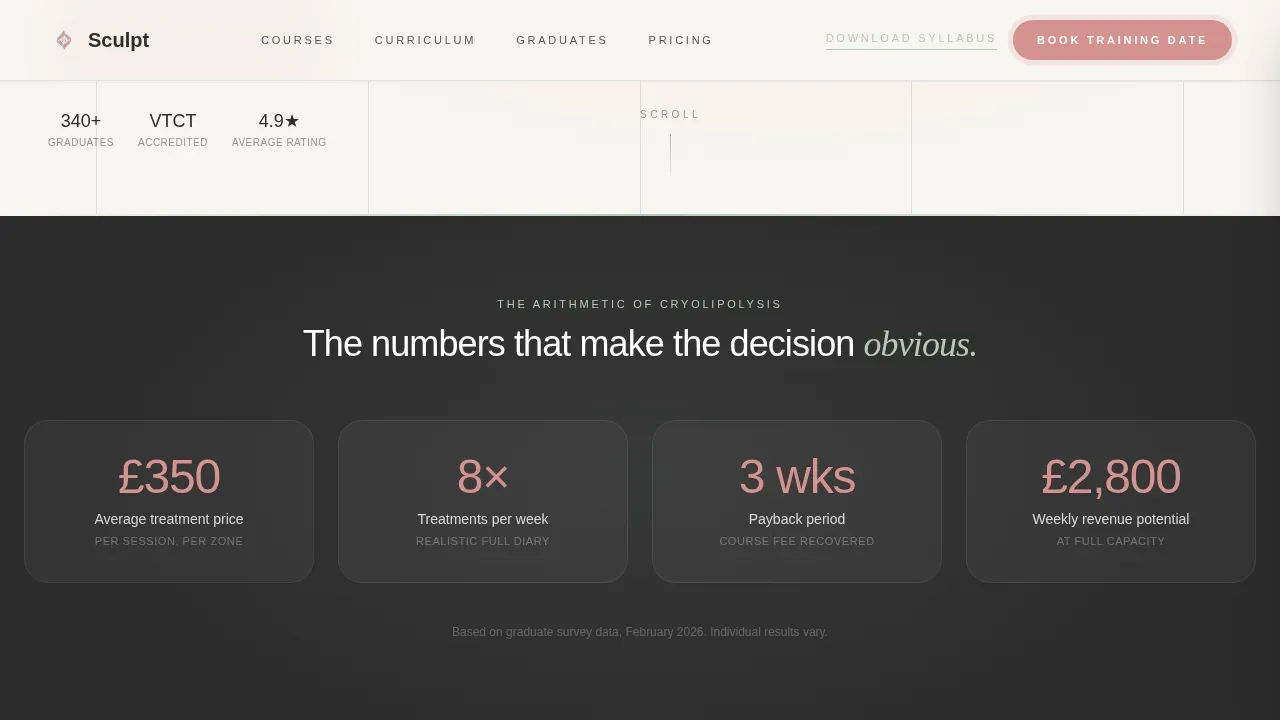
Before the first pricing card appears, students encounter a dedicated income statistics section. Average treatment price, estimated treatments per week, and the payback period on course fees are displayed as prominent data points. The idea is simple: make the purchase decision feel like arithmetic, not aspiration. When a visitor can draw a straight line between course cost and recovered revenue, the hesitation dissolves. This section does not guess at motivation. It addresses it directly with numbers.
Inline Three-Tier Booking Panel
The pricing section displays three course cards side by side: Foundation (one-day), Advanced (two-day), and Masterclass (with mentorship). Each card shows the course tier name, price in GBP, next available date, and a single reserve button with a deposit amount. The panel opens inline, meaning the visitor does not leave the page to complete a reservation. A sticky call-to-action bar, called the floating booking button, is fixed to the bottom of the viewport throughout the scroll so the action is always one tap away. The design uses clinical rose exclusively for these monetary and action elements, keeping the visual vocabulary of "spend" separate from the rest of the palette.
Syllabus Download Secondary Path
Not every visitor is ready to book. A secondary conversion path is built into the template in eucalyptus green. The "Download the Syllabus" button opens a lightweight form that captures name, email, and current qualification level. This creates a lead without requiring full commitment, giving the academy a warm audience to follow up with. The form is positioned as a natural pause point for visitors who want to gather more information before they decide.
Graduate Testimonial Video Cards
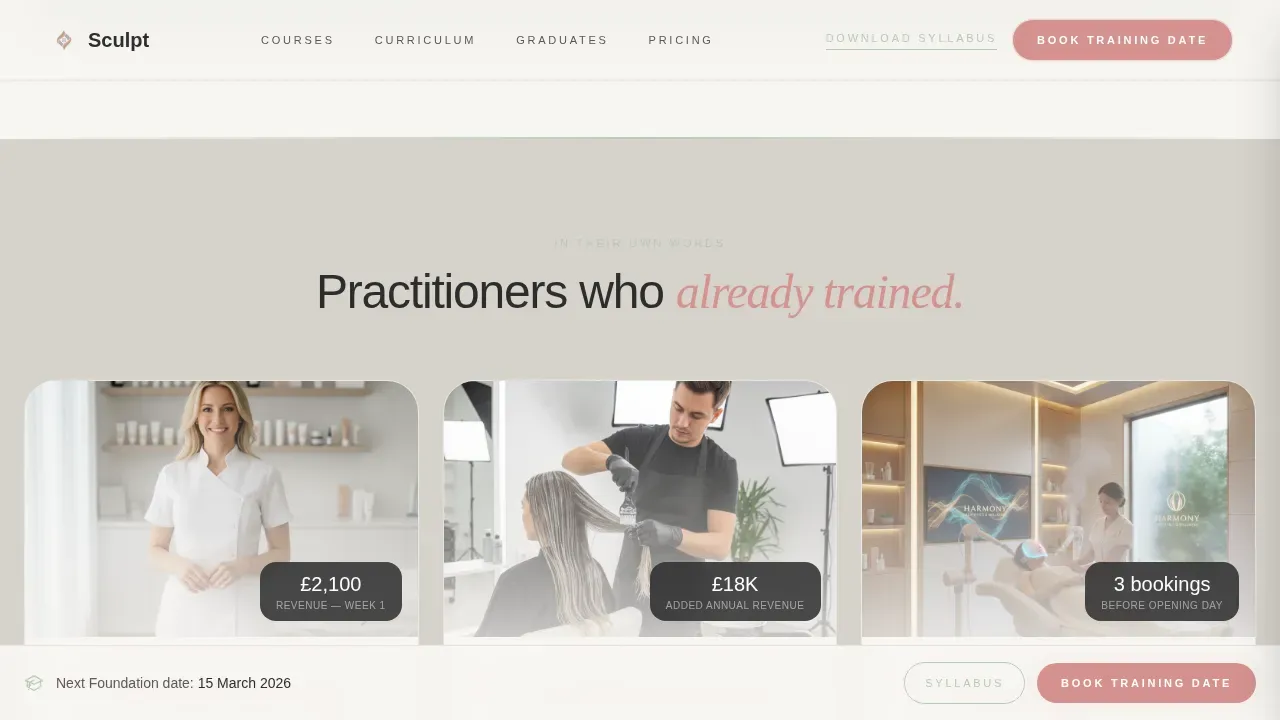
A dedicated testimonials section presents video-style cards shot in natural light with a warm, human aesthetic. Each card displays the graduate's name and qualification level, creating social proof that is specific and believable. Students see people who match their own professional profile endorsing the training. That match matters more than generic five-star ratings. The video card format introduces motion into an otherwise still section, providing a visual contrast that refreshes attention at exactly the right moment in the scroll.
Page sections overview
| Section | Purpose |
|---|---|
| Hero with Spin | Opens with 3D applicator rotation, headline, and dual call to action |
| Income Stats Block | Front-loads revenue arithmetic to justify course investment |
| Resolution Season Gallery | January campaign row expanding to Foundation course detail |
| Wedding Prep Gallery | Spring treatment protocol breakdown for arms, flanks, submental |
| Confidence Season Gallery | Summer video testimonial row with natural-light graduate cards |
| Upskill Window Gallery | Autumn training campaign for practitioners planning quiet-month upskill |
| Graduate Testimonials | Video-style cards with qualification level and income story |
| Three-Tier Pricing Panel | Inline booking cards for Foundation, Advanced, and Masterclass |
| Syllabus Download Form | Secondary lead-capture for browsers not yet ready to book |
| Sticky Booking Bar | Persistent viewport-bottom call to action across full scroll |
| Footer (Horizontal Flow) | Pattern 3 horizontal footer with navigation and contact |
Design & branding system
The visual identity follows an Organic Flow theme built on the Cloud Canvas color system. The palette was chosen to feel like a treatment room where linen curtains diffuse morning light onto polished concrete: warm enough to be human, cool enough to be medical. Every color has a defined role and that role does not change across the page.
- Cirrus white (#F7F5F2) and mist gray (#D6D2CB) alternate as full-width background bands, creating a gentle rhythm without hard borders.
- Pale eucalyptus (#B7C9B8) marks section dividers, icon fills, and secondary action elements including the syllabus download button.
- Clinical rose (#D4918E) appears exclusively on call-to-action buttons and pricing highlights, training the visitor's eye to associate that color with commitment and cost.
Typography pairs DM Sans in wide-tracked thin weight for all display headings with Fraunces in serif italic for accent phrases and pull-quote moments. The combination creates a character that is both clinical and considered, authoritative without being cold. High-resolution imagery uses simple backdrops to keep the eye on the subject, following the principle that visual curation for training pages should eliminate distractions.
Mobile & speed optimization
The template is built desktop-first because practitioners researching a multi-hundred-pound course investment typically sit at a desk. That said, the layout is fully responsive and adapts cleanly for mobile browsing. The seasonal gallery rows reflow from horizontal to vertical stacks. The three-tier pricing cards collapse into a single scrollable column. The sticky booking bar remains fixed at the bottom of the viewport on all screen sizes, ensuring the call to action is always visible regardless of how the visitor arrived at the page.
- The 3D applicator spin uses CSS animation rather than heavy video files, keeping the header experience smooth across connection speeds.
- Server components are used for all static sections (hero text, income stats, footer) while client components handle the interactive gallery expand-and-collapse and the inline booking panel, reducing unnecessary JavaScript load.
- The seasonal gallery images are structured to load progressively so that the first visible frames appear immediately and additional image rows load as the visitor scrolls down the page.
How this template helps you convert
Conversion in training academy pages is won or lost in the first thirty seconds. If a visitor does not quickly understand who this is for, what they will earn, and how easy it is to book, they leave. Sculpt is structured to answer all three questions before the scroll reaches the first gallery row.
- The hero section combines the cinematic 3D spin with the dual call-to-action structure: the primary "Book Your Training Date" button in clinical rose sits directly beneath the headline, while the secondary "Download the Syllabus" link in eucalyptus gives non-ready visitors somewhere to go instead of bouncing. Both paths keep the visitor inside the funnel from the very first scroll point.
- The income statistics block immediately follows the hero. Before students see a price, they see what that price earns back for them. The section draws a clear line between course cost and treatment revenue, framing the spend as a business investment with a calculable payback period rather than a personal expense.
- The inline booking panel removes friction from the final step. Three clearly differentiated course cards with visible prices, real dates, and a single action per card mean the visitor never has to navigate away to complete a reservation. The sticky bar repeats the primary call to action throughout the entire scroll so that a converted visitor can act the moment they are ready, not after they hunt for the button.
Other information about this template
This section covers additional context that helps you understand how the template was built, what tools and conventions it draws from, and how it fits into a broader ecosystem of academy and training page design.
The Sculpt learn the freeze build the practice landing page template is built with a high animation budget. CSS 3D spin for the header, cinematic entrance transitions, scroll-reveal staggered cards, and the expand-collapse gallery all contribute to an experience that feels premium without sacrificing clarity. Students who encounter a visually rich page form an immediate sense that the academy behind it is serious. That impression has a direct effect on willingness to pay.
The template draws on a long tradition of using story and scene structure to guide buyers through a decision journey. Just as drama and storytelling techniques can help students embody vocabulary and concepts by giving them a physical and emotional context, the seasonal narrative structure here gives practitioners a temporal frame they already live inside. They recognise Resolution Season. They recognise the Upskill Window. The page meets them in their own life calendar and says: this is the right moment.
Freeze frames as a concept work both literally and metaphorically here. In educational drama, freeze frames are used to communicate ideas or tell a story without movement, fixing a moment so the audience can read it. In this template, each seasonal gallery panel is itself a kind of freeze frame: a moment in the practitioner calendar held still long enough to explore. Clicking opens the detail. The pause is intentional.
The template's gallery and detail structure mirrors how interactive learning works in classroom settings. Interactive learning games enhance student engagement by allowing them to draw connections between concepts at their own pace. The browse-then-dive format here does exactly the same thing: it lets each visitor determine their own depth of engagement rather than forcing a linear read. Some will click every seasonal panel. Others will go straight to pricing. The page supports both journeys without losing either visitor.
The visual art direction borrows from principles that teachers of visual subjects know well. In 3D sculpting techniques, using the layer tool creates depth by allowing non-destructive edits that build up gradually rather than committing to a final shape too early. The seasonal layout of this template works the same way: each scroll section adds a new layer of context, building the case for booking without revealing everything at once. The mask tool concept applies too: information is strategically revealed rather than dumped. The visitor sees what they need at each moment, and the rest stays beneath the surface until they reach for it.
Consider the analogy of working with physical material. In polymer clay work, chilling pieces in a freezer for five to ten minutes firms them up and makes them easier to handle without distortion. In training page design, the equivalent is giving visitors just enough information at each stage to feel confident before they move to the next decision point. The template applies this principle across its scroll structure.
The page builds its vocabulary of trust deliberately. Graduate income statistics, qualification-level testimonials, before-and-after gallery references, and the clear three-tier course structure all speak to the same object: a practitioner who needs to justify a spend to themselves or to their business. Every section is a point on that justification curve.
The distinction between cryolipolysis and general body contouring matters here. Cryolipolysis is a non-invasive medical procedure that crystallises and eliminates fat cells through controlled cooling, causing programmed cell death. It targets smaller areas of fat rather than large-scale weight loss. Post-treatment massage of the treated area for two to three minutes can improve results by up to 68 percent. These are the kinds of facts that serious students want to see taught. The template signals, through its clinical visual character and the depth of its course card breakdowns, that the academy behind it understands this science and teaches it properly. Cryolipolysis treatments should always be performed by trained professionals to avoid risks, and that is precisely why professional training matters.
The corner where clinical credibility meets commercial design is where this template lives. It does not guess at what practitioners want. It was built from a clear picture of who they are: aesthetic nurses expanding their treatment menus, salon owners tired of referring body-contouring clients elsewhere, and newly qualified beauty therapists who want a clinical edge. The template gives all three groups a version of the page that speaks to them without alienating the others.
The page works in smaller groups of content rather than overwhelming walls of text. Each seasonal panel is its own contained idea. Each course card is its own contained object. Each testimonial card is its own contained story. This creates a page that scales without ever feeling cluttered. Visitors from different groups within the professional spectrum can navigate to their relevant content without getting lost. Whether someone approaches with one finger on a mobile screen or two fingers pinching to zoom a course card on a tablet, the layout holds its shape.
The structure supports writing a strong academy story across the full year calendar. Templates in the wellness and beauty training space often ignore the seasonal dimension of how practitioners plan. This one does not. The Upskill Window in autumn is a fantastic example of meeting the audience where they are psychologically, not just commercially. Quiet months are when smart practitioners train, and the page says that plainly in its copy.
The post subdivision of the page into seasonal acts creates natural pacing. Rather than one long scroll through identical sections, the visitor experiences four distinct story moments before arriving at pricing. Each act introduces a new angle on the same core idea: that learning to freeze fat safely and skillfully is a business decision worth making now. The ability to create that sense of forward momentum from a static page is what separates a template built with narrative intention from one assembled purely from components.
The income statistics block is the sharp edge of the page. It is where warm design meets hard numbers. Average treatment price, treatments per week, payback period on course fees: these data points are the correct information to put first, before pricing, because they rotate the visitor's frame from "this costs money" to "this makes money." That rotation is the single most important conversion function on the page. Do not underestimate it. Do not bury it. The template does not. It places these numbers directly beneath the hero, in full-width space, in a size that commands attention.
No-code platforms now make it possible to launch a production-ready training academy page from natural-language prompts, handling backend integrations and deployment automatically. AI-powered tools can streamline the process of creating landing pages for specific niches, reducing time from idea to live page without extensive coding knowledge. This template fits that workflow: it is structured to be customised efficiently, with clearly labelled sections, a consistent color vocabulary, and component blocks that adjust without breaking the overall design.
The footer uses Pattern 3 Horizontal Flow, presenting navigation, contact, and legal links in a clean horizontal band that does not interrupt the clinical aesthetic established above it. It is the correct way to close a page that has worked hard to maintain a specific visual register throughout. A heavy or ornate footer would break the spell. This one does not.
- The template is localised for UK English, GBP currency, and DD/MM/YYYY date formatting throughout the booking panel and course cards.
- Animation intensity is set to high across all interactive elements, including CSS 3D spin, scroll reveals, staggered card entrances, and the gallery expand-collapse system.
- The footer follows the Vercel Horizontal Flow pattern (Pattern 3), keeping the close of the page clean and on-brand.
Theme
Organic Flow
Creative direction
Seasonal/Moment
Color system
Cloud Canvas
Style
Gallery + Detail
Direction
Direct Sales
Page Sections
Cinematic CSS 3D Header Spin
Seasonal Gallery with Expand-and-collapse Detail
Front-loaded Income Statistics Block
Inline Three-tier Booking Panel with Sticky Call to Action
Secondary Syllabus Download Lead Path
Graduate Testimonial Video Cards
Related questions
What kind of business is this template designed for?
Can I display multiple course tiers and available dates inside the same page?
Does the seasonal gallery structure work if I only offer courses in specific months?
What happens when a visitor clicks the syllabus download button?
Is this template suitable for mobile even though it is built desktop-first?