Obesity Care Specialist Professional Website Template
A single-column landing page built for obesity clinical trial matching. Visitors enter basic health details through a progressive inline form and instantly see how many active trials fit their profile. The design uses clean typography, a restrained color palette, and a transparent five-step process to build trust before asking for any personal information.
by Rocket studio
Quick summary
This landing page template connects adults living with obesity to active clinical trials through an anonymous, progressive screener form. It covers pharmacological, device, behavioral, and surgical trial categories. The Transparent Process design approach walks visitors through every stage before they type a single character, so trust is earned well before the screener begins.
Who this template is for
This template was built for two distinct audiences who share one urgent need: access to obesity treatment options outside the standard insurance track.
- Adults aged 35 to 55 whose insurance denied coverage for GLP-1 medications or who are weighing non-surgical alternatives before committing to bariatric surgery.
- Clinical research coordinators who need to fill open enrollment slots before sponsor deadlines and want a public-facing screener that qualifies candidates efficiently.
What problem this template solves
Finding a relevant obesity clinical trial is genuinely difficult. Most trial databases are written for clinicians, not patients. Eligibility criteria are buried in regulatory language, and there is no simple path from "I qualify" to "I am enrolled."
- Patients waste hours reading trial listings that were never written for them, often abandoning the search entirely.
- Research coordinators lose qualified candidates because no clear, trustworthy entry point exists for self-referral.
What you get with this template
You get a fully structured, single-column landing page that handles both patient education and active lead qualification in one continuous scroll. Every section is purpose-built, from the zero-image hero headline down to the gated PDF call to action.
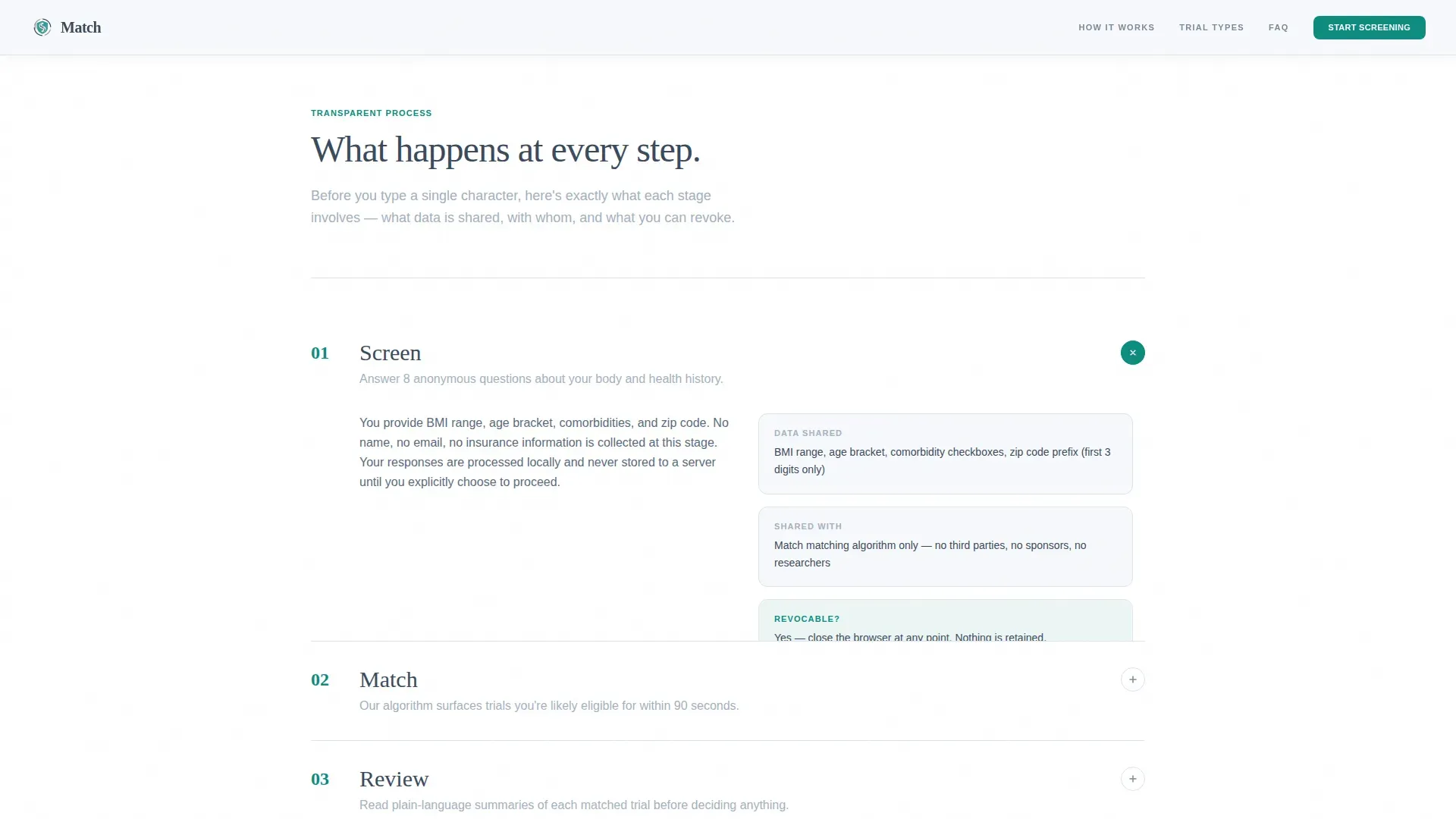
- A five-step accordion process section that expands on click to explain exactly what data is shared, with whom, and what the visitor can revoke at any stage.
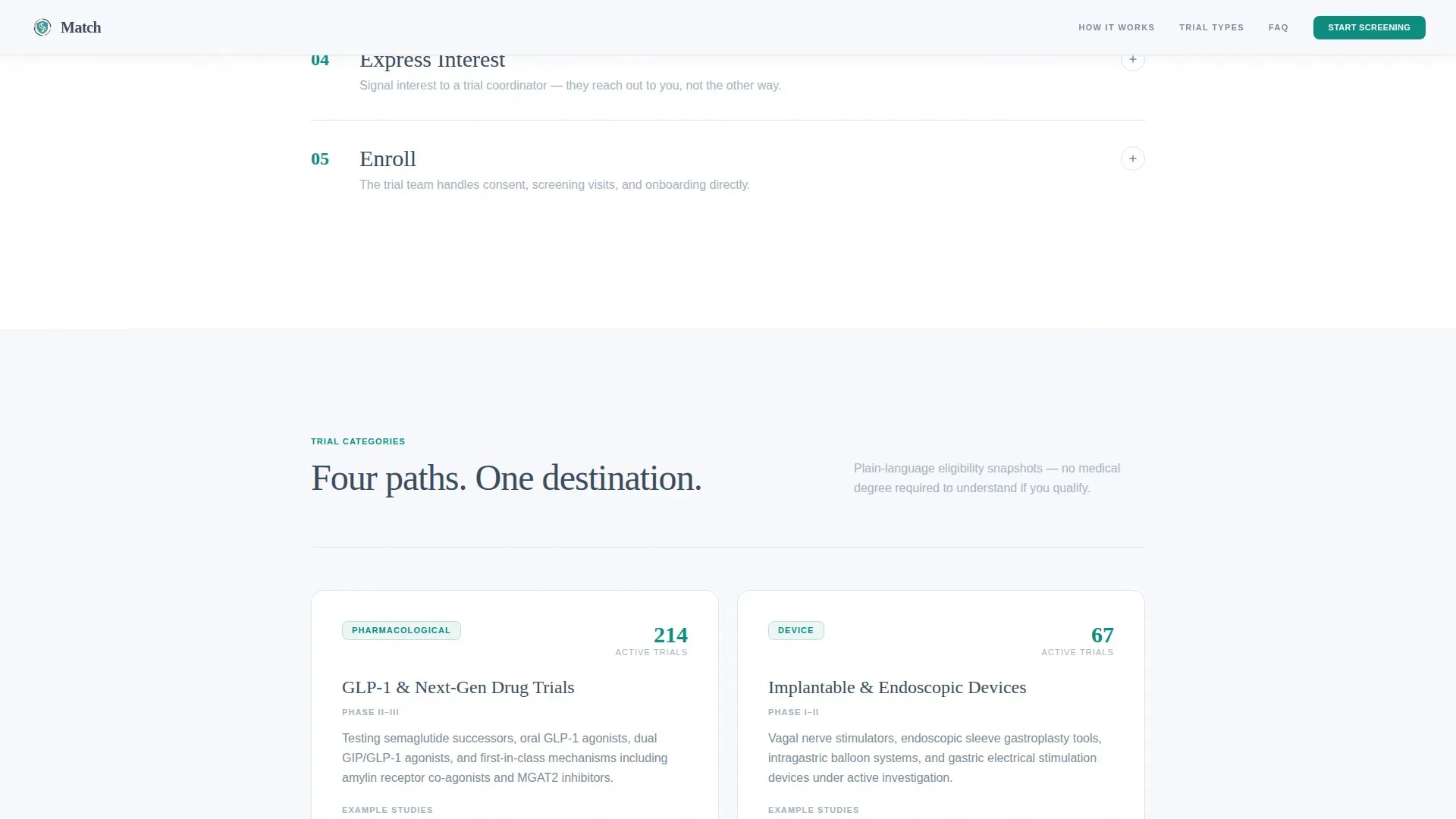
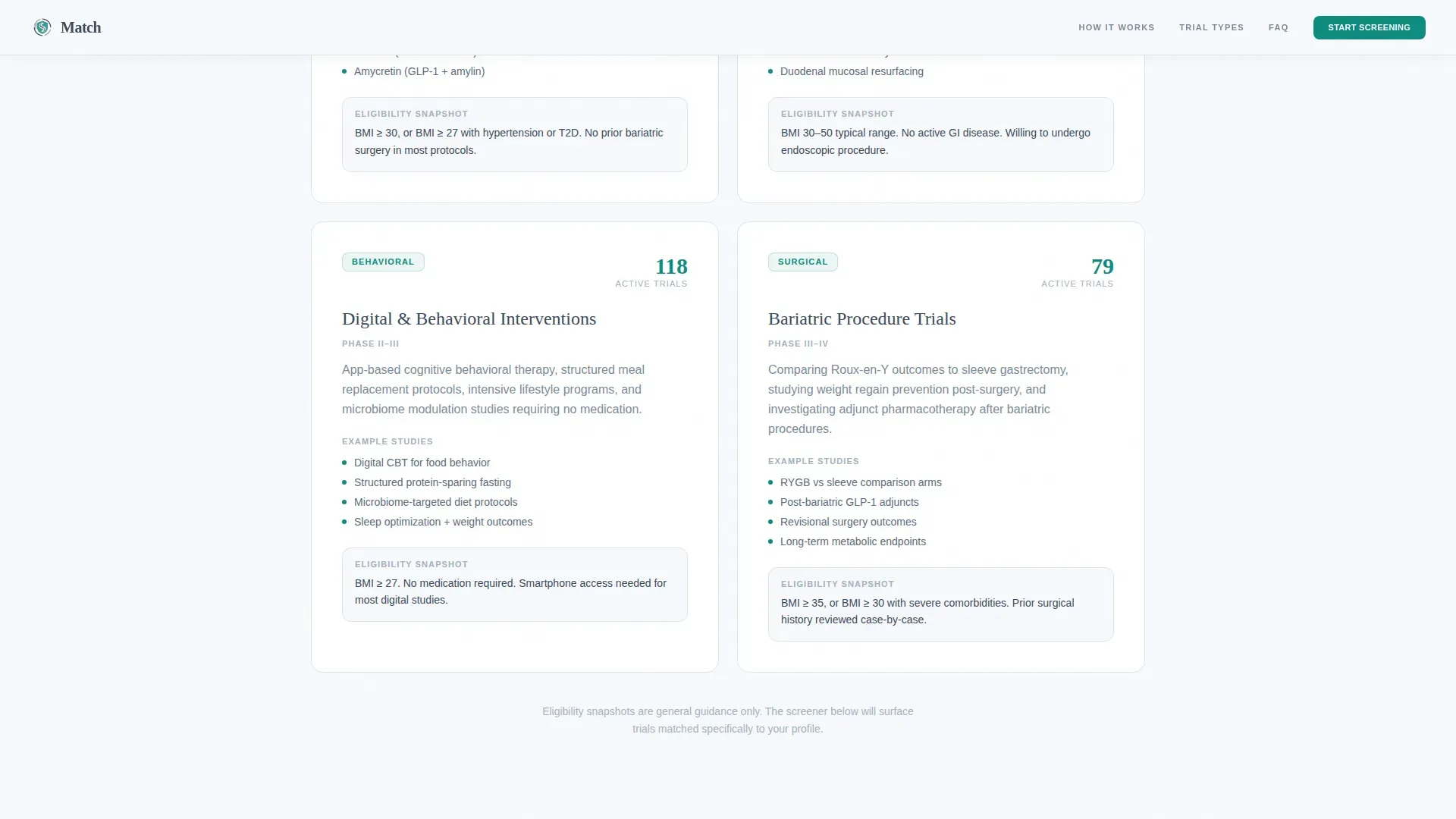
- Four trial category cards covering pharmacological, device, behavioral, and surgical study types, each with plain-language eligibility snapshots.
- A progressive inline screener form that shows a live count of matching trials after each answered step, rewarding the visitor before asking for more.
Feature list
This template is built around a small set of high-impact interactive components that work together to earn trust and drive screener completions.
Giant Centered Hero Headline
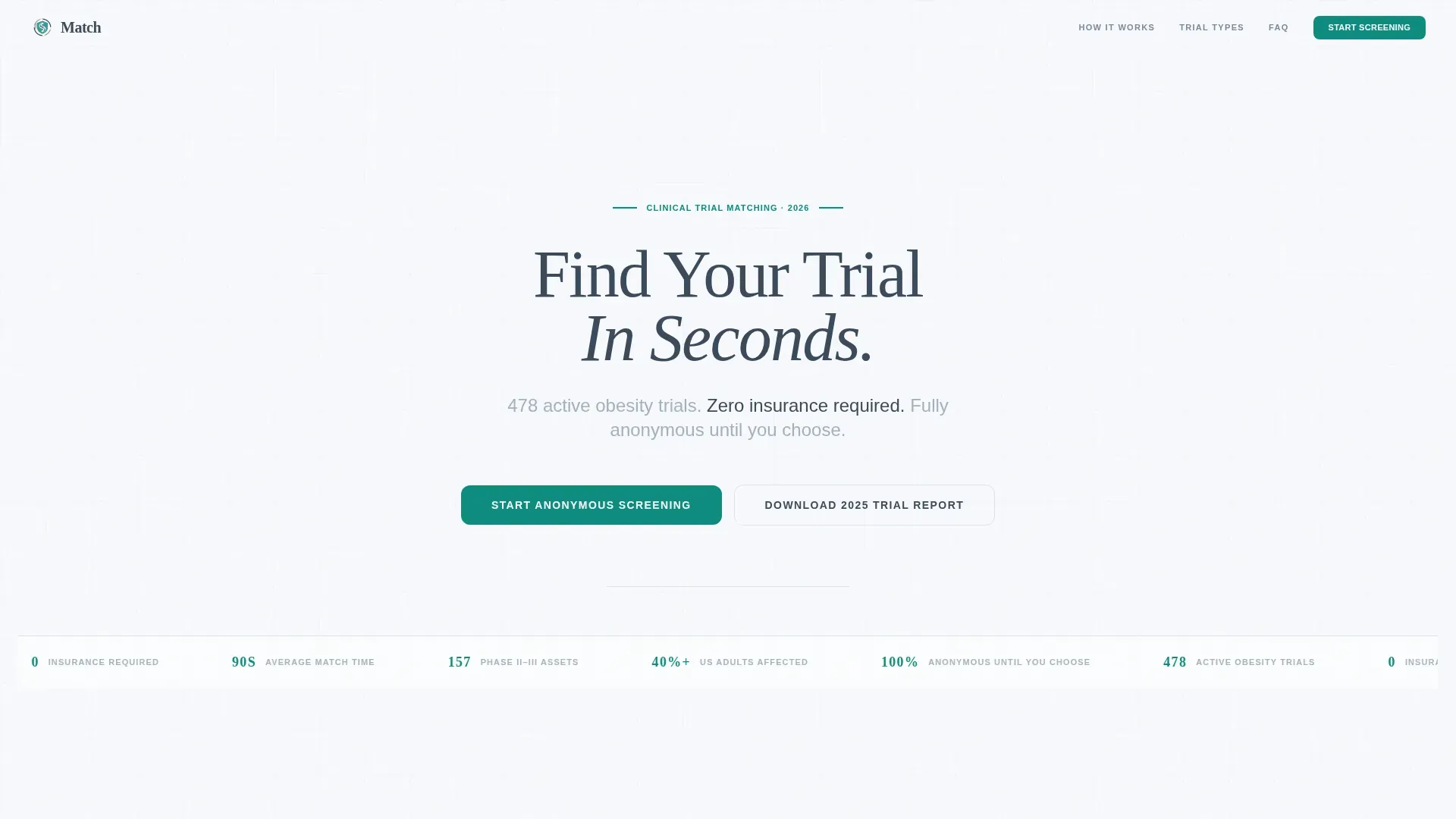
The header opens with a single five-word statement at 72 pixels or larger on a glacier white background. One line of secondary text below it states the trial count, the zero-insurance requirement, and the fully anonymous nature of the process. No images, no illustrations.
Five-Step Expandable Process Accordion
A dedicated section walks visitors through each stage of trial participation: screen, match, review, consent, and enroll. Each step expands on click to reveal exactly what information is collected, who receives it, and what the participant can withdraw at any point.
Progressive Inline Screener Form
The screener unfolds in three steps: body mass index (BMI) and age range first, then comorbidity checkboxes covering type 2 diabetes, sleep apnea, hypertension, and polycystic ovary syndrome (PCOS), then zip code for proximity matching. After each step, a live trial count updates to show how many studies currently match the inputs entered so far.
Trial Category Cards
Four defined cards present the four study types available for matching. Each card uses plain-language eligibility criteria so a visitor without a clinical background can immediately assess whether a category applies to them.
Gated PDF Report Call to Action
A secondary conversion path offers a downloadable 2025 Obesity Trial Landscape Report. It is gated behind an email address only, keeping the barrier low for both patients and clinical coordinators who want a reference document for their own use.
Patient FAQ Accordion
Seven questions sourced from real patient forum research are answered in a dedicated accordion section. The questions reflect what first-time trial participants actually ask, not what legal teams want them to read.
Page sections overview
| Section | Purpose |
|---|---|
| Hero Headline | States the core value proposition with a live trial count and zero-insurance promise |
| Transparent Process Steps | Builds trust by showing each matching stage before the visitor starts the screener |
| Trial Category Cards | Helps visitors identify which study type fits their situation |
| Patient FAQ Accordion | Answers the seven most common first-time participant questions |
| Inline Screener Form | Qualifies visitors through a progressive three-step form with live matching feedback |
| PDF Report Download | Offers a gated resource for deeper research and coordinator-level use |
| Footer | Provides a single-row linear layout with essential navigation |
Design & branding system
The visual identity follows a Corporate Precision approach built around the Alpine Fresh color system. The palette is intentionally restrained so that every accent color carries clear meaning.
- Glacier white (#F7F9FC) fills open backgrounds; alpine slate (#3B4A5C) handles body text and structural dividers; clinical teal (#0E8C7F) appears only on primary buttons and progress indicators; summit stone (#A3B1BF) handles secondary labels and form borders.
- Typography pairs Fraunces serif for headlines with DM Sans for body text and interface elements, creating a contrast between editorial authority and functional clarity.
Mobile & speed optimization
The template is built desktop-first, with a strong mobile fallback for patients who research treatment options on their phones. Interactive components are split between static and dynamic rendering to keep initial load lean.
- Static sections such as the hero, process steps, and trial cards use server-rendered components; the screener form and FAQ accordion use client-side components for interactivity.
- Scroll-triggered animations use GSAP ScrollTrigger with staggered reveals on cards and smooth transitions between form steps, keeping motion purposeful rather than decorative.
How this template helps you convert
The page is structured so that trust accumulates before the visitor is asked to act. Each section earns the next click by showing value first.
- The live trial count in the hero and the transparent process accordion both deliver information before requesting anything, so the visitor arrives at the screener already informed and less guarded.
- The progressive screener form rewards each answered step with a visible update to the matching trial count, turning data disclosure into an immediately gratifying exchange rather than a blind form submission.
Other information about this template
This template is designed for the United States market. It references US zip codes, Food and Drug Administration (FDA) trial standards, and USD-denominated context throughout. The stat strip and live trial count use a baseline figure of 478 active obesity trials. The template supports both a business-to-consumer (B2C) patient path and a business-to-business (B2B) coordinator path from a single page, without requiring separate versions. The footer follows a Linear Single-Row pattern for minimal visual weight. Scroll-reveal animations are set to a medium intensity level, consistent with a clinical, trust-building tone.
- The PDF report positions as a resource clinical coordinators share internally and patients bring to appointments, giving it a long tail of use beyond the initial download.
- The page earns both the patient click and the coordinator referral by showing its matching logic openly before asking for any contact details.
Theme
Corporate Precision
Creative direction
Transparent Process
Color system
Alpine Fresh
Style
Single Column Flow
Direction
Content/Resource
Page Sections
Giant Centered Hero Headline
Five-step Process Accordion
Progressive Inline Screener Form
Trial Category Cards
Gated PDF Report Download
Patient FAQ Accordion
Related questions
Does this template require an external trial database to work?
Can I edit the comorbidity options in the screener form?
Is the downloadable PDF report included with the template?
Who is the primary audience this landing page template is designed for?
What interactive components are included in the template?