Match - Precision Skincare Landing Page Template
Match is a precision skin tone matching landing page template built for direct-to-consumer beauty tech brands. It showcases a camera-based foundation shade algorithm across a Gallery and Detail layout, guiding visitors through a UGC photo wall, an immersive scroll-unboxing flow, and an inline skin-scan call to action that resolves to one pre-selected shade out of ninety-six.
by Rocket studio
Quick summary
Match is a single-page Gallery and Detail template designed for a skin tone matching technology brand. It opens with a breathing mosaic of real customer selfies, walks visitors through a tactile scroll-unboxing experience, and closes with an inline shade-scan flow that pre-selects the exact foundation. The page converts by making the match feel inevitable before the cart ever opens.
Who this template is for
This template is built for beauty tech founders, direct-to-consumer foundation brands, and makeup product teams who need a landing page that does real persuasion work. It suits any product that relies on precision matching logic and wants to show proof before asking for a purchase.
- Beauty tech brands launching a camera-based shade matching product
- Professional makeup artists or beauty educators building a direct sales channel
- First-to-market foundation brands that need to explain a new kind of buying experience
What problem this template solves
Foundation buyers face a specific, frustrating problem: every shade looks almost right until it does not. Drawers fill up with wrong bottles, swatches blur together under store lighting, and first-time buyers freeze at the shelf. This template builds a page that addresses that exact hesitation head-on.
- Eliminates confusion by centering the entire page on a single, resolved match
- Replaces generic product photography with real customer skin diversity shown at scale
- Guides hesitant buyers through the logic of the scan before they reach the buy button
What you get with this template
You get a fully structured Gallery and Detail landing page organized around six purposeful sections. Every section is designed to carry emotional momentum forward, from the first selfie tile to the final shade confirmation.
- A UGC photo wall hero with flip-to-shade-reveal tiles and a sticky "Find My Shade" call to action
- A scroll-unboxing product journey featuring scan interface, shade result card, bottle rotation, and ingredient callouts
- A ninety-six shade gallery grouped by undertone, a testimonial proof section, and a final inline scan launcher with a discovery kit secondary path
Feature list
Breathing UGC Photo Wall
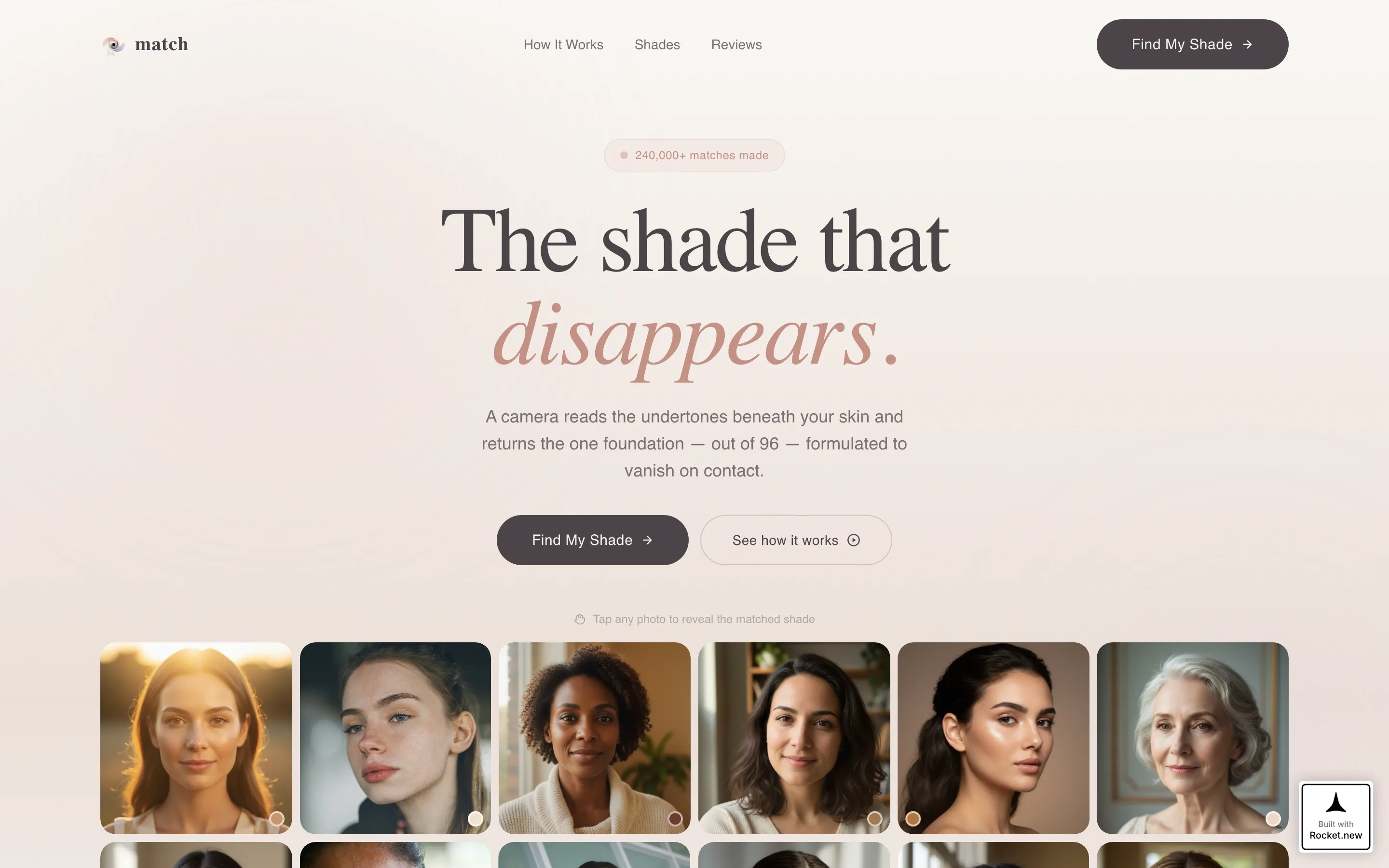
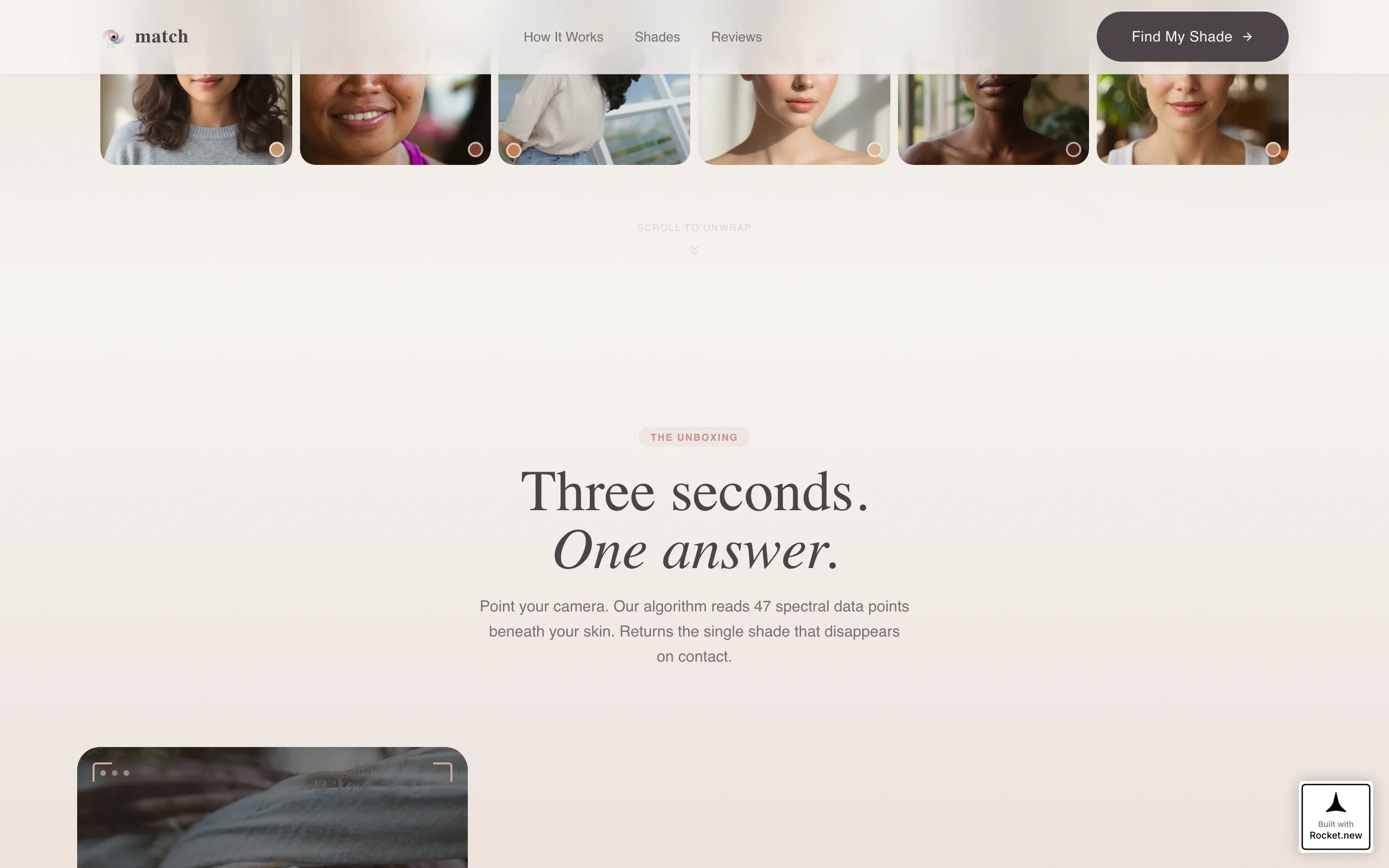
The hero section displays a living mosaic of real customer selfies. Each tile is framed in a soft rounded square tinted to the matched shade for that person. The grid subtly scales and shuffles, and tapping any tile flips it with a CSS 3D animation to reveal the matched shade name, shade number, and a one-line customer quote.
Scroll-Unboxing Product Journey
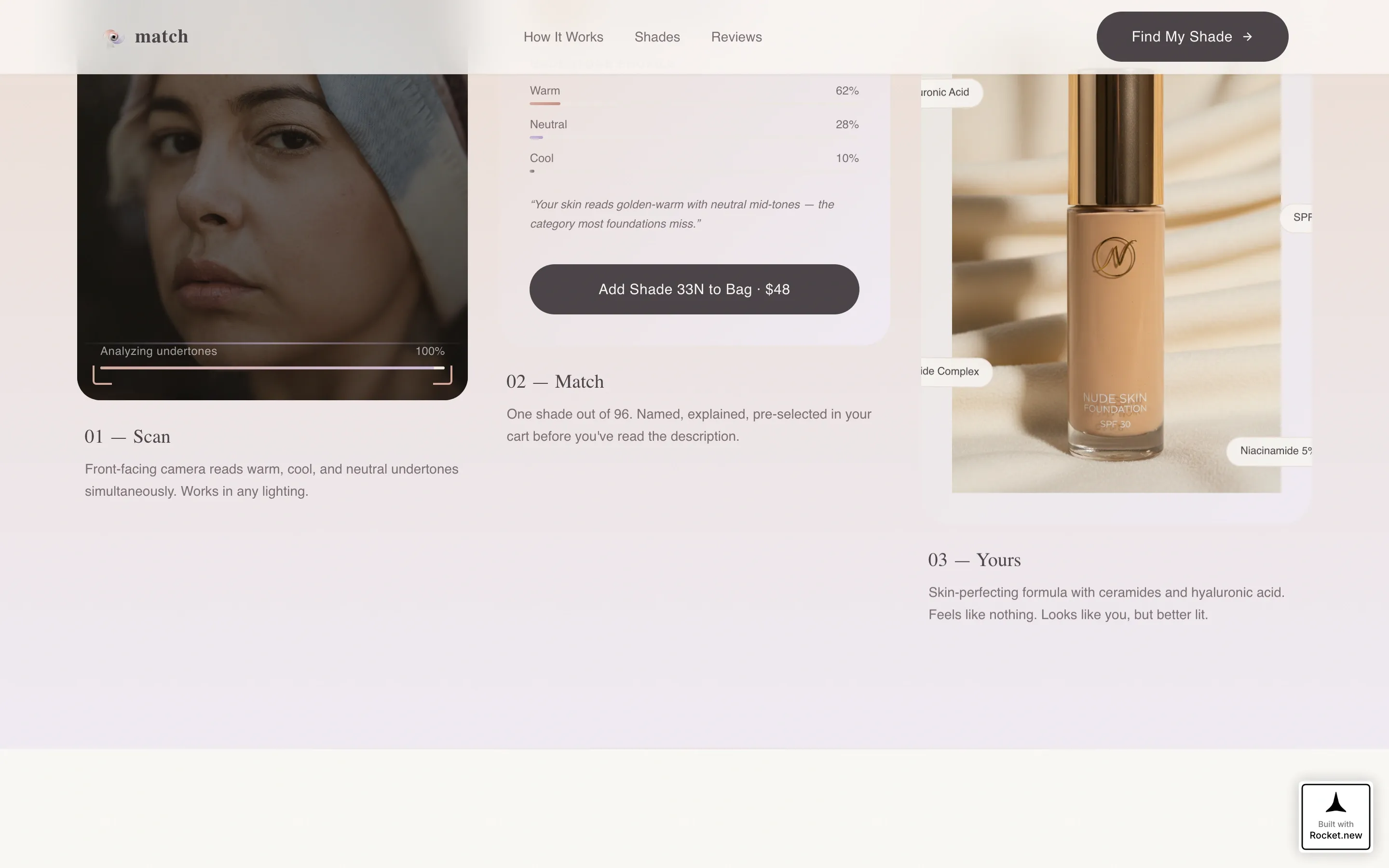
As the visitor scrolls past the hero, each product layer appears the way tissue paper peels from a package. The scan interface appears first, then a shade result card slides out like a drawer, then the foundation bottle rotates into view with ingredient callouts lifting off like printed inserts. Tactile micro-animations give the page a physical, sensory quality.
Ninety-Six Shade Gallery
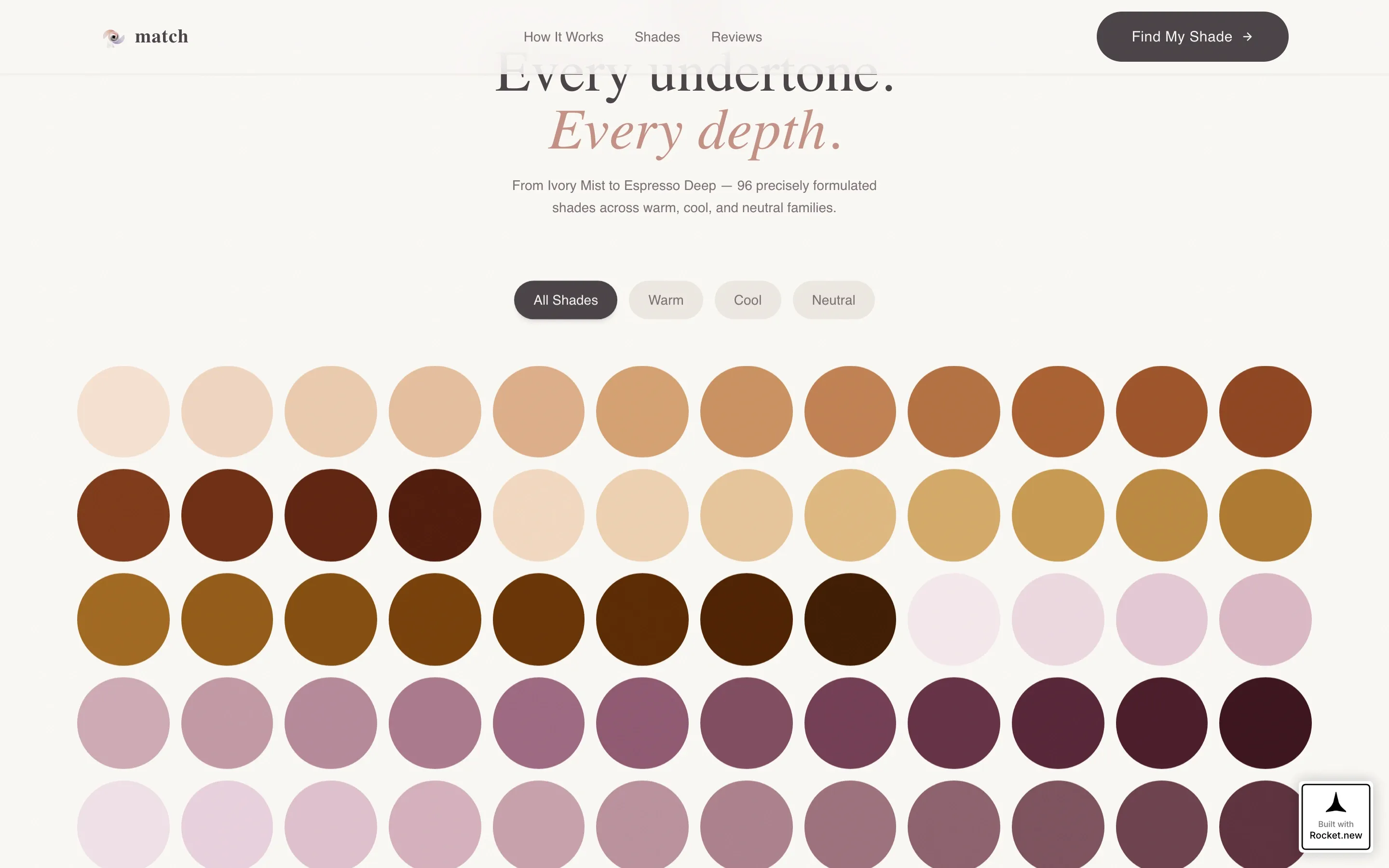
All ninety-six foundation shades are presented as tactile swatch tiles grouped by undertone. Hovering over any swatch reveals the shade name and number. The layout makes the full range visible at a glance while keeping individual shades identifiable and approachable.
Inline Skin-Scan Call-to-Action Flow
The primary call to action reads "Find My Shade" and launches an inline scan flow directly on the page. The flow requires only a front-facing photo and a lighting confirmation step. Once the match resolves, the button shifts to "Add My Shade to Bag" with the exact product pre-selected and price visible.
Discovery Kit Secondary Path
Visitors who are not ready to commit to a single bottle are offered a three-shade discovery kit. This secondary path sits alongside the resolved match result and captures hesitant buyers without pulling them off the main conversion flow.
Testimonial Proof Section
The social proof section features named testimonials that include each customer's wrong-shade history, the correct shade number they were matched to, and real results. Makeup artist credentials appear where relevant. The format builds trust through specificity rather than generic five-star ratings.
Page sections overview
| Section | Purpose |
|---|---|
| Hero Photo Wall | Opens with real-customer selfie mosaic and "Find My Shade" call to action |
| Scan Flow Unboxing | Reveals scan interface, shade card, bottle rotation, and ingredient callouts on scroll |
| Ninety-Six Shade Gallery | Displays all shades grouped by undertone with hover name reveal |
| Testimonial Proof | Shows named customer results with wrong-shade context and shade numbers |
| Final Call-to-Action | Inline scan launcher with discovery kit secondary path |
| Footer | Horizontal flow footer layout |
Design & branding system
The visual identity follows a Soft Mist palette built around four deliberate colors. Typography pairs an editorial serif for headlines with a clean sans-serif for body text, creating warmth balanced with precision. The overall feel is described in the brief as a skincare brand crossed with precision optics.
- Cloud white (#F7F5F2) and warm-nude blush (#D4A99E) form the primary backgrounds in slow vertical gradients
- Whisper lilac (#C9B8D9) appears exclusively on hover states and progress indicators; barely-there charcoal (#4A4347) anchors all typography
- Headlines use Fraunces, an editorial serif; body text uses DM Sans, a clean and legible sans-serif
Mobile & speed optimization
The template is built mobile-first because the core interaction, the skin scan, is phone-native. Camera access, lighting confirmation, and shade resolution are all designed for a handheld screen before desktop polish is applied.
- Interactive sections including the photo mosaic and scan flow modal are built as client components for responsive behavior
- Static sections such as the shade gallery and testimonials use server component architecture to keep initial load lean
- The sticky call-to-action bar remains visible throughout scrolling on both mobile and desktop viewports
How this template helps you convert
The page is structured so the visitor earns trust through evidence before they reach any explicit sales message. The scan result itself does the persuasion work by naming and explaining the visitor's precise undertone.
- The photo wall opens with proof of diversity and real results, reducing skepticism before a single marketing claim is read
- The scroll-unboxing experience creates physical proximity to the product through tactile animation, making the purchase feel familiar before it happens
- The inline scan flow removes all friction by pre-selecting the exact product so the visitor moves from "Find My Shade" to "Add My Shade to Bag" in one seamless step
Other information about this template
This template is part of a Gallery and Detail template style category within the Beauty and Personal Care vertical. It is designed specifically for the Skin Tone Matching Technology niche and sits within the Beauty Tech and Device subcategory. A few additional details worth noting:
- The template is localized for English-language audiences with United States dollar pricing and United States date formatting
- Animation intensity is high throughout, including a breathing grid, CSS 3D flip transitions, scroll-triggered unboxing reveals, bottle rotation, and drawer slide effects
- The Soft Gradient theme and Soft Mist color system give the page a cottony, intimate aesthetic that feels distinct from typical clinical beauty tech presentations
- The Unboxing Experience creative direction and UGC Photo Wall header concept are core structural decisions baked into the template layout, not optional add-ons
- The footer follows a horizontal flow layout pattern suited to minimal, brand-forward footers
Theme
Soft Gradient
Creative direction
Unboxing Experience
Color system
Soft Mist
Style
Gallery + Detail
Direction
Direct Sales
Page Sections
Breathing UGC Photo Wall Hero
Scroll-unboxing Product Journey
Ninety-six Shade Swatch Gallery
Inline Skin-scan Conversion Flow
Discovery Kit Secondary Path
Specific Testimonial Proof Section
Related questions
Can I change the shade count if my product has fewer than ninety-six shades?
Does the inline scan flow work on mobile browsers?
Can I use this template without a camera-based matching tool?
How do I add my own customer photos to the UGC photo wall?
Is the three-shade discovery kit path required?