Maxillofacial Surgeon Booking Website Template
Maxilla is a precision surgical comparison landing page template built for oral and maxillofacial surgery practices. It uses a stats-led hero, frequently asked question-driven accordion sections, and structured comparison tables to guide anxious patients from first research to a booked consultation. The Corporate Precision design keeps every element clinical, credible, and conversion-ready.
by Rocket studio
Quick summary
Maxilla is a single-page, click-through landing page template purpose-built for oral and maxillofacial surgery practices. It opens with a monumental metrics wall, then walks patients through their exact questions using frequently asked question accordion sections paired with side-by-side comparison tables. The result is a page that feels like a calm, confident consultation rather than a generic medical website.
Who this template is for
This template is designed for practices where surgical confidence and patient reassurance must exist on the same page. It suits specialists who want their digital presence to reflect the same precision they bring to the operating theatre.
- Oral and maxillofacial surgeons running private or hospital-linked practices who treat wisdom teeth, corrective jaw cases, and trauma referrals
- Maxillofacial surgery teams offering orthognathic surgery, reconstructive surgery, and dental implant placement who need a conversion-focused page without building from scratch
- Practice managers or clinic marketers who want a professionally structured, ready-to-deploy surgical landing page that speaks directly to anxious patients and referring clinicians
What problem this template solves
Patients researching maxillofacial surgery arrive with fear, confusion, and a long list of unspoken questions. Most practice websites answer none of them clearly. Generic layouts with stock photography and vague service descriptions do not convert nervous patients into booked consultations.
- There is no structured way to address the real questions patients ask, such as differences between orthognathic surgery and braces alone, or what anaesthesia options exist for a given surgical procedure
- Practices lose potential bookings because their pages cannot demonstrate surgical depth, clinical accuracy, or the step-by-step clarity that builds patient trust before a consultation
- Comparison tables, evidence-led metrics, and a clear call to action are absent from most medical page templates, leaving patients to search elsewhere for the reassurance they need
What you get with this template
Maxilla delivers a complete, structured landing page with every section pre-built and logically sequenced. You are not assembling components from scratch. The surgical plan is already laid out for you.
- A four-metric stats hero, five frequently asked question accordion sections with embedded comparison tables, and a linear single-row footer, all styled in the Alpine Fresh colour system with deep alpine navy, clinical snow white, surgical steel grey, and glacial teal
- A fixed bottom call-to-action bar that stays visible on scroll, a primary "Book Your Consultation" button in glacial teal, and a secondary "Call the Practice Directly" text link beside every call to action placement
- Typography set in DM Sans for body text and Fraunces for display headings, with medium animations including a teal underline pulse on load and scroll-reveal section transitions
Feature list
This section details the core built-in capabilities of the Maxilla surgical landing page template. Every feature described below is directly specified in the template brief.
Monumental Stats Hero with Metric Wall
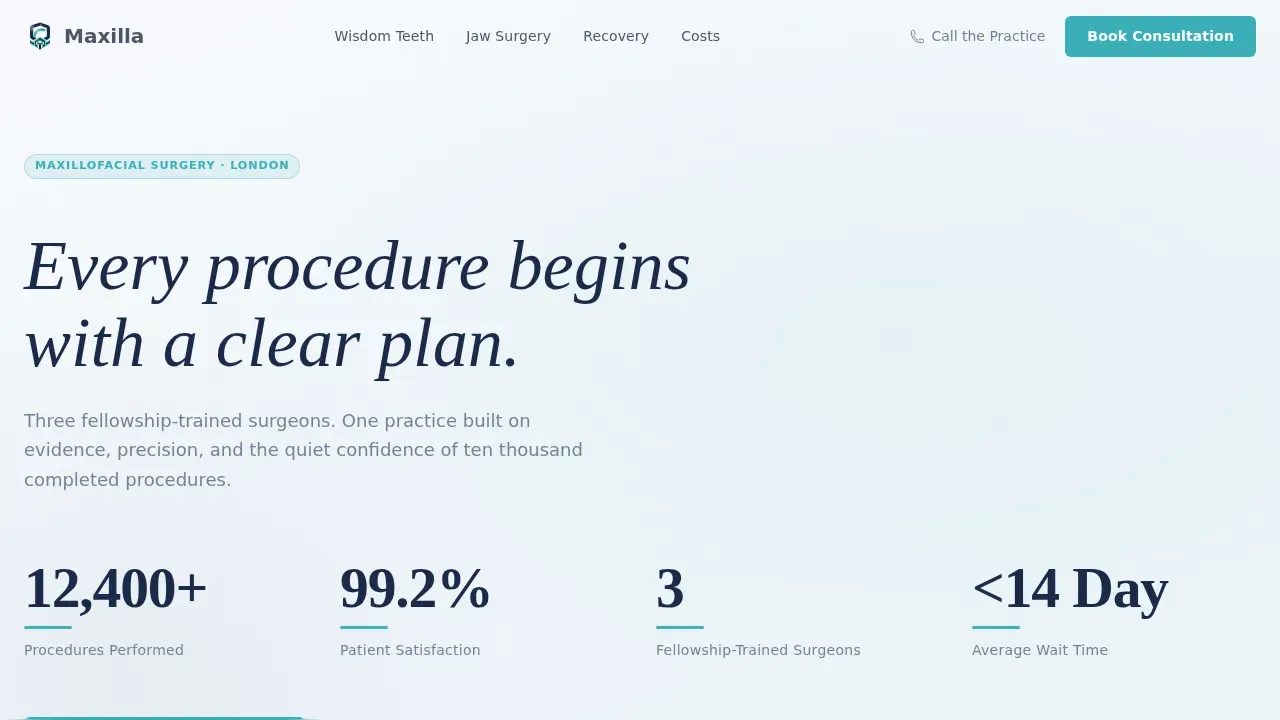
The header is a full-viewport stats wall displaying four oversized figures in deep alpine navy: 12,400-plus procedures performed, 99.2 percent patient satisfaction, three fellowship-trained surgeons, and under 14-day average wait. Each metric sits above a glacial teal underline that pulses subtly on page load. There are no stock photographs and no smiling faces. The section leads with evidence, positioned to establish immediate credibility for patients who arrive already anxious.
frequently asked question-Driven Accordion with Embedded Comparison Tables
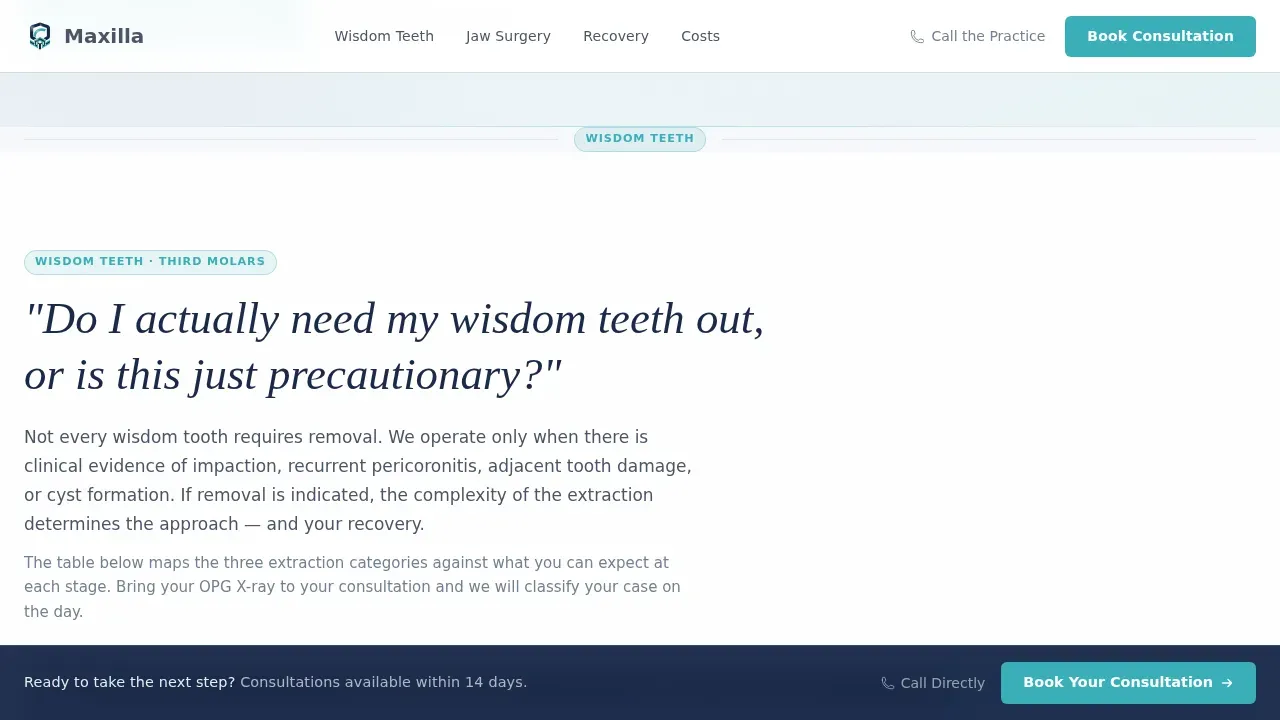
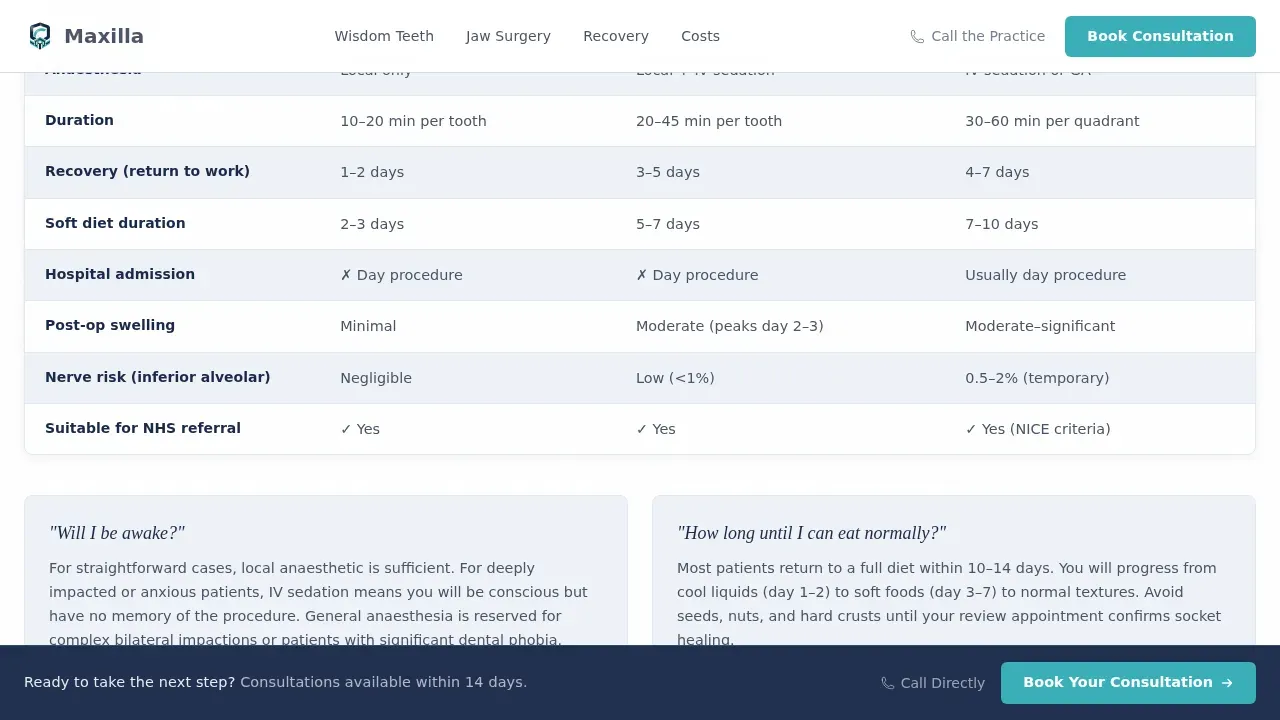
The scroll structure mirrors the exact internal conversation a nervous patient has before surgery. Each frequently asked question section opens with a real patient question and unfolds into a structured comparison table. Tables cover procedure types alongside recovery timelines, anaesthesia options, and expected outcomes. The sequence escalates logically from common concerns such as wisdom teeth and cost toward complex reconstructive surgery and orthognathic surgery, guiding patients from curiosity toward commitment.
Fixed Bottom Call-to-Action Bar
A persistent call-to-action bar is anchored to the bottom of the viewport on scroll. The primary button reads "Book Your Consultation" in glacial teal. A secondary "Call the Practice Directly" text link sits beside it for patients who need a human voice before committing. The click passes the visitor through to the scheduling platform with procedure type pre-selected based on which frequently asked question section they engaged with most.
Corporate Precision Design System
The Alpine Fresh colour system is applied consistently across every element. Clinical snow white (#F7F9FC) covers all backgrounds. Surgical steel grey (#4A5568) is used for body text and table borders. Deep alpine navy (#1B2A4A) anchors headlines and primary containers. Glacial teal (#3AAFB9) is reserved exclusively for calls to action, active states, and metric highlights. The palette is sterile without feeling hostile and sharp without feeling cold.
Scroll-Reveal Section Animations
Each frequently asked question section reveals on scroll with a measured transition. The animation pacing is set to medium, keeping the page feeling clinical and controlled rather than flashy. The teal underline pulse on the hero metrics fires on load. These motion choices reinforce the template's overall tone of quiet surgical confidence.
Single-Row Footer Layout
The footer follows Pattern 1: a linear single-row layout. It is minimal by design, keeping the visual focus on the conversion path above it. The footer does not distract from the fixed call-to-action bar or compete with the frequently asked question content for patient attention.
Page sections overview
| Section | Purpose |
|---|---|
| Stats Metrics Hero | Establish instant credibility with four monumental performance figures and glacial teal pulse underlines |
| Wisdom Teeth frequently asked question | Address common procedure questions with a side-by-side table covering procedure types, recovery, and anaesthesia |
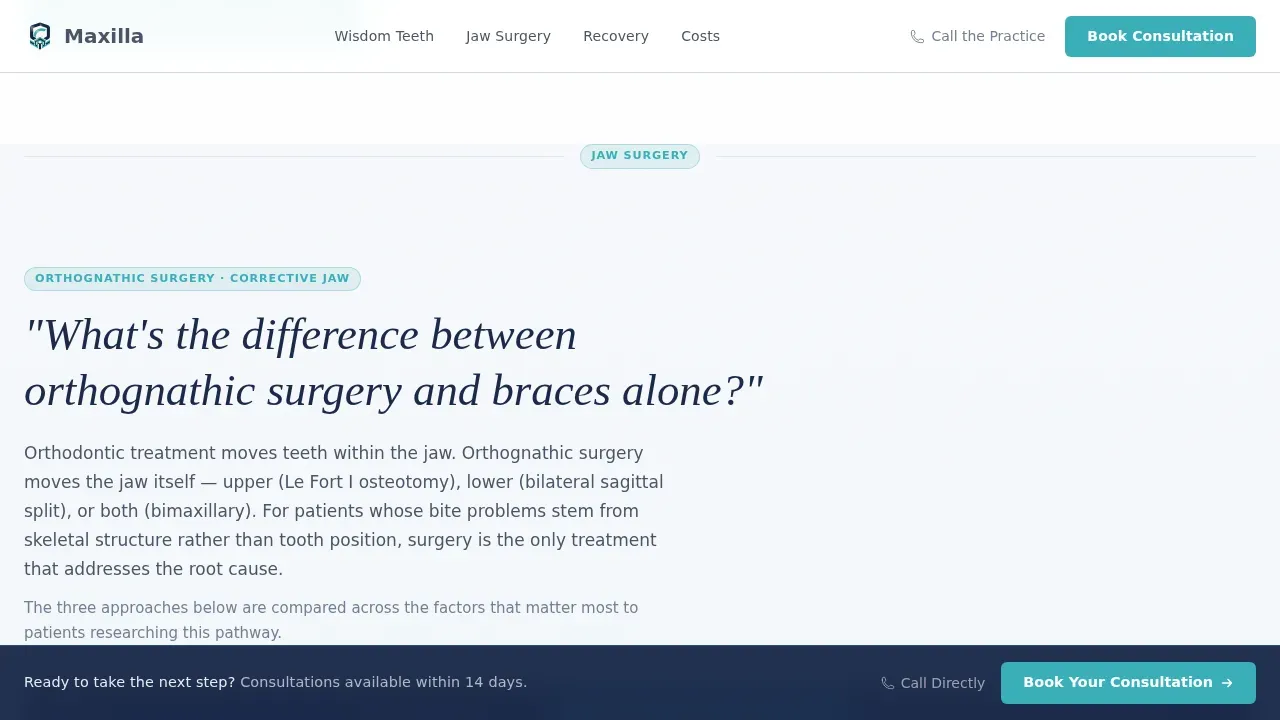
| Orthognathic Surgery frequently asked question | Compare orthognathic surgery against braces alone in a structured benefits table |
| Anaesthesia Recovery frequently asked question | Present recovery timelines and anaesthesia options in a clear comparison format |
| Cost Insurance frequently asked question | Provide pricing clarity and reconstruction complexity context through a structured table |
| Fixed call to action Bar | Keep the booking action accessible at all times via a bottom-anchored call-to-action bar |
| Linear Footer | Close the page cleanly with a single-row footer that supports navigation without distraction |
Design & branding system
The Maxilla template follows a Corporate Precision visual theme built on the Alpine Fresh colour system. Every design decision reinforces surgical authority without creating a cold or institutional feeling. The palette and typography work together to produce a page that feels like a clean operating environment, precise and purposeful.
- Colour palette: clinical snow white (#F7F9FC) for backgrounds, surgical steel grey (#4A5568) for body text and table borders, deep alpine navy (#1B2A4A) for headlines and containers, glacial teal (#3AAFB9) restricted to calls to action, active states, and metric accents
- Typography: DM Sans for all body text and interface elements, Fraunces for display headings where gravitas is required; no decorative typefaces are used anywhere else in the layout
- Visual style: no stock photography anywhere on the page; evidence and clinical precision are the visual language, with monumental number typesetting, clean table borders, and restrained use of colour accent to guide the eye toward conversion points
Mobile & speed optimization
The Maxilla template is built desktop-first with a strong mobile experience layered in. Patients researching oral and maxillofacial surgery frequently do so on a phone, often late at night after receiving a referral letter. The comparison tables and frequently asked question accordion sections are structured to remain scannable and readable at smaller viewport widths.
- Comparison tables are structured to reflow cleanly on mobile, ensuring that the side-by-side surgical procedure data remains legible without horizontal scrolling
- Static server components handle all non-interactive content, with minimal JavaScript used for accordion interactions and the fixed call-to-action bar, keeping the page lightweight without sacrificing the scroll-reveal and pulse animation behaviour
- The fixed bottom call-to-action bar is optimised for thumb reach on mobile, keeping the "Book Your Consultation" action accessible at all scroll depths without requiring the patient to return to the top of the page
How this template helps you convert
Every structural and design decision in Maxilla is oriented toward one outcome: moving a nervous, research-phase patient into a confirmed consultation booking. The template does this through a specific sequence of trust-building and friction-reducing elements.
- The stats hero eliminates the first objection immediately. Before a patient reads a single word of body copy, they see 12,400-plus procedures and 99.2 percent satisfaction. Credibility is established in the first second of the page visit, reducing the chance that an anxious patient clicks away to compare other practices.
- The frequently asked question comparison table structure answers the exact questions that prevent patients from booking. By organising content around real patient concerns, such as anaesthesia options, recovery expectations, cost transparency, and the difference between orthognathic surgery and orthodontic treatment alone, the template removes the information gaps that cause hesitation. Each table is positioned as the answer to a question, not as a product feature list.
- The fixed call-to-action bar ensures the booking action is always one tap or click away. Combined with the procedure-type pre-selection passed through to the scheduling platform, the call to action reduces the number of steps between a patient deciding they are ready and an appointment being confirmed.
Other information about this template
Maxilla is designed as a maxilla precision surgical comparison landing page template that sits at the intersection of clinical authority and patient-facing clarity. It is informed by the methods and evidence base used in oral and maxillofacial surgery research and practice, making it especially credible for specialist audiences.
- The comparison table structure reflects how oral maxillofac surg literature approaches analysis of surgical methods. Research published across sources including j oral maxillofac surg, j craniomaxillofac surg, and craniomaxillofac surg demonstrates that computer assisted techniques produce a significant difference in outcomes compared to freehand methods. The template's side-by-side layout lets a practice communicate this distinction to patients without requiring them to read a journal.
- Virtual surgical planning concepts are central to the template's frequently asked question content architecture. Virtual surgical planning, or VSP, allows surgeons to perform a detailed surgical simulation before actual surgery begins. The integration of anatomical landmarks in VSP provides a structured quantitative approach for postoperative analysis. The comparison tables in the template can present VSP versus conventional surgical planning, or CSP, side by side, helping patients understand why the planned position matters and how digital methods reduce deviation from the intended result.
- CAD/CAM surgical template technology underpins how this landing page positions precision. CAD/CAM technology is used to create a patient specific surgical template that improves the accuracy of maxillary surgery. Digital templates result in a significantly smaller mean linear distance between the planned and actual postoperative positions of the maxilla compared to conventional resin occlusal splints. The use of CAD/CAM-based methods can replace traditional intermediate splints, leading to more predictable outcomes and a statistically significant increase in repositioning accuracy. Three dimensional analysis of the maxillomandibular complex, including assessment along the coronal plane and at the most inferior point of key anatomical structures such as the zygomaticomaxillary buttress, is the basis for this level of accuracy. The coordinate system used in computer assisted planning allows surgeons to track the positioned segments against the surgical plan in a way that freehand methods cannot replicate.
- Three dimensional printing of surgical guides plays a practical role in transferring a surgical plan from screen to theatre. STL files exported from planning software are used to fabricate a surgical guide that matches the patient's anatomy precisely. Tools such as mimics software and materialise nv workflows support this process in clinical practice. The accuracy of the surgical guide is influenced by how precisely the template is positioned intraoperatively. Intraoperative navigation further supports accuracy verification during actual surgery.
- The template's evidence-informed structure aligns with findings from a systematic review of computer assisted orthognathic surgery methods. A prospective study and retrospective study both results suggest that computer assisted techniques deliver greater surgical accuracy than conventional approaches. An experimental study involving twenty patients randomly assigned to different methods showed a significant difference in deviation at the inferior point of key landmarks. Clinical feasibility and clinical validation of these methods are now well established in dentistry and oral and maxillofacial surgery practice. Institutional review board approval has been obtained in multiple studies examining these approaches, supporting their use across implant dent, j prosthet dent, j prosthodont, oral sci, bmc oral health, and clin oral implants literature.
- The template can support three different types of comparison content: clinical research formats, medical marketing layouts, and technical visualisation structures. This flexibility makes it relevant not only for patient-facing practice pages but also for practices that want to demonstrate bimaxillary orthognathic surgery capability, bimaxillary surgery planning depth, or dental implants and implant placement outcomes to referring clinicians. Dental implant placement content, including implant positioning and placement accuracy data, can be incorporated into the frequently asked question table sections. Soft tissues response analysis and changes to soft tissues following orthognathic or reconstructive surgery can also be presented as a comparison column in the relevant frequently asked question table. Plastic surgeons who collaborate with oral maxillofacial teams on reconstructive cases may also find the authority template format useful for co-branded referral pages. A financial interest disclosure section can be added to research-adjacent pages where clinical validation data is presented to a professional audience.
- The template has been designed to appear on specialist platforms alongside other authority medical layouts. It can be published via e mail campaign links for referral networks or shared directly with patients who need a resource to review before their consultation.
Theme
Corporate Precision
Creative direction
FAQ-Driven
Color system
Alpine Fresh
Style
Comparison Table
Direction
Click-Through
Page Sections
Monumental Stats Hero Wall
Frequently Asked Question Accordion with Comparison Tables
Fixed Bottom Call-to-action Bar
Corporate Precision Design System
Scroll-reveal Section Animations
Linear Single-row Footer
Related questions
Can I adapt the comparison tables for different surgical procedures?
Does the template include the scheduling platform or booking system?
Is the fixed call-to-action bar included on mobile as well as desktop?
Can this template be used for a practice that also performs dental implant placement?
What is the colour system and can it be changed?