Soil & Water Conservation Specialist Booking Website Template
Meander is a single-column flow landing page template built for river restoration practices. It combines a field-notebook aesthetic with community-driven storytelling, lead generation forms, and rich scroll animations. Municipal planners, land trusts, and neighborhood advocates will all find a clear path forward, whether that means booking a stream assessment or downloading a free stream health checklist.
by Rocket studio
Quick summary
Meander is a lead generation landing page template designed for ecological river restoration practices. It tells creek recovery stories through named community projects, resident testimonials, and illustrated data callouts. The page guides two distinct audiences, technical municipal clients and community advocates, toward a clear next step without losing either group along the way.
Who this template is for
This template is built for environmental services practices that work at the intersection of ecology, engineering, and community trust. It suits teams that need to speak to both regulators and residents on the same page.
- Municipal water boards and county planners filing Environmental Protection Agency (EPA) compliance reports and seeking credible stormwater solutions
- Land trusts and watershed coordinators managing riparian corridor protection projects
- Neighborhood associations and community advocates who want their local creek restored, not just managed
What problem this template solves
Most environmental services pages either read like a government report or feel too vague to earn professional trust. Neither approach converts the range of people who actually commission stream restoration work.
- Technical decision-makers need compliance credibility and project proof before they make contact
- Community advocates need emotional resonance and an easy, low-commitment entry point before they are ready to hire
- Without both pathways on the same page, practices lose one audience or the other every time
What you get with this template
You get a fully structured, single-column flow landing page that moves visitors through community stories, service offerings, and a layered lead capture system. Every section is designed to earn trust before asking for anything.
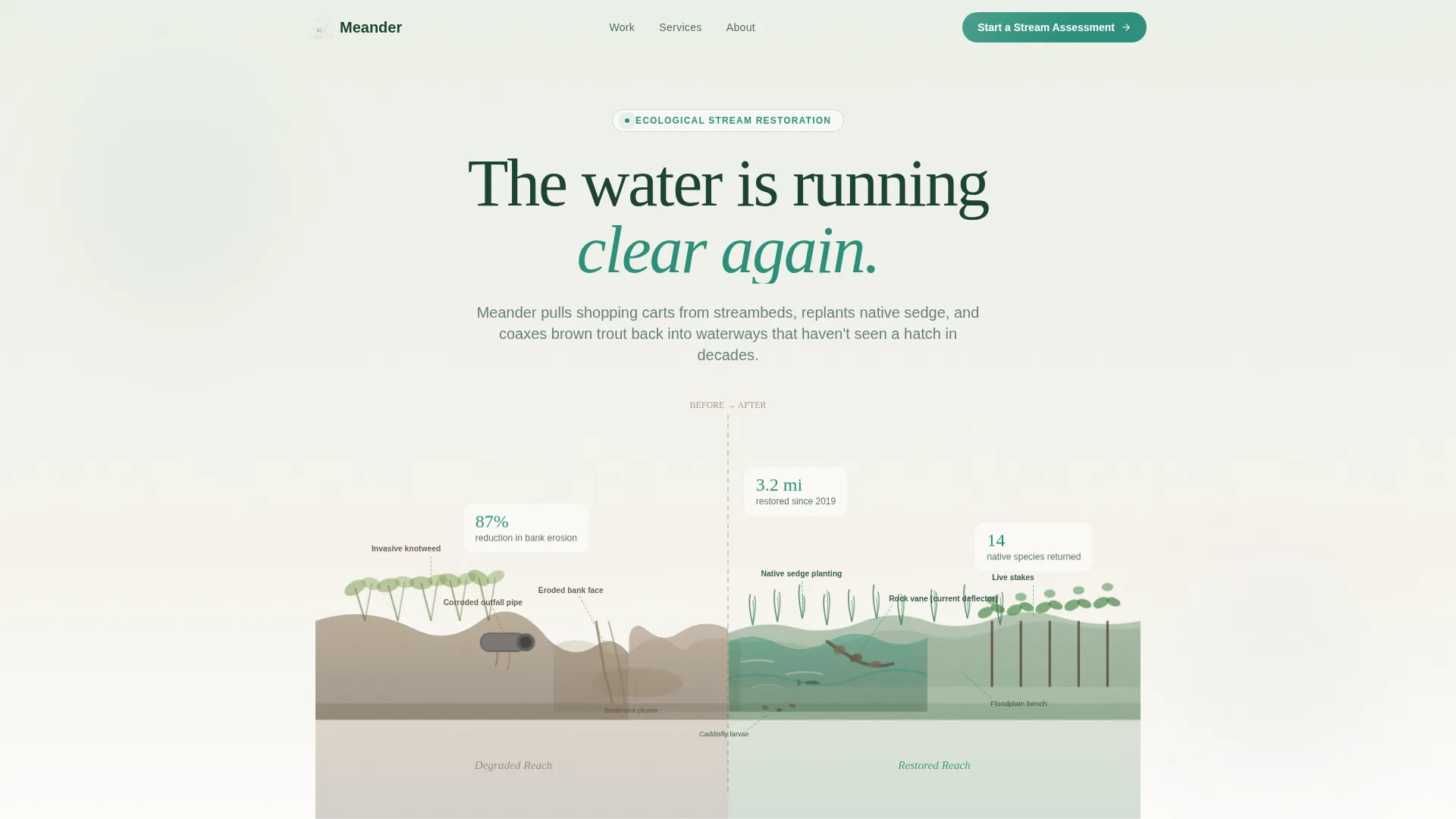
- A full-viewport hero section featuring a hand-illustrated, annotated stream cross-section with floating data callouts and scroll-triggered counter animations
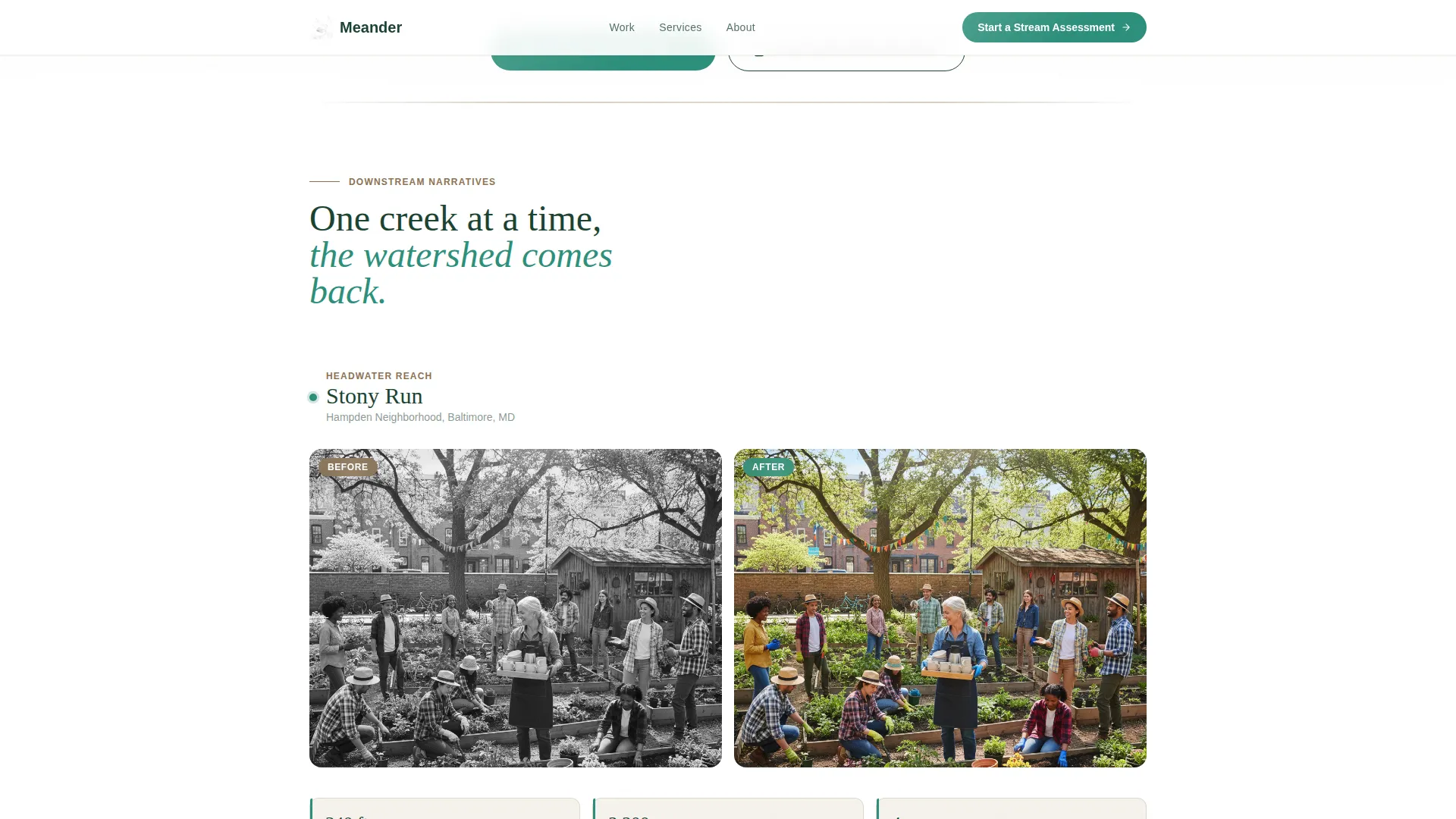
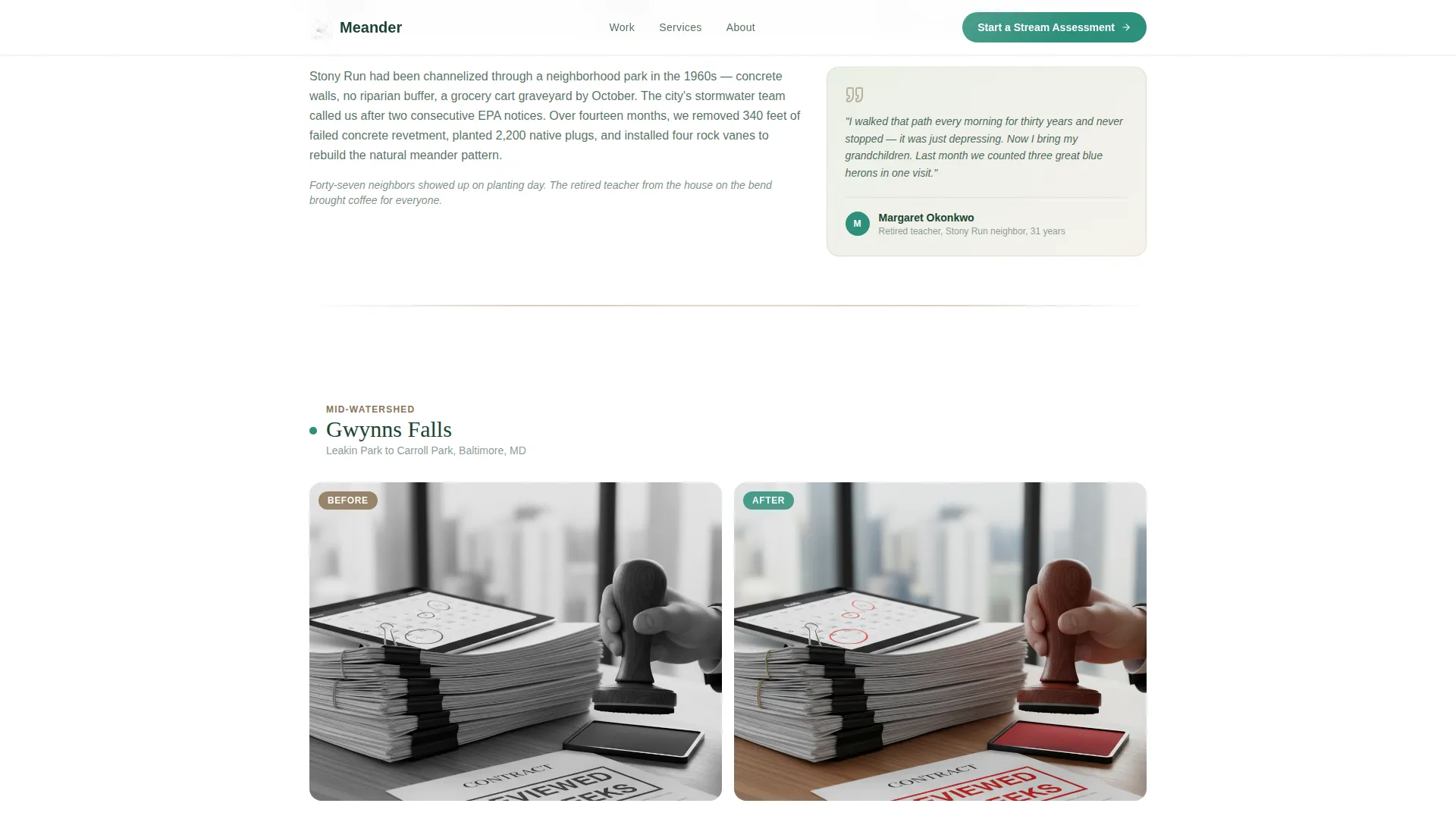
- A community stories section that moves visitors downstream through named creek narratives, before-and-after photographs, and resident testimonials
- A dual-path lead generation section with a primary stream assessment form and a secondary PDF checklist gated behind just an email address
Feature list
This section details the core built-in capabilities that make Meander work as both a storytelling page and a practical lead generation tool.
Illustrated Hero with Animated Callouts
The header fills the full viewport with a hand-illustrated, field-notebook cross-section of a degraded stream transforming into a restored reach. Floating data callouts clip in on scroll and display figures such as bank erosion reduction, native species returned, and total miles restored. The illustration style feels closer to a watershed coordinator's desk than a corporate brochure.
Scroll-Downstream Community Stories
Each story section zooms into a single named creek project. A before photograph, a short community narrative, and a resident testimonial follow a downstream structure, moving from headwater projects to tidal estuary work. The cumulative effect reads like an entire watershed slowly coming back to life.
Services Bento Grid
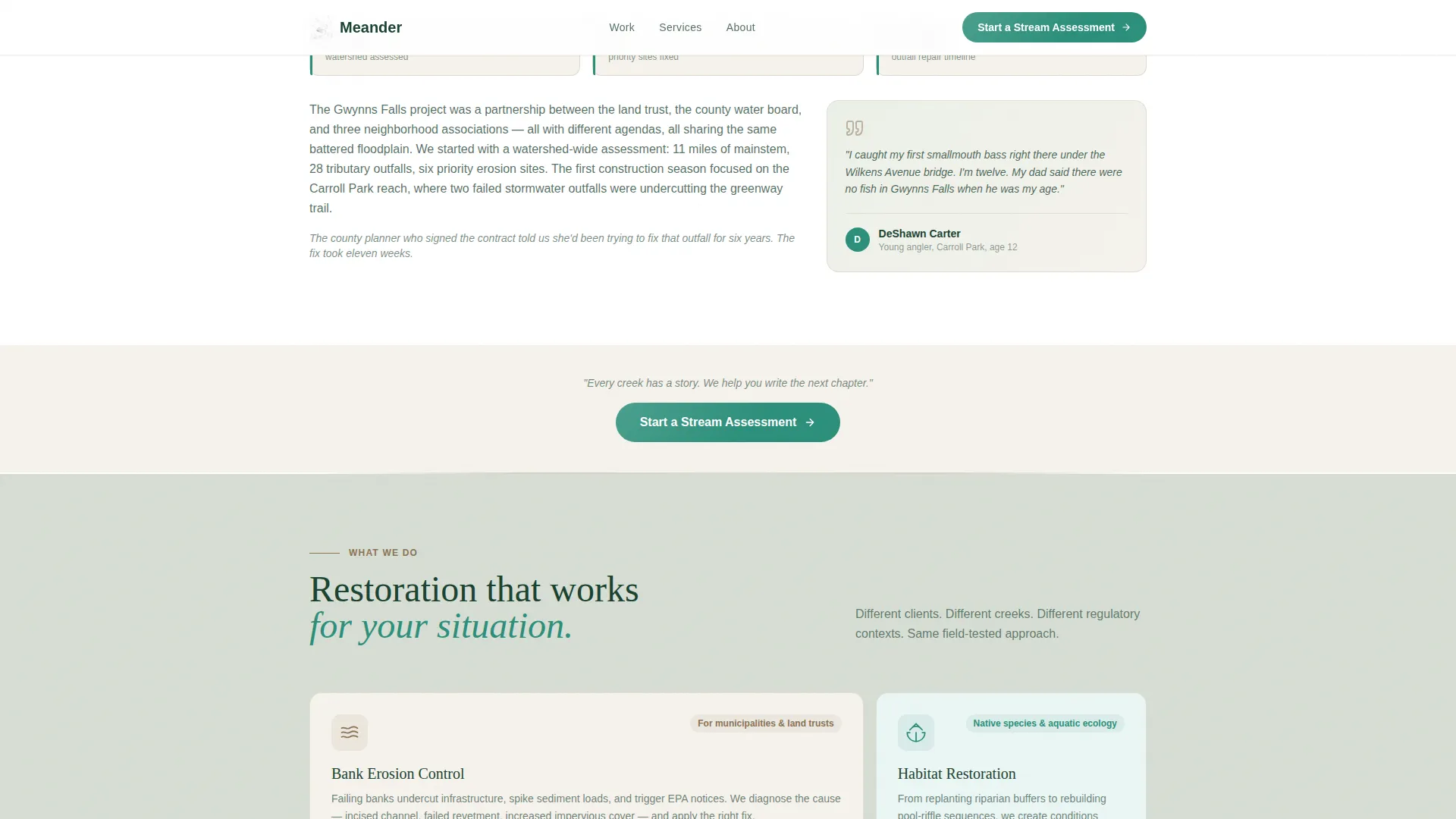
An asymmetric grid presents four core service categories: erosion control, habitat restoration, stormwater compliance, and community greenway development. Spotlight hover cards draw attention to each offering without crowding the page. The layout lets visitors quickly locate the service type most relevant to their project.
Animated Proof and Metrics Panel
A field-notebook styled stats panel uses scroll-triggered counters to surface project metrics. The section reinforces credibility for both technical reviewers and community audiences. Numbers animate into view as visitors reach the section, adding life to the data without distraction.
Layered Lead Generation Form
The primary call to action, "Start a Stream Assessment," collects watershed or creek name, project type, property ownership category, and a phone number. Conditional fields adjust based on project type selection. A secondary path offers a free downloadable PDF, "Your Stream Health Checklist," gated behind an email address alone, designed for advocates who are ready to care but not yet ready to hire.
Single-Row Footer
The footer follows a linear single-row pattern that keeps the page clean and focused. It closes the page without pulling attention away from the lead generation section above it. This approach suits practices that want the form to remain the final destination for every visitor.
Page sections overview
| Section | Purpose |
|---|---|
| Hero illustration | Present an annotated before-and-after stream cross-section with floating data callouts |
| Community creek stories | Walk visitors through named project narratives, before-and-after photos, and resident testimonials |
| Services bento grid | Showcase four core service areas using asymmetric hover cards |
| Proof and metrics | Display animated scroll-triggered project counters in a field-notebook styled panel |
| Lead generation form | Capture assessment leads via a conditional form and offer a PDF checklist secondary path |
| Linear single-row footer | Close the page with a clean, minimal footer that keeps focus on the form above |
Design & branding system
The visual identity follows a Pastoral Calm theme inspired by a wooded floodplain at dawn. Every color and typographic choice reinforces the feeling of a landscape recovering rather than a product being sold.
- Color palette draws from a Rainforest system: deep canopy green (#1B4332) for body text, silt-brown (#8B7355) for section divider rules, morning fog gray (#D6DDD3) and white for alternating backgrounds, and living-water teal (#2D8F7B) reserved for buttons, progress indicators, and hover states
- Typography pairs DM Serif Display for headings with Manrope for body text, creating a warm, editorial feel that sits between a field notebook and a professional report
- Section dividers use a subtle silt-brown rule that reads like a sediment line on a riverbank, giving the page a natural vertical rhythm without hard breaks
Mobile & speed optimization
The template is built desktop-first to serve municipal planners and water board staff on workstations, and it includes full mobile support for community advocates browsing on phones.
- Scroll-triggered animations use IntersectionObserver for efficient loading, so counters and clip-in reveals fire only when each section enters the viewport
- CSS animations handle parallax layers and floating callouts without relying on heavy JavaScript libraries, keeping the visual richness manageable across devices
- The conditional lead generation form adapts its field layout cleanly for smaller screens, keeping the assessment path accessible regardless of device
How this template helps you convert
Meander is structured to move two very different audiences toward action within the same page, without asking either group to work too hard.
- The community story sections build emotional trust early, so neighborhood advocates and first-time visitors feel understood before they encounter any form or call to action
- The "Start a Stream Assessment" call to action appears after the second community story and then anchors to the bottom of the page, catching visitors at peak engagement before the services and proof sections reinforce the decision
- The secondary PDF path, gated behind only an email address, converts visitors who are not ready to schedule an assessment, turning low-commitment browsers into warm leads for later outreach
Other information about this template
This template is part of a broader Agriculture and Environment category, sitting within the Soil and Water Conservation subcategory and the River Restoration niche. A few additional details worth noting before you build with it.
- The creative direction follows a Local and Neighborhood approach, meaning the page is built around specific community stories rather than generic service claims
- The header concept is an Infographic style illustration, which distinguishes it from photography-led or typographic hero approaches common in environmental services templates
- The template is localized for United States projects, using imperial measurements and framing compliance language around EPA regulatory context
- Animation complexity is high, including clip-in reveals, parallax layers, scroll-triggered counters, and floating callout animations, so plan for a content production phase that includes illustrated assets and project photography
- The intersection match score for this template across category, subcategory, and niche alignment is 13, reflecting a well-targeted fit for watershed restoration practices
Theme
Pastoral Calm
Creative direction
Local & Neighborhood
Color system
Rainforest
Style
Single Column Flow
Direction
Lead Generation
Page Sections
Illustrated Hero with Floating Data Callouts
Scroll-downstream Community Stories
Services Bento Grid with Hover Cards
Animated Metrics and Proof Panel
Dual-path Lead Generation Section
Related questions
Who is this landing page template designed for?
What lead capture options are built into this template?
Does this template support multiple service types on one page?
What kind of illustration assets does the hero section need?
Can the community story sections be updated with my own project content?