Marriage Counselor Booking Website Template
Mend is a hub and spoke landing page for marriage counselors. It uses clinical statistics, plain-language anchor navigation, and six condition deep-dives to meet couples where they are. A sticky lead generation form and a free PDF download path turn late-night researchers into booked consultations without a single administrative hurdle.
by Rocket studio
Quick summary
Mend is a single-page marriage counseling template built around emotional recognition and lead capture. Three clinical statistics open the page. A hub of plain-language questions links to six condition deep-dives. A sticky call-to-action bar and a downloadable PDF offer two clear paths forward for visitors at different stages of readiness.
Who this template is for
This template is designed for marriage counselors and couples therapists who want a practice website that speaks to real people, not clinical gatekeepers. It works especially well when the practice serves clients who arrive scared, skeptical, or mid-crisis.
- Solo practitioners and small therapy practices focused on couples work
- Counselors who want to pre-qualify leads through condition recognition before the first session
- Therapists whose referrals come from pediatricians, mediators, or word of mouth
What problem this template solves
Most therapy practice pages feel like intake forms dressed up with stock photography. They list credentials and session rates, then ask the visitor to take a leap of faith. That structure fails the person who typed "is my marriage normal" at one in the morning.
- Visitors leave before they feel seen, because the page never names their specific pattern
- Generic contact forms ask for insurance details before offering any emotional reason to stay
- Pages built for professional credibility miss the one thing the visitor actually needs: recognition
What you get with this template
This template gives you a complete, ready-to-customize single landing page built around the journey from silent dread to booked session. Every section serves a specific conversion role without feeling transactional.
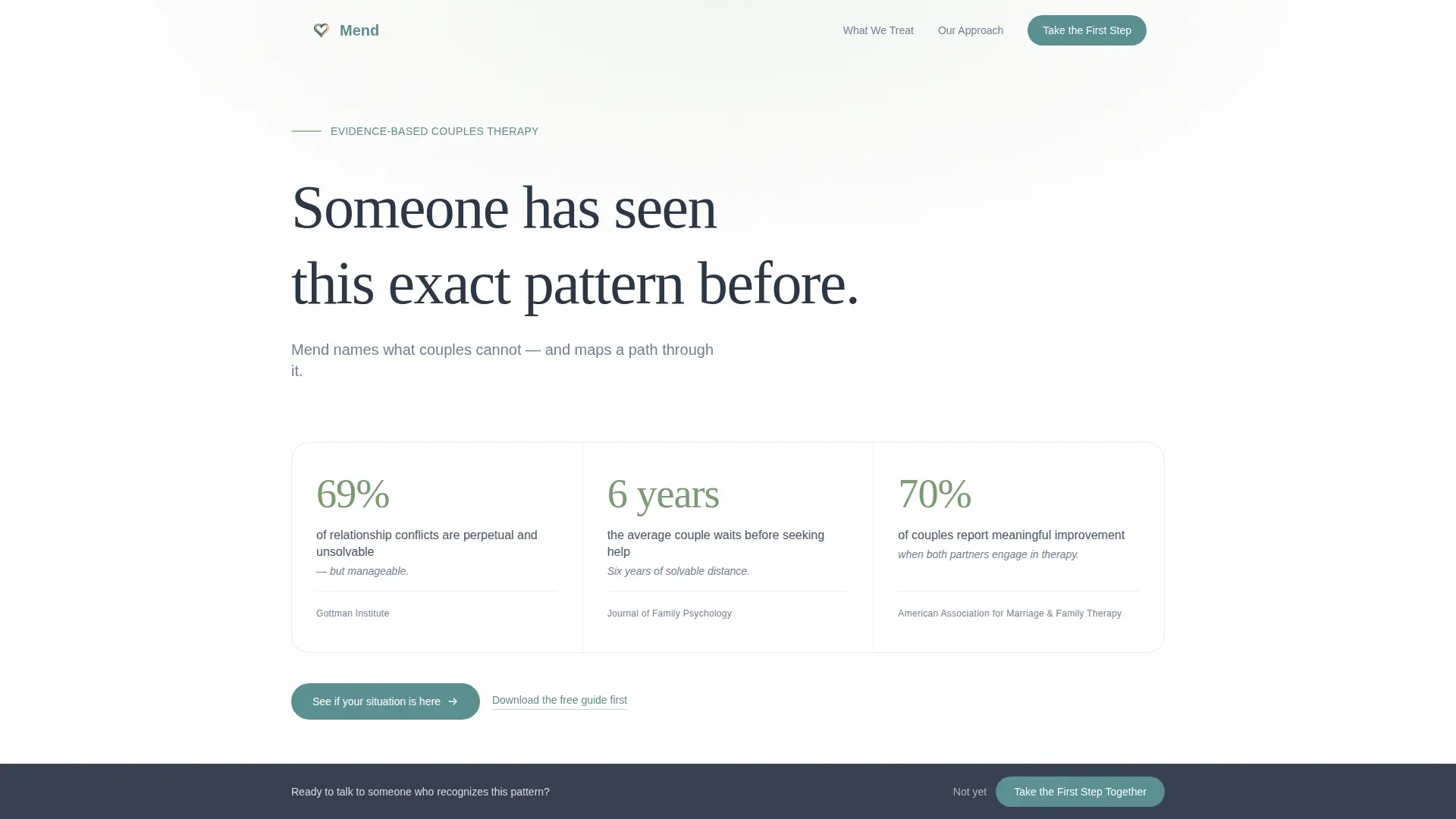
- A stats-driven hero section with three research-backed statistics typeset for emotional impact
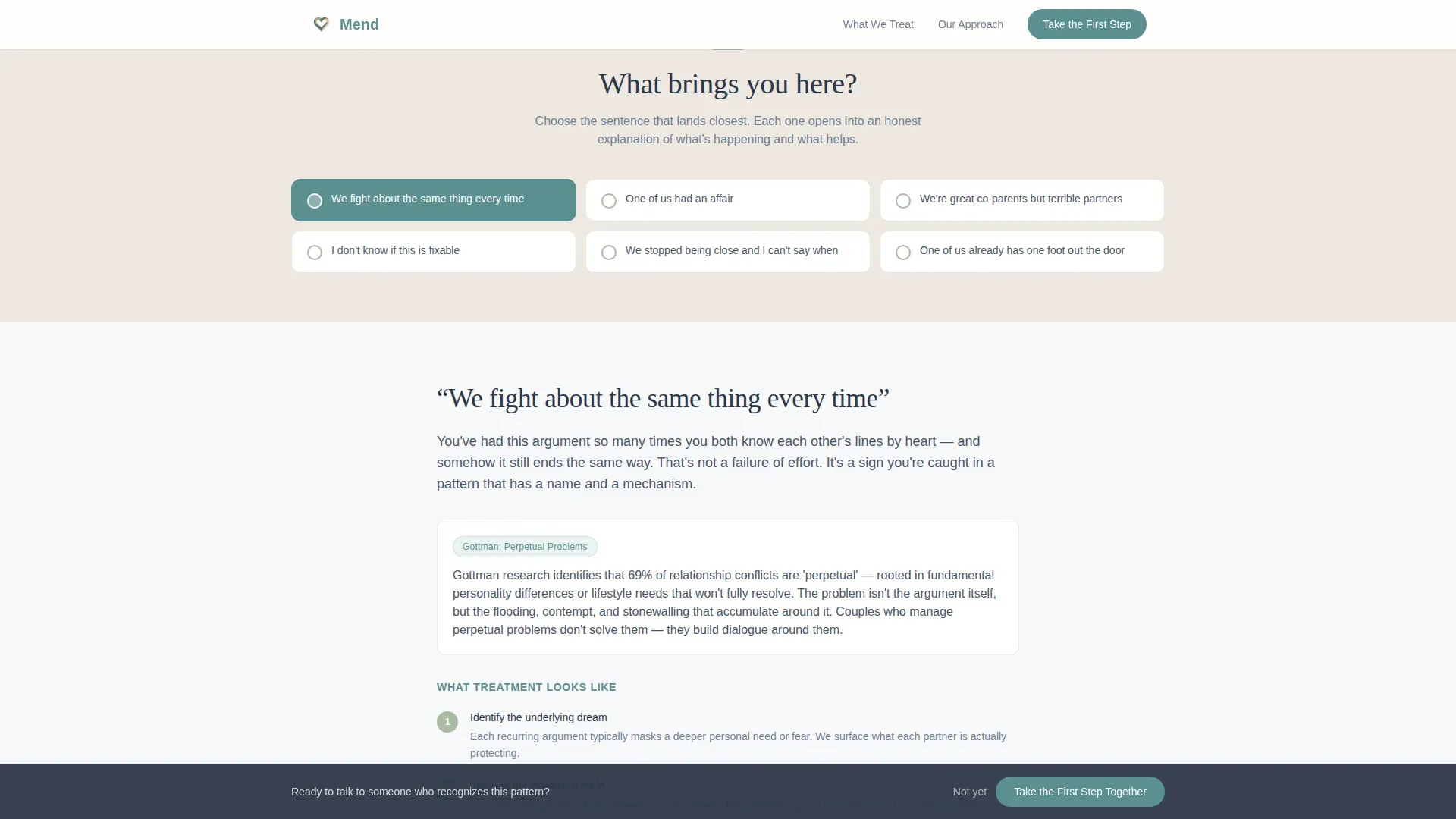
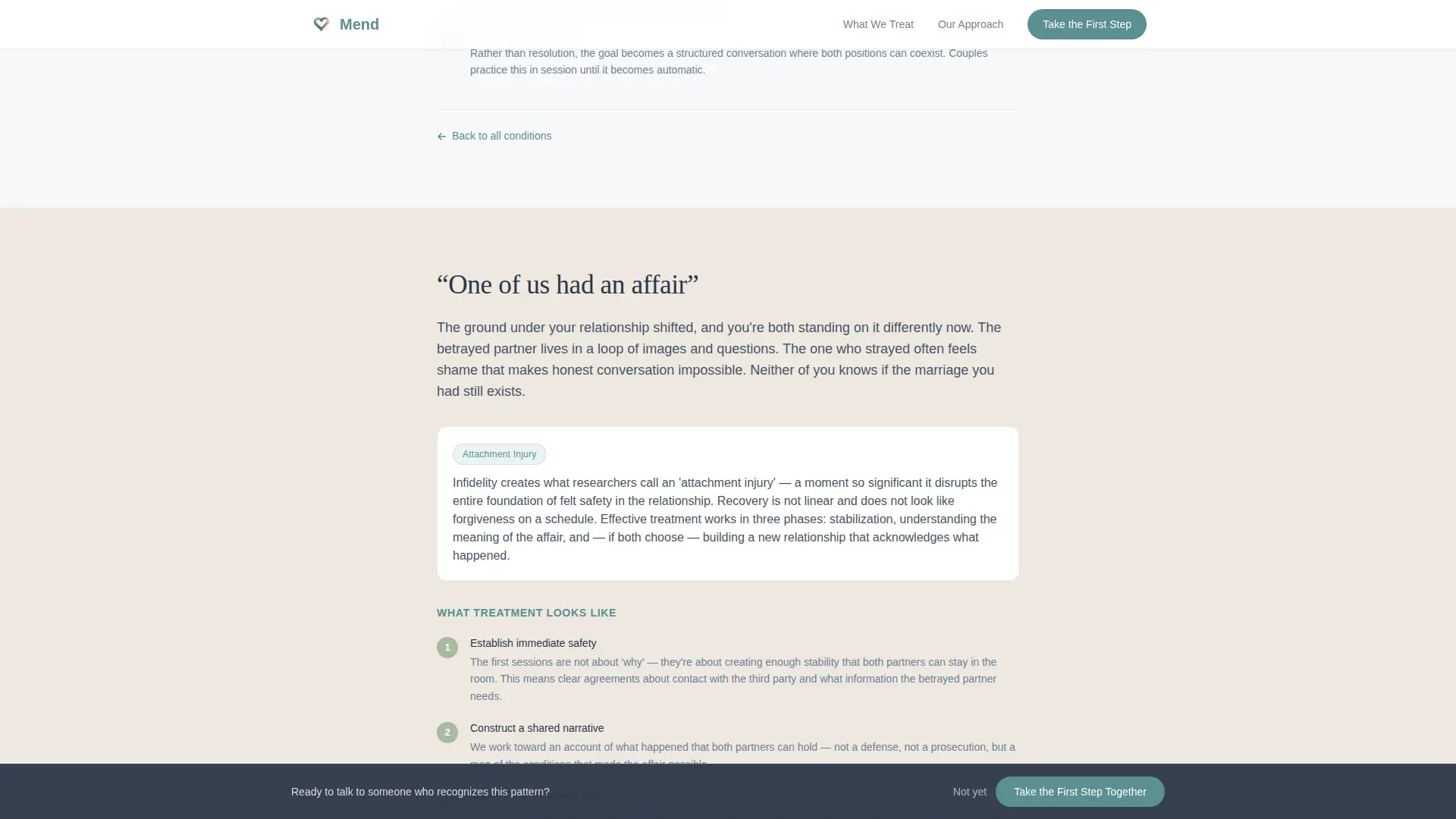
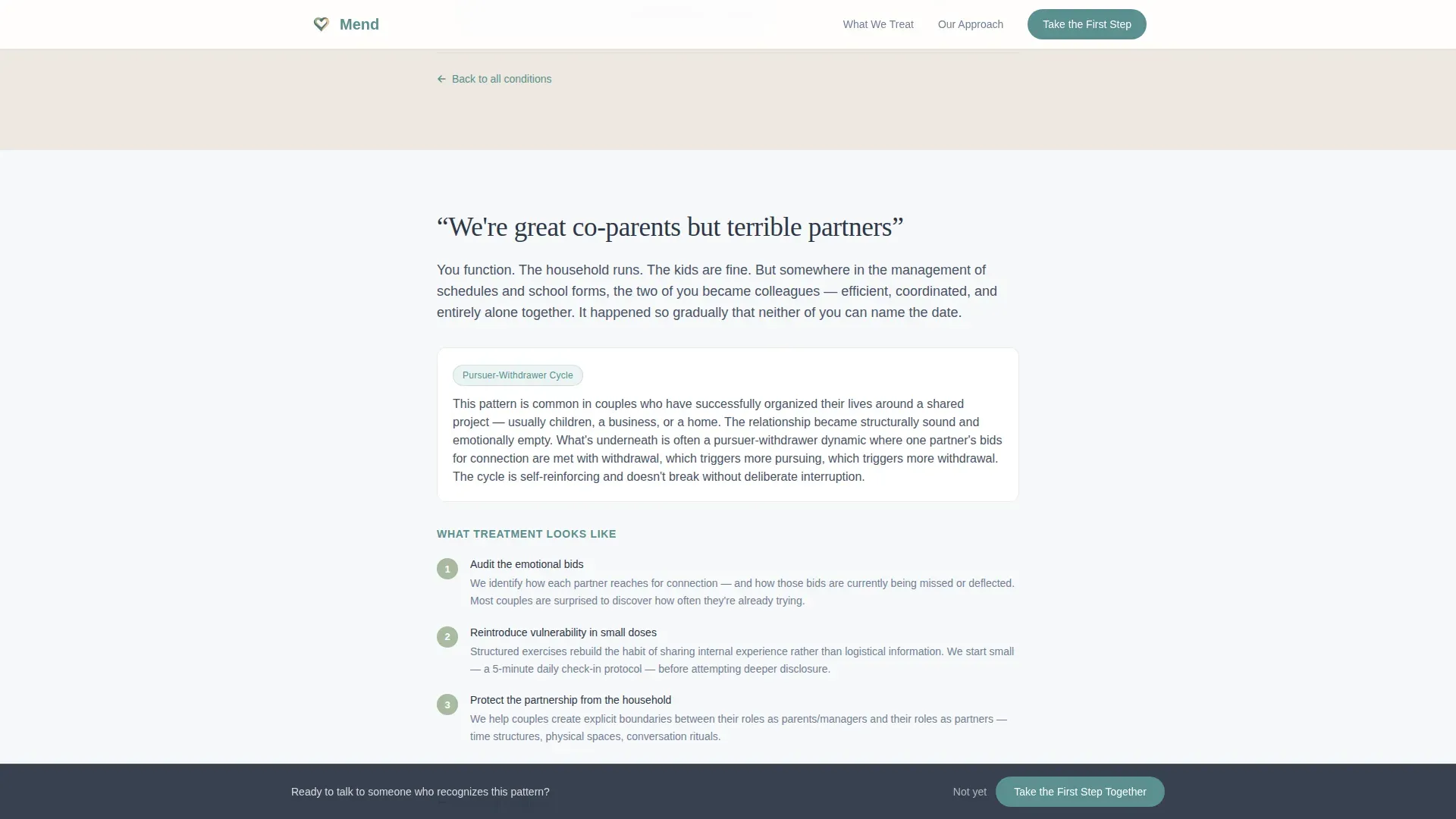
- A hub anchor navigation and six condition deep-dives written in plain, human language
- A lead generation form, a sticky call-to-action bar, and a secondary PDF download path
Feature list
This template packs a specific set of purpose-built components into one cohesive landing page. Each one is designed to lower resistance and build the small commitments that lead to a booked session.
Stats and Metrics Hero Display
Three clinical statistics are centered on a clean white field with no photography, no animation, and no decorative clutter. Key figures are typeset at display scale in therapeutic sage so the numbers carry the emotional weight on their own.
Hub and Spoke Anchor Navigation
A central navigation block lists six relationship concerns written the way real people search for them, not the way a clinical manual would classify them. Each entry scrolls to its own deep-dive section and returns the visitor to the hub with a soft teal back-link.
Condition Deep-Dive Sections
Each spoke section opens by stating the plain-language concern, validates the feeling in two sentences, names the clinical pattern underneath it, and then describes the treatment approach in concrete steps. Six conditions are covered across the full page.
Sticky Lead Generation Bar
A bottom bar appears after the visitor has engaged with any two spoke sections. This timing signals readiness. The bar stays anchored to the viewport and surfaces the primary call to action at exactly the right moment.
Emotional Micro-Commitment Form
The lead form asks for first names, a condition dropdown, a preferred session format, and one open question. A checkbox reads "My partner doesn't know I'm here yet, and that's okay." No insurance questions, no lengthy intake fields.
Free PDF Download Path
A secondary conversion path offers a downloadable guide in exchange for an email address. This catches visitors who are not yet ready to book but are willing to take a smaller step toward engaging with the practice.
Page sections overview
| Section | Purpose |
|---|---|
| Hero Stats Display | Opens with three research-backed statistics to establish credibility and emotional resonance |
| Hub Anchor Navigation | Lists six plain-language conditions as clickable links that scroll to deep-dive sections |
| Condition Deep-Dive Sections | Each spoke names a clinical pattern and describes the treatment path in concrete steps |
| Lead Generation Form | Captures first names, condition match, session format preference, and one open question |
| PDF Download Offer | Secondary email capture for visitors who prefer to read before they reach out |
| Footer | Single-row linear footer with practice links and minimal supporting information |
Design & branding system
The visual identity follows a Medical Clarity direction. Every color, typeface, and spacing decision is chosen to feel warm and clinical at the same time, lowering the visitor's guard without sacrificing professional trust.
- Color palette: morning fog white (#F7F8FA), therapeutic sage (#A8BBA0), warm parchment (#EDE8E0), grounding slate (#4A5568) for body text, and muted teal (#5B8F8F) for accent links and active navigation states
- Typography pairing: Fraunces serif for display headings, DM Sans for body copy, creating a balance of warmth and readability
- Animations are kept low to medium intensity, using line reveals and scroll-triggered fades rather than motion that distracts or delays
Mobile & speed optimization
The template is built mobile-first because the primary visitor is likely on a phone late at night. Every section stacks cleanly, the sticky bar is thumb-friendly, and the form fields are sized for one-handed input.
- Scroll-triggered fades and the sticky call-to-action bar are handled as client components to keep static sections fast
- Server components power the static content sections, keeping the initial page load lean
- Typography scales are tested for small screens so the stats display remains legible at mobile viewport widths
How this template helps you convert
The conversion strategy is built on a principle of progressive commitment. Each interaction asks for a slightly larger step, only after the visitor has already received something of value.
- The stats hero establishes credibility before asking for anything, so the visitor arrives at the hub with a reason to stay.
- The condition deep-dives create the experience of being understood, making the lead form feel like the natural next step rather than an interruption.
- The sticky bar and PDF offer provide two separate conversion paths, so both ready-to-book visitors and hesitant researchers have a clear route forward.
Other information about this template
This template is built for the Health and Medical category, specifically for the marriage counselor condition and treatment library niche. It is designed as a hub and spoke landing page, meaning all content lives on one scrollable page organized around a central anchor navigation.
- The page uses a Soft Mist color system, a palette selected to feel like a therapist's office rather than a medical clinic
- The FAQ-driven creative direction means condition sections are written the way clients think and search, not the way practitioners document
- The header concept is Stats and Metrics, deliberately avoiding photography in favor of numbers that carry emotional weight on their own
- The lead generation direction means every design decision, from form field labels to sticky bar timing, is oriented toward capturing a first-name and an intent signal, not completing an intake process
Theme
Medical Clarity
Creative direction
FAQ-Driven
Color system
Soft Mist
Style
Hub & Spoke (Anchor Nav)
Direction
Lead Generation
Page Sections
Stats and Metrics Hero Section
Hub Anchor Navigation
Condition Deep-dive Spoke Sections
Sticky Lead Generation Bar
Emotional Micro-commitment Form
Secondary PDF Download Path
Related questions
Can I change the six condition topics to match my practice focus?
What does the lead form actually collect from visitors?
Do I need to create the PDF myself, or is it included?
When does the sticky call-to-action bar appear on screen?
Is this template suitable for a solo marriage counselor, not just a larger practice?