Podiatry & Foot Care Booking Website Template
Mend is a single-column landing page template built for wound care and foot ulcer clinics. It guides visitors through a self-assessment checklist, a side-by-side care protocol comparison, and a gated checklist download. The Forest Trust color system and Fraunces serif typography create a tone of clinical warmth, earning patient trust before asking for a booking.
by Rocket studio
Quick summary
Mend is a focused, single-column landing page template for wound care clinics treating diabetic foot ulcers, post-surgical wounds, and chronic non-healing wounds. It walks visitors through a scroll-driven self-assessment, builds credibility with a care protocol comparison, and converts through two clear paths: a gated checklist download and a short wound evaluation request form.
Who this template is for
This template is designed for wound care specialists and podiatry clinics that treat patients who have not found healing through standard care. It also fits clinics looking to reach caregivers who are researching options for elderly parents.
- Wound care clinics treating diabetic foot ulcers and chronic non-healing wounds
- Podiatrists and post-surgical care providers seeking patient acquisition pages
- Adult caregivers and family members researching specialist options for a loved one
What problem this template solves
Many patients with chronic wounds spend months cycling through general practitioners without receiving specialist-level guidance. They arrive at a wound care clinic confused, undertreated, and unsure whether their wound is serious enough to warrant a visit.
- Patients do not know the warning signs that signal a wound needs specialist attention
- Side-by-side protocol comparisons are missing from most clinic pages, leaving patients unable to evaluate care quality
- Clinics lack a low-friction entry point that converts researchers into booked evaluations
What you get with this template
This template delivers a complete, ready-to-customize landing page structured around patient education and trust-building. Every section is purposefully ordered to move a hesitant visitor toward confident action.
- A scroll-triggered animated checklist revealing five clinical warning signs with moss-green check animations
- A side-by-side care protocol comparison panel with hover states showing standard care versus specialist-level wound management
- Two conversion paths: a gated two-field checklist download form and a short wound evaluation intake form
Feature list
This template includes a focused set of interactive and structural components. Each one is built to serve the specific needs of a wound care patient acquisition page.
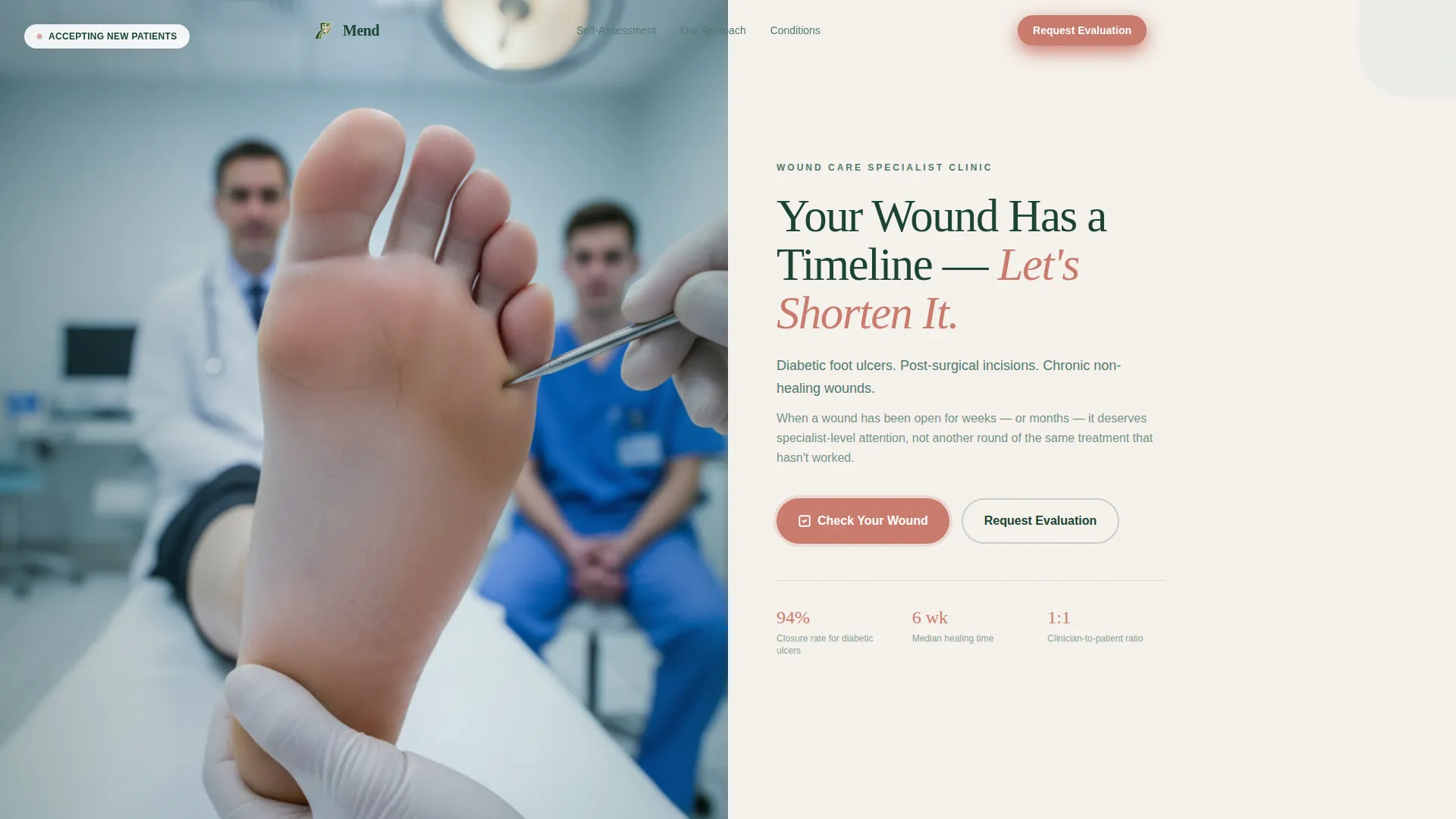
Cinematic Hero Section
The hero uses a half-page split layout. A clinical photograph sits on the left, framed at table level to feel intimate and specific. The headline and three-condition subhead appear on the right over a birch cream background.
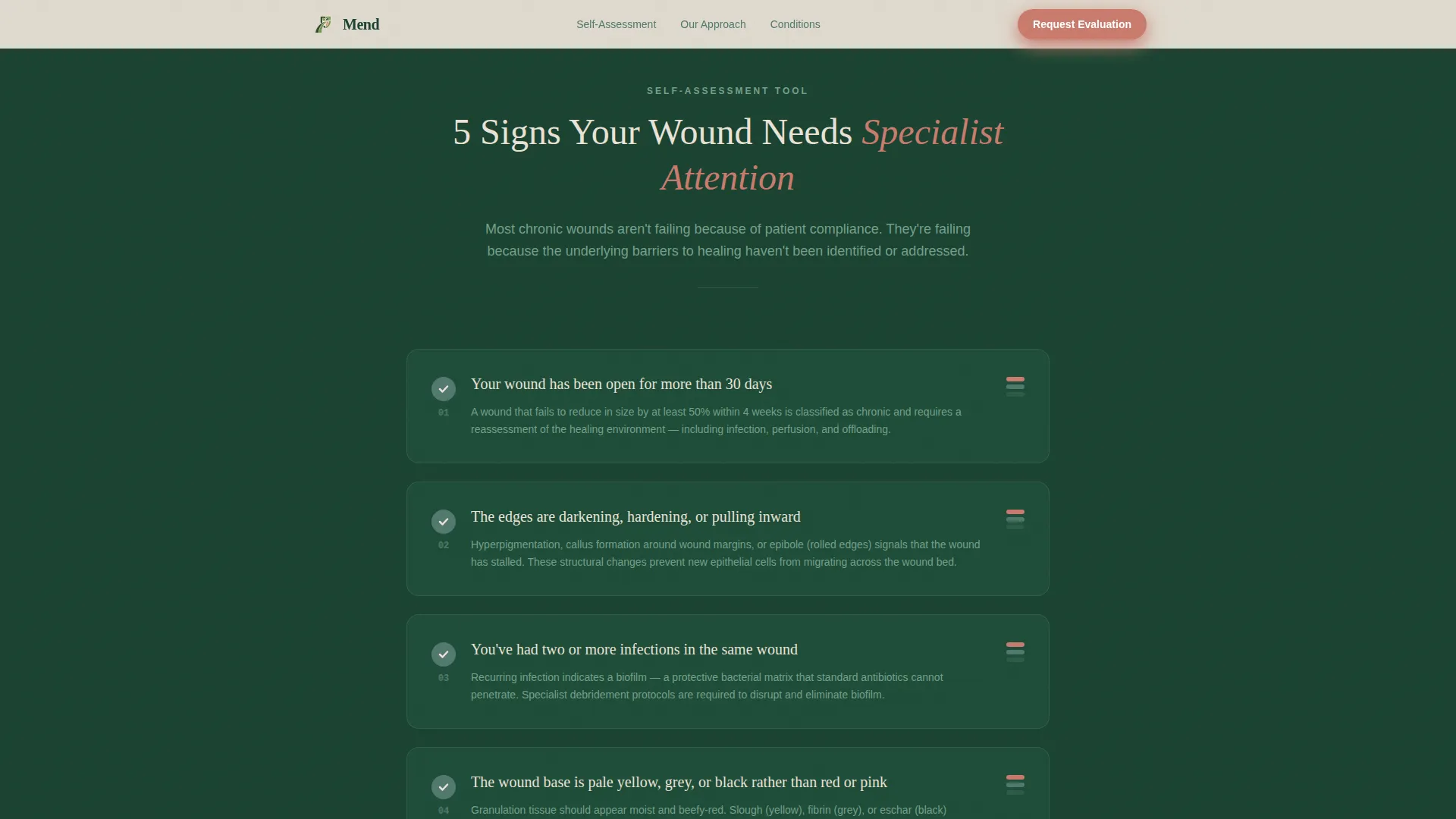
Scroll-Triggered Self-Assessment Checklist
Five warning signs are revealed one at a time on scroll. Each item names a specific symptom, such as a wound open longer than 30 days or darkening edges, and pairs it with a brief clinical explanation. Moss-green check animations reinforce each reveal.
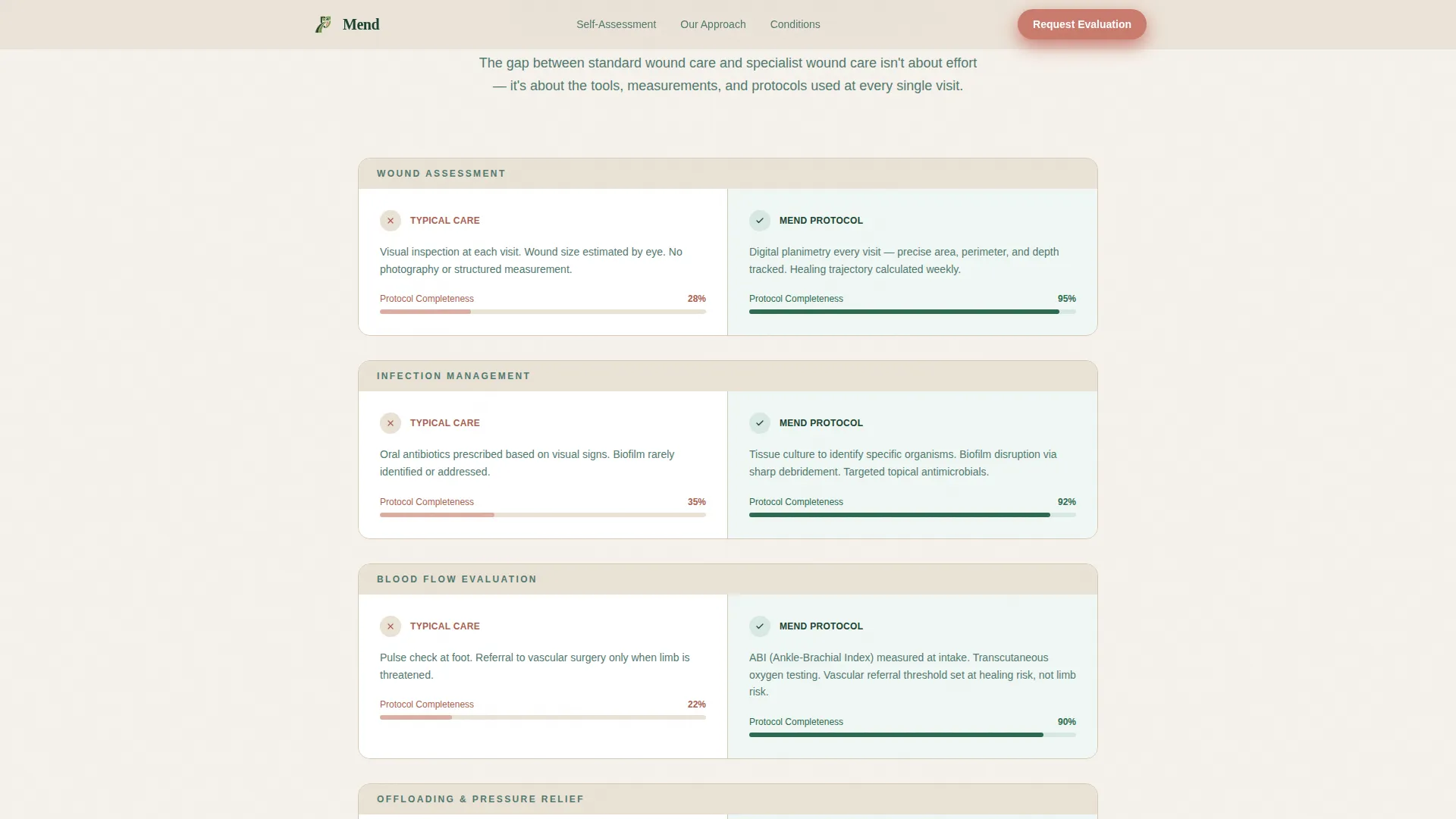
Care Protocol Comparison Panel
A side-by-side audit shows what patients typically receive versus the specialist approach. Hover states activate on desktop to surface additional detail. This section builds the case for specialist care methodically and without pressure.
Conditions Treated Cards
Three bento-style cards cover diabetic foot ulcers, post-surgical wounds, and chronic non-healing wounds. Each card gives patients a clear entry point to recognize their own situation.
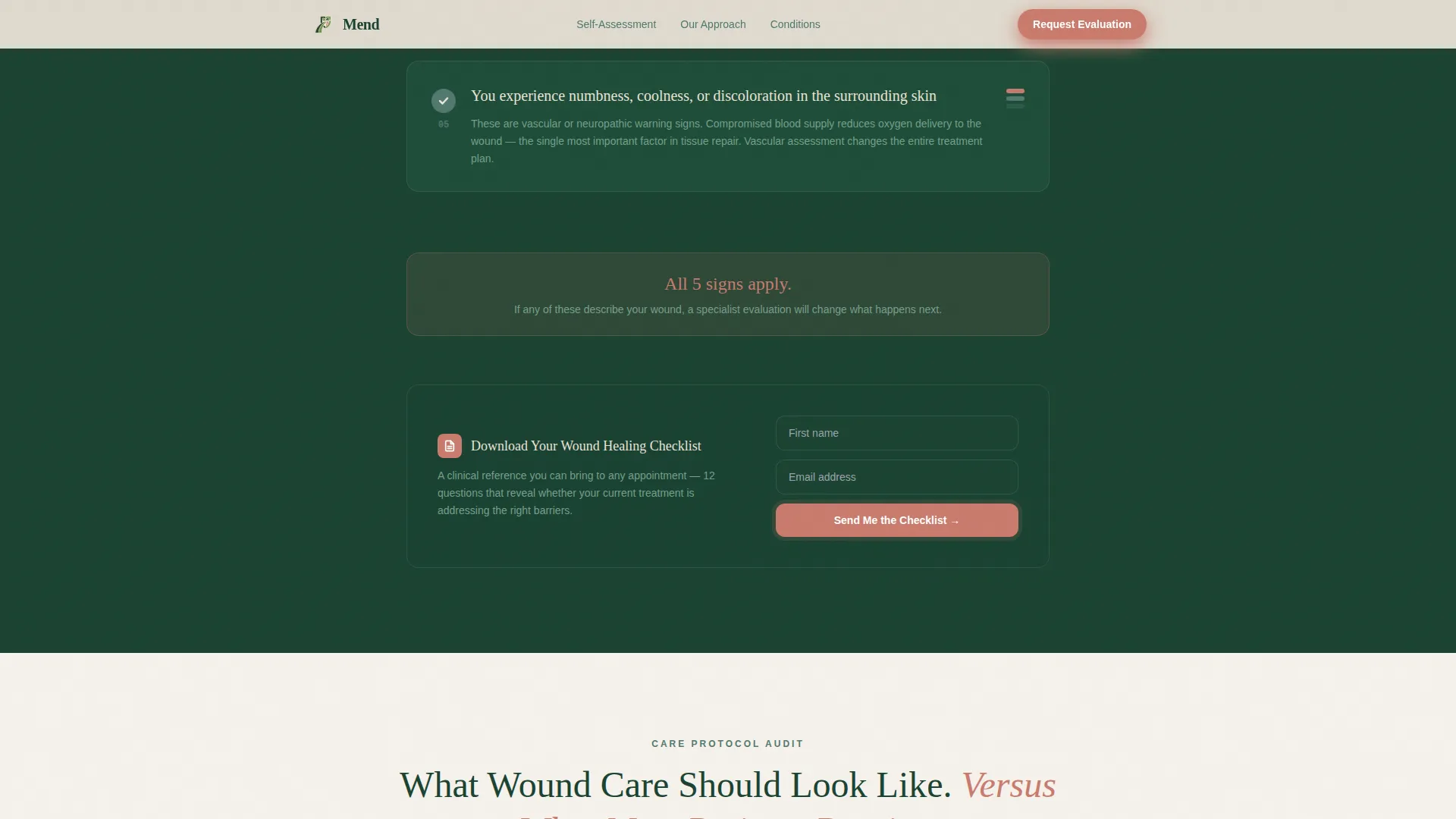
Gated Checklist Download Form
A two-field form collects first name and email in exchange for the wound healing checklist. It appears directly after the self-assessment section and again at the bottom of the page. A mock form submission handler is included.
Wound Evaluation Intake Form
A short secondary form asks for wound location, duration in weeks, and current treatment. It sits inside the request evaluation section and provides a low-barrier path for patients ready to book.
Page sections overview
| Section | Purpose |
|---|---|
| Hero split layout | Introduces the clinic headline and three core conditions treated |
| Self-assessment checklist | Helps visitors identify five clinical warning signs on scroll |
| Checklist download form | Captures first name and email in exchange for the wound checklist |
| Care protocol comparison | Contrasts standard care with specialist wound management side by side |
| Conditions treated cards | Presents diabetic foot ulcers, post-surgical, and chronic wound cards |
| Wound evaluation form | Collects wound location, duration, and current treatment for intake |
| Page footer | Single-row linear footer with clinic navigation and contact links |
Design & branding system
The visual identity follows a Healing Space theme built on the Forest Trust color system. The result is a palette that feels grounded and regenerative without losing clinical credibility.
- Deep evergreen (#1B4332) anchors backgrounds and headers; soft moss (#52796F) carries body text and secondary panels; birch bark cream (#EAE2D6) creates breathing room between sections
- Living-tissue rose (#C97B6D) appears only on calls to action and progress indicators, reserved to direct attention precisely where action is needed
- Fraunces serif headings pair with DM Sans body text to balance organic warmth with clean clinical readability
Mobile & speed optimization
The template is built desktop-first, with a strong mobile adaptation designed for caregivers researching on phones. Interactive components are split into Server Components for static content and Client Components for animated and form-driven elements.
- Scroll-triggered checklist animations and form handlers are isolated as Client Components to keep static sections lightweight
- Staggered section entries and a subtle hero parallax effect are tuned for smooth desktop rendering and graceful mobile fallback
- The single-column flow collapses naturally on smaller screens without requiring separate mobile layout overrides
How this template helps you convert
The page earns conversion by delivering clinical value before asking for anything in return. Visitors leave each section more informed than when they arrived, which builds the confidence needed to act.
- The self-assessment checklist gives visitors an immediate, personal reason to stay. By the time they finish reading, they have already identified whether their wound qualifies for specialist care.
- The care protocol comparison reframes the visit as an upgrade, not just another appointment. Patients understand exactly what they have been missing and why this clinic is different.
- Two distinct conversion paths accommodate visitors at different stages. The checklist download captures researchers who are not ready to book, while the evaluation intake form converts patients who are ready to act now.
Other information about this template
This template is part of the Mend visual identity system, a design language built specifically for healthcare providers working in high-stakes patient acquisition contexts. A few additional details worth knowing before you start building:
- The template uses Fraunces and DM Sans, both available through Google Fonts, making typography setup straightforward
- Tissue rose (#C97B6D) is intentionally restricted to calls to action only; using it elsewhere weakens its directional signal
- The footer follows a linear single-row pattern suitable for clinics with a small navigation set
- The template supports English (United States) localization with standard United States date formatting and no currency display
- Clinical specificity is the primary trust signal throughout; the template is designed to carry real symptom names, protocol details, and healing metrics rather than generic medical copy
Theme
Healing Space
Creative direction
Checklist & Audit
Color system
Forest Trust
Style
Single Column Flow
Direction
Content/Resource
Page Sections
Scroll-triggered Warning Sign Checklist
Side-by-side Protocol Comparison
Gated Checklist Download Form
Wound Evaluation Intake Form
Conditions Treated Bento Cards
Cinematic Split Hero Layout
Related questions
What types of wound care clinics is this template best suited for?
Can I use this template to capture patient leads before they book an appointment?
How many sections does this landing page template include?
Are the scroll animations included in the template build?
Can I update the color system to match my clinic's existing branding?