Mesa - Agrarian Ecuadorian Restaurant Landing Page Template
Mesa is a gallery and detail landing page template designed for authentic Ecuadorian restaurants. It combines a scroll-triggered Before/After dish reveal gallery, a macro close-up hero, and a three-step reservation form to turn visitor curiosity into confirmed bookings. The Agrarian Root visual identity uses volcanic earth tones, warm serif typography, and clay-textured backgrounds to place every visitor at the table before they ever arrive.
by Rocket studio
Quick summary
Mesa is a single-page restaurant template built around one goal: make visitors hungry enough to book a table. A macro close-up hero, a scroll-triggered ingredient-to-plate gallery, a three-step reservation form, and a warm Agrarian Root design system work together to carry diners from first impression to confirmed reservation without friction.
Who this template is for
This template is designed for Ecuadorian restaurant owners who want a web presence that feels as real as the food. It suits operators serving diaspora communities, curious food explorers, and event planners who need a catering path alongside a dining one.
- Restaurant owners serving homesick Ecuadorian families who drive for Sunday encebollado
- Food-forward dining spots that attract adventurous couples and press-curious diners
- Operators who handle both table reservations and corporate catering inquiries
What problem this template solves
Most restaurant landing pages fail to communicate flavor, story, or place. They list dishes without making visitors feel anything. Mesa solves the gap between a menu and an experience. It gives each dish a before-and-after life, pairing raw ingredients from the field with the finished plate and a short origin story.
- Visitors leave generic restaurant pages without booking because nothing earns their attention
- Catering clients have no clear secondary path on most restaurant sites, so they look elsewhere
- Cultural authenticity is hard to communicate through stock layouts and generic color schemes
What you get with this template
You get a fully structured single-page layout designed for gallery-led storytelling and booking conversion. Every section is production-ready and purposeful, from the hero photograph to the footer split.
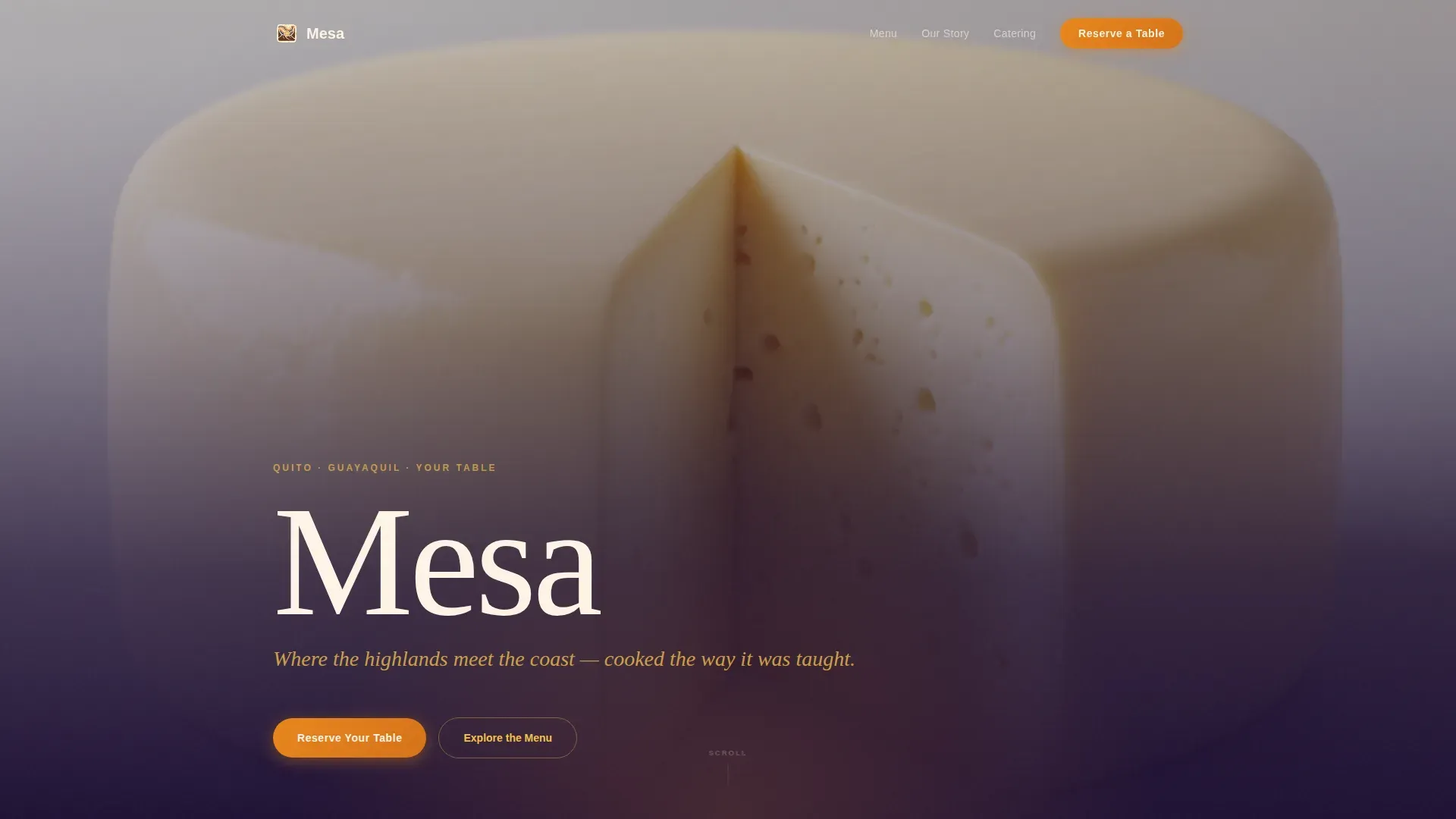
- A macro close-up hero section with restaurant name in warm serif typography rising from the food
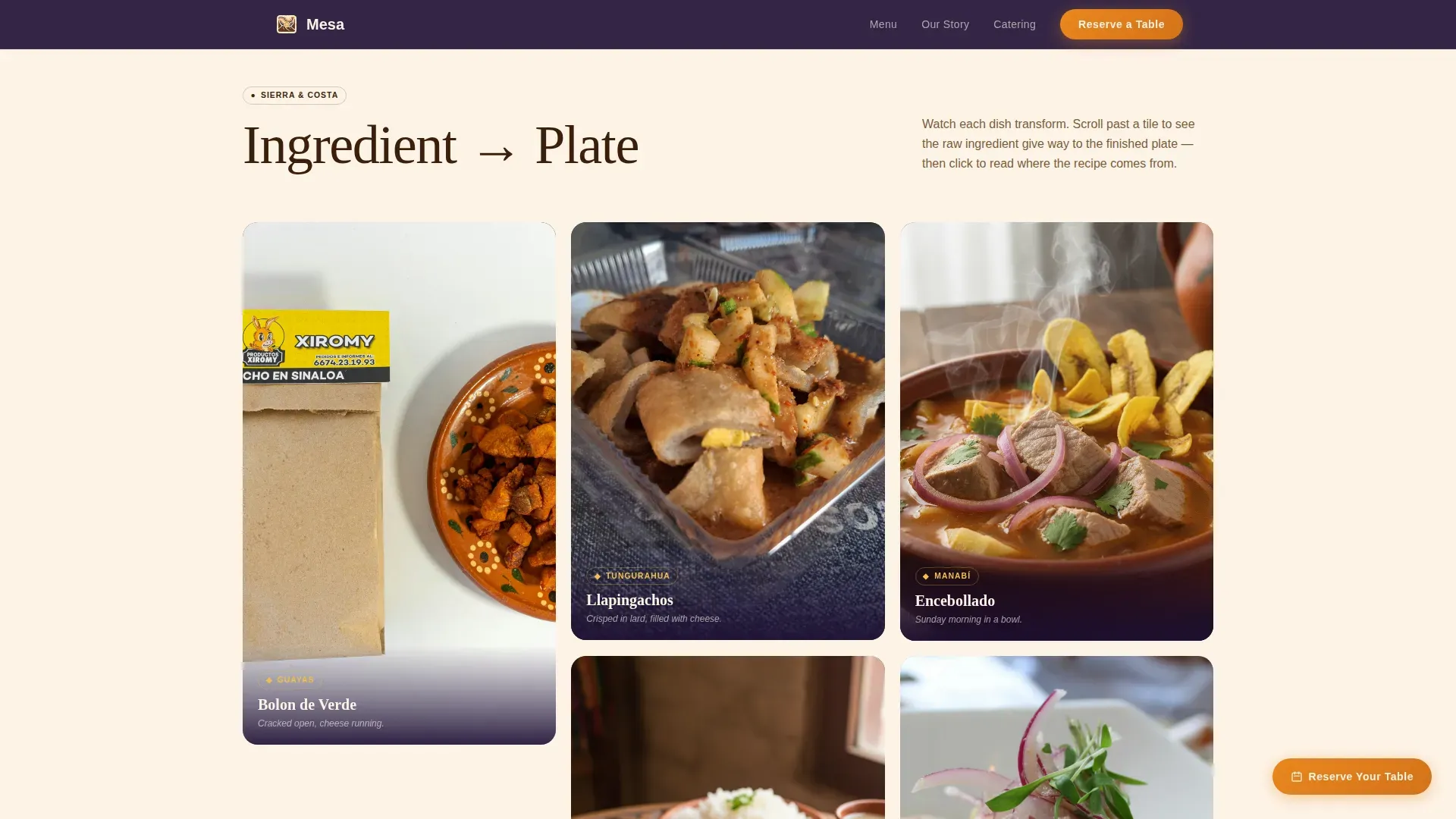
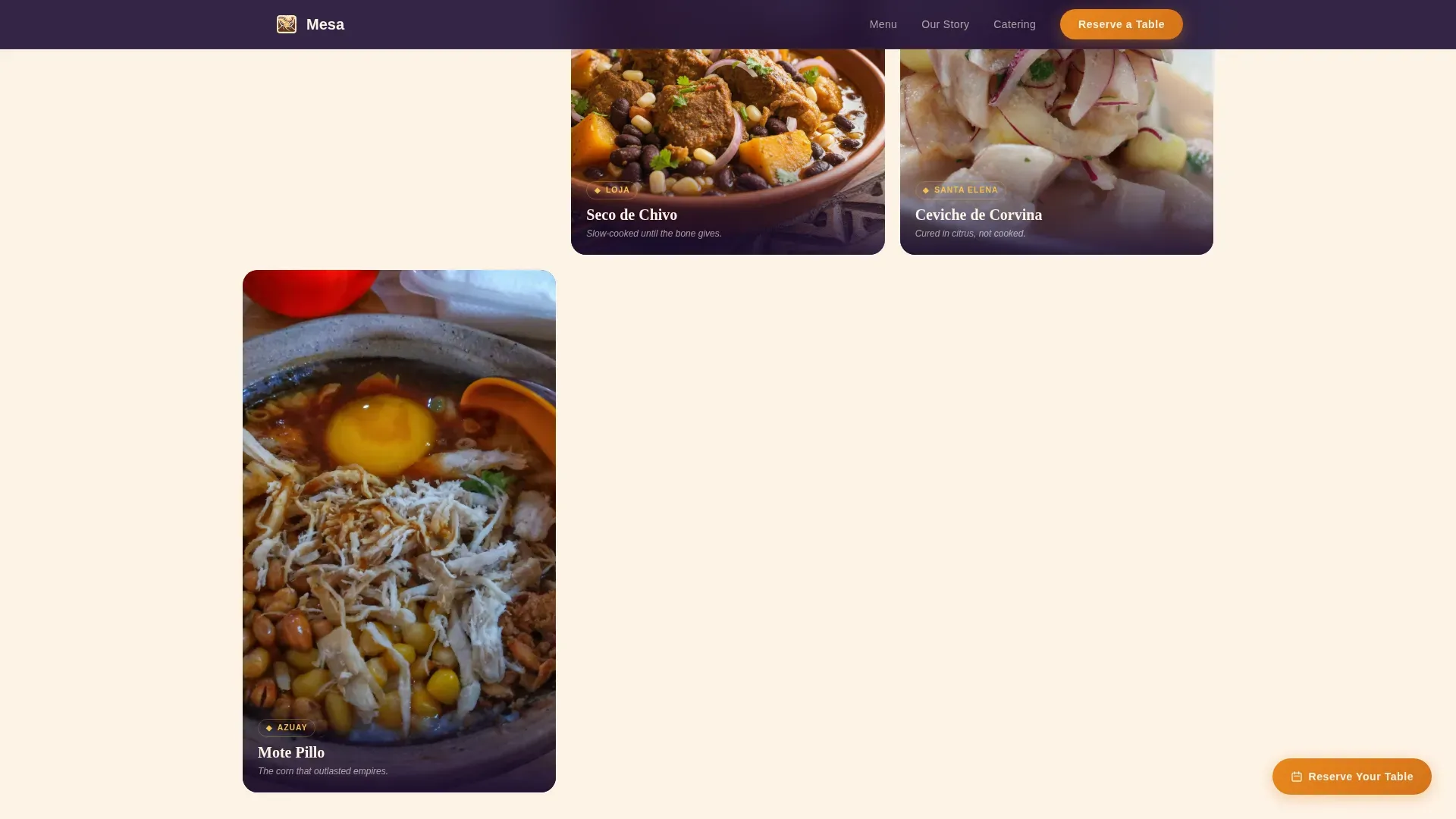
- A six-tile dish gallery with scroll-triggered before/after wipe reveals and expandable detail panels
- A three-step reservation form with an optional catering secondary call to action
Feature list
This template is designed around five core capabilities, each drawn directly from the project brief.
Scroll-Triggered Before/After Dish Gallery
Each dish tile opens with a raw ingredient portrait, then wipes to the finished plate on scroll. Clicking any tile expands a detail panel where a two-sentence origin story explains which province the recipe comes from and whose hands taught it. The gallery is designed to hold six to eight dishes and build appetite progressively as visitors scroll.
Macro Close-Up Hero with Floating Call to Action
The hero is a tightly framed, shallow-depth-of-field photograph designed to fill the screen with texture and steam. The restaurant name rises in a warm serif font as the first typographic moment. After the hero scrolls past, a floating "Reserve Your Table" button in naranjilla orange stays pinned to the viewport to secure the booking path at all times.
Three-Step Reservation Form
The reservation form is designed to prepare visitors to book in three quick steps: date, party size, and time preference (lunch or dinner). An optional fourth field captures celebration notes or dietary context. A secondary "Order Catering" path links to a tray-selection flow for larger events, so office managers and event planners find a clear route without trouble navigating away.
Restaurant Story Section
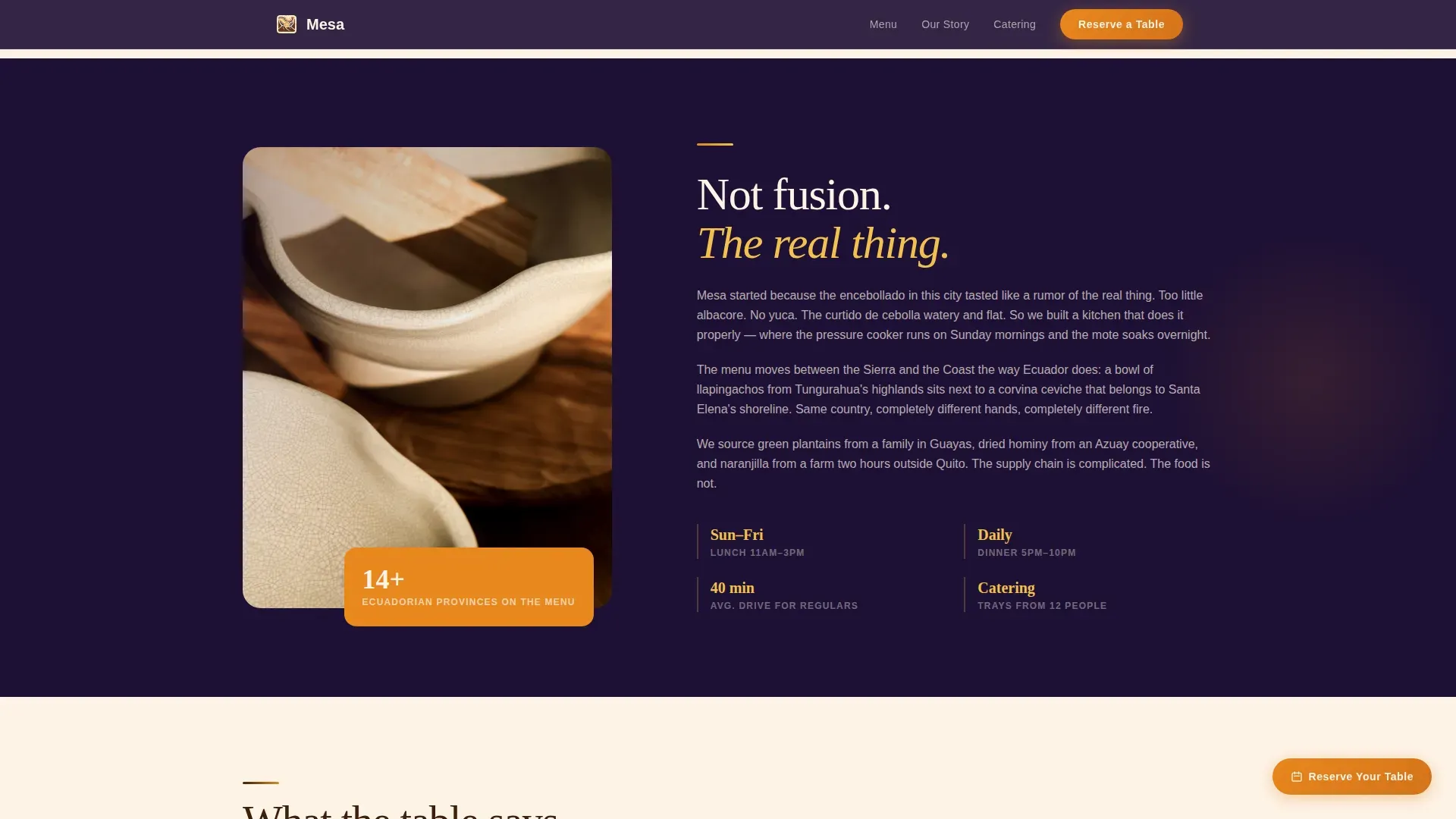
An asymmetric split layout introduces Mesa's culinary philosophy with emphasis on the highlands and coastal duality of Ecuadorian cooking. This section is the center of the narrative and can support origin context, community roots, and the abuela's table atmosphere described in the brief. Cultural integration here helps the page reflect the heritage and traditions of the communities it serves.
Social Proof Testimonials
Three testimonial blocks are designed with personality and specificity. Each voice represents a distinct audience: a homesick family, an adventurous diner, and a catering client. Spanish dish names are preserved throughout, which adds authenticity and helps the page engage diaspora visitors who want to learn that their language and food are respected here.
Page sections overview
| Section | Purpose |
|---|---|
| Hero Close-Up | Full-screen macro food photograph with restaurant name and initial call to action |
| Dish Reveal Gallery | Six to eight scroll-triggered before/after ingredient-to-plate tiles |
| Dish Detail Panel | Expandable overlay with two-sentence origin story per dish |
| Restaurant Story | Asymmetric split layout introducing culinary philosophy and place |
| Testimonials Block | Three audience-specific social proof quotes with dish references |
| Reservation Form | Three-step date, party size, and time booking flow |
| Catering Call to Action | Secondary path for larger event and tray-selection inquiries |
| Page Footer | Arc split layout with logo and tagline left, navigation links right |
Design & branding system
The visual identity follows an Agrarian Root theme built on a Sunset Gradient color system. The palette moves from deep volcanic dusk through warm earth tones to cream, the way last light drags across terracotta before it disappears. Fraunces handles display typography with warmth and weight; DM Sans carries body copy at a clean, readable scale.
- Colors: deep dusk (#1E1034), volcanic brown (#3B1F0B), naranjilla orange (#E8871E), Andean gold (#F2C14E), warm cream (#FDF3E7)
- Textures: clay, weathered wood, stone details, and traditional Andean textile patterns in backgrounds and borders
- Typography: Fraunces serif for headings and display moments, DM Sans for body and form labels
Mobile & speed optimization
Sunday morning family searches happen on phones in the car. This template is designed mobile-first to match that reality. Every section reflows cleanly, and interactive elements like gallery tiles and form steps are touch-friendly at their default sizes.
- Gallery tiles and detail panels are designed for thumb-friendly tap targets on small screens
- The floating reservation button stays accessible and visible across all viewport sizes
- Image lazy loading and GPU-accelerated transforms are used to support smooth scroll performance
How this template helps you convert
The page is engineered so that by the time a visitor reaches the reservation form, skipping it feels like leaving the table before dessert. Every earlier section does conversion work so the form step itself feels easy and earned.
- The macro hero and scroll-triggered reveals build appetite and emotional investment before any call to action appears
- Testimonials from three distinct audience types address the range of visitor motivations and reduce hesitation
- The floating "Reserve Your Table" button and the end-of-page form create two natural booking moments so visitors find a clear path at any scroll depth
Other information about this template
This template is a strong starting point for any restaurant owner who wants to study what high-converting food and hospitality pages do well and then work from a ready-made foundation. No-code tools allow individuals to customize this template without traditional programming skills, which means restaurant owners can quickly launch their site and reach their audience without a development department. The mesa agrarian ecuadorian restaurant landing page template is a practical example of how cultural integration, agrarian storytelling, and conversion design can work together.
Restaurants across Latin America and in diaspora communities throughout the world use pages like this to build networks of loyal guests across generations. The template can support a range of food and beverage brands beyond Ecuador itself. Operators who study cuisine from Peru, highland agriculture traditions, or coastal cooking from across the region will find this visual and structural system adaptable. The emphasis on local produce, traditional techniques, and environmental connection gives the template broad relevance for any farm-to-table or culturally rooted restaurant concept.
The design can also support content that goes beyond a menu. Films documenting kitchen work, origin stories exploring forests and farms, and educational content about agriculture all fit naturally into the gallery and story sections. Restaurateurs who want to engage guests with education about Ecuadorian culinary heritage, or who want to master the visual language of agrarian dining, will find the template's structure ready for that work.
- The template preserves Spanish dish names throughout, reinforcing cultural authenticity
- Highlighting local produce and sourcing practices helps attract guests who value provenance
- The secondary catering path means the template can serve both dining and event revenue streams
Theme
Agrarian Root
Creative direction
Before/After Reveal
Color system
Sunset Gradient
Style
Gallery + Detail
Direction
Booking/Scheduling
Page Sections
Scroll-triggered Before/after Gallery
Macro Close-up Hero Section
Three-step Reservation Form
Restaurant Story and Narrative Split
Social Proof Testimonials Block
Arc Split Footer
Related questions
Can I adapt this template for a different cuisine style?
Does the template include the reservation form layout?
How does the before/after dish reveal work?
Is this template suitable for catering businesses too?
Can I use this template without coding experience?