Complete Zinc Products Professional Website Template
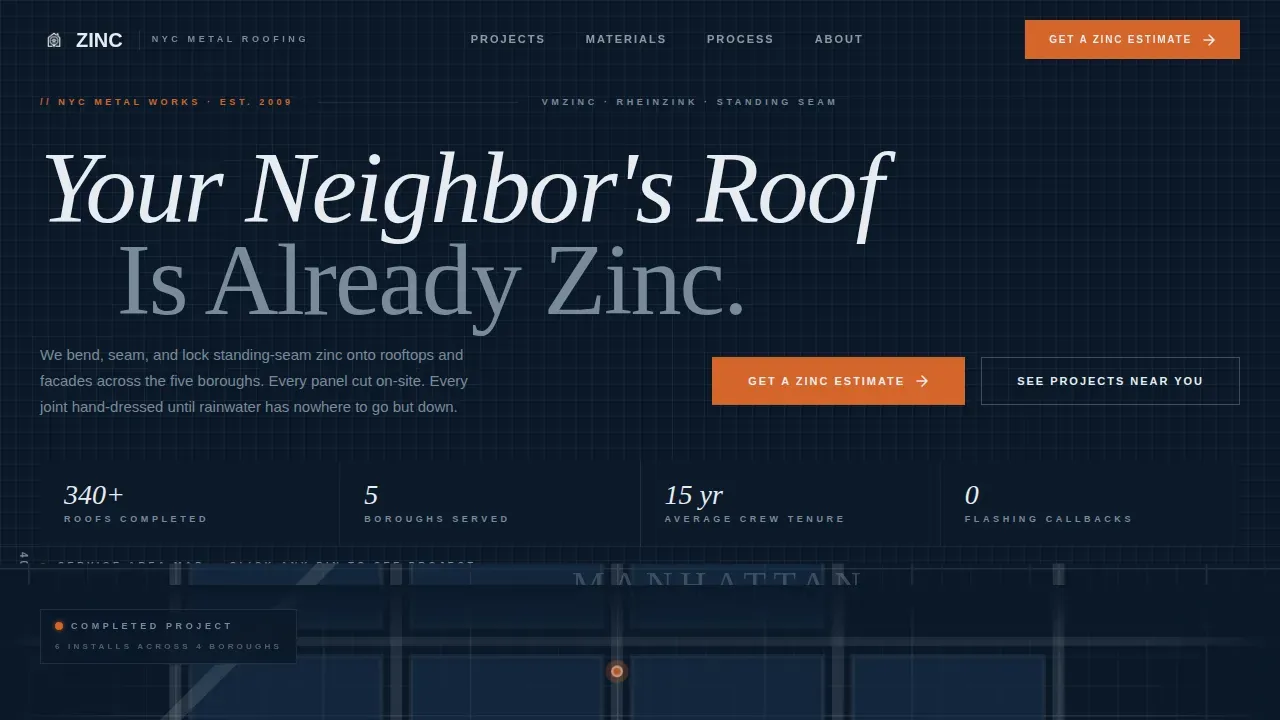
The Zinc landing page template is built for standing-seam zinc roofing installers working across NYC's boroughs. It combines a blueprint-style map hero, address-anchored project photography, and a lead-capture form to turn neighborhood curiosity into estimate requests. Every section is designed to prove proximity, craft, and confidence before the visitor ever fills in their address.
by Rocket studio
Quick summary
This zinc precision standing seam roofing landing page template gives specialist installers a single-column flow page that earns trust block by block. An animated blueprint map opens the experience, sidewalk-level project photos build social proof, and a streamlined estimate form closes the loop. The result is a page that feels as deliberate as a double-lock seam on a cold morning.
Who this template is for
This template suits trade contractors whose work lives on rooftops and facades across dense urban neighborhoods. It is equally useful for businesses serving both homeowners and design professionals.
- Zinc roofing installers targeting brownstone and townhouse owners in NYC metro areas
- Architects specifying premium standing seam systems for mid-century renovations
- General contractors who need a reliable sub for complex flashing and facade work
What problem this template solves
Most roofing websites look the same. They show stock photography, generic copy, and a phone number buried in a footer. This template solves the proximity problem: it proves the installer has already worked on the visitor's street, making the pitch feel local rather than generic.
- Visitors have no easy way to gauge whether a contractor knows their neighborhood's parapets and setbacks
- Generic contact forms fail to capture the roof-specific details needed for an accurate estimate
- Scattered project galleries do not build the block-by-block social proof that converts skeptical homeowners
What you get with this template
You get a fully structured single-column landing page designed for lead generation in a high-trust trade category. Every section serves a specific conversion role.
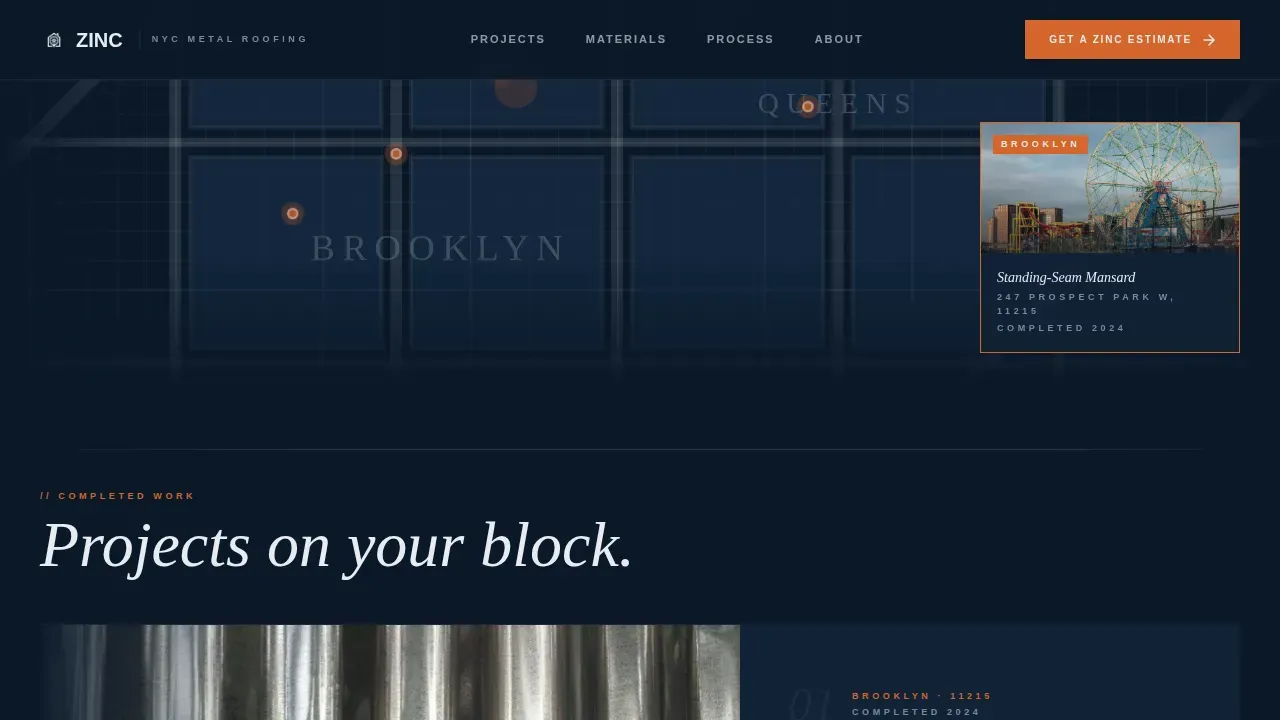
- Blueprint map hero with animated orange pins and a typewriter headline
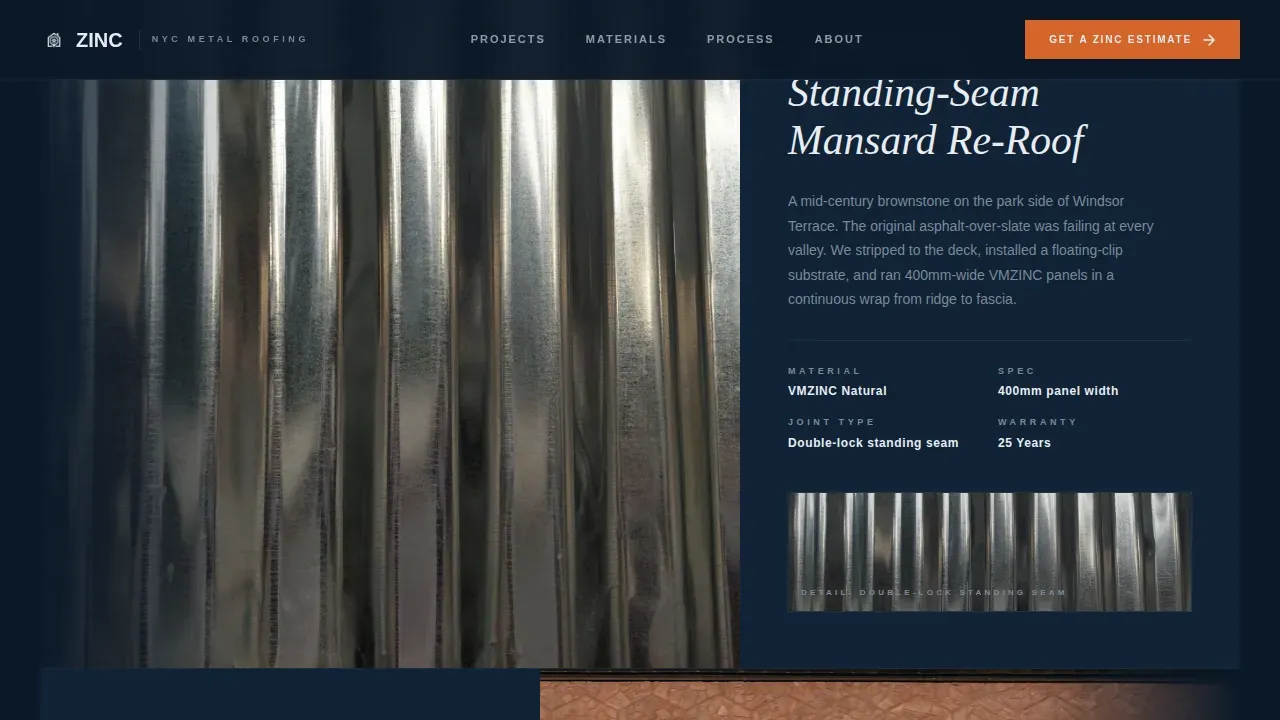
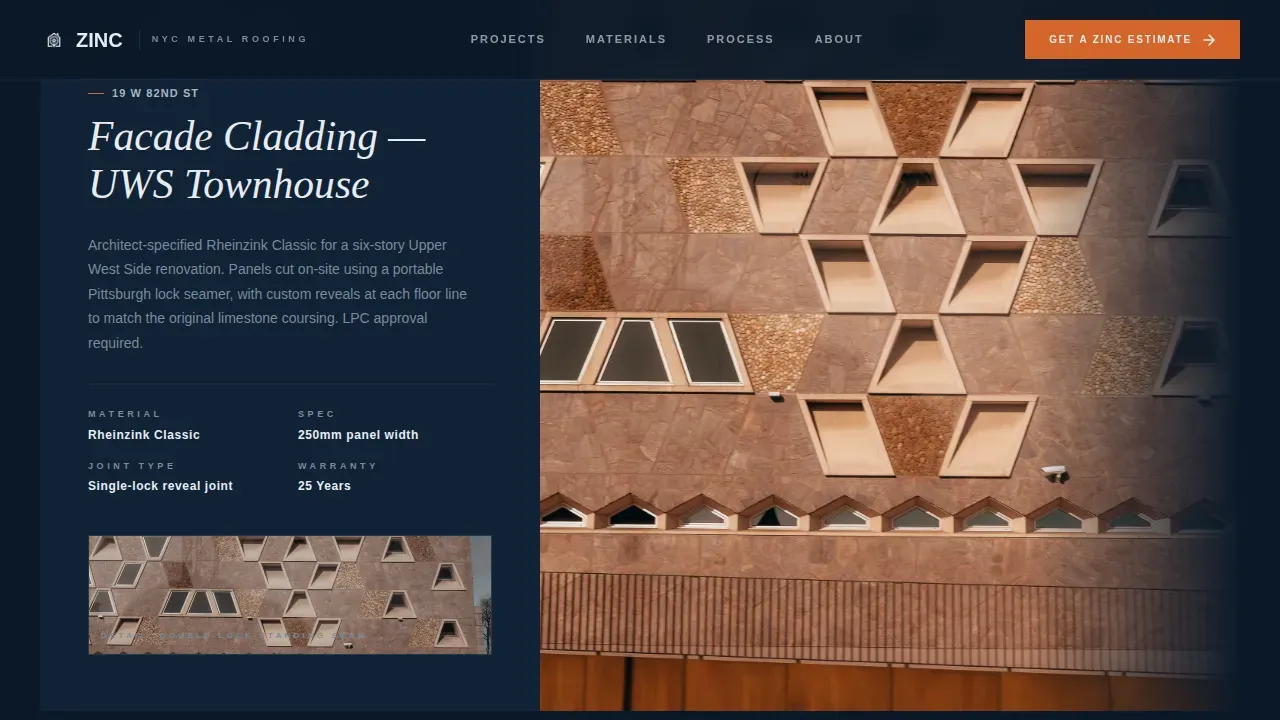
- Three address-anchored neighborhood project sections with alternating photo layouts
- A "Why Zinc" section covering materials longevity, thermal movement, and patina timeline
- A bento-grid craft detail section focused on close-up seam photography
- An address-first estimate form with roof type selector and open description field
- A linear single-row footer
Feature list
This section covers the core capabilities built into the template's design and structure.
Animated Blueprint Map Hero
The hero opens with an overhead street map rendered in navy and white blueprint style. Completed roof projects appear as glowing orange pins. The map zooms from a borough-wide view into the visitor's neighborhood, and a typewriter headline animates like a drafter's annotation. One pulsing pin reveals a project thumbnail on click, making the installer's local presence immediately tangible.
Address-Anchored Project Sections
Three neighborhood project sections alternate between close-up details of standing seam work and wide sidewalk shots showing how panels weather against brick and brownstone. Each section is anchored to a specific street and zip code, allowing the design to build quiet social proof as the visitor scrolls. The shape and height of each building are visible in the photography, giving architects and general contractors the technical context they need.
Why Zinc Section
This section provides a direct materials comparison covering longevity, thermal movement, and patina timeline. Standing seam roofing systems can accommodate thermal expansion through concealed fastener systems, and zinc panels are suitable for pitches as low as 5/8 inch in 12. The section gives homeowners the confidence to invest and gives architects the specification language they expect.
Craft Detail Bento Grid
A bento-style grid of close-up seam photography highlights the installer's hand-dressed joints and on-site panel cutting. The grid demonstrates the precision required to achieve watertight standing seam work, allowing visitors to see the craft standard before they ever make contact.
Address-First Estimate Form
The lead capture form asks for street address first, auto-populating the map pin so the visitor sees their location highlighted. A roof type selector covers flat, pitched, mansard, and facade cladding options. An open field invites a plain-language description of the current roof situation, giving the installer everything needed to provide a meaningful estimate.
Repeat call to action and Secondary Conversion Path
The primary "Get a Zinc Estimate" call to action appears beneath the map and again after every second project section. A secondary path, "See Zinc Projects Near You," filters the map to the visitor's zip code, turning curiosity into address capture without requiring an immediate commitment.
Page sections overview
| Section | Purpose |
|---|---|
| Blueprint Map Hero | Establish local presence with animated project pins and typewriter headline |
| Neighborhood Projects | Build block-by-block social proof with address-anchored photography |
| Why Zinc | Explain material longevity, patina, and thermal movement for informed buyers |
| Craft Detail Grid | Showcase precision seam photography in a bento layout |
| Estimate Form | Capture address, roof type, and project description for qualified leads |
| Linear Footer | Provide single-row contact and navigation closure |
Design & branding system
The visual identity follows an Engineering Blueprint theme. Every color and type choice reinforces the idea of a shop drawing pulled from a foreman's tube.
- Deep midnight navy (#0B1929) as the primary background, technical white (#E8ECF1) for linework and body text, zinc-gray (#7A8B99) for secondary surfaces and dividers
- Signal orange (#D4652A) reserved exclusively for calls to action and interactive hotspots, ensuring high contrast and clear directions for the visitor's eye
- Fraunces serif for display headlines and DM Sans for body text, pairing authority with ease of reading
Mobile & speed optimization
The template is built mobile-first, recognizing that homeowners often search from their phones while standing on the sidewalk outside a neighbor's house.
- Server Components handle static sections for fast initial load, while Client Components manage the interactive map and estimate form
- GSAP scroll reveals and parallax effects are applied progressively, so the page remains usable even before animations fully render
- The single-column flow keeps the structure clean on small screens, with the form fields and call to action buttons sized for thumb-friendly access
How this template helps you convert
Every design decision points toward one outcome: a completed estimate request from a qualified local lead.
- The animated map and pulsing pins create immediate curiosity, pulling the visitor into a project thumbnail before they have time to scroll past the hero.
- Address-anchored project photos build proof block by block, so by the time the visitor reaches the estimate form, they already feel like a neighbor rather than a cold prospect.
- The address-first form flow, combined with the secondary "See Zinc Projects Near You" path, captures location data from visitors who are not yet ready to commit, enabling follow-up without pressure.
Other information about this template
This template is well suited to installers working across multiple boroughs and regions, including areas with demanding climates where snowfall, strong winds, and heavy rainfall are seasonal factors.
- Standing seam roofing systems are suitable for very large roof and facade surfaces, making this template relevant for projects ranging from a single house to large commercial structures
- Metal roof panels are available in steel and aluminum depending on load-bearing capacity and moisture resistance factors; zinc roofing panels typically range from 0.7mm to 0.8mm in thickness
- Snap-Clad panels are produced in continuous panel lengths for superior flatness; Tite-Loc and Tite-Loc Plus panels are ideal for low roof slopes and a variety of substrates; PAC-150 panels require mechanical field seaming to either 90 degrees or 180 degrees depending on uplift requirements
- FormLock metal roof panels provide maximum securement and wind uplift resistance for demanding installations; FormTight ribbed panels assist in reducing oil canning
- Aluminum is a favored sheet material for standing seam roofs due to its corrosion resistance; steel panels provide structural strength depending on the building's load requirements
- The minimum radius achievable with on-site roll-forming machines affects whether concave or curved roof shapes are feasible; installers should confirm minimum radius capability before specifying panels for complex geometry
- Installation costs for zinc roofing typically range from $10 to $20 per square foot, often higher than steel or aluminum, making clear value communication on the landing page important for this website
- This template is distinguished by its neighborhood-proof concept, which no generic roofing website template currently replicates at this level of local specificity
Theme
Engineering Blueprint
Creative direction
Local & Neighborhood
Color system
Navy Authority
Style
Single Column Flow
Direction
Lead Generation
Page Sections
Animated Blueprint Map Hero
Address-anchored Project Sections
Why Zinc Materials Section
Craft Detail Bento Grid
Address-first Estimate Form
Repeat Call to Action and Secondary Conversion Path
Related questions
What type of roofing businesses should use this template?
Can the template handle multiple roof types in the estimate form?
How does the map section work for lead capture?
Is this template suitable for projects beyond residential roofing?
What makes this template different from a standard roofing landing page?