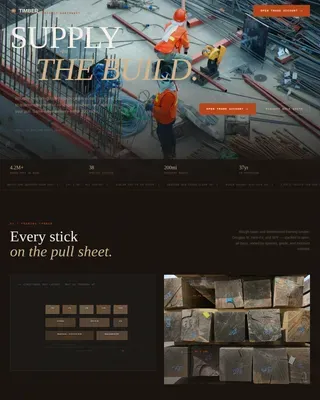
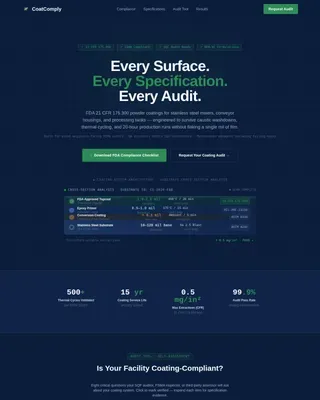
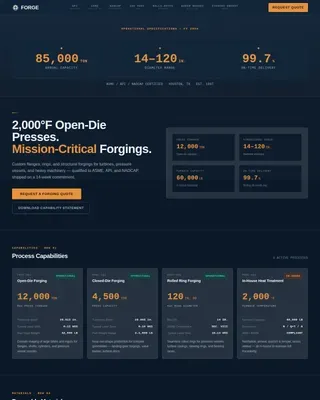
Specialist Manufacturing Processes Careers & Recruitment Website Template
Mill is a precision-focused landing page template built for CNC machining equipment manufacturers. It uses an Engineering Blueprint visual theme with a Warm Stone color system to present machine specifications, side-by-side competitor comparisons, and a structured quote request form. The single-column flow guides production managers, job shop owners, and manufacturing engineers from first impression to conversion.
by Rocket studio
Quick summary
Mill is a single-column landing page template designed for CNC machining equipment manufacturers. It combines architectural photography, blueprint-style annotation overlays, and interactive specification comparison modules. The Warm Stone color palette and Engineering Blueprint theme give every section the weight and precision that serious manufacturing buyers expect.
Who this template is for
This template is built for manufacturers and sales teams who need to convince technically sophisticated buyers. It speaks directly to people who evaluate machines by tolerances, spindle hours, and total cost of ownership, not marketing language.
- Production managers evaluating vertical machining centers for high-volume floor operations
- Job shop owners replacing aging equipment and comparing specifications before committing to a purchase
- Manufacturing engineers specifying machines for defense or aerospace contracts that require tight, single-setup tolerances
What problem this template solves
Most industrial equipment pages present specifications in isolation. A buyer reads one manufacturer's numbers, then opens three other tabs to compare. That friction costs deals. Mill solves this by placing your machine's specifications directly alongside two named competitors inside every major section, so the numbers argue the case without asking the buyer to do the legwork.
- Buyers leave pages that don't answer the comparison question they already have in mind
- Generic industrial templates lack the visual credibility that precision manufacturing demands
- Standard contact forms fail engineers who need a shareable specification document to circulate internally
What you get with this template
Mill delivers a fully structured, single-column landing page with every section designed around the comparison-driven buying decision. The layout moves from structural integrity to performance data to total cost of ownership, building a progressive case for your machine at every scroll depth.
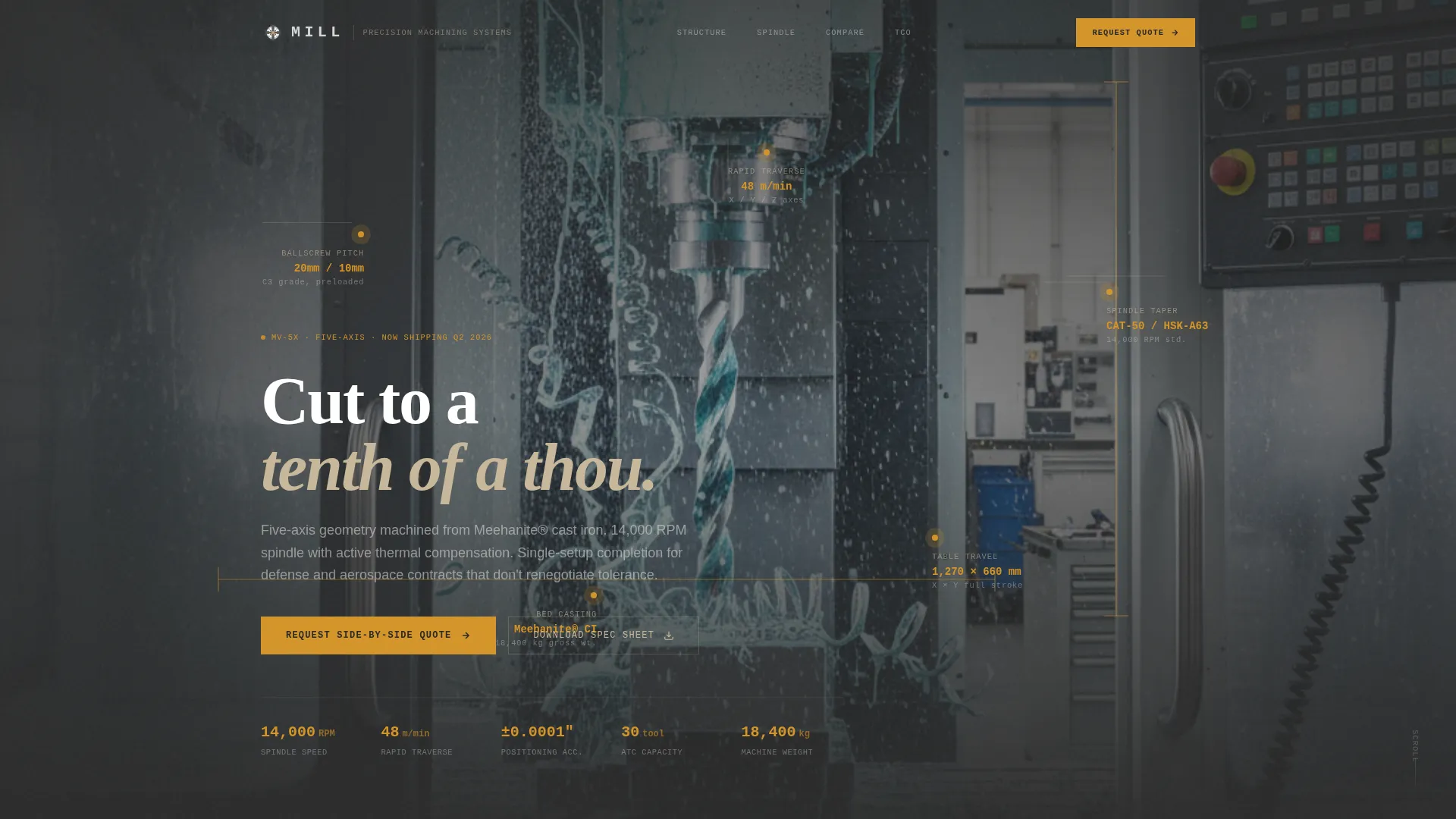
- A panoramic hero section with blueprint-style dimension and GD&T (geometric dimensioning and tolerancing) annotation overlays
- Interactive toggle comparison modules that display your machine against two named competitors across every key specification
- A dual conversion path: a detailed quote request form and a gated PDF download requiring only an email address
Feature list
This template includes six core components, each designed to address a specific moment in the manufacturing buyer's evaluation process.
Panoramic Hero with Blueprint Annotations
The header spans the full horizontal width and shows the entire machine from bed casting to spindle nose. Blueprint-style dimension lines and GD&T callouts are overlaid directly on the photograph, turning the hero image into a living engineering drawing with ballscrew pitch, rapid traverse rate, and spindle taper all visible at a glance.
Section-by-Section Machine Architecture Walk
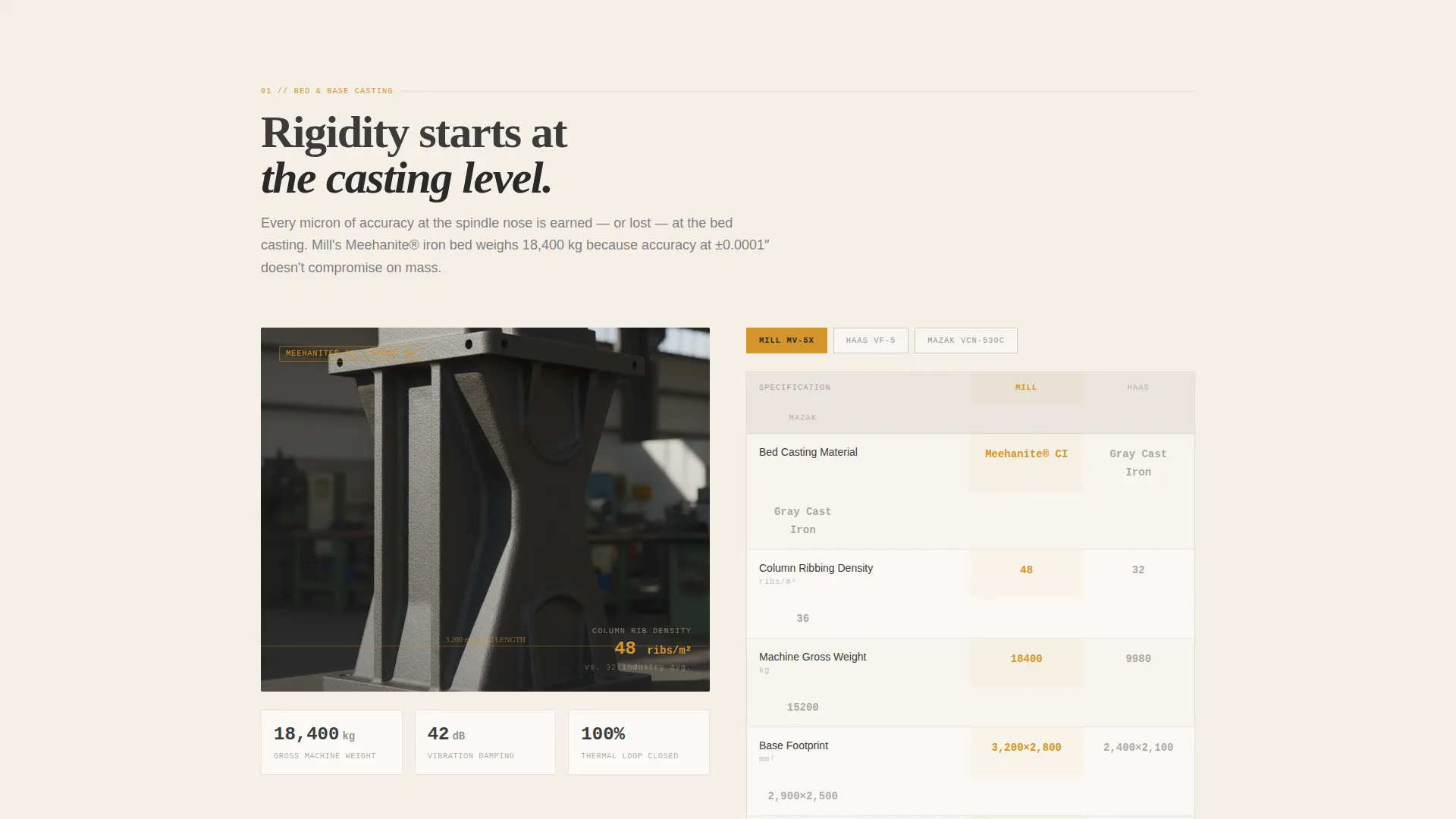
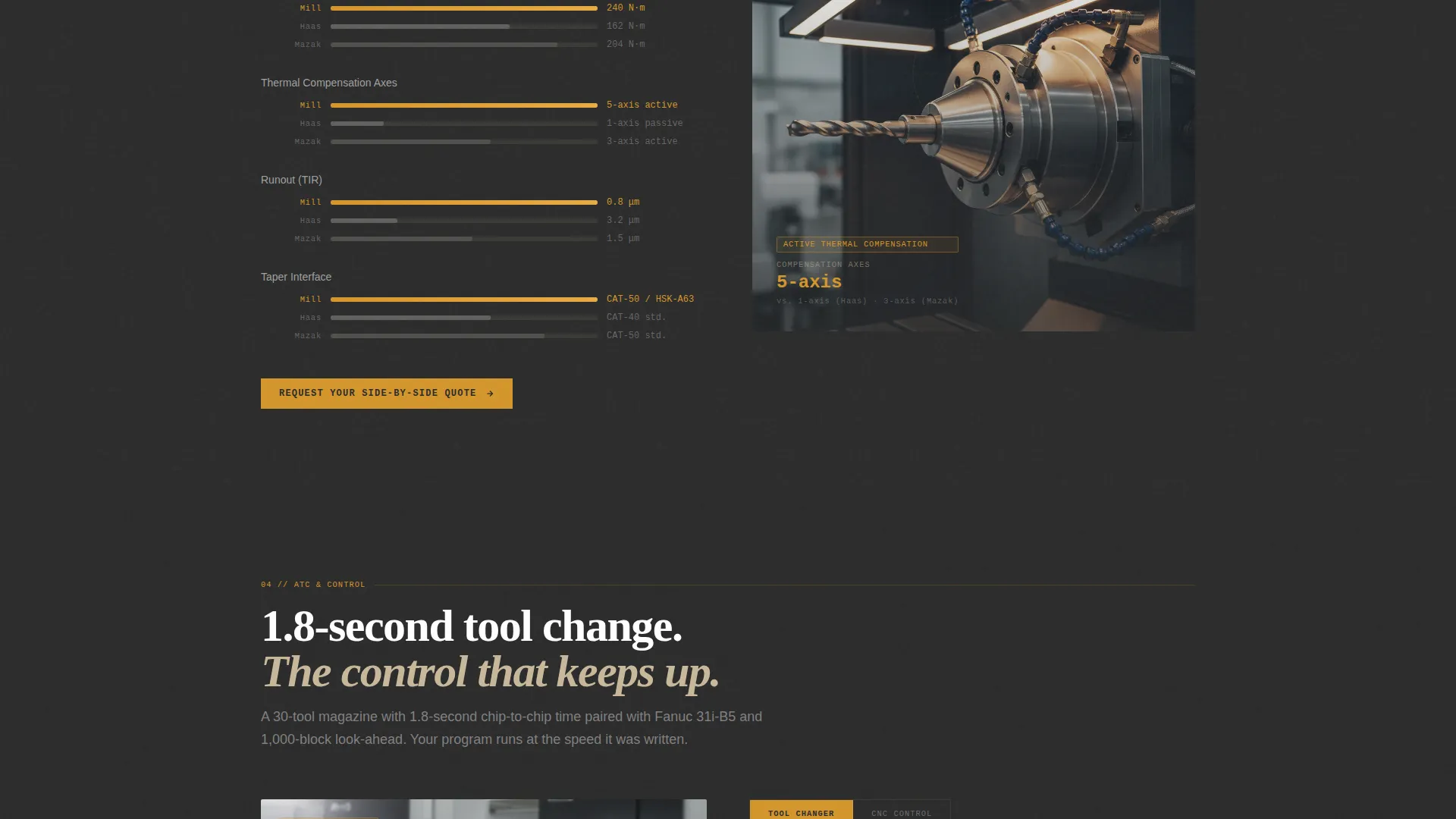
Each structural system gets its own dedicated section: the bed and base casting, the spindle assembly, the tool changer, and the control interface. Each section uses the same architectural framing and blueprint annotation style, creating a consistent visual language that builds credibility as the buyer scrolls.
Interactive Specification Comparison Toggles
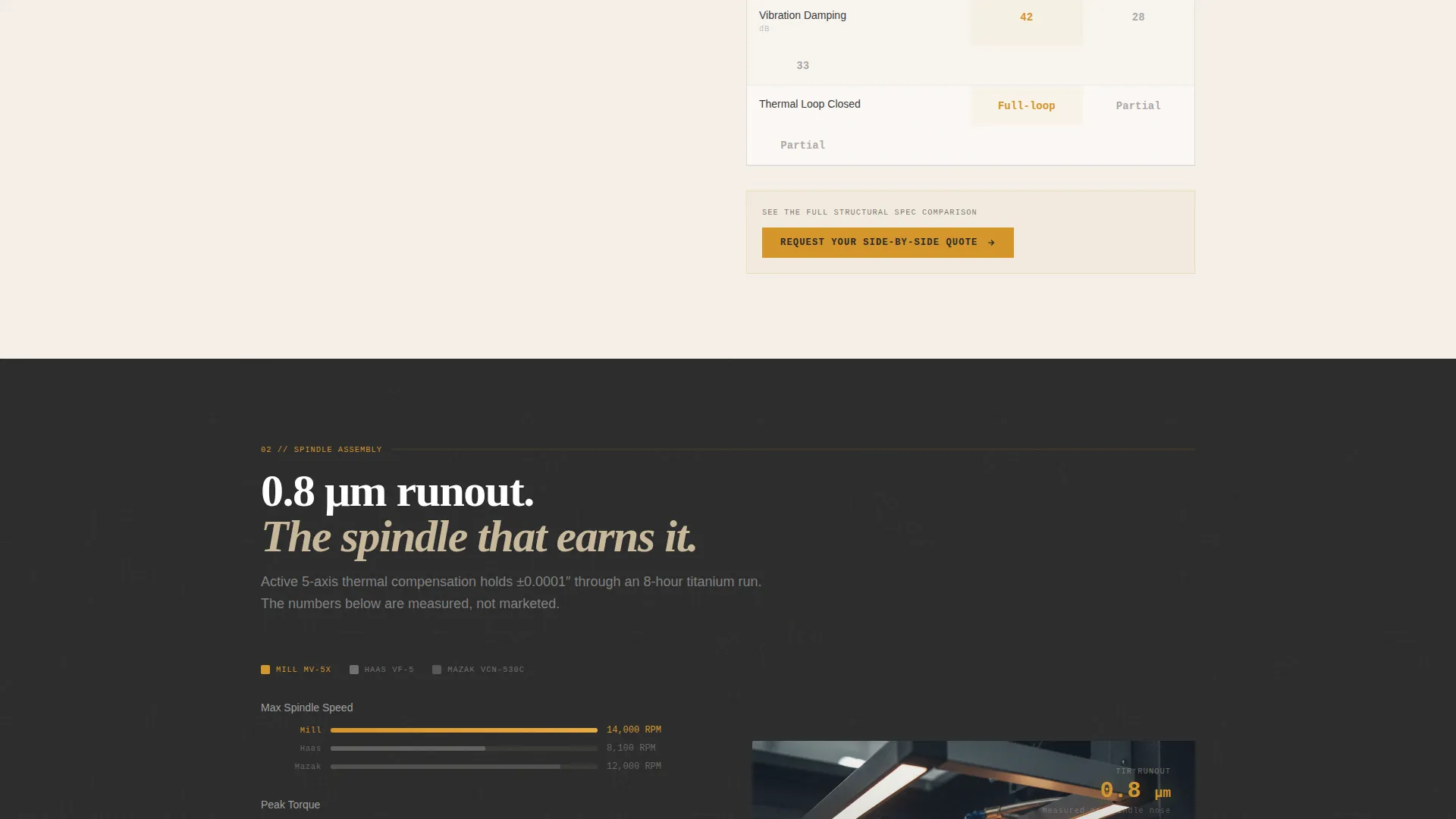
Every key specification appears inside a toggle module where the visitor switches between your machine and two named competitors. Spindle speed curves, feed rates, and tolerance figures are shown side by side on a warm stone background. The numbers make the argument without requiring additional copy.
Comparison-Driven Quote Request Form
The primary call to action reads "Request Your Side-by-Side Quote." The form collects the buyer's current machine model from a dropdown of common competitors, primary material cut, typical part tolerance range, and expected annual spindle hours. These fields qualify the lead precisely while lowering friction.
Gated Specification PDF Download
A secondary conversion path offers a full specification comparison document gated behind a single email field. Engineers get the document they need to circulate internally. The manufacturer captures a qualified lead identified by the machine they are replacing.
Amber Callout System for Critical Numbers
Datum-line amber is reserved exclusively for tolerances, feed rates, spindle speeds, and the numbers that close deals. This typographic discipline ensures the eye lands exactly where the decision is made, without cluttering the rest of the page with competing highlights.
Page sections overview
| Section | Purpose |
|---|---|
| Panoramic Hero | Introduce machine with blueprint overlays |
| Bed and Base | Showcase casting rigidity and structural specs |
| Spindle Assembly | Present spindle speed and performance data |
| Tool Changer | Detail tool capacity and change cycle specs |
| Control Interface | Display control system features and layout |
| First Comparison Module | Show spec toggle against two competitors |
| Quote Request Form | Capture qualified leads with machine-specific fields |
| Cost of Ownership | Build total-value case with comparative data |
| PDF Download Gate | Offer spec sheet in exchange for email address |
| Sticky call to action Anchor | Repeat quote request at every section base |
Design & branding system
The Engineering Blueprint theme uses a Warm Stone color system that pairs industrial hardness with craft heritage. Backgrounds alternate between deep workshop graphite and pale quarried limestone, giving each section a distinct visual weight without breaking the scroll rhythm.
- Core palette: quarried limestone (#C8B89A), workshop graphite (#3B3B3B), machined aluminum (#D6D6D6), and datum-line amber (#D4952A)
- Typography uses machined aluminum gray on dark sections and workshop graphite on light sections, keeping contrast clean and readable
- Amber appears only on tolerances, feed rates, comparison highlights, and interactive toggle elements, never as a decorative color
Mobile & speed optimization
The single-column flow is inherently well-suited to smaller screens. The layout stacks cleanly from desktop to tablet to mobile without losing the visual logic of the comparison modules or the blueprint annotation overlays.
- Comparison toggle modules are designed to remain readable and functional at narrower viewport widths
- The panoramic hero maintains its architectural impact by preserving the horizontal framing at key breakpoints
- Section-by-section scroll pacing keeps content digestible on mobile without requiring horizontal scrolling or pinch-to-zoom interaction
How this template helps you convert
Mill is built around a specific insight: precision manufacturing buyers make decisions by comparing specifications, not by reading marketing claims. Every structural choice in the template supports that comparison-driven path to conversion.
- The interactive specification toggles give buyers the side-by-side view they are already seeking, reducing the chance they leave the page to find it elsewhere
- The "Request Your Side-by-Side Quote" call to action appears after the first comparison module and anchors to the base of every subsequent section, keeping the conversion path visible at every scroll depth
- The gated PDF download captures engineers earlier in the process, giving them a shareable document while qualifying the lead by the machine they intend to replace
Other information about this template
Mill is categorized under Manufacturing and Industrial, with a specific focus on the CNC machining equipment manufacturer niche within Manufacturing Processes. The template is built as a single-column flow landing page using the Spatial and Architectural creative direction, which guides the scroll experience the way a trade show floor guides a buyer walking around a live machine.
- The template style is Single Column Flow, optimized for a focused, distraction-free path from hero to conversion
- The Comparison/Versus landing page direction is the structural backbone of the design, making it well-suited for competitive markets where buyers arrive with shortlists already formed
- The header concept is Panoramic/Wide, designed to communicate machine scale, precision, and build quality in a single unbroken frame
- The template is built for the intersection of Warm Stone color system, Engineering Blueprint theme, and Spatial and Architectural creative direction, a combination that positions the manufacturer as technically credible and visually authoritative
Theme
Engineering Blueprint
Creative direction
Spatial & Architectural
Color system
Warm Stone
Style
Single Column Flow
Direction
Comparison/Versus
Page Sections
Panoramic Hero with Blueprint Annotations
Interactive Specification Comparison Toggles
Comparison-driven Quote Request Form
Gated Specification PDF Download
Architectural Section-by-section Machine Walk
Amber Callout Highlight System
Related questions
Who is this landing page template built for?
Can I customize the competitor names in the comparison toggles?
What fields does the quote request form include?
How does the PDF download conversion path work?
Is this template suitable for a multi-product equipment lineup?