Specialist Wellness Modalities Reviews & Social Proof Website Template
Calibrate is a Dynamic Motion landing page template built for neurofeedback online course creators. It pairs a testimonial-led hero with zigzag Before/After sections, a seven-question brain-type quiz, and scroll-triggered waveform animations. The Alpine Fresh color system keeps every screen sharp and clinical, guiding visitors from curious skeptic to enrolled student with confidence.
by Rocket studio
Quick summary
Calibrate is a single-page landing page template designed for neurofeedback training course creators who need to earn trust before asking for commitment. It opens with an oversized testimonial card, moves through three zigzag Before/After sections that answer the hardest skepticism questions, and closes the loop with an interactive seven-question quiz that identifies each visitor's brain type. The result is a page that feels like the science, organized, purposeful, and building toward a clear signal.
Who this template is for
This template speaks directly to course creators working in the brain training and neurofeedback space. It is built for people who need to explain real science to a skeptical, educated audience without losing them in jargon.
- Neurofeedback practitioners and educators launching a home-based training program for burned-out professionals, anxious therapists, or parents of children with attention challenges
- Health-tech educators and biohackers who want a focused, quiz-driven landing page that personalizes the enrollment experience before asking visitors to sign up
- Course creators in the wellness and cognitive performance space who want to lead with social proof and peer-reviewed credibility rather than generic marketing copy
What problem this template solves
Selling a neurofeedback course online is genuinely difficult. Visitors arrive curious but skeptical. They have tried medication, read the research summaries, and are aware that the field has open questions around effectiveness and physiological outcomes. A generic course page does not address those doubts, it just adds to the noise.
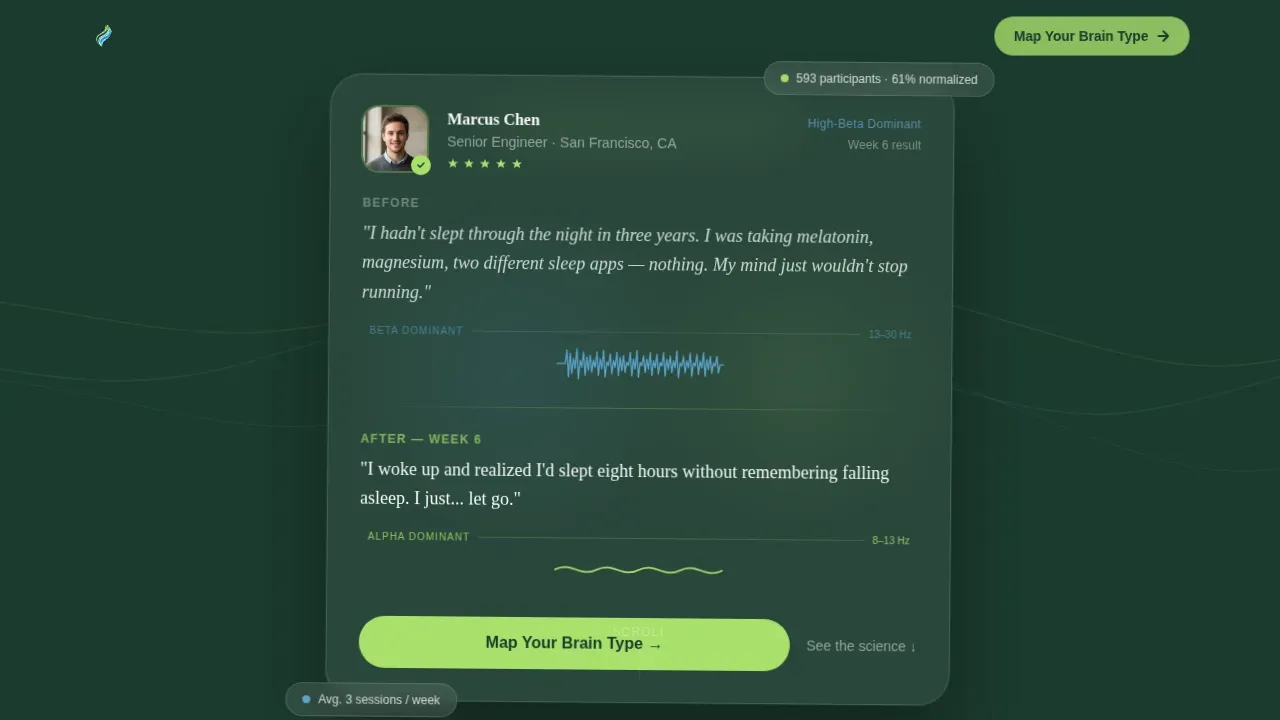
- It removes the credibility gap by leading with a real student transformation, peer-reviewed citation cards, and stated participant statistics (593 participants, 61% normalization rate), giving visitors something concrete to assess
- It answers the three loudest objections in sequence, "Is this real science?", "Can I actually do this at home?", and "What if my brain is different?", before the primary call to action appears on the page
- It replaces passive scrolling with active participation through the brain-type quiz, so visitors feel genuinely understood rather than sold to, which significantly reduces drop-off before enrollment
What you get with this template
You get a fully structured, single-page layout with every section pre-built and ready to populate with your course content. The design decisions are already made, colors, typography hierarchy, animation cues, and section rhythm are all resolved so you can focus on writing and customization.
- A hero section built around a testimonial card with animated brainwave sine curves in the background, a student before/after quote, and a small electroencephalography (EEG)-style waveform graphic showing the shift from jagged beta dominance to smooth alpha rhythms
- Three zigzag Before/After content sections with desaturated "before" panels and Alpine-clarity "after" panels, each targeting a different layer of visitor skepticism with space for citation cards, equipment walkthrough imagery, and protocol customization visuals
- A seven-question interactive brain-type quiz (the "Map Your Brain Type" assessment) with animated waveform background morphing tied to each answer, ending in a personalized brain-type result and a "Start Your Protocol" secondary call to action that carries quiz data into enrollment
Feature list
This template delivers a set of purpose-built components that work together to guide visitors from skeptical reader to enrolled student. Each feature is grounded in the brief and serves the core conversion goal of the page.
Animated Testimonial Hero Card
The hero does not open with a headline, it opens with a person. An oversized floating card displays a real student's headshot, their raw before-state quote, a thin divider, and their after-state outcome. Behind the card, slow-drifting brainwave sine curves animate continuously, giving the page immediate motion and visual depth without competing with the testimonial itself. A small EEG waveform graphic below the quote shows the shift from scattered beta patterns to smooth alpha, giving the transformation a visual anchor grounded in neuroscience.
Zigzag Before/After Section Rhythm
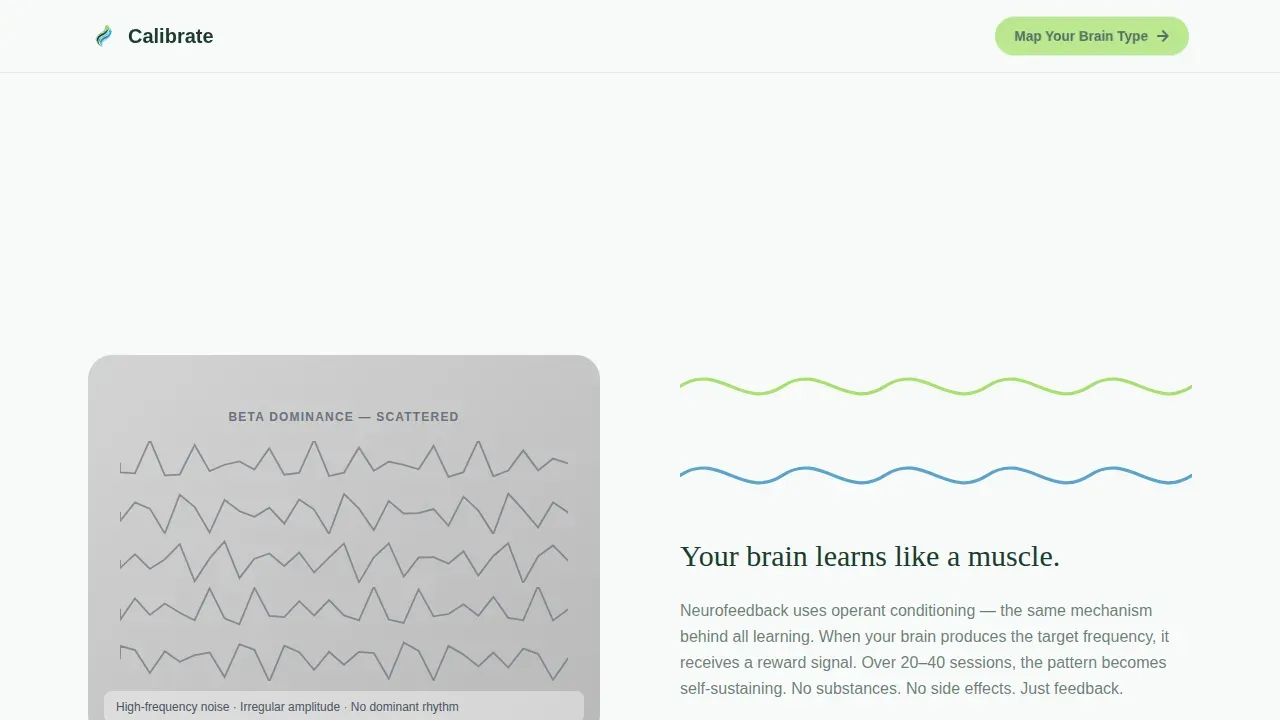
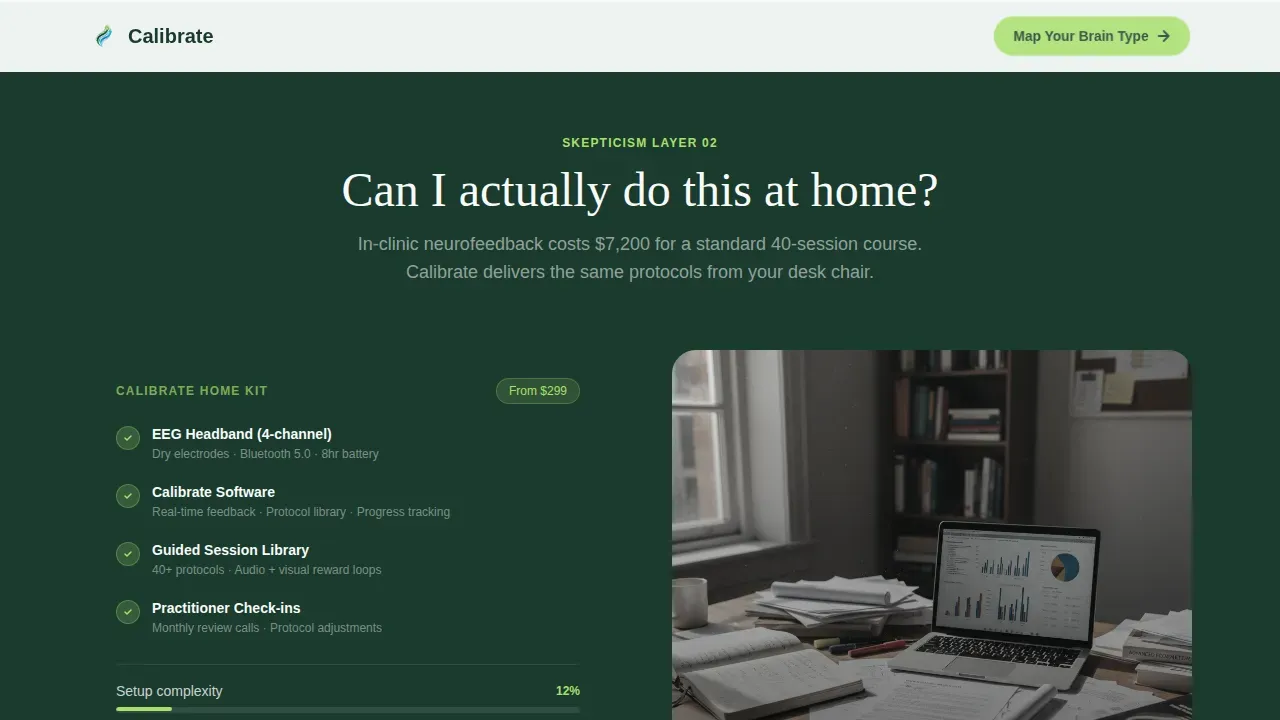
Three alternating content sections each pair a "before" left panel against an "after" right panel. The before panels use desaturated color and scattered waveform visuals, distracted desk scenes, medication bottles, noisy brain activity graphics. The after panels snap into Alpine Fresh clarity with organized waveform graphics, calm workspace imagery, and sharp typography. Each section is designed to address a specific skepticism layer: the science behind the method, the practical home setup, and the possibility of protocol customization for individual differences in brain state.
Seven-Question Brain-Type Quiz
The primary call to action on this page is an interactive assessment titled "Map Your Brain Type." The quiz opens with the question "What does your mind do in the first ten minutes after you lie down?" and progressively narrows through focus patterns, sleep quality, emotional reactivity, and stimulant use history. As each answer is selected, the background waveform animation shifts to mirror the emerging brain profile. The quiz ends with a named result, for example, "High-Beta Dominant: The Overthinker", and a recommended course track. A secondary call to action, "Start Your Protocol," links to enrollment with the quiz results pre-loaded.
Scroll-Linked Waveform Animations
Dynamic Motion is the defining theme of this template. Waveforms draw themselves as you scroll. Cards slide into alignment. Progress bars fill in response to scroll position. The page itself behaves like a brain organizing in real time, making the experience of scrolling through the landing page feel thematically consistent with the subject matter, neurofeedback training as a process of moving from noise to signal.
Alpine Fresh Color System with Purposeful Accent Logic
The color logic is intentional and restrained. Glacier white (#F7FAFA) and deep evergreen (#1B3A2D) handle backgrounds and primary text. High-altitude sky (#5BA4CF) carries secondary information. Electric lichen (#A8E06C) is reserved exclusively for progress indicators, active states, and call-to-action pulses, it appears only where the page wants your eyes to move next. This restraint keeps the palette feeling clinical and precise, which builds trust for a science-backed course.
Citation Cards and Social Proof Integration
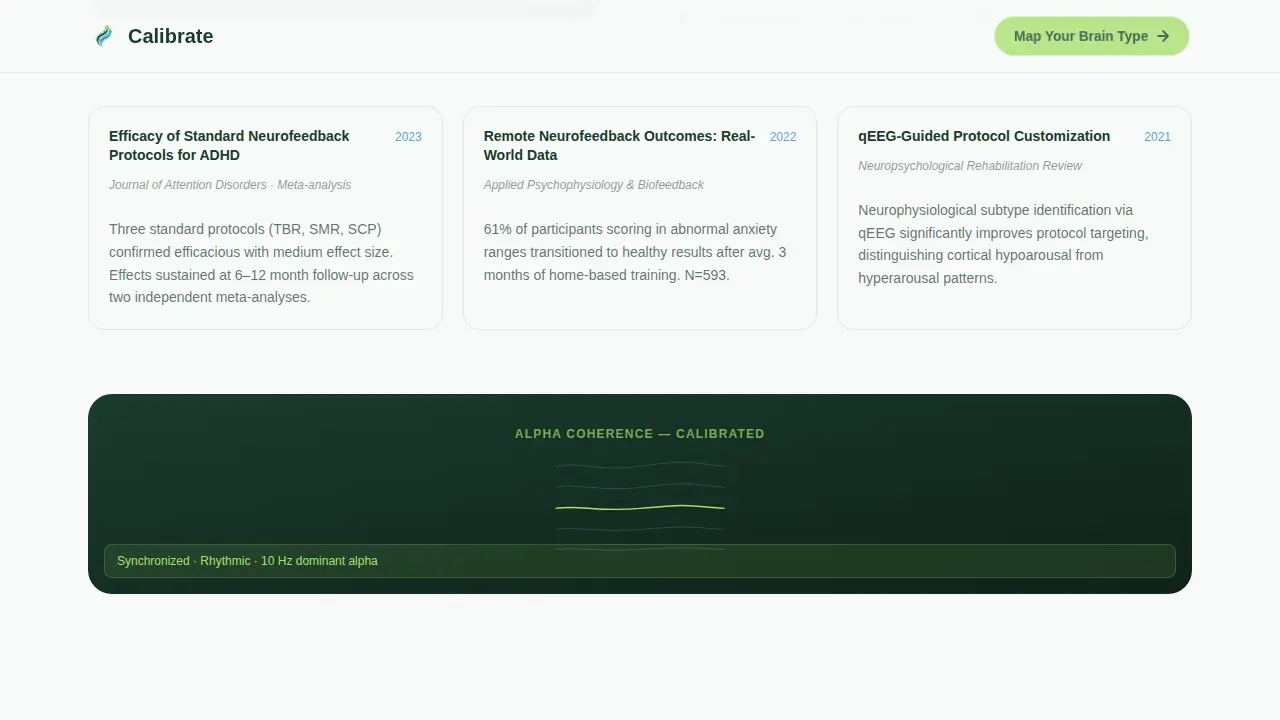
The template includes designated space for interactive citation cards within the "Is this real science?" zigzag section. These cards are designed to hold peer-reviewed research references and participant data, giving visitors a way to assess the evidence base before committing. The hero section testimonial card is built to display measurable student outcomes, reinforcing social proof at the very first moment of the visitor's experience on the page.
Page sections overview
| Section | Purpose |
|---|---|
| Testimonial Hero Card | Opens with a real student transformation against animated brainwave curves to establish immediate emotional and scientific credibility |
| Before/After Zigzag One | Addresses "Is this real science?" with scattered-versus-organized waveform panels and interactive peer-reviewed citation cards |
| Before/After Zigzag Two | Addresses "Can I do this at home?" by contrasting medication imagery against an equipment kit and software walkthrough visual |
| Before/After Zigzag Three | Addresses "What if my brain is different?" by showing generic protocol imagery against a customized protocol visualization |
| Brain-Type Quiz Block | Hosts the seven-question "Map Your Brain Type" interactive assessment with animated waveform response and personalized result |
| Arc Split Footer | Closes the page with a tagline, navigation links, and brand anchoring using the Pattern 7 Arc Browser Split layout |
Design & branding system
The design language behind this template is called Dynamic Motion, and it is built on the Alpine Fresh color system. Every visual decision connects to a single feeling: the moment a neurofeedback session locks in and the monitor's scattered static resolves into clean, rhythmic waves. The palette and motion work together to make that feeling visceral before the visitor reads a single word of course content.
- Typography uses Fraunces (a serif display typeface at editorial weight) for headings and primary statements, paired with DM Sans (a geometric sans-serif) for body text and user interface elements. The combination reads as authoritative but accessible, clinical precision without clinical coldness.
- Colors are structured by role: glacier white (#F7FAFA) and deep evergreen (#1B3A2D) alternate as section backgrounds, text lives in the contrast between them, high-altitude sky (#5BA4CF) handles secondary accents, and electric lichen (#A8E06C) appears only on progress indicators, active quiz states, and call-to-action elements to guide the eye without distracting from content.
Mobile & speed optimization
Although the template is designed desktop-first to match the desk-based context of home neurofeedback training sessions, it includes a solid mobile fallback so visitors who discover the page on a phone still receive a coherent, readable experience. The design hierarchy holds across breakpoints, and the quiz flow remains functional on smaller screens.
- Scroll-linked animations use Intersection Observer so they fire only when elements enter the viewport, keeping the animation system lightweight and responsive rather than running continuously in the background
- CSS custom properties handle theme switching between the glacier white and evergreen background alternation, which means background transitions are handled at the style layer rather than through JavaScript-heavy repaints, preserving visual responsiveness on the page
How this template helps you convert
This landing page is built around a single insight: people do not enroll in a neurofeedback course because they read a feature list. They enroll because they feel understood. Every structural decision in this template is designed to create that feeling before asking for anything in return.
- The testimonial hero card earns attention in the first three seconds by leading with a real person's measured outcome rather than a product headline, which immediately signals that this course has produced results that participants can describe in their own words
- The Before/After zigzag structure dismantles the three most common objections in sequence, so by the time a visitor reaches the quiz, they have already moved through the skepticism layers that typically cause them to leave a course page without converting
- The brain-type quiz replaces a passive call-to-action button with an active, personalized experience, visitors answer seven questions, watch the page respond to their answers, and receive a named brain profile with a tailored course recommendation, which means the "Start Your Protocol" enrollment link feels like a natural next step rather than a sales request
Other information about this template
This section covers additional context about the template's technical design approach, the broader landscape it operates in, and practical considerations for course creators who want to customize it for their specific neurofeedback training program.
This template was developed specifically for the neurofeedback online course niche within the Wellness and Fitness category. It is the Calibrate brain training neurofeedback online course landing page template, positioned at the intersection of health-tech education, cognitive performance, and medication-skeptical wellness audiences.
The template is built to support course creators who want to address real pain points honestly. Common struggles in neurofeedback training include dealing with noisy electroencephalography data, interpreting results without clinical background, and navigating complex equipment setups. The Before/After sections provide structured space to acknowledge those frustrations directly before presenting the course solution.
Calibration is a foundational concept in neurofeedback protocols. The calibration process typically involves measuring brain signals to establish a baseline for subsequent neurofeedback sessions. Calibration allows algorithms to detect personalized differences between targeted and alternative brain states. The template's "What if my brain is different?" section is specifically designed to surface this concept, reassuring visitors that the course accounts for individual variation rather than applying a one-size-fits-all method.
Consumer-grade neurofeedback devices are generally cheaper and easier to implement than laboratory-based neurofeedback systems, making home-based training a realistic possibility for most enrolled students. Devices like Muse are commonly used in mindfulness-based neurofeedback (mbNF) to help users optimize their brain states and establish a baseline for feedback during training sessions. The template's equipment walkthrough section provides space to show exactly what setup participants will need, reducing ambiguity before enrollment.
Research in this field is active and evolving. Studies published in journals such as Frontiers in Human Neuroscience (cited in the field as Front Hum Neurosci) have examined the effectiveness of neurofeedback approaches across populations dealing with anxiety disorders, attention difficulties, depression, and elevated levels of physiological stress. Some research has compared neurofeedback participants against a control group to assess significance, though multiple comparisons across studies mean that results should be interpreted with care. The field continues to assess outcomes including changes in mind wandering, default mode network activity, and subjective experience of cognitive clarity. The citation card components in this template are designed to present this research honestly, with appropriate context rather than overclaiming outcomes.
The template's copy strategy encourages course creators to include instructor credentials prominently. In neurofeedback education, certifications such as BCIA (Biofeedback Certification International Alliance) carry real significance for a skeptical audience. An instructor bio section can be placed adjacent to the citation card area to reinforce the scientific basis of the course alongside personal authority.
For course creators building this page without a development team, the template is compatible with no-code platforms that enable non-technical users to create and market online courses effectively. AI-powered no-code tools can further streamline the process, allowing users to iterate on the page based on student feedback and engagement data without requiring traditional programming skills.
Additional practical considerations for this template include:
- The quiz section supports pre-loading results into the enrollment flow, creating a lower-friction path from assessment to sign-up
- The arc-split footer (Pattern 7) provides clean space for course links, legal text, and a brief tagline without disrupting the page's visual momentum
- Social proof elements, the hero testimonial card, participant statistics, and citation cards, are each placed at a different depth of the page to reinforce credibility at multiple decision points throughout the scroll
- Course creators may consider offering a money-back guarantee (typically ranging from 14 to 30 days) in the footer or near the primary call-to-action to reduce the perceived risk of enrollment
- Testing individual page elements, such as the quiz opening question or the hero testimonial quote, through structured review can help improve conversion rates as more students move through the course
Theme
Dynamic Motion
Creative direction
Before/After Reveal
Color system
Alpine Fresh
Direction
Quiz/Assessment
Page Sections
Animated Testimonial Hero Card
Zigzag Before/after Section Layout
Seven-question Brain-type Quiz
Scroll-linked Waveform Animations
Interactive Citation Card Components
Alpine Fresh Color System with Accent Restraint
Related questions
Do I need coding skills to use this template?
Can I customize the brain-type quiz questions for my specific course?
Is this template suitable for a course focused on anxiety or attention challenges?
How does the animated waveform background in the quiz work?
Can I add an instructor bio and credentials to this template?