Complete Coin & Numismatics Professional Website Template
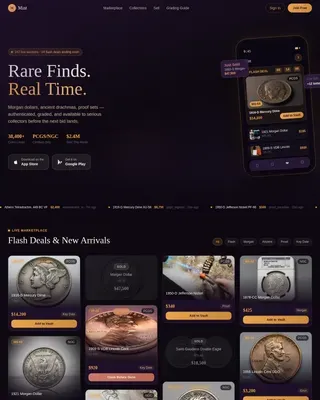
Mint is a bento grid landing page template built for numismatic auction houses. It combines a Luxe Minimal visual identity with an immersive unboxing scroll experience. The layout features curated lot cells, macro coin photography reveals, provenance cards, and dual conversion paths, a per-lot bid field and a catalog request form, all tuned for serious collectors and estate buyers.
by Rocket studio
Quick summary
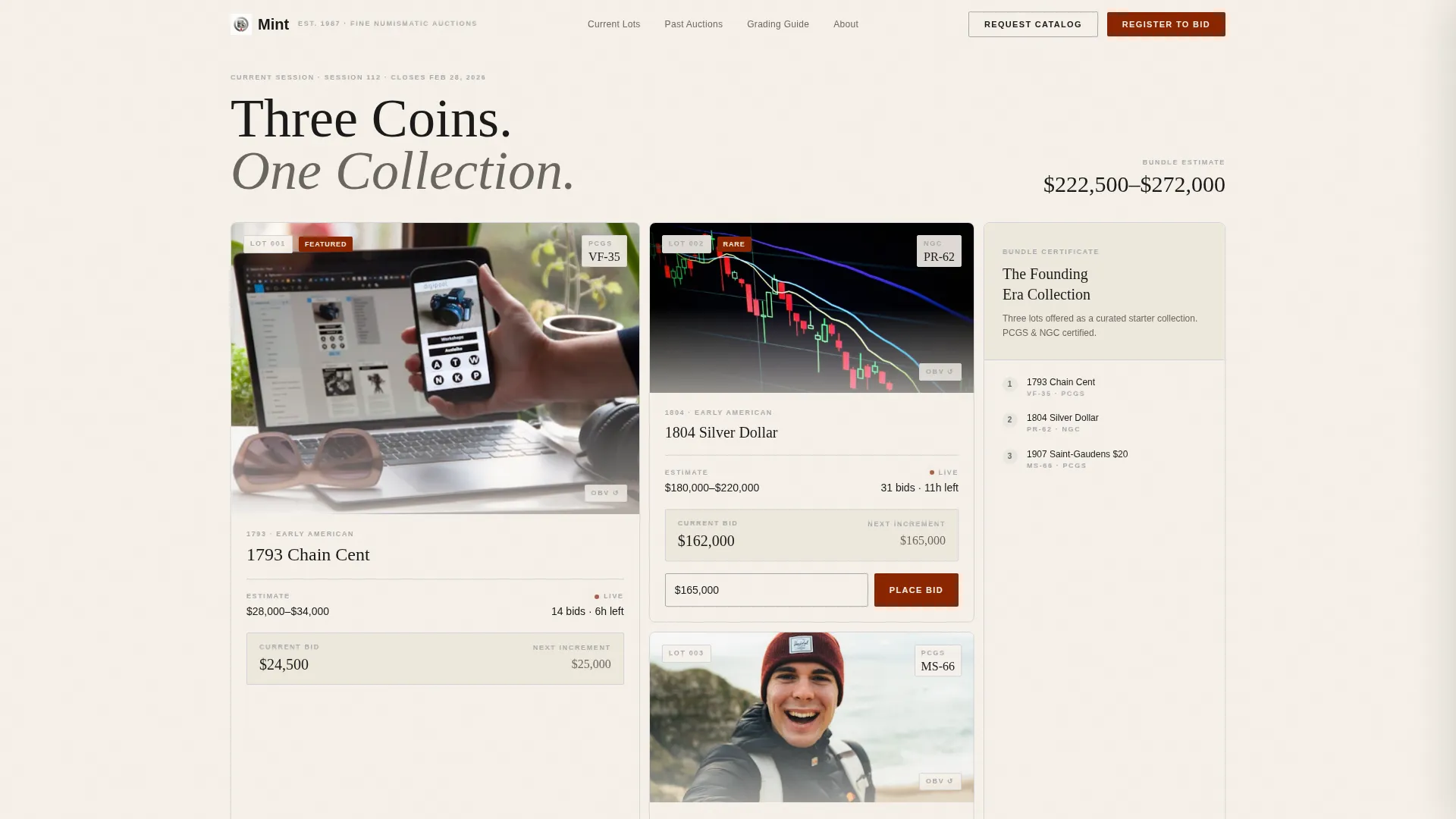
Mint is a single-page bento grid template designed for coin auction houses and numismatic dealers. It opens with a three-lot bundle header, moves through an unboxing-style scroll sequence, and closes with two conversion paths: a direct bid field and a catalog request form. Every cell is built to let the coins command attention, not the interface.
Who this template is for
This template is built for sellers and platforms where the coins carry the story and the buyers already know what they are looking for. The layout respects that audience and meets them at their level.
- Numismatic auction houses presenting curated lots to advanced collectors
- Estate executors and dealers liquidating significant collections with provenance detail
- Institutional numismatists and variety specialists building targeted type sets
What problem this template solves
Standard thumbnail grids cannot convey die polish lines, original toning gradients, or census rarity data. Buyers who spend serious money on a single coin need more than a small image and a price field before they commit.
- Generic auction layouts flatten every lot to the same visual weight, losing the drama of a significant find
- High-value collectors abandon pages that feel rushed or transactional rather than curatorial
- Dual buyer paths, immediate bidding and catalog requests, rarely coexist cleanly in off-the-shelf templates
What you get with this template
You get a fully structured bento grid landing page that guides collectors from first impression to bid confirmation without friction. The layout is deliberate, sequential, and built around the ritual of examining a coin properly.
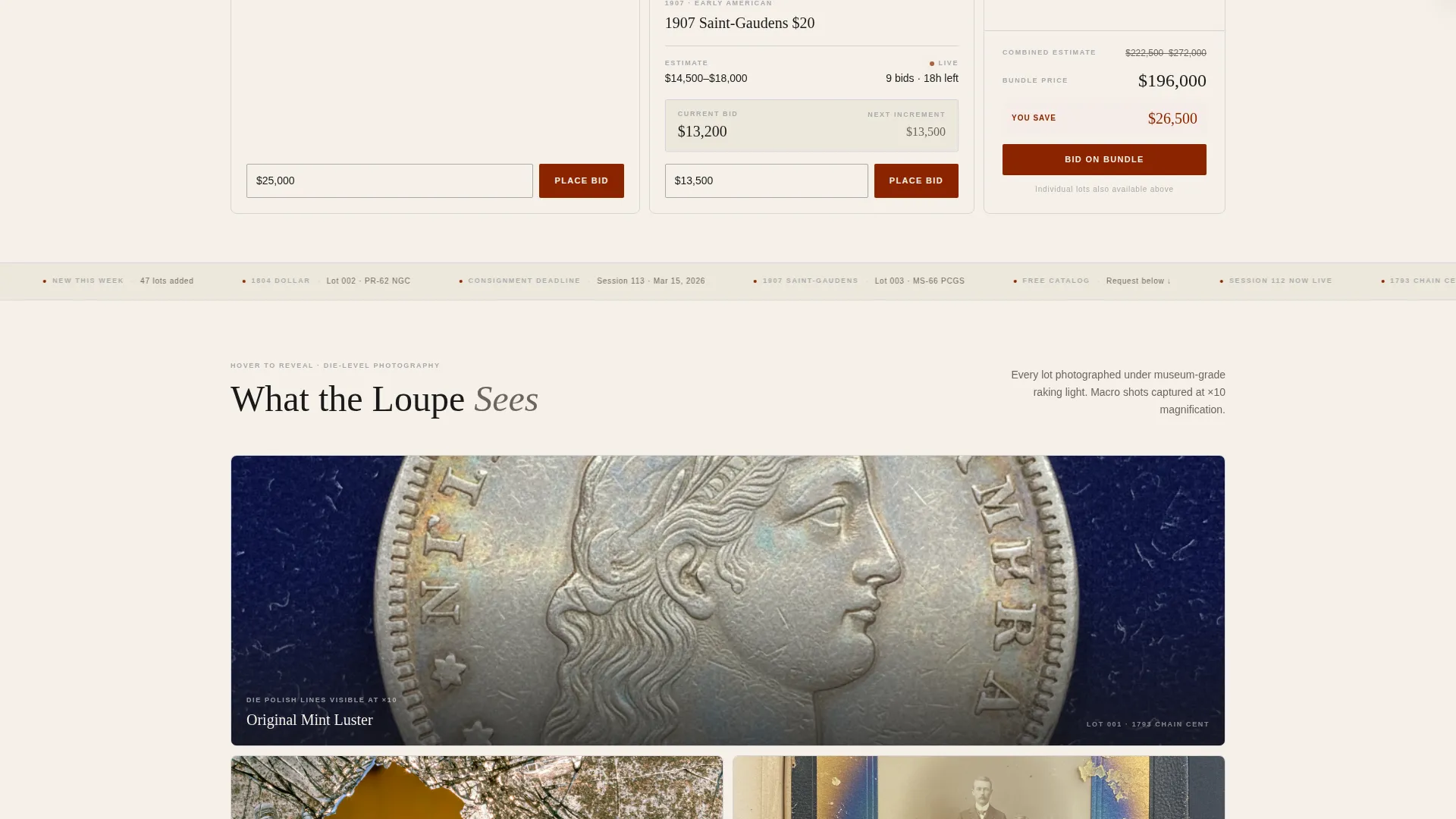
- A curated three-lot header bundle with a fourth cell showing combined estimate versus bundle price
- Hover-triggered macro photography reveals and provenance cards that slide in on scroll
- Two conversion paths: a per-lot bid field with pre-filled next increment and a two-field catalog request form
Feature list
The template delivers a focused set of purpose-built components. Each one is grounded in how serious collectors actually browse, evaluate, and decide.
Bento Grid Lot Layout
Each coin occupies its own bento cell with dedicated space for obverse and reverse photography. The grid separates lots clearly while maintaining a unified catalog feel across the full page.
Bundle Header with Savings Display
The header arranges three flagship lots as a curated starter collection. A fourth cell shows the combined lot estimate alongside the bundle price, with the savings figure rendered in provenance red for immediate visual emphasis.
Unboxing Scroll Sequence
Scroll behavior decelerates through each content zone. The page moves from slabbed lot photography to macro hover reveals, then to provenance cards, then to grading population reports, simulating the deliberate pace of examining a coin under a loupe.
Macro Photography Hover Reveal
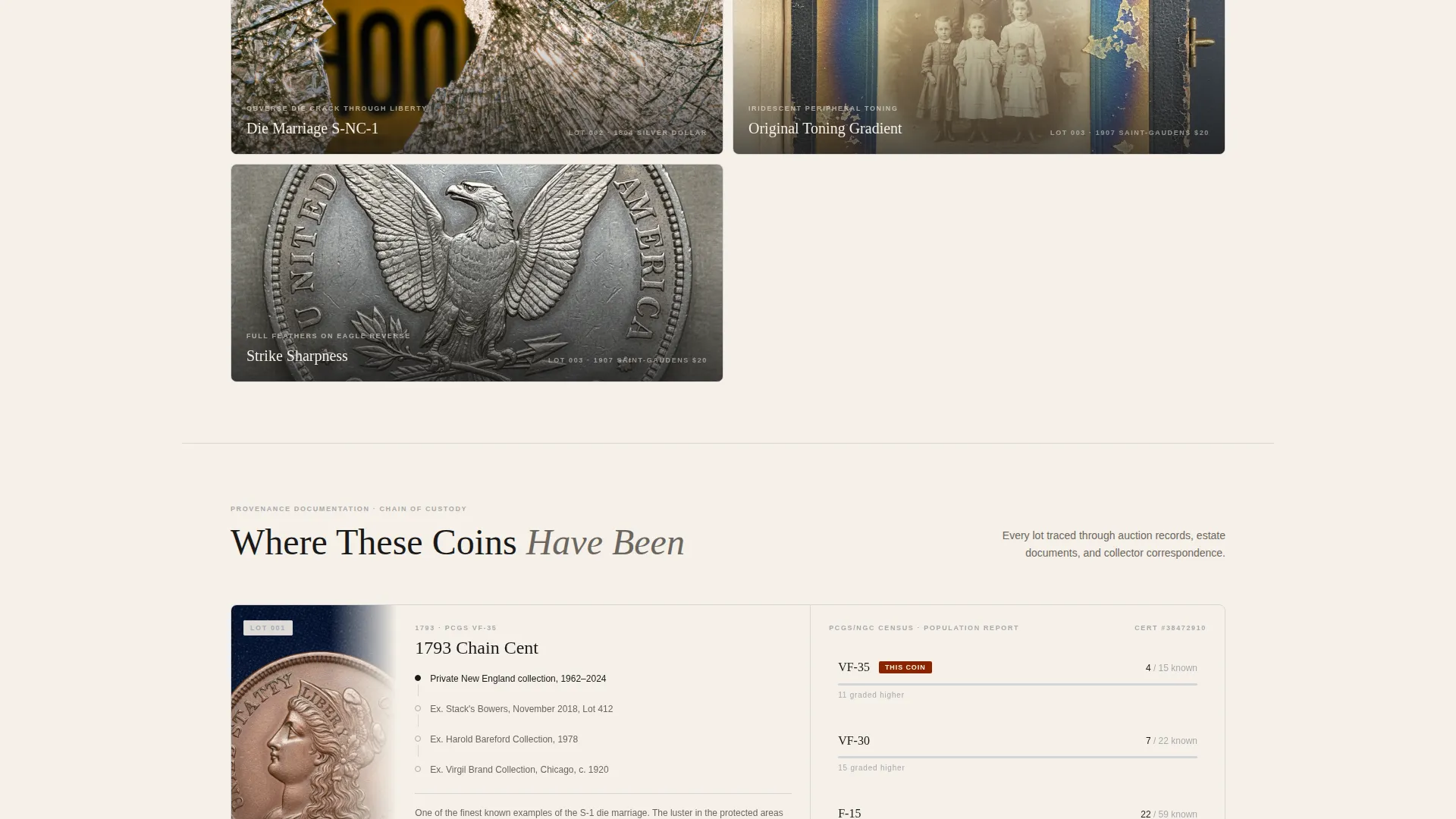
Hovering over a lot cell triggers a high-resolution view of mint luster, die cracks, and toning gradients. This interaction replaces the need for a separate zoom tool and keeps the buyer inside the page experience.
Per-Lot Bid Field with Increment Pre-fill
Every lot cell includes a bid input pre-filled to the next valid increment. A single-tap confirm reduces the steps between intent and commitment, removing the friction that causes drop-off at the final moment.
Catalog Request Slide-In Form
A secondary conversion form slides in from the right edge of the page. It captures email address and collecting specialty, early copper, gold type, or world crowns, giving the house a qualified lead with context for follow-up.
Page sections overview
| Section | Purpose |
|---|---|
| Bundle Header | Presents three curated lots with a combined estimate and savings cell |
| Lot Grid Cells | Displays individual coins with obverse, reverse, and metadata |
| Macro Reveal Zone | Triggers high-resolution coin detail on hover |
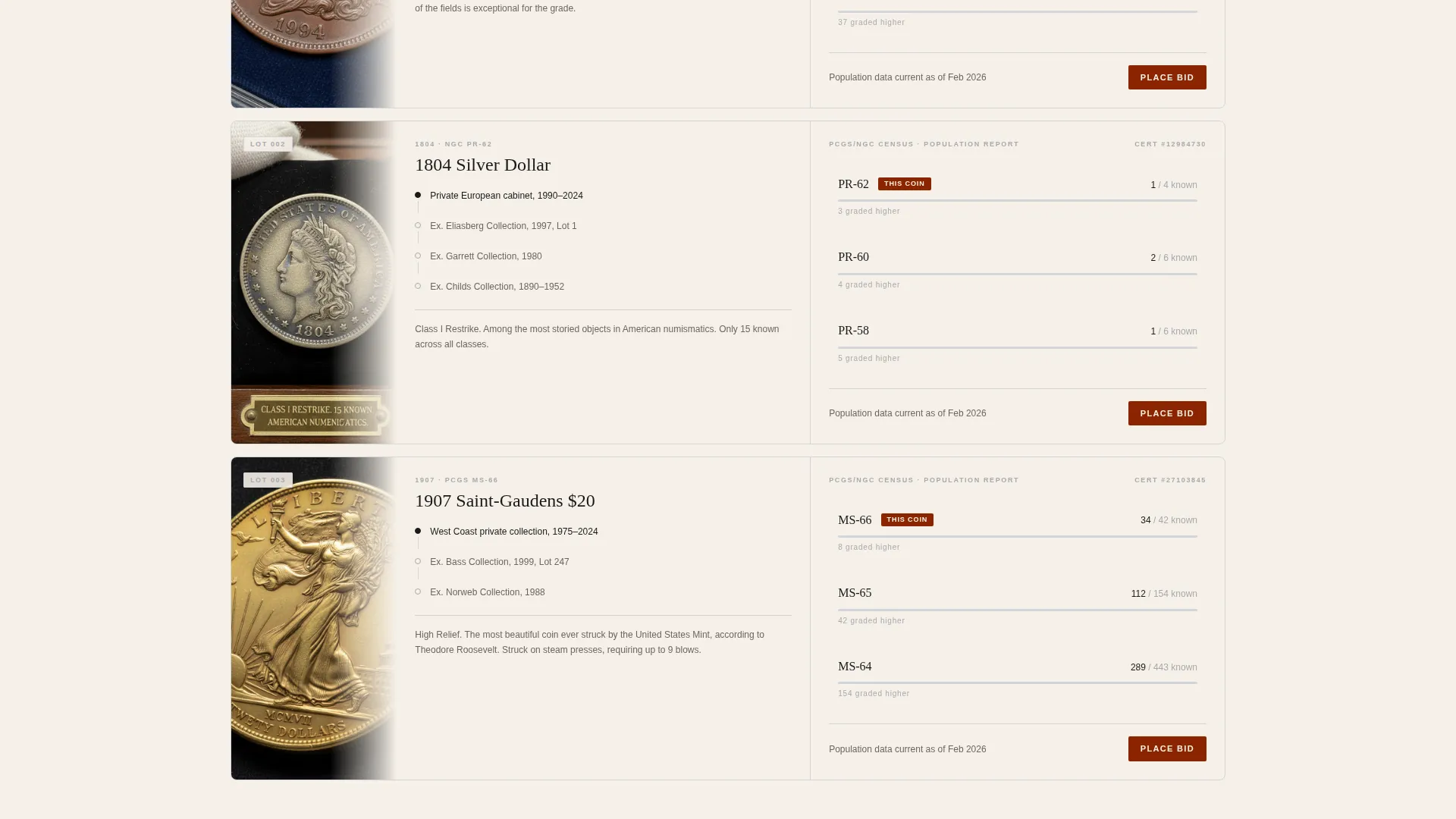
| Provenance Card Section | Slides in enclosure-style cards with lot history and attribution |
| Population Report Block | Shows grading census data as quiet evidence of rarity |
| Bid Confirmation Row | Houses per-lot bid fields with pre-filled increment and single-tap confirm |
| Catalog Request Form | Captures email and collecting specialty via a right-edge slide-in |
Design & branding system
The visual identity follows a Luxe Minimal theme built around an Ink and Paper color system. Every choice signals authority and restraint. The coins are the spectacle; the page simply holds them correctly.
- Archival cream (#F5F0E8) dominates all backgrounds; catalog ink black (#1A1A1A) handles all typography at confident weights; toned silver (#A8A9AD) separates grid cells like cotton-lined album dividers
- Provenance red (#8B2500) appears exclusively on bid buttons and lot alerts, functioning as a visual gavel drop against the restrained cream ground
- Subtle parallax shift on scroll gives coin photography dimensional weight, reinforcing the sense of metal rather than a flat image
Mobile & speed optimization
The bento grid layout is structured to reflow cleanly at smaller viewport sizes. Lot cells stack in a logical reading order so mobile visitors can work through each coin without losing the narrative sequence.
- Macro hover reveals adapt to tap interactions on touch screens, keeping the detail view accessible without a secondary zoom modal
- The catalog request slide-in form collapses to a bottom-anchored drawer on mobile, maintaining the two-field structure without covering primary lot content
How this template helps you convert
The template earns the bid by showing what a thumbnail grid cannot. Every scroll zone adds a layer of evidence before the ask arrives.
- The unboxing scroll sequence builds confidence incrementally, macro photography and provenance cards resolve doubt before the bid field appears, reducing the gap between interest and action.
- The pre-filled bid increment removes calculation friction at the moment of decision, and the single-tap confirm keeps the commitment path as short as possible.
- The catalog request form captures buyers who are not ready to bid immediately, collecting their specialty so the follow-up communication is relevant rather than generic.
Other information about this template
This template is purpose-built for the numismatic auction segment and carries design decisions that reflect that specificity. A few additional details are worth noting for buyers evaluating it.
- The color system is intentionally narrow; provenance red (#8B2500) is reserved solely for bid buttons and lot alerts to preserve its signal value across every page state
- The template is designed for single-page deployment as a focused auction landing page, not as a multi-page catalog site
- The bento grid structure supports anywhere from three to six active lot cells before the layout requires adjustment
- Lot metadata fields, grade, certification number, die variety, and estimate, are built into each cell as labeled text blocks, not as pop-up overlays
Theme
Neo-Retro
Creative direction
Unboxing Experience
Color system
Dopamine Pop
Style
Masonry/Pinterest
Direction
Direct Sales
Page Sections
Bento Grid Lot Layout
Bundle Header with Savings Display
Unboxing Scroll Sequence
Macro Photography Hover Reveal
Per-lot Bid Field with Increment Pre-fill
Catalog Request Slide-in Form
Related questions
Can I use this template for a single featured coin rather than a three-lot bundle?
How does the catalog request form work?
Does the macro photography reveal work on mobile devices?
What types of coins and lots is this layout best suited for?
Can the provenance cards and population report blocks be edited for each lot?