Clinical Movement Therapy Landing Page Template
Stride is a clinical landing page template built for Parkinson's disease exercise programs. It uses a zigzag alternating layout to walk visitors step by step through intake methodology, exercise prescription, session footage, and real outcome data. The design balances corporate precision with kinetic energy so every scroll builds evidence, not just emotion, and every click feels earned.
by Rocket studio
Quick summary
Stride is a single-page landing page template designed for evidence-based exercise programs serving people with Parkinson's disease. It walks skeptical visitors through a transparent, layer-by-layer case for structured movement, from clinical intake scales to anonymized outcome charts, then drives them to a program schedule with a high-contrast coral call-to-action button.
Who this template is for
This template is built for healthcare organizations and specialist fitness providers who serve the Parkinson's disease community. It speaks directly to three types of visitors who arrive with very different needs but the same core question: does this actually work?
- Newly diagnosed professionals who want to stay active and need clinical proof before they commit time to a program
- Adult children researching structured, proactive options for a parent living with PD
- Neurologists who need a credible, outcomes-tracked referral they can present with confidence
What problem this template solves
Many exercise program pages for people with Parkinson's disease rely on soft photography and vague wellness language. That approach loses the most important visitors fast. Skeptical patients, cautious families, and evidence-driven clinicians all need something more rigorous before they click through to a schedule.
- Generic fitness pages fail to show how exercise prescription maps to specific PD symptom severity
- Visitors cannot assess program credibility without seeing methodology, credentials, or real outcome data
- Most pages bury the call to action behind emotional appeals that do not satisfy a research-oriented audience
What you get with this template
You get a fully structured, desktop-first landing page built around a transparent evidence flow. Every section earns the next by answering the skeptic's next question before they ask it. The layout is ready to customize with your program's real data, imagery, and session schedule.
- A stacked typographic hero section, five zigzag content sections, a sticky bottom call-to-action bar, and a single-row footer
- Scroll-triggered counter animations, staggered section reveals, and alternating backgrounds that keep the page active without distracting from the content
- A click-through structure with no on-page form, sending visitors directly to a detailed class calendar and registration form on the destination page
Feature list
A paragraph introduction for this section: each built-in feature serves the single goal of converting skeptical, research-oriented visitors into confident program schedule viewers. Below are the core capabilities this template delivers.
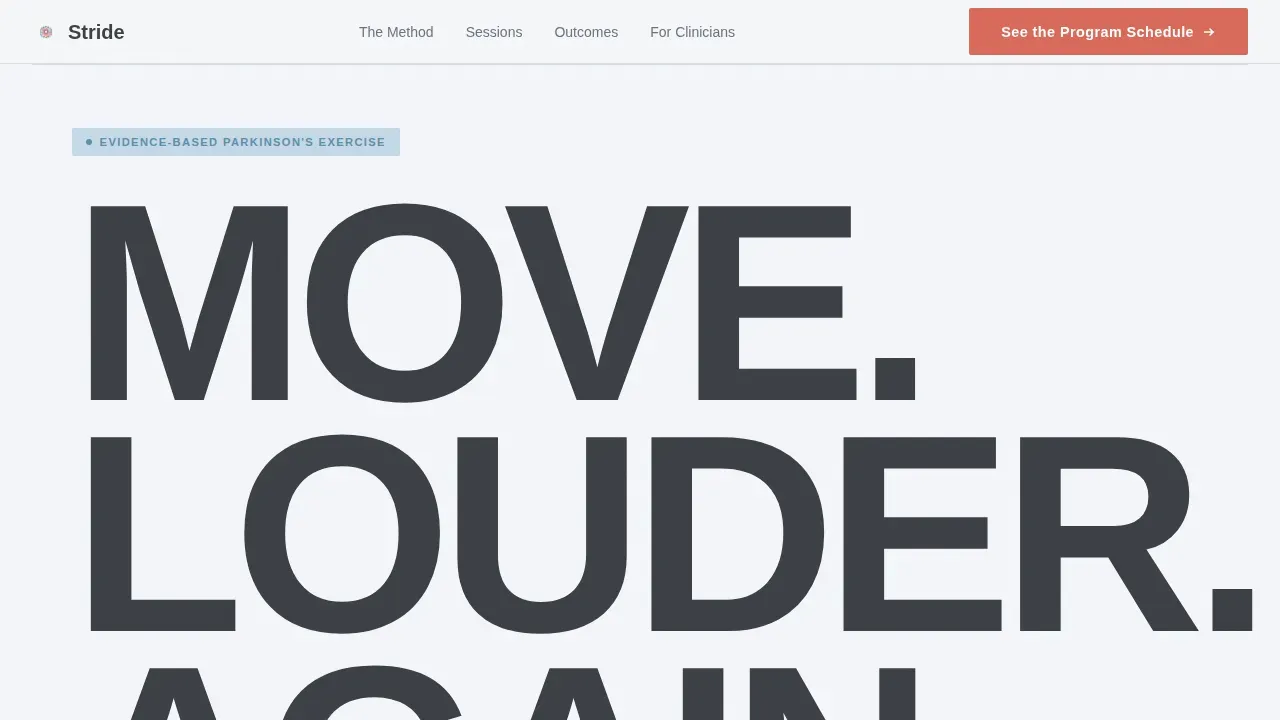
Stacked Type Tower Hero
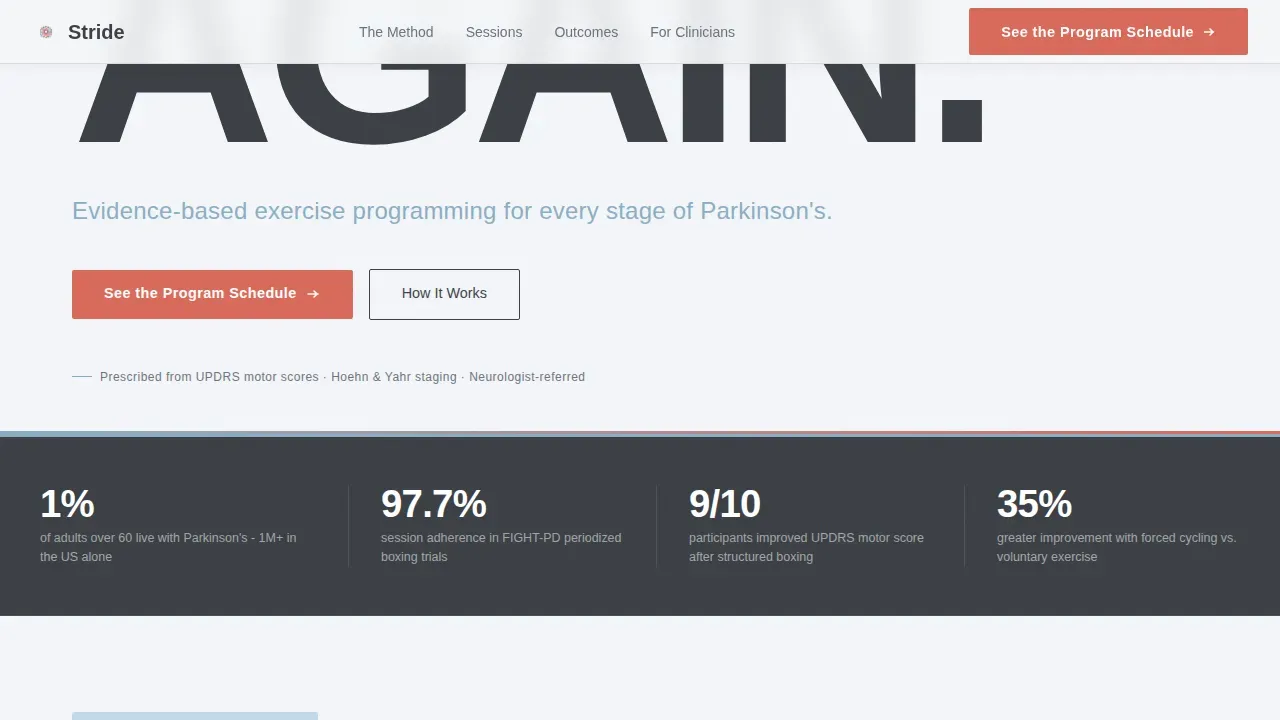
The hero uses massive condensed typographic weight, no photography, no video. Three stacked words fill eighty percent of the viewport height. A single line in therapeutic sky anchors the value proposition below. The restraint signals precision and builds immediate trust.
Zigzag Alternating Section Layout
Five content sections alternate between cloud white and a faint graphite tint. Each section peels back one layer of how the program works: intake assessment, exercise prescription, session footage, and outcome data. People can step through the evidence at their own pace, left-to-right and right-to-left across the page.
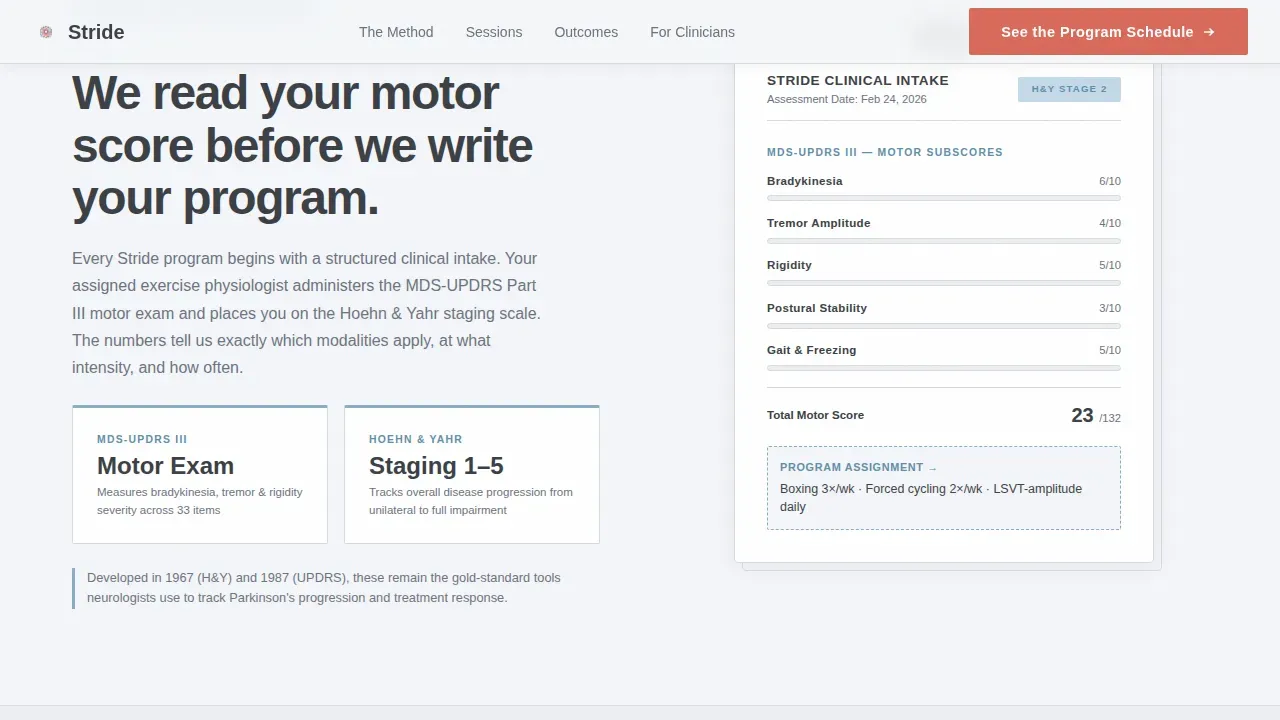
Clinical Intake Methodology Display
The assessment section presents specific clinical scales, UPDRS (Unified Parkinson's Disease Rating Scale) motor scores and Hoehn and Yahr staging, alongside a clinician's clipboard photograph. This is the first step that separates a structured PD exercise program from a generic active living class.
Outcome Data Visualization
The outcomes section displays anonymized bar charts showing gait speed improvements at eight and sixteen weeks. Real progression data presented clearly helps neurologists and patients alike learn what to expect from consistent exercise participation year over year.
Sticky Bottom Call-to-Action Bar
A determined coral call-to-action bar locks to the bottom of the screen after the visitor scrolls past the second zigzag section. It stays visible through every subsequent step. This keeps the click path open without interrupting the evidence-building scroll.
Scroll-Triggered Counter Animations
Key statistics animate into view as visitors scroll. Progress bars and counters update in real time, making outcome numbers feel live and immediate. The animation reinforces that this is an active, updated program, not a static brochure.
Page sections overview
| Section | Purpose |
|---|---|
| Hero Type Tower | Establish clinical tone and introduce the program's core promise |
| Assessment Zigzag Left | Present UPDRS and Hoehn and Yahr intake methodology with clinical detail |
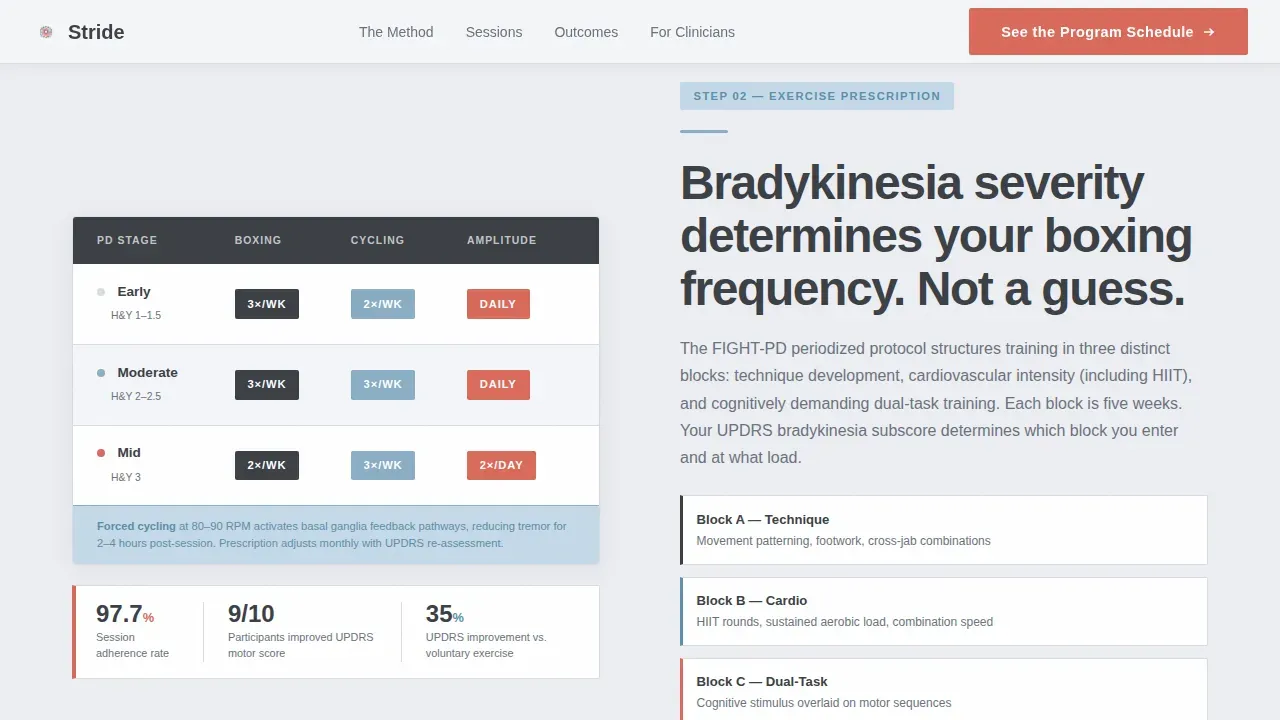
| Prescription Zigzag Right | Map exercise science and training frequency to PD symptom severity |
| Session Zigzag Left | Show a real participant exercise session with trainer-counted amplitude drills |
| Outcomes Zigzag Right | Display anonymized gait speed and UPDRS improvement data at 8 and 16 weeks |
| Sticky call to action Bar | Keep the schedule click visible after visitors scroll past section two |
| Footer Single Row | Provide minimal navigation in a linear single-row footer pattern |
Design & branding system
The template uses a Corporate Precision visual theme built on the Cloud Canvas color system. The palette feels clinical but not cold. Each color has a defined, exclusive role so nothing competes for attention.
- Cloud white (#F4F6F9) as the primary background, quiet graphite (#3B3F45) for body text and structural dividers, and therapeutic sky (#8AAEC4) for section accent bands and iconography
- Determined coral (#D96A5B) reserved exclusively for calls to action and progress indicators, never used as a decorative color
- Manrope heavy condensed for the typographic tower; DM Sans for all body text, providing clear legibility for a desktop-first professional audience
Mobile & speed optimization
The template is built desktop-first to match its primary audience of working professionals and neurologists reviewing referral options. Full mobile support is included so the page remains readable and navigable on any screen.
- Server Components handle all static sections to minimize JavaScript execution and keep the page responsive across devices
- Scroll-triggered animations use a minimal JavaScript footprint, activating only after the visitor reaches each section
- Large clear fonts and high-contrast colors ensure the page is readable at any zoom level, supporting users who need larger text or higher contrast to stay active on the page
How this template helps you convert
The page is structured as a click-through landing page. There is no on-page registration form. The entire scroll is designed to earn a single, confident click to the program schedule.
- Clinical credibility is front-loaded: intake methodology and outcome data appear before any call to action is repeated, so the coral button feels like the logical next step rather than a pressure tactic
- The sticky call-to-action bar ensures the click path is always visible once a visitor has read enough to be convinced, removing friction at the exact moment of decision
- Social proof is embedded in the data sections, with real gait velocity figures and adherence rates that give neurologists and patients a concrete reason to recommend or join the program
Other information about this template
This template is designed to align with current guidance from organizations such as the Parkinson's Foundation, which has updated exercise recommendations to reflect the growing body of evidence for structured, intensity-mapped PD exercise. University research consistently supports the neuroprotective and quality-of-life benefits of regular exercise for people with PD.
- The Stride evidence based Parkinson's exercise program landing page template is suitable for programs offering sessions in English or Spanish, and can be updated to reflect localized class schedules, instructor credentials, and regional community partnerships
- The four key exercise domains, aerobic activity, strength training, flexibility, and balance and agility, can each be represented in the prescription section with appropriate adaptations for different mobility levels, including participants who are wheelchair-bound
- People with PD who engage in at least 2.5 hours of exercise per week, as supported by the Parkinson's Outcomes Project, experience measurably better quality of life; this template is built to present that evidence clearly so community members and referring clinicians understand the stakes of getting started
Theme
Corporate Precision
Creative direction
Transparent Process
Color system
Cloud Canvas
Style
Zigzag/Alternating
Direction
Click-Through
Page Sections
Stacked Type Tower Hero
Zigzag Alternating Section Layout
Clinical Intake and Prescription Display
Outcome Data Visualization
Sticky Bottom Call-to-action Bar
Scroll-triggered Counter Animations
Related questions
Who is the primary audience this landing page template is built for?
Does this template include a registration form on the page?
Can I update the outcome data and clinical scales to match my program?
Is this template suitable for programs that serve participants at different stages of PD?
Can this template support a Spanish-language version of the program page?