Precision Renovation Landing Page Template
Modularrevive is a zigzag landing page built for modular home renovation companies. It pairs full-bleed project photography with real renovation numbers, guides visitors through a booking flow, and captures both ready-to-schedule leads and early-stage inquiries. The design uses a dark emerald and brushed brass palette that signals serious, honest craftsmanship.
by Rocket studio
Quick summary
Modularrevive is a single-page template built for companies that buy, gut, and rebuild modular homes into high-value living spaces. It opens with an address input that sets visitor intent immediately. A zigzag layout then walks visitors through real project transformations before delivering a clear booking call to action.
Who this template is for
This template is designed for renovation-focused businesses operating in the modular and manufactured housing space. It speaks directly to three distinct audiences a modular home flipper typically serves.
- Rural landowners who hold depreciated manufactured homes and want to understand their property's renovated value
- Young couples priced out of conventional stick-built construction who are exploring more affordable paths to modern living
- Small-portfolio investors looking for affordable rehab projects in secondary and rural markets
What problem this template solves
Most renovation service pages lead with credentials or generic before-and-after photos. They fail to answer the one question every visitor actually has: what is my specific home worth after a rebuild? This template solves that by making the address input the first interaction, then proving the answer with real project data.
- Visitors arrive with doubt about whether a modular home can become a quality living space, and the page answers that doubt visually and numerically
- Potential clients who are not ready to book still have a low-friction path to engage through the secondary email capture option
- The fixed bottom booking bar keeps the primary call to action present without interrupting the project story being told in the scroll
What you get with this template
This template delivers a fully structured, single-page layout designed for modular home renovation lead generation and appointment booking. Every section is purpose-built around the buyer's decision journey.
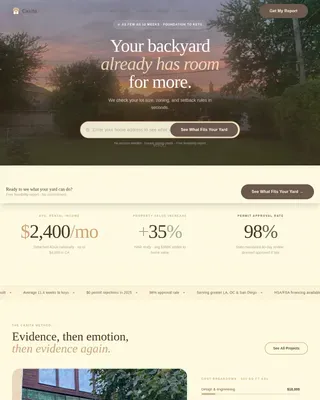
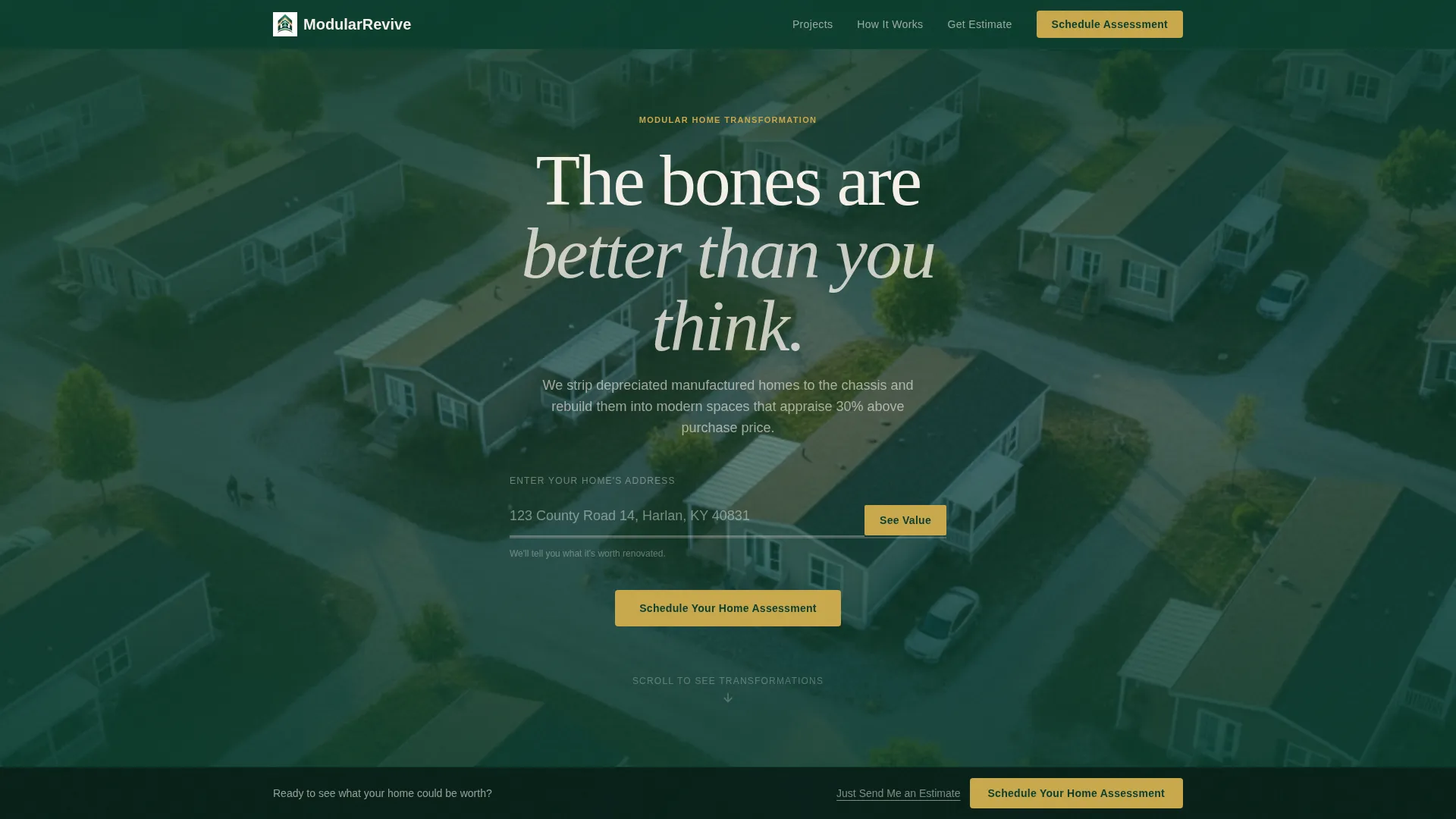
- A header section with a centered address input field over a drone aerial background, including auto-complete styling and a clear value proposition line beneath the field
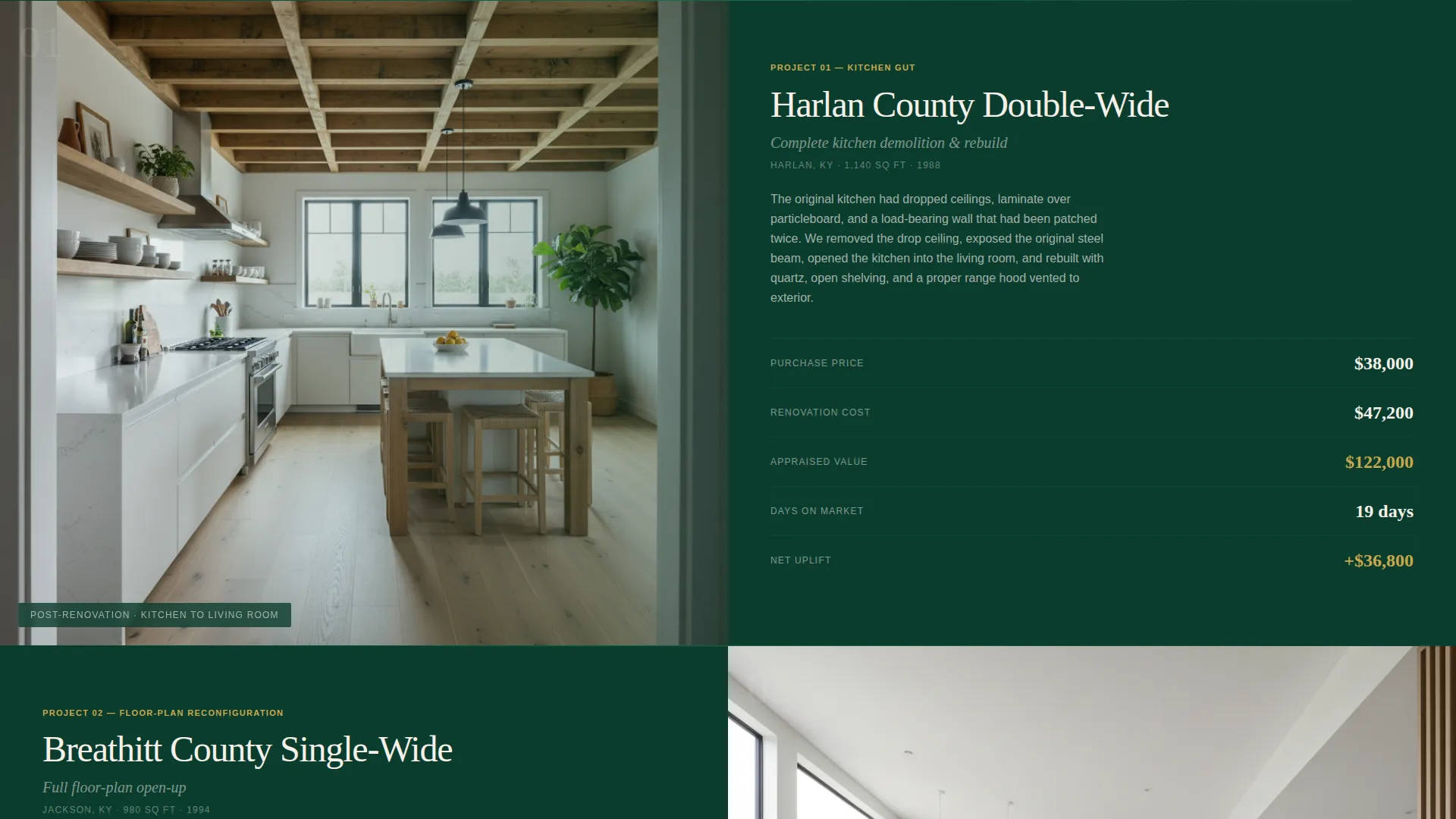
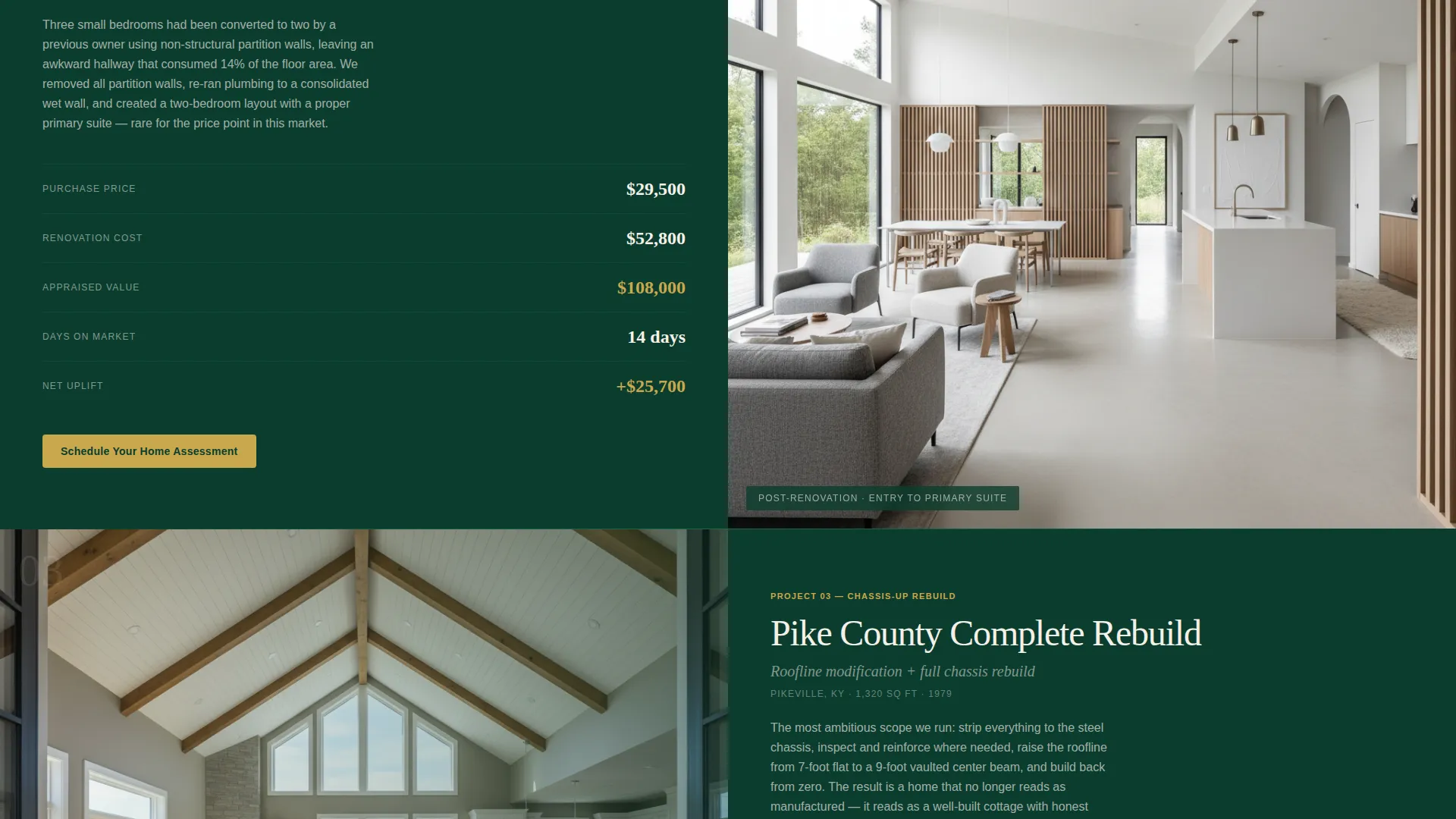
- A zigzag alternating section layout featuring full-bleed interior photography paired with structured renovation data panels showing purchase price, renovation cost, appraised value, and days on market
- A dual-path conversion section with a primary booking form and a secondary email-plus-address capture form for visitors not yet ready to schedule
Feature list
This template is built around deliberate design decisions that reflect how a modular home renovation company actually earns trust and books clients.
Address Input Header
The header places a clean, centered address field over a slow-panning aerial drone shot of a modular home community at golden hour. The field prompt reads "Enter your home's address" with a supporting line: "We'll tell you what it's worth renovated." Auto-complete triggers a subtle emerald underline, and submitting the address scrolls the visitor directly into the first project story.
Zigzag Project Sections
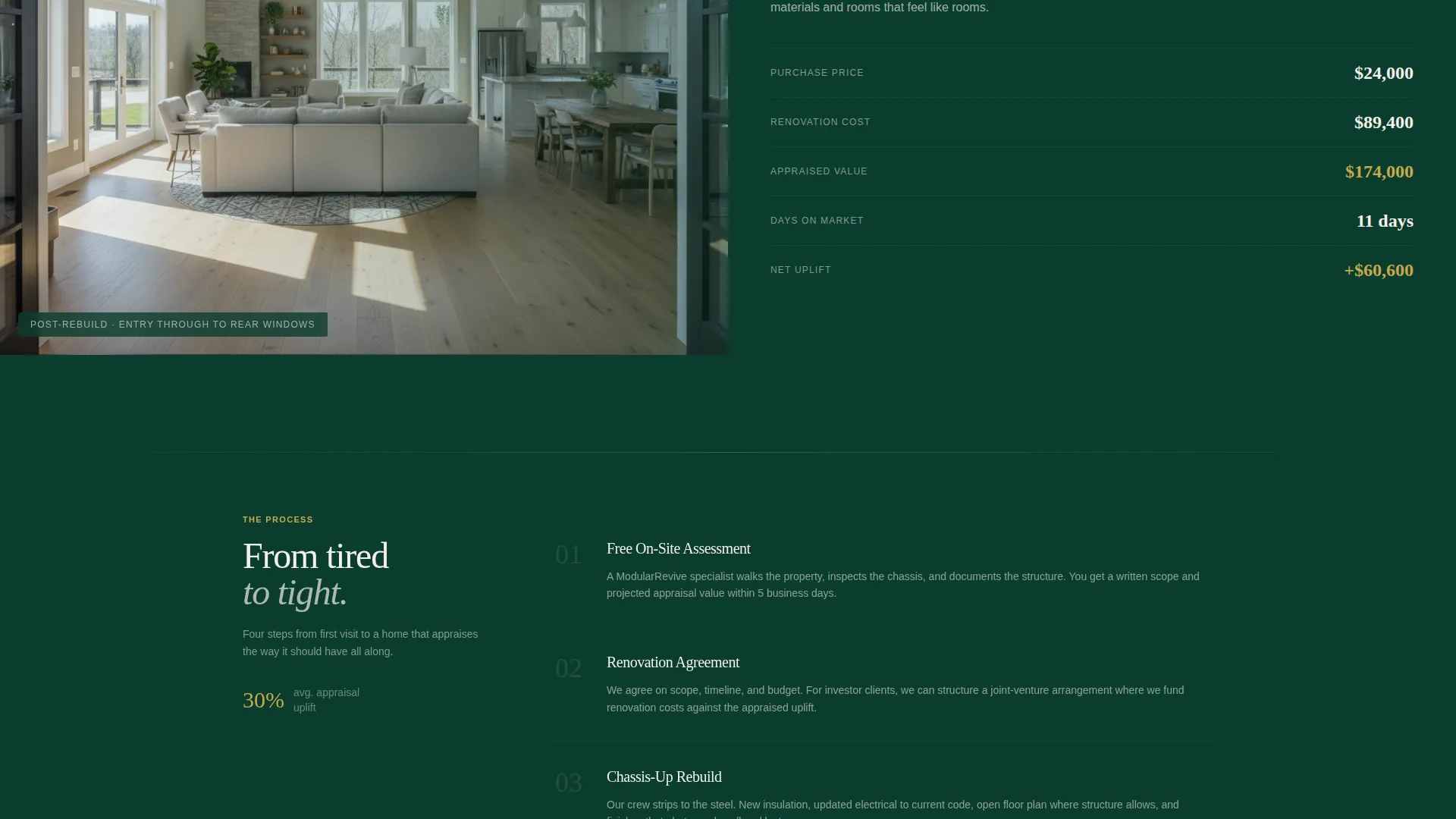
Each alternating section pairs a wide-angle interior photograph with a structured data panel showing the real numbers behind the renovation. The photos are shot from doorways to convey depth and spatial transformation. Projects escalate in scope from a kitchen gut to a full floor-plan reconfiguration to a chassis-up rebuild with roofline modification.
Brass Accent Number Display
Purchase price, renovation cost, and appraised value are displayed in brushed brass typography to make the financial case impossible to ignore. Numbers like "$47K in, $122K out" are positioned as the most attention-grabbing element in each data panel, reinforcing the thirty-percent-or-higher appraisal improvement narrative.
Dual-Path Booking Form
The primary booking form pre-fills the property address from the header input. It includes fields for home year and approximate square footage, a single toggle between "renovate and keep" or "renovate and sell," and a preferred visit window selector showing the next ten available dates. A secondary path captures email and address for leads not yet ready to commit.
Fixed Bottom Booking Bar
After the visitor scrolls past the third project section, a fixed bottom bar appears carrying the primary call to action: "Schedule Your Home Assessment." This keeps conversion accessible throughout the remainder of the page without requiring the visitor to scroll back to the top.
Corporate Precision Visual System
The dark emerald and warm alabaster palette creates contrast that is easy to read and visually distinctive. Brushed brass is reserved exclusively for calls to action and price callouts, so the eye is trained to associate that color with action and value. The overall aesthetic signals careful investment without pretension.
Page sections overview
| Section | Purpose |
|---|---|
| Address Input Header | Captures visitor intent and sets the renovation value proposition immediately |
| First Project Zigzag | Shows a kitchen gut renovation with paired photography and cost data |
| Second Project Zigzag | Presents a full floor-plan reconfiguration with escalated scope and numbers |
| Third Project Zigzag | Delivers the chassis-up rebuild story with roofline modification detail |
| Primary Booking Form | Qualifies and converts visitors ready to schedule a home assessment |
| Secondary Lead Capture | Collects email and address from visitors who want an estimate first |
| Fixed Bottom Bar | Keeps the booking call to action visible after the third project section |
Design & branding system
The visual identity follows a Corporate Precision theme. The palette is built around contrast and restraint, where every color carries a specific role and nothing is decorative for its own sake.
- Deep forest black-green (#0B3D2E) serves as the primary background, creating a serious and grounded canvas across all full-bleed sections
- Polished emerald (#1B6B4A) is used for section dividers and hover states, providing subtle depth without competing with content
- Warm alabaster (#F5F0E8) fills text panels and breathing-room zones, keeping body copy highly legible against the dark background
- Brushed brass (#C9A84C) appears strictly on calls to action and price callouts, signaling value and directing the eye toward conversion moments
Mobile & speed optimization
The zigzag layout is structured to restack cleanly on smaller screens, keeping the photography and data panels readable without horizontal scrolling. Each section is designed to load sequentially, so the most important content reaches the visitor first.
- Full-bleed images are positioned to crop gracefully on portrait-orientation screens, preserving the sense of depth from the original wide-angle framing
- The fixed bottom booking bar remains accessible on mobile viewports, so the call to action is always one tap away regardless of scroll position
How this template helps you convert
This template is engineered around the specific psychology of a modular home renovation buyer. Doubt is high and the decision is both financial and personal, so the page earns trust incrementally before asking for a commitment.
- The address input at the top immediately makes the visit feel personal and relevant, shifting the visitor from passive reader to active participant before they see a single project
- Each zigzag project section raises the stakes visually and financially, building a cumulative case for what is possible before the booking form appears
- The dual-path conversion structure captures leads at two different levels of readiness, so the page converts visitors whether they are ready to book today or still weighing the decision
Other information about this template
This template is part of a modular home real estate category and is suited to businesses operating across the modular and manufactured housing renovation niche. It is a strong fit for renovation companies positioning themselves in secondary and rural markets where manufactured housing inventory is high and comparable modern homes are scarce.
- The template style is a zigzag alternating layout, which is well-suited to case study narrative presentations where each section tells a complete project story
- The header concept is a search box or address input, which aligns with assessment-led and quiz-style landing page flows common in property valuation and renovation services
- The booking and scheduling direction of the page makes it appropriate for companies that use a home visit or assessment as the primary sales entry point
- The Executive Suite theme and Corporate Precision design direction make this template suitable for renovation businesses that want to signal professionalism and financial credibility to investor and landowner audiences
Theme
Executive Suite
Creative direction
Case Study Narrative
Color system
Charcoal & Amber
Style
Zigzag/Alternating
Direction
Quiz/Assessment
Page Sections
Address Input Header with Drone Background
Zigzag Alternating Project Layout
Brass Accent Financial Callouts
Dual-path Conversion Flow
Fixed Bottom Booking Bar
Corporate Precision Color System
Related questions
Can I edit the renovation project data shown in the zigzag sections?
Does the booking form support a date selector out of the box?
What happens if a visitor skips the header address input?
Is this template suitable for a renovation company that only does partial upgrades, not full rebuilds?
Can the secondary lead capture path be used instead of the full booking form?