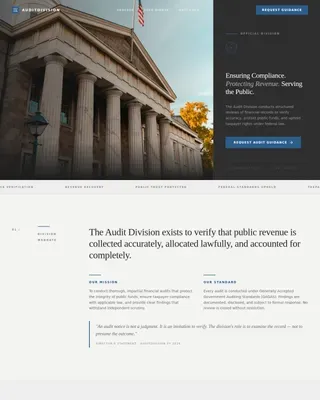
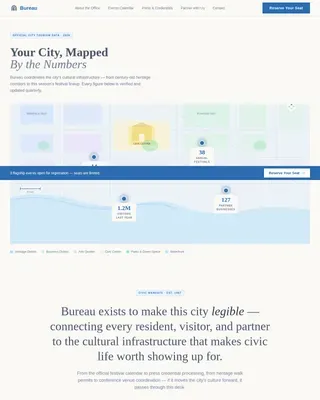
Historic Preservation Government Professional Website Template
This register authoritative historic preservation federal agency landing page template gives preservation professionals a sidebar-driven, step-by-step guide through the national register nomination and tax credit process. Built for state historic preservation officers, architectural firms, property owners, and tribal officers, it turns a complex federal undertaking into a clear, navigable corridor with embedded tools and a focused download prompt.
by Rocket studio
Quick summary
This landing page template models a federal historic preservation agency portal. It combines an interactive map header, a persistent numbered sidebar, and a scrollable five-step content pane to guide every visitor from preliminary research through national register listing and federal tax credit application. The design feels institutional, sober, and trustworthy before a single word is read.
Who this template is for
This template serves professionals and property owners who work inside the historic preservation process every day. They know the regulations, but they need a clear, authoritative guide that respects their time and their expertise.
- State Historic Preservation Officers managing Section 106 compliance reviews and nominating properties to the national register on behalf of their state agency
- Architectural historians, architectural firms, and preservation consultants navigating the Secretary of the Interior's standards for proposed changes to historic buildings
- Property owners pursuing the federal rehabilitation tax credit and tribal historic preservation officers asserting sovereignty over ancestral cultural resources
What problem this template solves
Historic preservation work involves overlapping layers of federal law, agency review, nomination forms, and tax credit criteria. Most agency websites present this information as a flat document dump. Visitors arrive knowing their goal but leave without a clear next step.
This template solves that problem structurally. The sidebar timeline keeps every visitor oriented inside the process. Each scrollable step deepens understanding before introducing new complexity.
- Professionals waste hours hunting for the right nomination forms, eligibility criteria, and guidance on properties designated under the national historic preservation act
- Property owners cannot quickly determine whether their building qualifies or what the rehabilitation process involves
- Tribal officers and students lack a single starting point that acknowledges their specific role and routes them to relevant resources
What you get with this template
The template ships as a fully designed, single-page sidebar companion layout. Every section is purpose-built for a federal historic preservation agency audience, with components mapped directly to the five-stage preservation process.
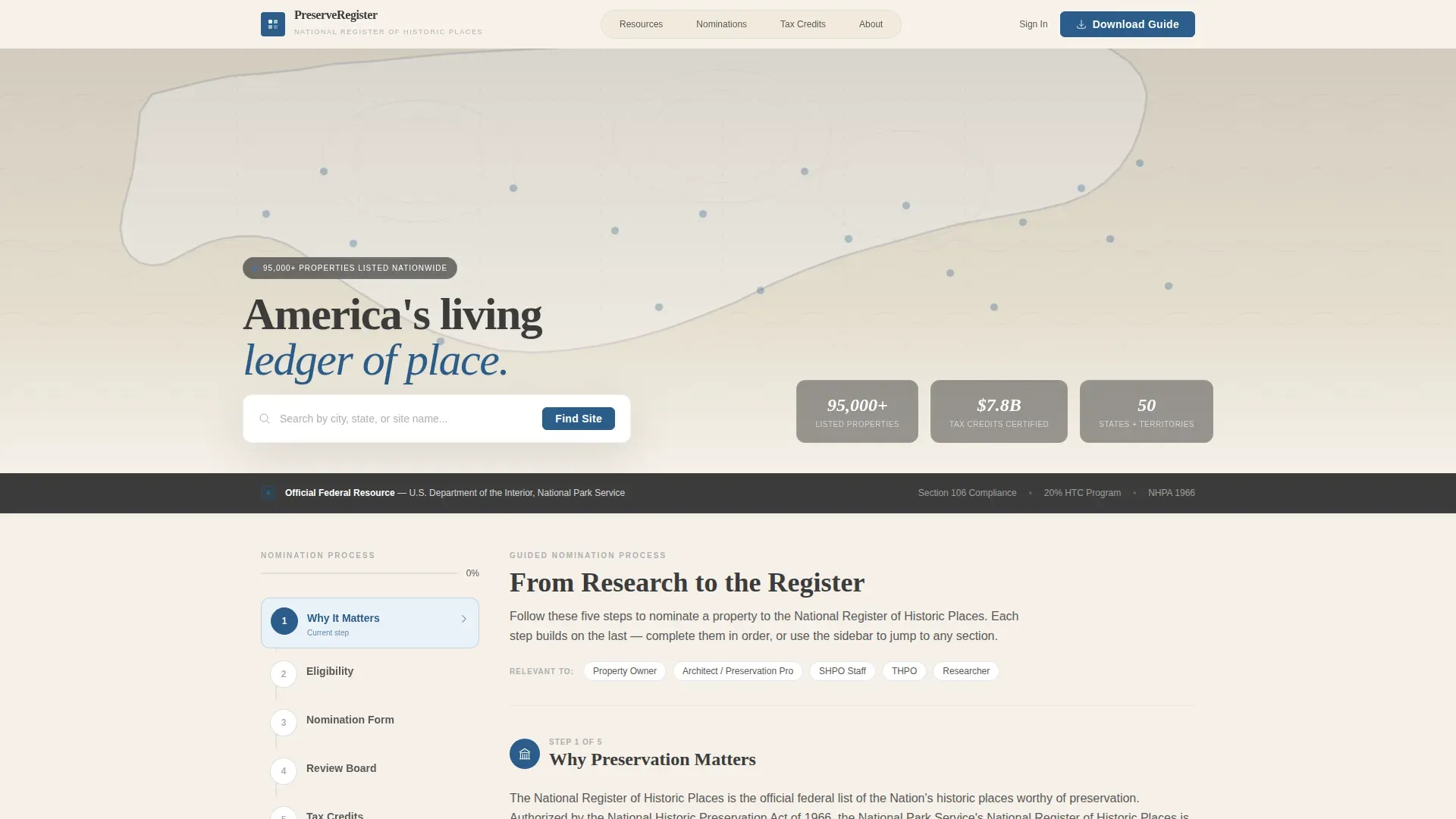
- An interactive full-width United States map with animated property pins, a glass-overlay search bar, and hover cards showing site name, thumbnail, and year of listing
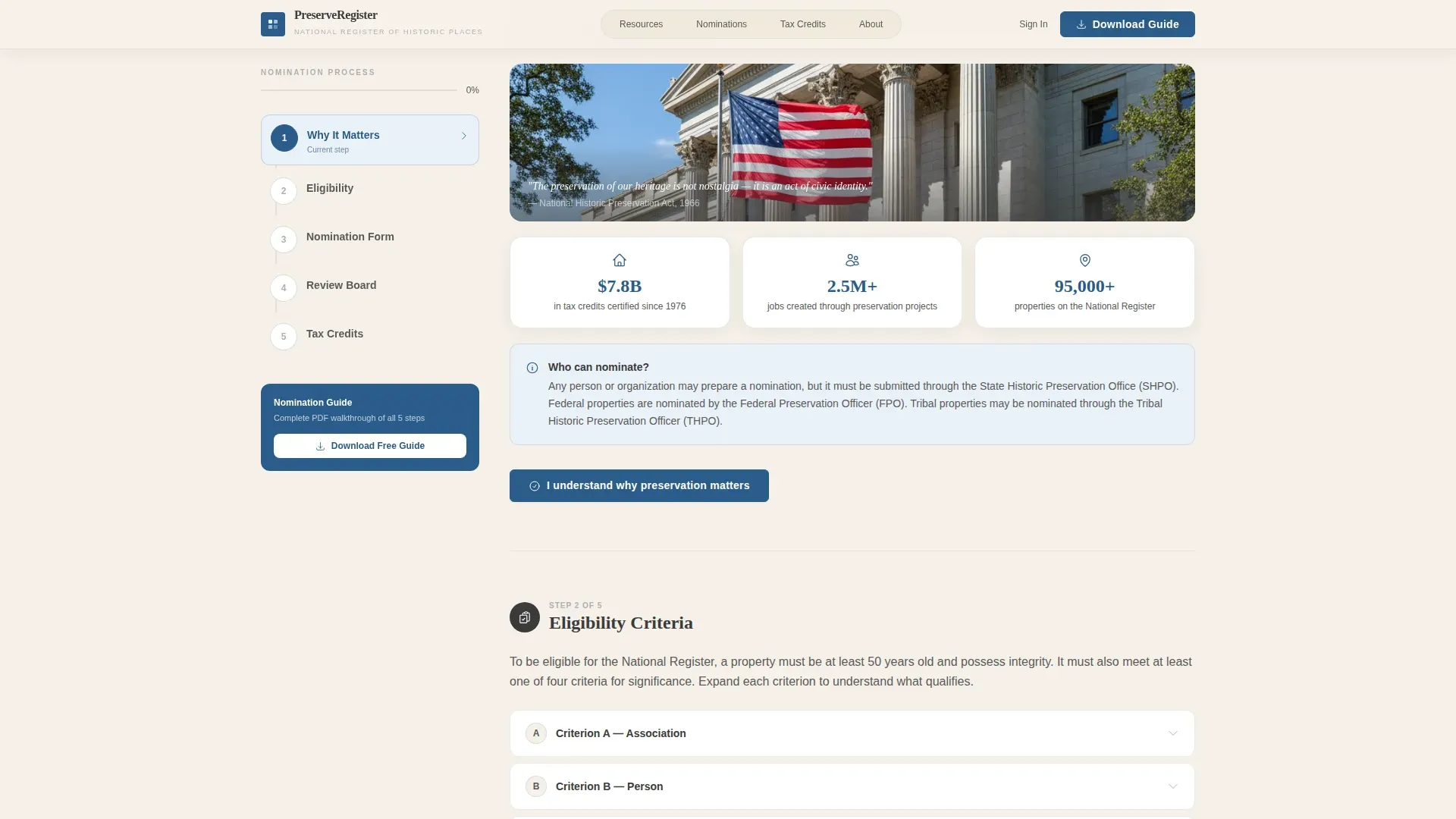
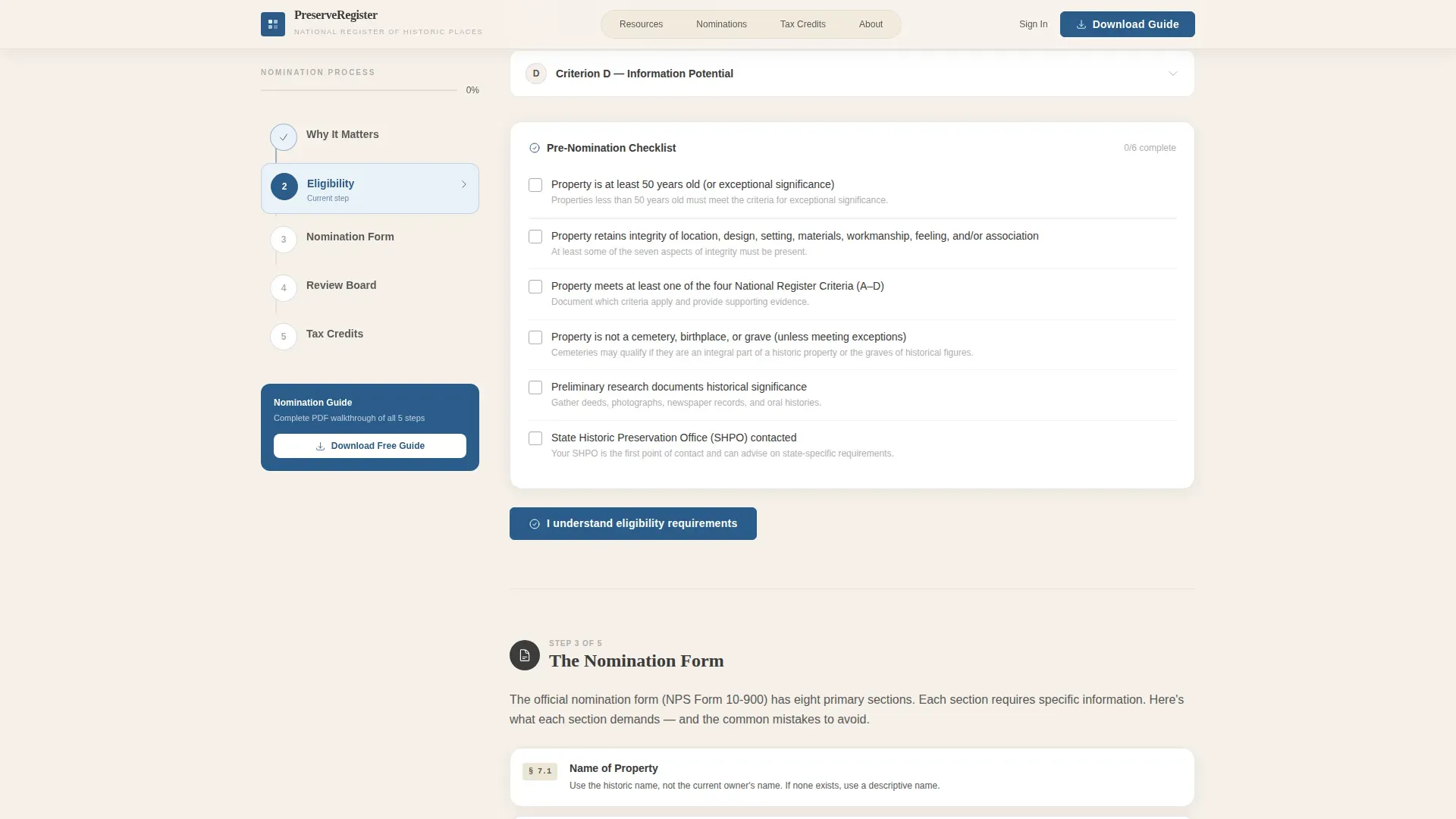
- A persistent left sidebar with a numbered vertical timeline that scroll-spies the active step, keeping visitors oriented across all five process stages
- An eligibility checker tool, a tax credit calculator, role-specific testimonial blocks, and a gated nomination guide download requiring only an email and role selection
Feature list
This section describes the built-in components and functional capabilities included in the template as delivered.
Interactive Topographic Map Header
The header renders a full-width SVG map of the United States in muted topographic layers. Archive parchment covers the landmass, overcast gray defines state borders, and thousands of animated blue pins represent properties listed in the national register. Each pin pulses gently and reveals a hover card with the property name, thumbnail image, and year of listing. A search bar pinned to the top-left lets visitors type a city, state, or site name and snap the map to local historic places instantly.
Persistent Sidebar Step Timeline
A numbered vertical timeline sits fixed in the left sidebar throughout the entire page scroll. As the visitor moves through the right-hand content pane, the sidebar highlights the current step using the National Register blue accent. The five steps move from narrative inspiration through eligibility criteria, nomination form guidance, State Review Board process, and finally certification with tax incentives. This scroll-spy behavior answers the visitor's most practical question at every moment: where am I in this process?
Five-Step Guided Content Pane
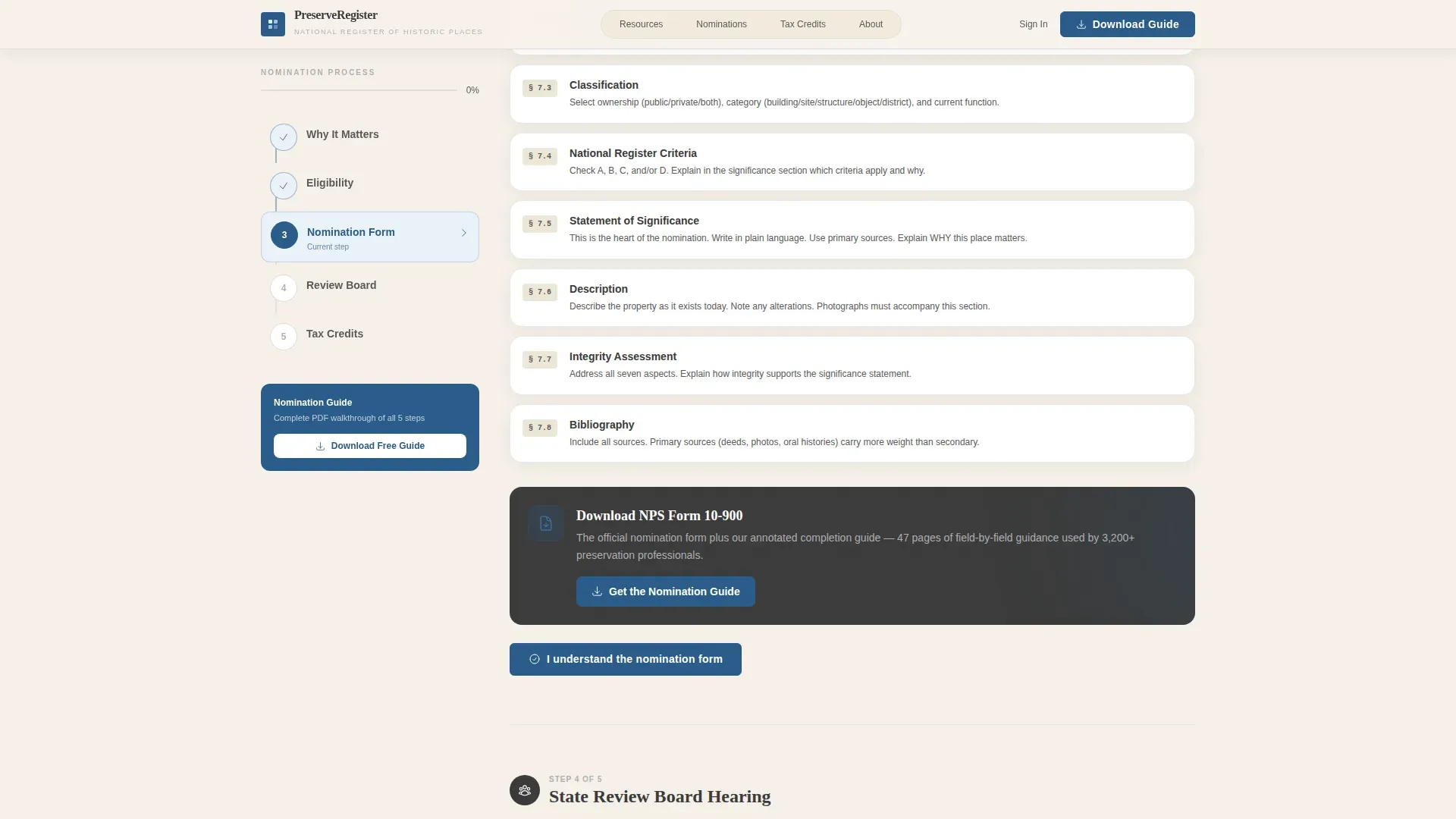
Each of the five steps occupies its own scrollable section with progressively deeper content. Step one is narrative and motivational, covering why preservation matters and the history behind the national historic preservation act. Step two introduces eligibility criteria with expandable checklists. Step three walks through nomination forms field by field with downloadable templates. Step four explains the State Review Board hearing. Step five covers federal certification and tax incentive calculations. Every step ends with a brief micro-confirmation before introducing the next layer of detail.
Eligibility Checker Tool
A three-field lookup tool accepts an address, year built, and property type. It returns an instant preliminary assessment of whether the property may be determined eligible for national register consideration. The result feeds into a longer guided questionnaire, giving visitors a clear starting point without requiring them to read every regulation before they understand their situation.
Tax Credit Calculator
A rehabilitation cost input field estimates the potential federal tax credit available for approved historic buildings. Owners of historic buildings may benefit from investment tax credits for rehabilitations of historic commercial, industrial, and residential buildings. This calculator makes that abstract incentive concrete and personal before the visitor reaches the download prompt.
Nomination Guide Download and Role Selector
The primary conversion point asks only for an email address and a role selection: property owner, preservation professional, government staff, or student and researcher. The guide is positioned both at the sidebar footer and inline after step three, where the visitor has already absorbed enough procedural clarity to understand why the download is genuinely useful.
Page sections overview
| Section | Purpose |
|---|---|
| Interactive Map Hero | Orient visitors to listed properties nationwide and invite local search |
| Sidebar Step Timeline | Provide persistent process navigation across all five preservation steps |
| Step One: Why Preserve | Establish mission context and emotional case for historic preservation |
| Step Two: Eligibility Criteria | Present expandable checklists for national register evaluation criteria |
| Step Three: Nomination Forms | Walk through nomination form fields with inline downloadable templates |
| Step Four: Review Board | Explain the State Review Board hearing and agency approval process |
| Step Five: Tax Incentives | Cover federal certification, rehabilitation credits, and calculator tool |
| Eligibility Checker | Return instant preliminary assessment from three-field property lookup |
| Testimonials Section | Display role-specific social proof from officers, architects, and owners |
| Footer Row | House legal links, agency contact details, and secondary navigation |
Design & branding system
The visual identity follows an Institutional Authority theme built on the Cloud Canvas color system. The palette feels like a clouded sky over a sandstone courthouse: muted, sober, and trustworthy in the way that only things without decoration can be.
- Colors: archive parchment (#F5F0E8) for backgrounds, iron gate charcoal (#3B3B3B) for all body text, overcast gray (#B0AEB3) for ruled lines and secondary navigation, and National Register blue (#2A5C8A) reserved sparingly for links, active sidebar states, and call-to-action buttons
- Typography: Fraunces serif headings carry the weight of historic architecture and institutional authority, while DM Sans handles all user interface body text with clean legibility across every content pane
- Every blue instance reads as an official directive; paint color choices across the system reinforce restraint, ensuring the content and the structure carry the page rather than decoration
Mobile & speed optimization
The template is built desktop-first to serve state preservation officers and professionals who review nomination forms and compliance documents on workstation screens. The layout responds fully to tablet and mobile viewports without losing the sidebar orientation system.
- The persistent sidebar collapses into a sticky progress indicator on smaller screens, keeping step context visible without consuming horizontal space needed for content
- Server components handle all static content sections, including step text, testimonials, and footer, while client components are scoped to the interactive map, sidebar scroll-spy, eligibility checker, and tax credit calculator
- Animated SVG map pins are optimized to pulse without blocking the main thread, and step transitions use lightweight CSS animations to keep the scroll experience fluid on mid-range devices
How this template helps you convert
The page earns the conversion before asking for it. By the time a visitor reaches the nomination guide download prompt, the template has already delivered genuine procedural clarity through five structured steps, an eligibility check, and a tax credit estimate.
- The interactive map creates immediate civic pride and local relevance, holding the visitor's attention from the first second and establishing the agency's authority over the national record of historic places
- The sidebar timeline removes disorientation, replacing the anxiety of bureaucratic complexity with a clear sense of progress, so visitors stay engaged through all five steps rather than bouncing when regulations appear
- The download prompt arrives after step three, when the visitor has already understood eligibility criteria and nomination form requirements, making the guide feel like the obvious next resource rather than an unsolicited gate
Other information about this template
This template is designed specifically for federal agencies operating under the national historic preservation act. It reflects the procedural reality of how historic preservation work actually flows, from the advisory council on historic preservation's role in Section 106 undertaking review through national park service approval of completed nomination forms.
The advisory council on historic preservation provides guidance that assists federal agencies in developing Section 106 agreement documents, including Memoranda of Agreement and Programmatic Agreements. A fundamental goal of Section 106 consultation is to ensure agency decisions are well-informed regarding effects to historic properties. The advisory council provides sample stipulations as reference tools for documenting commitments within those agreement documents.
Federal agencies must establish a program to locate, inventory, and nominate properties under their ownership or control that appear to qualify for inclusion on the national register. All federal agencies in the United States are created through Acts of Congress, and each agency must receive a budget appropriation from Congress to hire personnel and begin operations.
There are three separate levels of historic designation: Local, State, and Federal. The national register represents the federal tier. Properties determined eligible at the state level may progress to national register nomination through the State Historic Preservation Officer. Certified local governments also participate in the nomination and review process. The designation process for historic resources may be initiated by property owners, local government bodies, or a historic preservation commission.
Listing in the national register does not prohibit property owners from taking actions with respect to their property under federal law or regulation. Historic designation does not affect property taxes unless an active incentive contract exists. Owners of historic properties may need to submit a Certificate of Appropriateness for proposed alterations to ensure compatibility with existing historic resources. All proposed changes to structures over 50 years old that may be considered historic resources can also trigger environmental review under applicable state law.
The national register serves as an authoritative guide used by federal, state, and local governments, private groups, and citizens to identify the nation's cultural resources. National historic landmarks represent the highest federal recognition, reserved for properties of exceptional national significance. Archeological resources and historic structures of all types, including those located in a surrounding neighborhood context, may qualify for consideration.
- The advisory council on historic preservation plays a central role in Section 106 review, giving consulting parties a reasonable opportunity to comment on proposed undertakings
- Architectural historians and preservation professionals use the Secretary of the Interior's standards when evaluating proposed changes and advising owners on new construction adjacent to historic buildings
- Properties listed in the national register make owners eligible for federal grants-in-aid and investment tax credits for rehabilitation of approved historic commercial, industrial, and residential buildings
- Creative ways to present procedural guidance, such as the five-step sidebar format in this template, help visitors find relevant resources without wading through dense regulatory text
- The national park service administers the national register, and nominations must be made on standard national register forms provided by the national park service before the State Review Board approves them for submission
Theme
Institutional Authority
Creative direction
Step-by-Step Guide
Color system
Cloud Canvas
Style
Sidebar Companion
Direction
Content/Resource
Page Sections
Interactive Topographic Map Header
Persistent Sidebar Step Timeline
Five-step Guided Content Pane
Three-field Eligibility Checker
Rehabilitation Tax Credit Calculator
Gated Nomination Guide Download
Related questions
Who is this template designed for?
What sections does the template include?
Does listing on the national register restrict what property owners can do?
How does the three-field eligibility checker work?
Can this template support a Section 106 compliance workflow?