Gastroenterology Research Center Landing Page Template
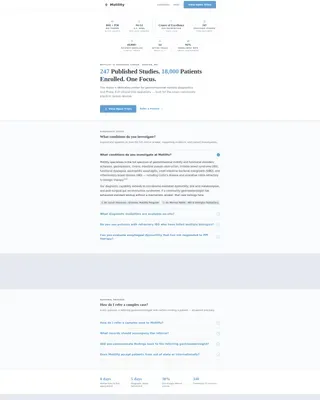
The Motility landing page is a single-column, FAQ-driven template built for a gastroenterology research center. It leads with an award badge rail and a bold credibility headline, then guides referring physicians, IBD patients, and pharmaceutical sponsors through accordion-style Q&A sections. Every interaction ends with a clear call to action linking to an enrollment portal.
by Rocket studio
Quick summary
The Motility template is a single-column landing page designed for a specialized gastroenterology research center. It opens with a horizontal badge rail displaying institutional credentials, then flows through three structured FAQ accordion clusters. Each cluster answers a distinct visitor question. The page ends every scroll segment with a prominent call-to-action button that routes to an open trials portal.
Who this template is for
This template is built for medical research centers that need to communicate clinical authority quickly. It works especially well when the audience includes time-pressed professionals who need specific answers before they act.
- Referring gastroenterologists seeking diagnostic capabilities beyond community practice
- IBD patients who have not achieved remission through standard biologic treatment
- Pharmaceutical sponsors evaluating clinical trial sites for Phase II or Phase III enrollment
What problem this template solves
Specialized research centers struggle to earn trust from skeptical, expert audiences. A generic page fails referring physicians who need evidence of capability, not marketing language. This template removes that friction by organizing the entire scroll around real questions those visitors would ask.
- Credibility is established before a single paragraph is read, through the badge rail headline format
- Complex referral and enrollment questions are answered inline, without requiring a phone call
- Repeated call-to-action placements remove the friction of hunting for next steps
What you get with this template
You get a fully structured, single-column landing page ready to represent a high-credibility gastroenterology research environment. Every section serves a specific audience segment and a specific conversion goal.
- A horizontal award badge rail with a credibility headline and dual call-to-action links
- Three FAQ accordion clusters covering capabilities, referral process, and active trial enrollment
- Recurring call-to-action breaks in open-sky blue with a pulse hover state, linking to the enrollment portal
Feature list
This template delivers a focused set of components, each chosen to serve the FAQ-driven, click-through purpose of the page.
Award Badge Rail with Credibility Headline
The page opens with a horizontal rail of institutional seals, including NIH funding badges, specialty ranking markers, ACG recognition medallions, and enrollment milestone indicators. A single-line charcoal headline beneath the rail reads: "247 Published Studies. 18,000 Patients Enrolled. One Focus." Credibility is declared before the visitor reads a word of body copy.
FAQ Accordion Clusters
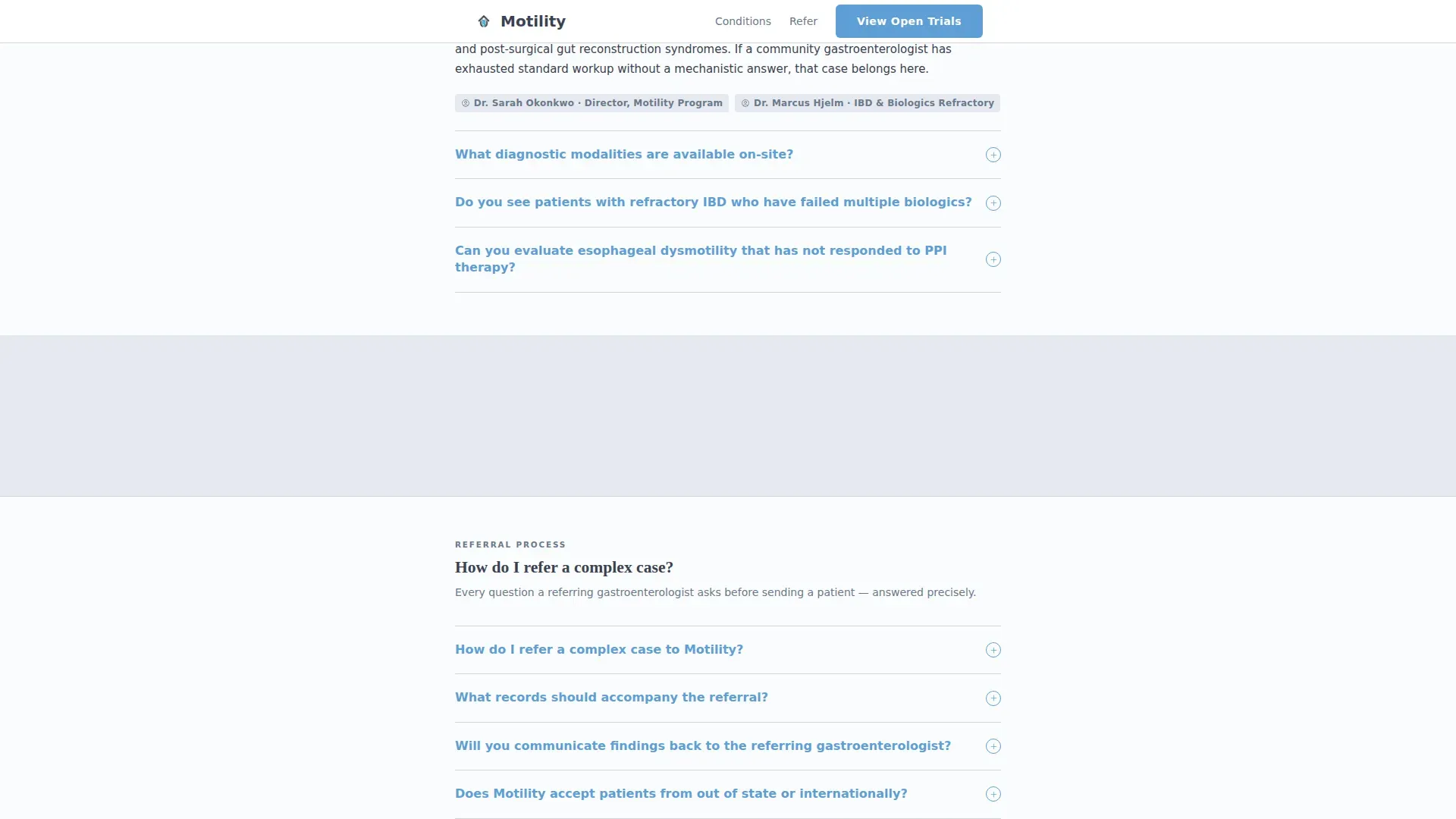
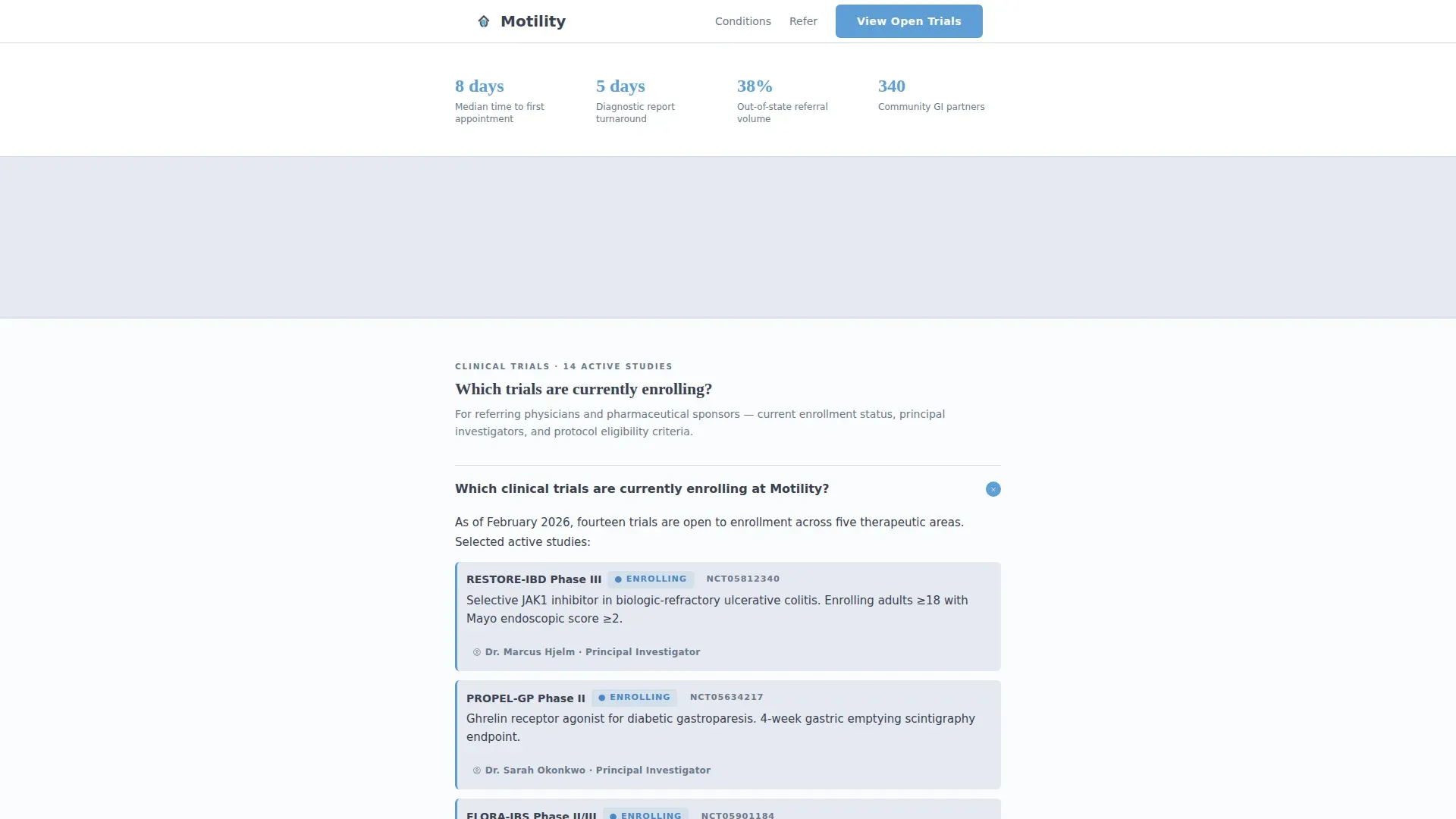
Three thematic accordion clusters structure the scroll: conditions investigated, referral process, and currently enrolling trials. Each accordion trigger is styled in open-sky blue and expands to reveal two to three precise sentences. Answers include linked citations and named principal investigators to reinforce clinical authority.
Pulsing Call-to-Action Buttons
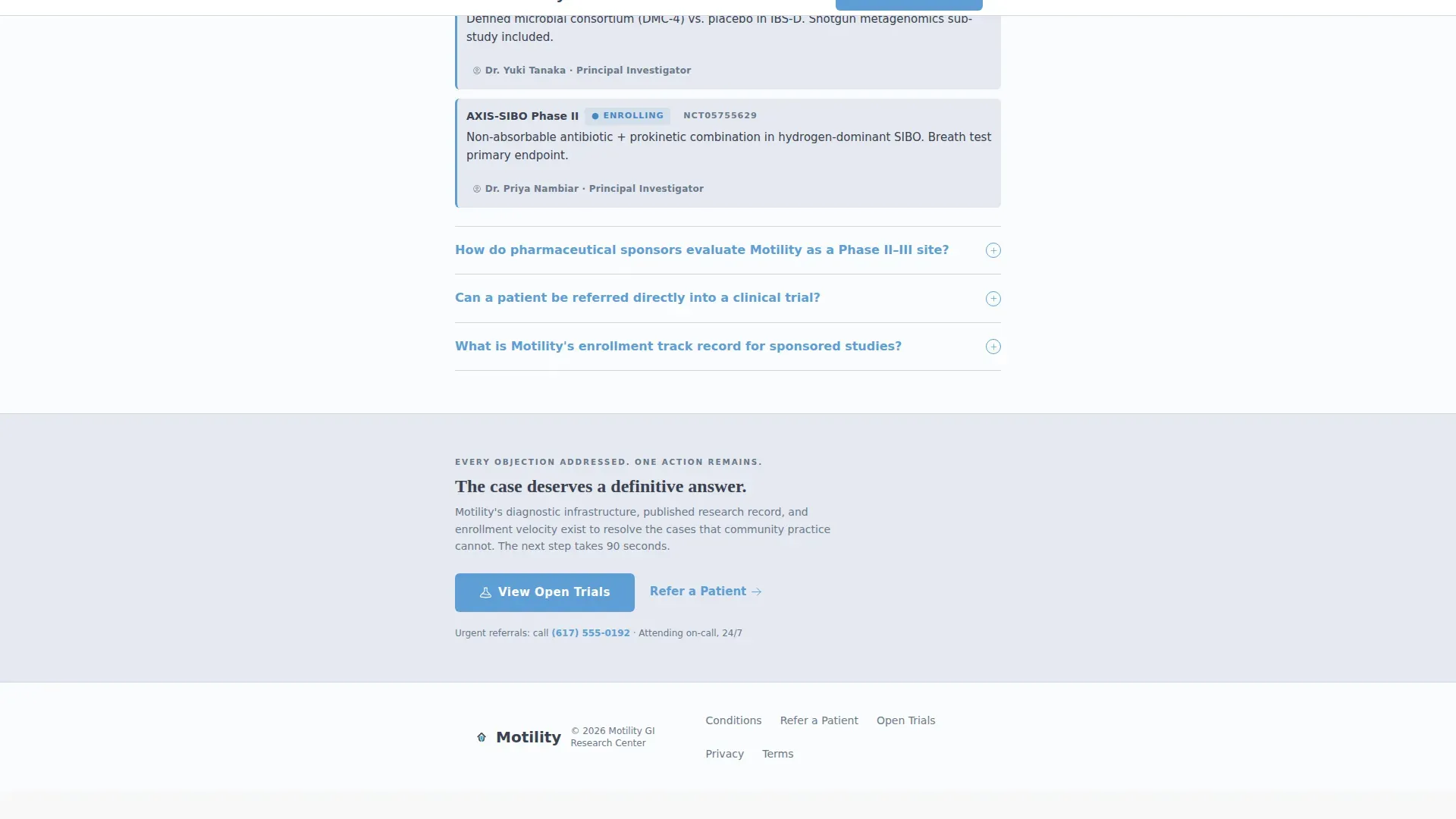
The primary call to action, "View Open Trials," appears first beneath the badge rail and repeats after every third FAQ accordion. It is rendered in open-sky blue with a subtle pulse on hover. A secondary text link, "Refer a Patient," routes to a secure referral intake form.
Smooth Scroll with Accordion Animation
Accordion sections open and close using a cubic-bezier easing curve, giving the interactions a calibrated, clinical feel rather than a jarring snap. Smooth scroll connects badge rail, FAQ clusters, and call-to-action breaks into one continuous reading experience.
Desktop-First Responsive Layout
The layout is built for referring physicians working at desktop workstations, with full mobile support for patients and sponsors reviewing on other devices. The single-column flow adapts cleanly across screen sizes without restructuring any content hierarchy.
Medical Clarity Typography System
Headlines are set in Fraunces, a serif typeface that reads with academic weight. Body text and interface labels use DM Sans for clean, clinical legibility. The pairing gives the page the feel of a peer-reviewed document rendered in a modern digital format.
Page sections overview
| Section | Purpose |
|---|---|
| Badge Rail Header | Establish institutional credibility before body copy |
| Credibility Headline | Anchor key metrics in a single scannable line |
| Dual call to action Links | Route visitors to trials portal and referral intake |
| Capabilities FAQ | Answer what conditions the center investigates |
| call to action Break One | Prompt enrollment portal click after capabilities section |
| Referral FAQ | Explain how referring physicians submit complex cases |
| Trials FAQ | Detail which studies are currently enrolling patients |
| Final call to action Block | Close the page with a clear enrollment portal action |
| Linear Footer | Provide single-row navigation and compliance links |
Design & branding system
The visual identity is built around a Slate and Sky color system that communicates clinical precision at first glance. Every color choice serves a functional role rather than a decorative one.
- Sterile white (#FAFBFC) canvas beneath all sections, clinical charcoal (#3B4252) for all body text
- Instrument-tray gray (#E5E9F0) alternating section backgrounds to separate content clusters cleanly
- Open-sky blue (#5E9ED6) reserved exclusively for interactive accordion triggers, linked citations, and call-to-action buttons
Mobile & speed optimization
The template is built desktop-first to match the primary audience of referring physicians at workstations, but it supports full mobile rendering across all sections.
- Server Components handle all static content blocks, keeping JavaScript load minimal across the page
- Accordion interactions use lightweight cubic-bezier animation rather than heavy library dependencies
- Single-column layout reflows cleanly on mobile without reordering or hiding any critical content
How this template helps you convert
The page is structured to resolve visitor hesitation before it becomes a reason to leave. Each FAQ cluster answers a specific objection, and each call-to-action appears only after that objection has been addressed.
- The badge rail and credibility headline establish authority in the first viewport, so the visitor continues reading rather than bouncing.
- FAQ accordions answer the exact questions a referring physician or trial sponsor would ask, sequentially removing every remaining hesitation before the final call to action appears.
Other information about this template
This template is part of the Health and Medical category under the Gastroenterology Medicine subcategory, specifically aligned with the Gastroenterology Research Center niche. It is localized for English-language audiences in the United States, using USD currency format and MM/DD/YYYY date conventions.
- Template style is Single Column Flow with a Medical Clarity theme
- Animation level is low to medium, consistent with a clinical, distraction-free reading environment
- The footer follows a Linear Single-Row pattern, keeping navigation compact and unobtrusive
Theme
Medical Clarity
Creative direction
FAQ-Driven
Color system
Slate & Sky
Style
Single Column Flow
Direction
Click-Through
Page Sections
Award Badge Rail and Credibility Headline
FAQ Accordion Clusters
Pulsing Call-to-action Buttons
Cubic-bezier Accordion Animation
Medical Clarity Typography Pairing
Desktop-first Responsive Layout
Related questions
What type of organization is this template designed for?
Can I customize the FAQ accordion content for my own research programs?
How does the call-to-action system work across the page?
Is this template suitable for both patient and physician audiences?
Does the template include the badge and credential graphics?