MS Nutrition Protocol Landing Page Template
The Myelin Clinical MS Nutrition Protocol landing page template is a hub-and-spoke single-page layout built for multiple sclerosis nutrition programs. It combines Medical Clarity design, anchor navigation across five clinical spoke sections, a centered download call to action, and a "Send to Neurologist" secondary path, giving people with MS a structured, evidence-grounded place to begin dietary change.
by Rocket studio
Quick summary
Myelin is a hub-and-spoke landing page template purpose-built for multiple sclerosis nutrition and diet programs. It opens with authority badges, delivers the complete dietary framework across five scroll-linked spoke sections, and collects qualified leads through a minimal three-field form. The Cloud Canvas color system and Medical Clarity design style give every section the quiet confidence of a specialist consultation, unhurried, transparent, and earned.
Who this template is for
This template serves practitioners, researchers, and digital health creators who need to present an evidence-based multiple sclerosis nutrition program with both clinical credibility and genuine human warmth. It is designed for programs that want to give the full framework away openly before asking for anything in return.
- Registered dietitians and functional nutritionists building a dedicated ms diet program for people with ms who are tired of contradictory advice
- Health content studios producing a diet and lifestyle program for newly diagnosed patients adjusting to disease modifying therapies alongside dietary change
- MS patient advocacy organizations seeking a content resource hub that explains how a healthy diet can support quality of life across subtypes including relapsing-remitting, secondary progressive ms, and primary progressive ms presentations
What problem this template solves
People with ms often face a frustrating gap between neurological care and practical daily nutrition guidance. They encounter conflicting recommendations from different practitioners, with no clear map connecting the food on their plate to the inflammatory processes affecting their central nervous system. A poor diet can worsen ms symptoms including fatigue, cognitive fog, pain, and weakness, yet most clinical encounters leave little time to address dietary habits in depth.
- There is no structured single source that explains, plainly and with full transparency, how dietary components like saturated fats, fatty acids, and vitamin d interact with disease activity and ms symptoms
- People with ms searching at midnight for something concrete find generic wellness content rather than a clinical resource that respects their intelligence and their diagnosis
- Practitioners have no ready-made digital format that presents the science behind an ms diet, collects MS subtype information, and routes visitors toward a shareable neurologist-ready summary
What you get with this template
This template delivers a complete, production-ready hub-and-spoke landing page for a multiple sclerosis nutrition program. Every section is pre-structured and editable. The visual architecture, interactive behaviors, and conversion paths are all defined in the source file so your team can focus on content rather than layout decisions.
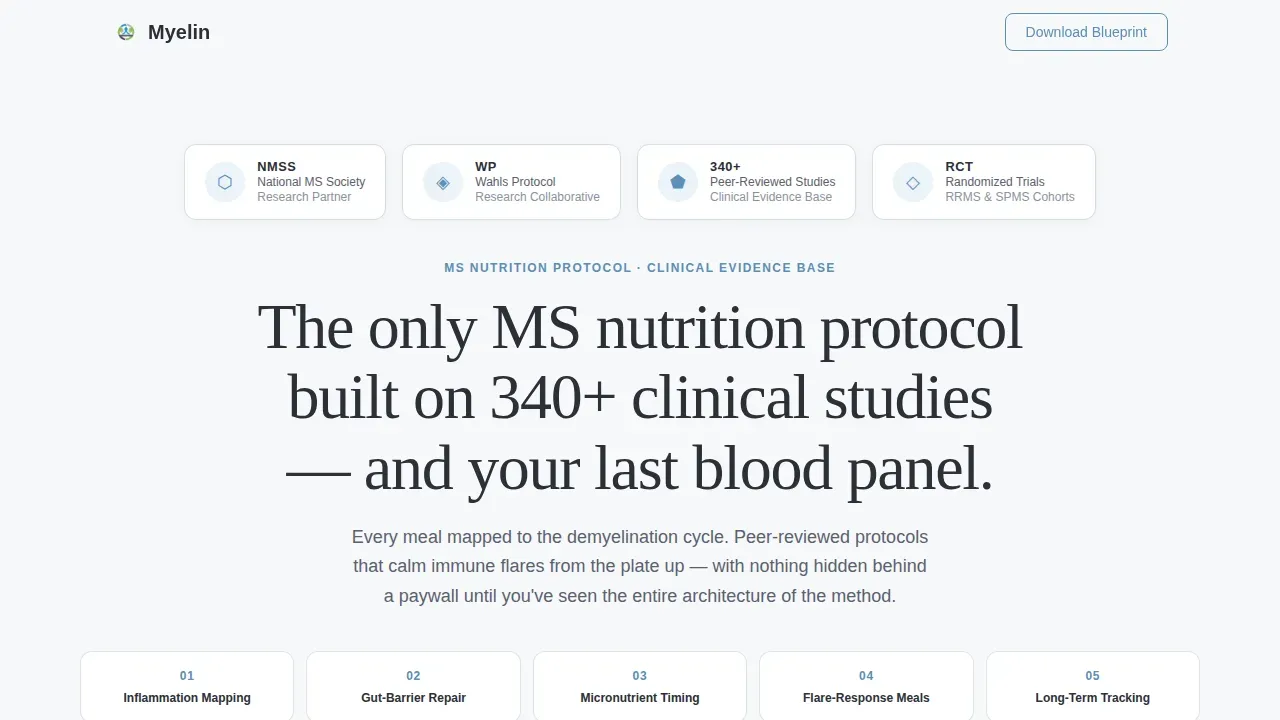
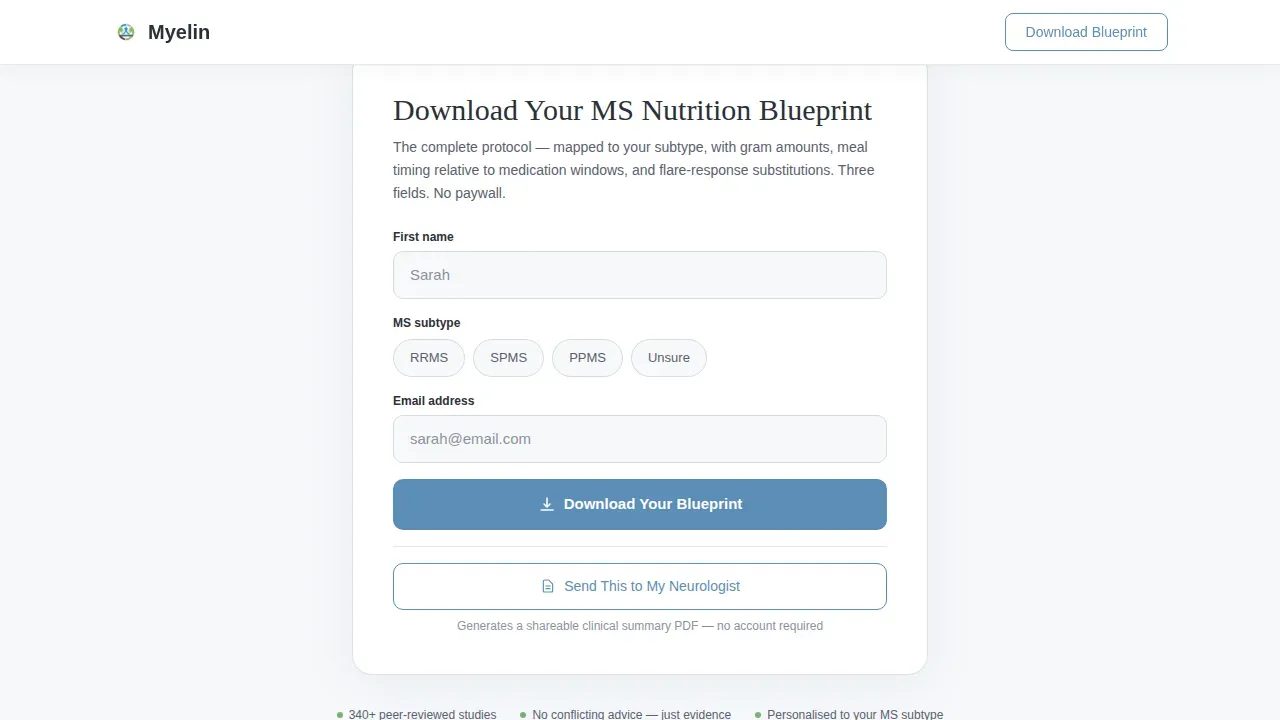
- A hero hub section with an award badge row, a serif headline block, a five-spoke anchor navigation bar, and an embedded three-field lead form asking for first name, MS subtype, and email
- Five fully scaffolded spoke sections covering Inflammation Mapping, Gut-Barrier Repair, Micronutrient Timing, Flare-Response Meals, and Long-Term Tracking, each ending with a repeated primary call-to-action button
- A "Send to My Neurologist" secondary conversion path that triggers a modal generating a shareable clinical summary, plus a linear single-row footer and scroll-linked section reveal animations throughout
Feature list
This template ships with a purposeful set of interactive and structural features derived directly from the program's clinical communication needs. Each feature serves a specific role in building trust, reducing friction, and guiding visitors toward the download action.
Hub Anchor Navigation with Active State Tracking
A persistent horizontal navigation bar links directly to each of the five spoke sections. As a visitor scrolls, the active spoke updates visually using steady-pulse blue. This keeps orientation clear across a long content page without requiring page reloads or separate URLs.
Five-Spoke Clinical Section Framework
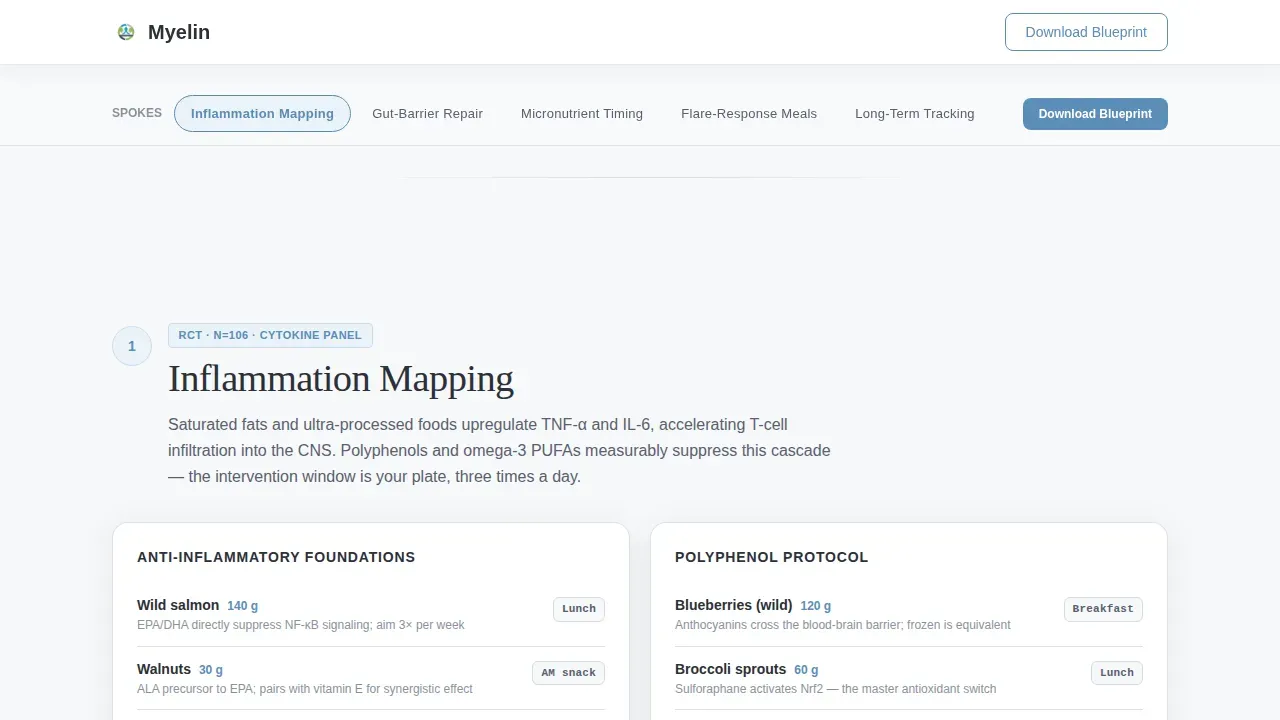
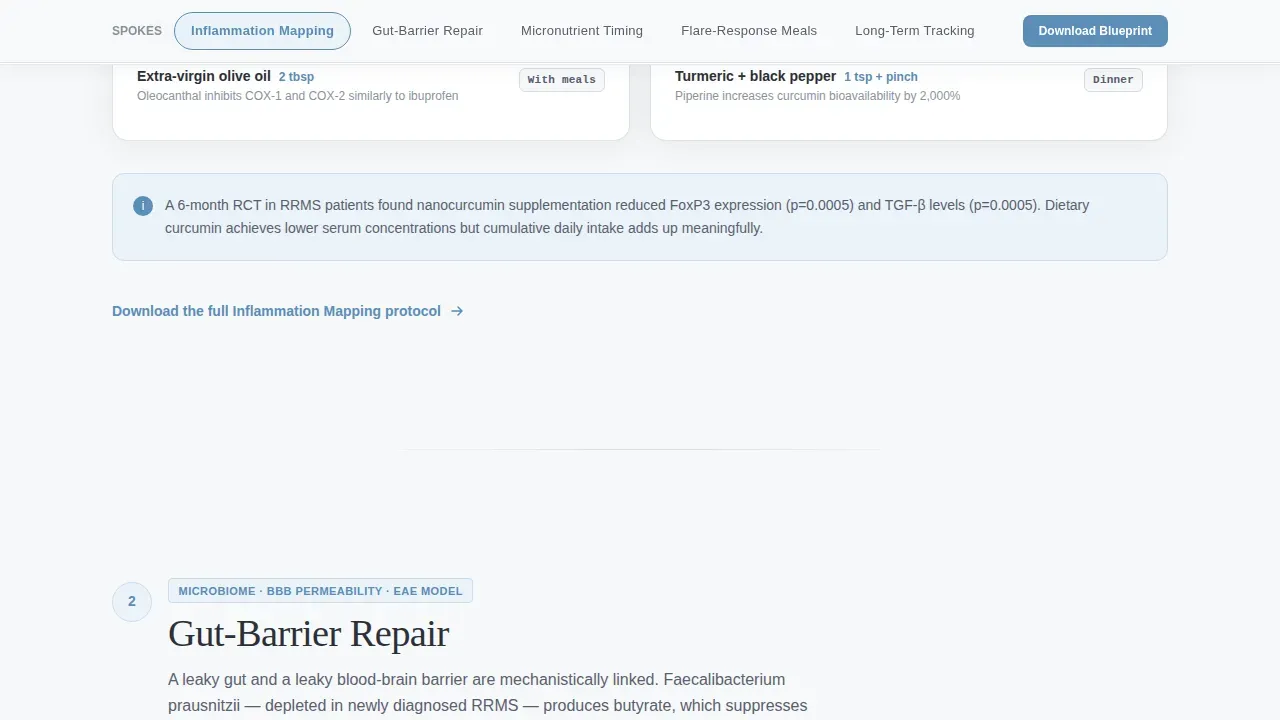
Each spoke section opens with the clinical mechanism stated in one plain sentence, then unfolds into the exact dietary protocol: named foods, gram amounts, and timing relative to medication windows. Accordion-expand interactivity lets visitors reveal detail progressively. This structure makes the science accessible without hiding it behind a gate.
MS Subtype-Aware Lead Form
The three-field form at the hub center collects first name, MS subtype selection (Relapsing-Remitting MS, Secondary Progressive MS, Primary Progressive MS, or unsure), and email. Keeping the form to three fields reduces abandonment while capturing the subtype data that makes the downloaded blueprint personally relevant.
"Send to My Neurologist" Modal Path
A secondary call-to-action button triggers a modal that generates a shareable clinical summary document in PDF format. This path addresses a real behavior: caregiving spouses and patients who want to bring evidence-based dietary interventions into a clinical conversation without translating the science themselves.
Award Badge Hero Row with Parallax Effect
The hero opens with a horizontal row of embossed credential medallions rendered against cloud white. A subtle parallax scroll effect animates the badge row as the visitor enters the page. No stock photography is used. The visual language communicates earned authority the way framed credentials line a specialist's wall.
Scroll-Linked Section Reveals and Staggered Cards
Spoke cards animate into view using intersection observer triggers as the visitor scrolls. Staggered entry timing creates a sense of deliberate pacing rather than visual noise. Each reveal feels like a doctor pulling up a chart and walking through every line, unhurried and respectful of the reader's attention.
Page sections overview
| Section | Purpose |
|---|---|
| Hero Hub | Award badges, headline, anchor nav, lead form |
| Inflammation Mapping | Omega-3 and polyphenol protocol with gram amounts |
| Gut-Barrier Repair | Microbiome-to-brain connection, butyrate food list |
| Micronutrient Timing | Vitamin D, fatty acids, timing near medication windows |
| Flare-Response Meals | Anti-inflammatory plans for active relapse periods |
| Long-Term Tracking | Remission metrics, neurologist-share call to action |
| Single-Row Footer | Linear footer with legal and contact links |
Design & branding system
The template uses a Medical Clarity design theme expressed through the Cloud Canvas color system. Every visual decision reinforces the feeling of a first clear morning after a relapse, soft, ordered, and within reach. Typography pairs Fraunces serif headlines with DM Sans body and interface text, creating a voice that is measured, clinical, and warm at the same time.
- Color roles are strictly defined: background stays in soft clinical white (#F7F8FA) and morning fog gray (#D6DCE1), all navigational elements anchor in steady-pulse blue (#5B8DB8), body text lives in deep charcoal (#2C3038) for effortless readability, and remission green (#7BAE7F) appears exclusively on progress indicators and confirmation states, never decoratively
- No stock photography of patients is used anywhere; visual authority comes from the badge row, inline clinical statistics, and the unhurried typographic hierarchy, giving the page the texture of a specialist's consultation room rather than a wellness marketing page
Mobile & speed optimization
The template is built desktop-first to match the primary use case: caregiving spouses and patients researching at a laptop late in the evening, composing questions for their next clinical appointment. A strong mobile fallback ensures the page remains fully readable and functional on smaller screens, with the anchor navigation adapting gracefully and the three-field form remaining easy to complete on a phone.
- Static-first rendering uses Server Components for all content sections, with Client Components scoped narrowly to the anchor navigation active state, the lead form, and the neurologist modal, keeping the interactive footprint small and the content load fast
- Scroll-linked animations use intersection observer logic so they activate only when a section enters the viewport, preventing unnecessary processing and keeping the scroll experience smooth on both desktop and mobile devices
How this template helps you convert
The page is built on a Transparent Process creative direction: give the entire framework away openly, so the download feels like a bookmark rather than a gate. Visitors who can see the full clinical architecture of the program before being asked for anything are far more likely to trust the offer and complete the form.
- The five-spoke structure delivers real dietary protocol detail, named foods, gram amounts, timing windows, before any call to action appears, so the "Download Your MS Nutrition Blueprint" button arrives after the visitor already understands the value
- The MS subtype selector in the lead form signals that the downloaded blueprint will be personally relevant, increasing perceived value of the conversion without adding friction
- The secondary "Send to My Neurologist" path serves a distinct audience segment, caregiving spouses and patients preparing for clinical appointments, converting visitors who would not self-download but will share a clinical summary on behalf of someone they love
Other information about this template
This template is designed to serve a nutritional science communication context that intersects with several established research frameworks and dietary protocols discussed in the multiple sclerosis literature. Understanding that context helps teams customize the spoke content accurately.
- The swank diet, which restricts saturated fat intake and animal fats to low levels, is one of the earliest dietary protocols proposed for people with ms and is a useful reference point for the Inflammation Mapping spoke section
- The paleo diet-inspired approach used in the Wahls Protocol emphasizes nutrient-dense food groups to support central nervous system function, and its framework aligns naturally with the Micronutrient Timing spoke content
- The bet diet (Best Bet diet) eliminates food proteins believed to trigger immune responses in autoimmune diseases, making it relevant background for teams customizing the Gut-Barrier Repair spoke
- A ketogenic diet is being actively explored in clinical trials for its potential effects on disease activity and quality of life in progressive multiple sclerosis, and its principles can inform the Flare-Response Meals spoke content
- The mediterranean diet, with its emphasis on oily fish, whole grains, vegetable oils, monounsaturated fats, unsaturated fats, and a reduced saturated fat intake, is one of the most studied dietary approaches for people with ms and maps well to the anti inflammatory foundations of this template's framework
- A vegan diet and gluten free diets both appear in patient-reported dietary habits among people with ms and should be addressed in the program copy when relevant to the target audience
- Expanded disability status scale (EDSS) scores are the standard clinical measure of disability and symptom severity in multiple sclerosis research; this metric is worth referencing in the Long-Term Tracking spoke to give the tracking section clinical grounding
- Vitamin d supplementation guidance in this template's context should reference a target serum level above 40 ng/mL, consistent with published supplementation guidance in the multiple sclerosis literature
- The gut microbial composition of people with ms differs from that of healthy controls, and dysbiosis has been associated with increased neuroinflammation; this makes the Gut-Barrier Repair spoke one of the most scientifically current sections of the template
- Disease modifying therapies (DMTs) remain the standard of care for relapsing forms of multiple sclerosis, and the template includes a built-in placeholder for a medical disclaimer stating clearly that this nutrition program does not replace DMTs
- Dietary supplements covered across the spoke sections should address vitamin d, essential fatty acids including polyunsaturated fatty acids and long chain fatty acids, and B vitamins (B12, Biotin, and Folate), all of which appear in the multiple sclerosis dietary literature
- The template's content architecture is aligned with the myelin clinical ms nutrition protocol landing page template use case and can be adapted for programs addressing clinically isolated syndrome at disease onset as well as established relapsing-remitting and progressive multiple sclerosis diagnoses
- Diet and lifestyle changes documented in the multiple sclerosis research consistently show that a healthy eating pattern low in processed foods, processed meats, fried foods, and red meat, and rich in whole grains, green leafy vegetables, and oily fish, is associated with better disease severity outcomes and improved quality of life scores
Theme
Medical Clarity
Creative direction
Transparent Process
Color system
Cloud Canvas
Style
Hub & Spoke (Anchor Nav)
Direction
Content/Resource
Page Sections
Hub Anchor Navigation with Active Tracking
Five-spoke Clinical Protocol Framework
MS Subtype Lead Form
Neurologist-share Modal and PDF Path
Award Badge Hero with Parallax Animation
Scroll-linked Reveals and Staggered Cards
Related questions
Does this template include the actual nutrition protocol content?
Can the MS subtype selector in the lead form be customized?
Is the 'Send to My Neurologist' modal included in the template?
Who is the primary audience this template was designed for?
Does the template include a medical disclaimer section?