Nephrology Medicine Education Website Template
Nephron is a split-screen patient education landing page built for chronic kidney disease patients, caregivers, and pre-dialysis individuals. It translates dense nephrology concepts like estimated glomerular filtration rate and creatinine into plain language through a Problem-to-Solution scroll arc, a 7-question adaptive quiz, and a warm, consultation-room visual identity anchored in teal and clinical white.
by Rocket studio
Quick summary
Nephron is a single-page kidney education platform template designed around the real questions patients ask after a CKD (chronic kidney disease) diagnosis. A 50/50 split-screen layout pairs a portrait-led hero with clear triage buttons, then walks visitors through scroll-triggered explainer sections before routing them into a personalized adaptive quiz. The result feels less like a brochure and more like a calm clinical conversation.
Who this template is for
This template is purpose-built for healthcare communicators and nephrology practices who need to serve patients clearly and compassionately. It works especially well for digital health teams translating clinical content for low health-literacy audiences.
- Nephrology clinics and patient education programs reaching newly diagnosed CKD patients
- Digital health teams building condition-specific education resources for caregivers
- Health content producers who need a structured, conversion-ready layout for kidney disease guidance
What problem this template solves
Most CKD patients leave their first appointment with a lab printout they cannot read. Generic health websites rarely meet them where they are, and they often search from a phone in a parking lot before they have processed what they just heard. This template replaces that overwhelm with structured clarity.
- Patients cannot decode terms like estimated glomerular filtration rate or creatinine without visual context
- Caregivers managing medication schedules for a parent or spouse need organized, scannable guidance
- Pre-dialysis patients fear dialysis because nobody has compared their options in plain language
What you get with this template
You get a fully structured, single-page layout that moves visitors from fear to comprehension in one continuous scroll. Every section is designed to resolve one specific anxiety before introducing the next.
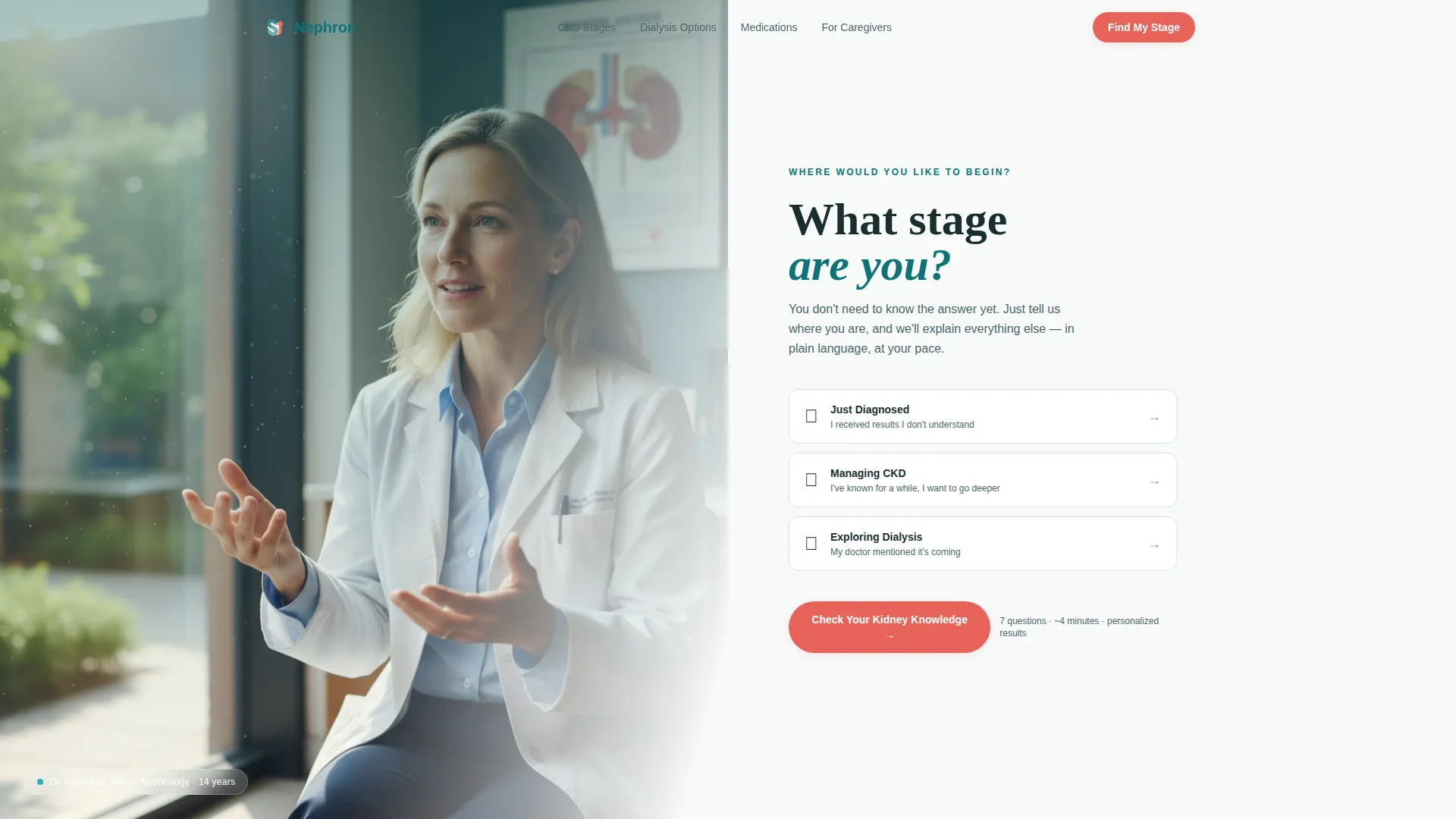
- A 50/50 split-screen hero with a nephrologist portrait on the left and three triage entry buttons on the right
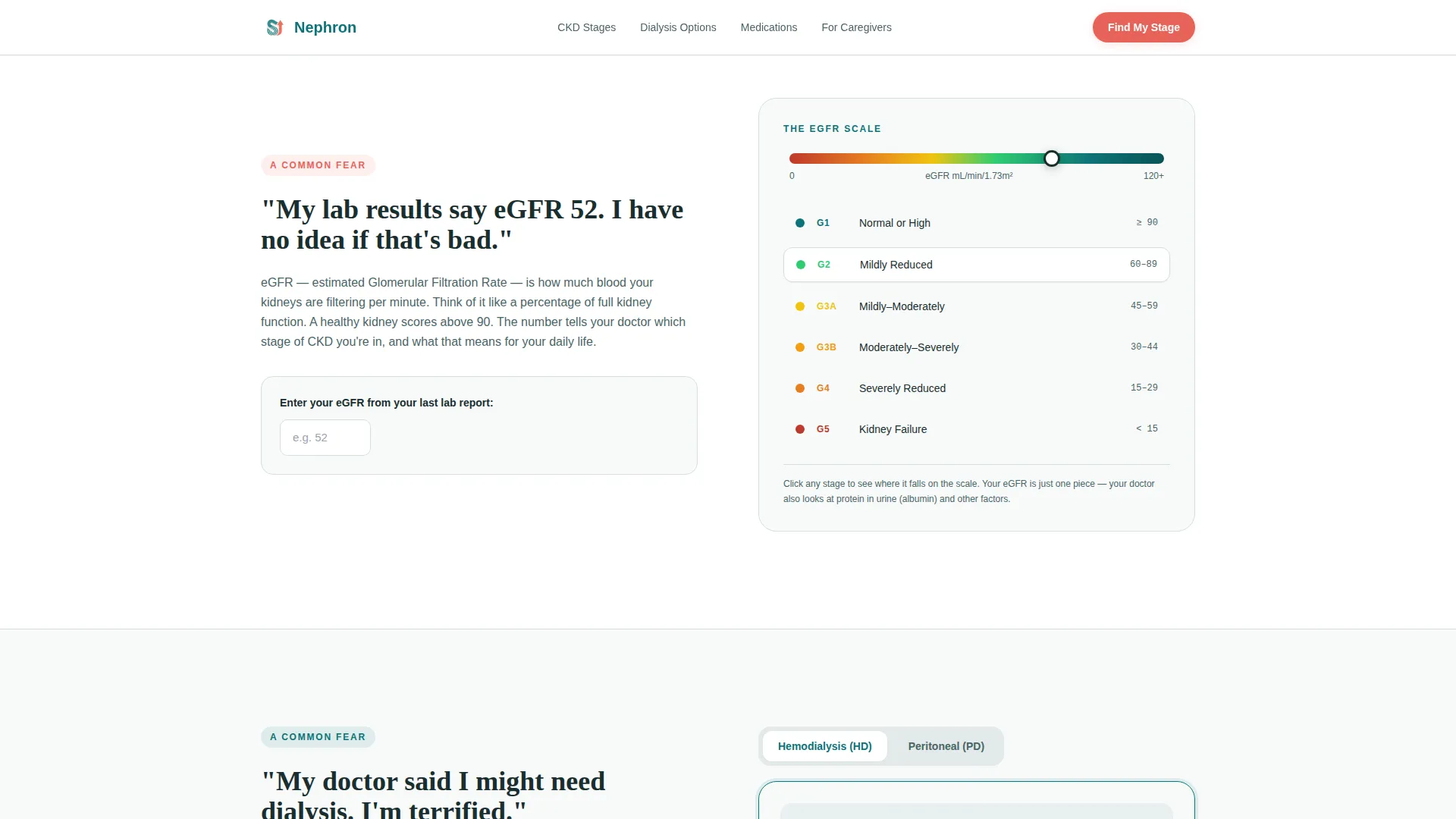
- Scroll-triggered Problem-to-Solution sections covering estimated glomerular filtration rate, dialysis options, and medication timelines
- A 7-question adaptive quiz with a personalized education plan output, printable summary, and an email capture field
Feature list
This template includes several purpose-built components, each mapped to a real patient need.
Portrait-Centered Split Hero
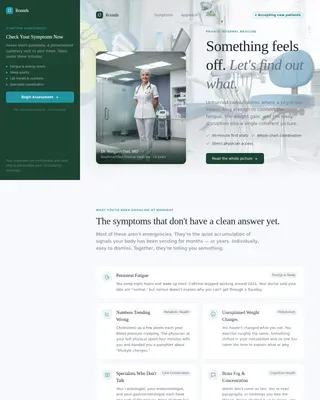
The hero divides the screen evenly. The left half holds a warm, naturally lit nephrologist portrait shot from the patient's seated perspective. The right half presents a single serif question ("What stage are you?") with three understated entry buttons that triage the visitor's path before the page continues.
Adaptive 7-Question Quiz Flow
The primary conversion element is a quiz labeled "Check Your Kidney Knowledge." It opens with lifestyle questions about fluid intake and sodium habits, then escalates to comprehension checks tied to the visitor's chosen entry path. Results deliver a personalized education plan, not a diagnosis, with a printable PDF summary.
Scroll-Triggered Problem-to-Solution Sections
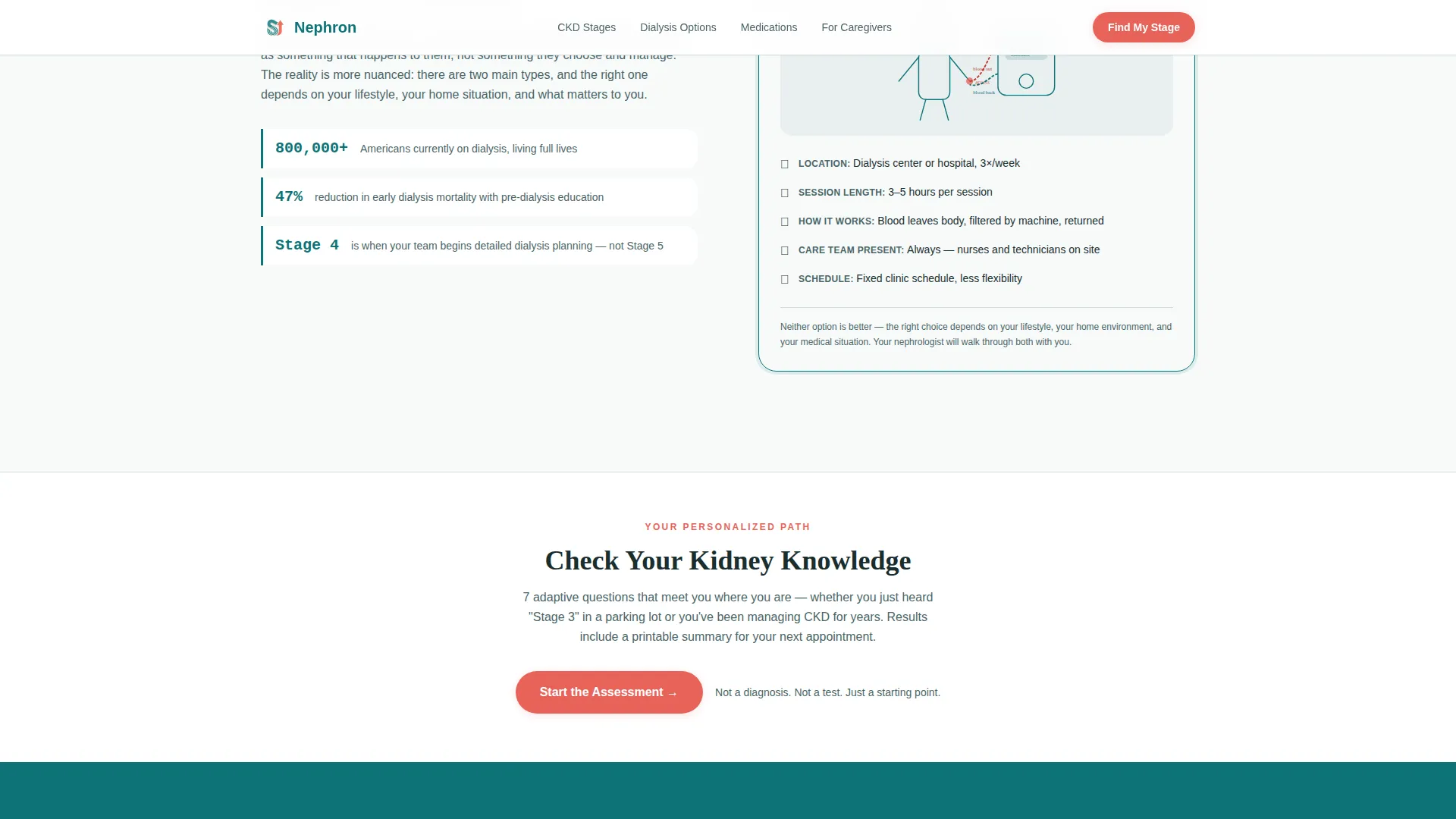
Each scroll section opens on the left with a plainly stated patient fear and resolves on the right with a visual explanation. An animated estimated glomerular filtration rate scale, a hemodialysis versus peritoneal dialysis body diagram comparison, and a medication timeline are all included as built-in components.
Persistent Quiz Call-to-Action Bar
After the third scroll section, a persistent bottom bar keeps the "Check Your Kidney Knowledge" prompt visible as visitors continue reading. This bottom bar removes the need to scroll back to find the primary action.
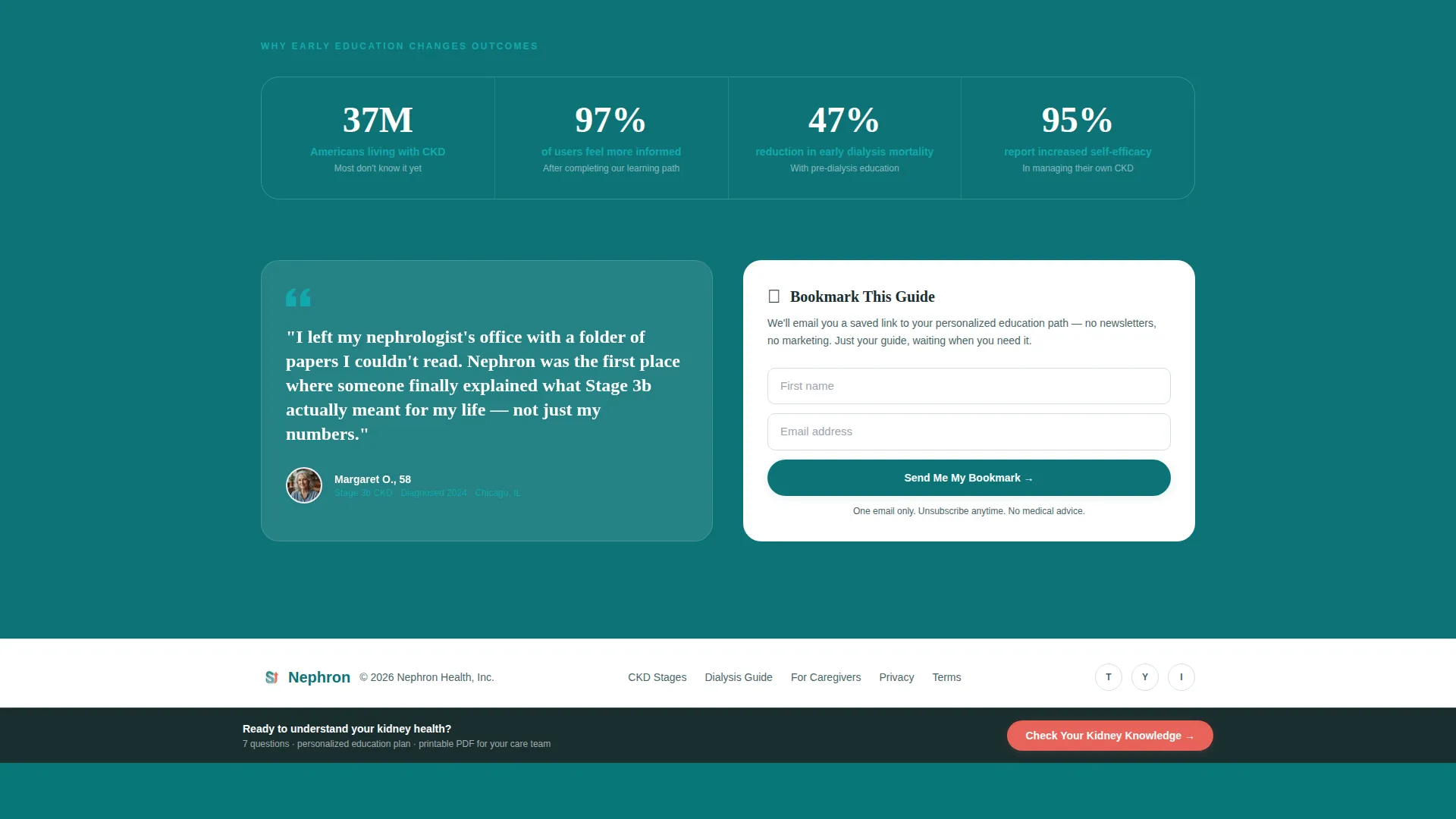
Trust and Social Proof Section
A dedicated trust section displays key social proof statistics and a nephrologist endorsement quote. This section also includes a care team integration call-to-action, inviting visitors to send their quiz results directly to their provider.
Bookmark Email Opt-In
A secondary conversion module labeled "Bookmark This Guide" collects a first name and email address. It is framed as a utility, helping visitors save and return to the guide, rather than as a marketing exchange.
Page sections overview
| Section | Purpose |
|---|---|
| Hero Split Screen | Triage visitor by CKD stage using portrait and three entry buttons |
| GFR Explainer | Resolve "I don't understand my GFR" with animated scale visual |
| Dialysis Demystifier | Compare hemodialysis and peritoneal dialysis with body diagrams |
| Quiz Call to Action | Route visitor into 7-question adaptive kidney knowledge assessment |
| Trust and Credentials | Build confidence with satisfaction stats and nephrologist endorsement |
| Footer Row | Provide single-row linear footer with essential navigation links |
Design & branding system
The visual identity follows an Educational Guide theme built around the Teal Catalyst color system. The palette deliberately evokes the calm consultation room rather than the emergency department, signaling competence without urgency.
- Deep renal teal (#0D7377) anchors headers, trust elements, and primary navigation
- Clinical white (#F7FAFA) fills content panels and keeps reading areas open and uncluttered
- Soft saline gray (#D5DFE0) handles secondary backgrounds and section dividers; catalyst coral (#E8635A) is reserved exclusively for interactive prompts and alert states
- Fraunces serif drives emotional headers and the hero question; DM Sans handles body text and interface elements throughout
Mobile & speed optimization
This template is built with a mobile-first priority, reflecting the real behavior of its target audience. Many CKD patients search for information immediately after a diagnosis, often from a phone before they have left the clinic parking lot.
- The above-fold portrait loads with rendering priority so the hero is immediately visible on mobile screens
- Scroll-triggered animations and staggered section entries are set at a medium intensity, keeping motion purposeful without slowing the reading experience
- The quiz flow and persistent call-to-action bar are both designed for touch interaction and small-screen navigation
How this template helps you convert
Conversion is built into the scroll structure itself. Each section earns trust before asking for an action, so visitors arrive at the quiz already oriented and reassured.
- The hero triage buttons capture intent immediately by letting visitors self-select their CKD stage, which personalizes everything that follows and reduces early drop-off
- The Problem-to-Solution arc dissolves specific anxieties one by one before the quiz call-to-action appears, so visitors reach the assessment with context and confidence rather than hesitation
- The email capture tied to quiz results is framed around care team sharing, making it feel clinically useful rather than promotional, which lowers friction at the final conversion step
Other information about this template
This template was designed specifically for the nephrology patient education space, where trust and clarity carry equal weight. A few additional details worth noting before you build with it.
- The quiz output is a personalized education plan, not a clinical diagnosis, making it appropriate for patient-facing digital health use
- Social proof figures included in the brief (97% user satisfaction, 47% mortality reduction context, and 37 million Americans living with CKD) are placeholders intended to be replaced with verified source-cited statistics before publishing
- The footer uses a linear single-row pattern, keeping the page focused on educational content rather than deep site navigation
- Typography pairing of Fraunces serif and DM Sans is chosen to balance emotional warmth with the clean readability patients need when processing unfamiliar medical terms
Theme
Educational Guide
Creative direction
Problem→Solution Arc
Color system
Teal Catalyst
Style
Split Screen (50/50)
Direction
Quiz/Assessment
Page Sections
Portrait-centered Split-screen Hero
Question Adaptive Quiz
Scroll-triggered Problem-to-solution Sections
Persistent Bottom Call-to-action Bar
Trust and Social Proof Section
Bookmark Email Opt-in Module
Related questions
Who is this template built for?
Does the quiz provide a medical diagnosis?
Can I edit the hero triage buttons and quiz content?
What are the two email capture points in this template?