Nephrologist Comparison Website Template
Nephron is a single-page insurance and billing landing page built for nephrology practices that want to give patients clear, honest answers about kidney care coverage. It combines a portrait-centered hero, an expert panel, and tabbed insurance comparison tables to walk CKD patients, dialysis patients, and transplant recipients through what their plan actually covers, without the jargon.
by Rocket studio
Quick summary
Nephron is a Health and Medical landing page template designed for nephrologist practices. It translates dense insurance complexity into plain language patients can actually use. The layout guides visitors through a portrait-centered hero, an attributed expert panel, side-by-side insurance comparison tables, a plain-English glossary, and a low-friction resource download form, all wrapped in a warm, forest-grounded visual identity.
Who this template is for
This template is built for nephrologist practices that treat patients navigating the financial and administrative side of kidney care. It works especially well for practices that already invest in patient education and want a dedicated page to support those conversations before the first appointment.
- Nephrology practices serving chronic kidney disease (CKD) patients who are comparing providers before their initial visit
- Dialysis programs helping patients verify coverage when switching clinics or insurance plans
- Transplant-focused practices supporting recipients who need to confirm immunosuppressant formulary status
What problem this template solves
Patients living with renal diseases often arrive at a practice appointment already exhausted by their diagnosis. They have searched for relevant data online, read article after article, and still cannot explain what their plan covers for dialysis sessions, telehealth follow-ups, or lab panels. The gap between what insurance documents say and what patients understand is where trust is lost.
This template closes that gap by structuring coverage information the way a knowledgeable navigator would explain it in a waiting room: clearly, honestly, and without unnecessary medical shorthand.
- It removes the burden of decoding prior authorization requirements, plan-type differences, and formulary language from the patient
- It gives the practice a credible, organized web page that demonstrates expertise before the patient ever submits a form
What you get with this template
The template ships as a complete, single-page layout with every section pre-built and ready to customize. Each component serves a specific role in the patient education journey, from the very first scroll to the final call to action.
- A portrait-centered hero section, four insurance comparison tables with tooltip rows, an expert panel, a plain-English glossary, a resource download form, and a linear single-row footer
- A Forest Trust color system, Fraunces serif display typography paired with DM Sans body text, and medium scroll-reveal animations with spring easing throughout
Feature list
This section explains each major built-in feature and the role it plays in the overall landing page experience.
Portrait-Centered Hero with Dual Call to Action
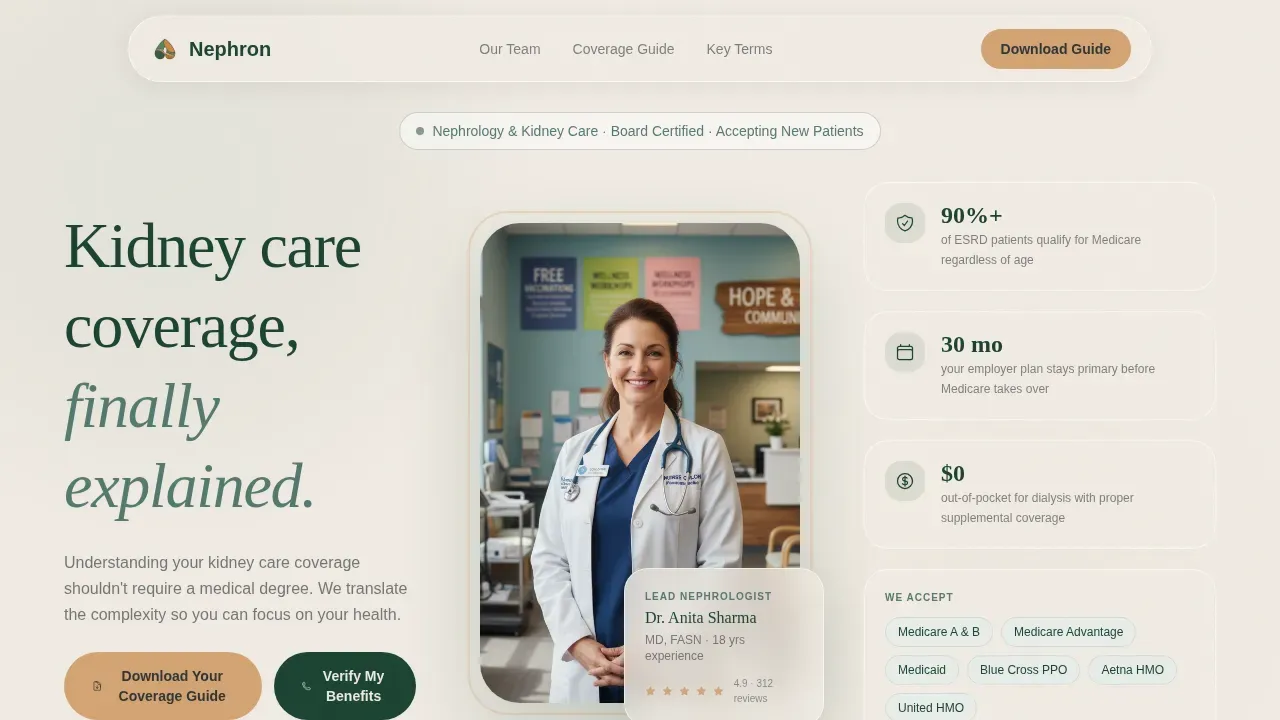
The hero opens with a warmly lit, shoulders-up photograph of the nephrologist set against a softly blurred clinic interior. The practice name anchors one side of the portrait; the line "Understanding your kidney care coverage shouldn't require a medical degree" anchors the other. Two calls to action sit beneath the portrait: a primary amber button labeled "Download Your Coverage Guide" and a secondary link reading "Verify My Benefits" that routes to a scheduling form for a free ten-minute call with the billing navigator. This section establishes immediate personal trust through face, tone, and an honest promise, all before the visitor scrolls a single pixel.
Attributed Expert Panel with Bento Cards
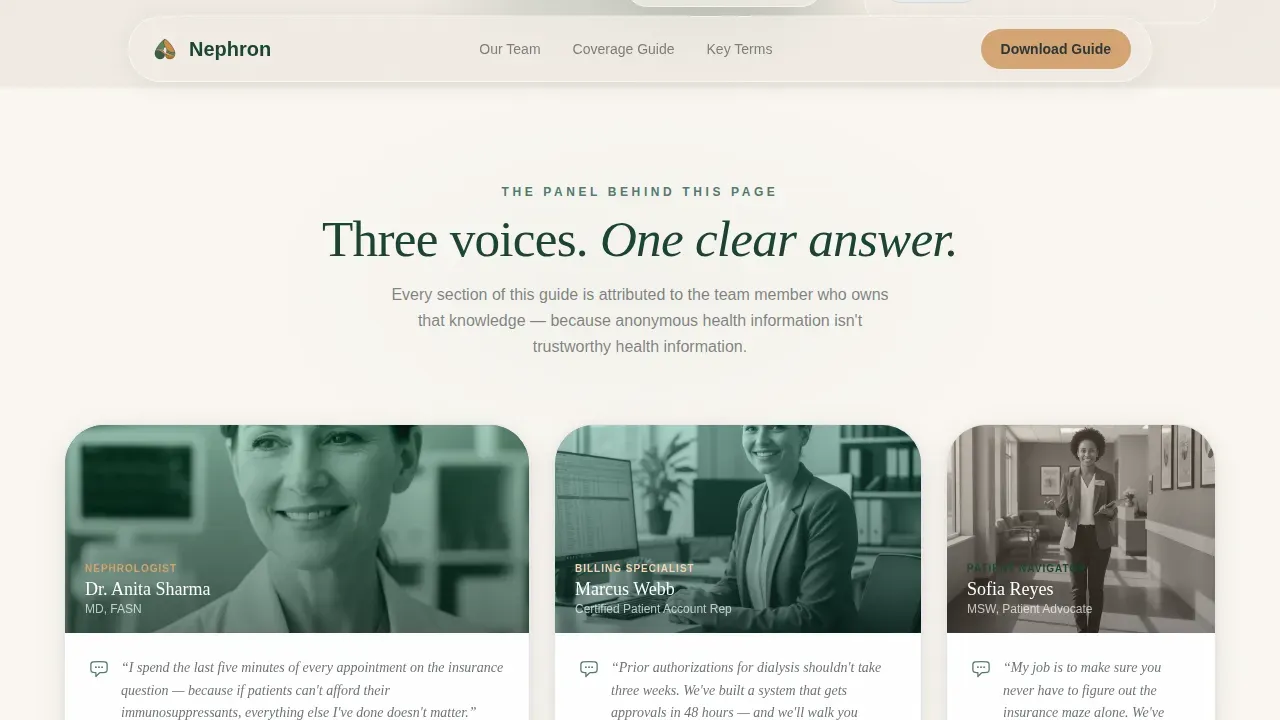
Below the hero, the template introduces a three-voice expert panel: the nephrologist, the billing specialist, and the patient navigator. Each voice is presented in a bento-style card with the contributor's name, role, and a short attributed statement relevant to their area of expertise. This structure is directly relevant to building the kind of authority a published article or peer-reviewed source carries in a clinical research context. The panel signals that the information on the page has been vetted and reviewed by real professionals, not assembled from a generic health article. It is the visual equivalent of a byline on a respected research publication.
Tabbed Insurance Comparison Tables with Tooltip Rows
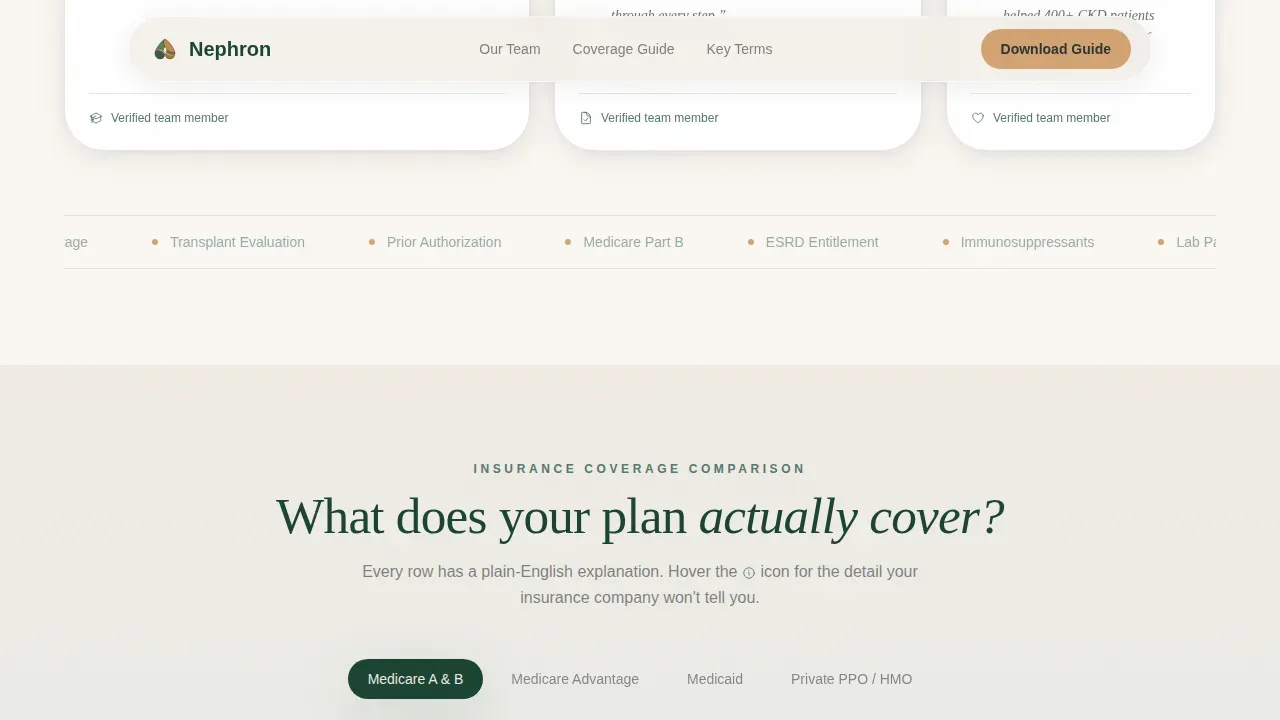
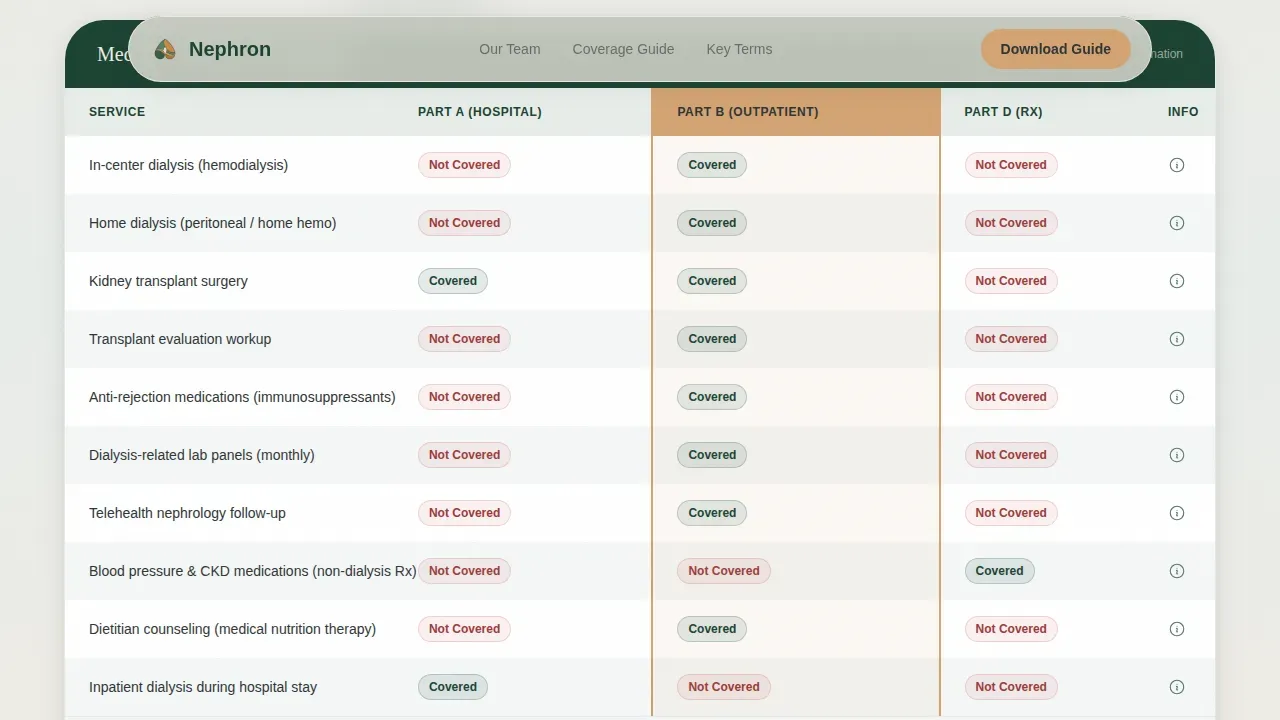
The comparison tables are the functional core of the page. Four insurance types are compared side by side: Medicare Traditional, Medicare Advantage, Medicaid, and private PPO/HMO plans. Rows cover dialysis sessions, transplant evaluation services, telehealth follow-ups, and lab panels. Each row includes a plain-English tooltip that a patient can hover over to get a brief, jargon-free explanation of the coverage term. Tab switching between insurance types is handled client-side for responsive interactivity. The tables are designed so that eighty percent of a patient's coverage question is answered directly on the page, making the download feel like the logical, helpful final step rather than a gated barrier.
Plain-English Glossary in Asymmetric Tile Layout
After the comparison tables, the template includes a "Key Terms Decoded" section presented as an asymmetric tile layout. Each tile defines one piece of insurance or billing language in plain terms, the kind of description that replaces a confusing phrase with something a patient can repeat to their spouse at dinner. Terms relevant to renal diseases, prior authorization, formulary status, and plan-type distinctions are each given space to breathe, supported by the white space built into the tile grid. This section functions as supplementary material to the tables, giving patients the vocabulary they need to understand what they just read.
Resource Download Form with Secondary Scheduling Path
The primary call to action is a resource download form that collects only three fields: first name, email address, and insurance provider from a dropdown menu. The form appears both beneath the hero portrait and pinned after the final comparison table, giving visitors two clear opportunities to submit without feeling pressured. A secondary path labeled "Verify My Benefits" links to a scheduling form for a free ten-minute call. The result the patient downloads is a printable PDF formatted for use at their next appointment. Low field count reduces friction and increases the likelihood that a visitor will submit.
Linear Single-Row Footer
The footer follows a clean Pattern 1 single-row layout. It keeps the bottom of the page uncluttered, reinforcing the template's philosophy of using white space as a trust signal rather than filling every pixel with content. The footer can hold the practice name, navigation links, and contact information without visual noise.
Page sections overview
| Section | Purpose |
|---|---|
| Hero Portrait | Establish trust with face, tagline, and dual call to action |
| Expert Panel Cards | Attribute content to named practice voices |
| Coverage Comparison Tables | Compare four insurance types row by row |
| Key Terms Decoded | Define billing and coverage language plainly |
| Download call to action Form | Capture lead with minimal three-field form |
| Single-Row Footer | Close the page cleanly with contact info |
Design & branding system
The visual identity follows a Healing Space theme built on the Forest Trust color system. Every color choice is deliberate, organic, and designed to feel restorative rather than clinical. The palette avoids hospital blue entirely, replacing institutional coldness with the grounded warmth of an old-growth forest after rain.
- Deep evergreen (#1B4332) anchors headers and table borders; soft moss (#52796F) alternates table rows and secondary backgrounds; birch white (#F0EBE3) serves as the primary canvas; warm amber (#D4A373) marks action buttons and highlighted plan columns; charcoal (#2D3436) carries all body text for readability
- Typography pairs Fraunces, a warmly expressive serif display face, with DM Sans for body copy and interface elements; animations use medium scroll reveals with spring easing, a parallax portrait effect in the hero, and staggered table row entrances
Mobile & speed optimization
The template is built desktop-first, reflecting the reality that patients doing serious insurance research before an appointment tend to sit at a desk or tablet. Full mobile support is included, and the layout adapts responsibly at smaller breakpoints.
- The comparison tables use tab switching to keep four insurance types readable on smaller screens without horizontal scrolling, and the single-column vertical layout that emerges on mobile follows best practices for patient navigation and readability
- Interactive elements including tooltip hovers, tab switching, and form inputs are handled client-side, while static content sections use server component architecture for efficient delivery of the page's primary educational content
How this template helps you convert
The conversion strategy is built on giving patients the answer before asking for anything in return. A landing page that teaches earns more trust than one that sells, and Nephron is designed to make the download feel like a natural conclusion to a genuinely useful reading experience.
- The comparison tables deliver so much clear, organized coverage data that the downloadable PDF becomes the obvious next step rather than a gated obstacle, patients feel informed, not manipulated, which makes them far more likely to submit the three-field form and book a follow-up call
- High-contrast amber call-to-action buttons are placed at the top beneath the hero, in the middle after the tables, and effectively at the bottom of the page, ensuring that every visitor has a visible action available at any scroll depth regardless of how much of the page they read
Other information about this template
This section covers additional context relevant to the Nephron template, including background on the research and clinical landscape it connects to, platform context, and supplementary detail for practices evaluating the template for their program.
- The template is categorized under Health and Medical, specifically in the Nephrologist Insurance and Billing Page niche, with an intersection match of Expert Panel creative direction, Portrait-Centered header concept, Content/Resource landing page direction, Forest Trust color system, and Healing Space theme
- Nephron is the nephron expert coverage comparison landing page template built on this platform; it is the only template in this niche combining tabbed comparison tables, an attributed expert panel, and a Forest Trust color system in a single-page layout
- The page is designed to align with the communication standards that govern how health information is shared responsibly; practices that publish educational health content benefit from approaching that content with the same care a submitting author brings to a peer-reviewed publication, including clear attribution, honest data, and transparent sourcing
- In nephrology-focused clinical research, the National Institutes of Health (NIH) provides funding opportunities for kidney research through various grant mechanisms; the National Institute of Diabetes and Digestive and Kidney Diseases (NIDDK) is a key component of the NIH that focuses on kidney-related research, and practices that participate in NIH-supported programs may find the Nephron template's open access to educational content aligns well with their patient outreach goals
- Research articles describing significant and original observations in renal diseases typically require prior approval from an Institutional Review Board (IRB) or Ethics Review Committee for all investigations involving human subjects; when a practice references clinical research findings in their patient education content, citing the accepted manuscript and including relevant data from pubmed central helps maintain credibility and reader access to primary sources
- The NIH mandates that the accepted manuscript must be archived in PubMed Central for NIH-funded research; practices whose clinical care teams contribute to published work in nephrology can reference those publications on the page to reinforce their expert panel's authority
- When nephrology practices contribute to research data or publish findings through clinical trials, those contributions are relevant to the supplementary material they can reference in their patient education pages; reporting guidelines such as the completed CONSORT checklist or the STROBE checklist for observational studies help ensure that the data shared with patients is grounded in rigorous study design
- The template supports practices that conduct systematic reviews, case reports, review articles, and pilot studies as part of their clinical research program; those publication types can be cited in the expert panel section to support the corresponding author's credibility and the practice's authority
- From a content management perspective, a submitting author preparing educational materials for this page should follow the same careful approach applied to manuscript submission: include a clear title page, organize the main text logically, maintain an accurate reference list, and ensure that any supplementary material or online supplementary material is clearly labeled and easy for readers to access
- The graphical abstract format, commonly used in published articles to give readers a quick visual summary of complex research data, is a useful model for how the Nephron template approaches its comparison tables: each table row is a distilled, reviewable data point that gives patients a graphical abstract-level summary of their coverage without requiring them to read the full plan document
- Practices using generative AI tools to draft patient education content should review outputs carefully before publication; AI-generated health content is solely responsible for accuracy only when reviewed and approved by a qualified clinical professional on the practice team
- The platform on which this template is built uses AI-powered no-code tools that allow users to build applications using natural language prompts; no-code platforms enable non-technical users to create production-ready applications without traditional programming skills, and the use of AI in application development can significantly reduce the time from idea to live page
- Subscription-based models for no-code platforms often include free trials to attract users; practices evaluating this template can explore the platform's program before committing to a paid plan
- The comparison table must be responsive and maintain readability on mobile devices; organizing content in a single-column vertical layout helps facilitate mobile user navigation, and high-contrast call to action buttons placed at the top, middle, and bottom of the page ensure user engagement at every scroll depth
- Social proof examples such as the named expert panel, practice statistics, and real coverage numbers are built into the template structure; these examples of credibility signals follow best practices for health and medical landing pages where trust is the primary conversion driver
- The editorial office of a nephrology journal and the journal editors who oversee peer review of clinical research in renal diseases operate under a formal review process; a corresponding author submitting to such a journal would prepare a cover letter, a title page, a reference list, and any required supplementary material as a single document before initiating the submission process; the editorial review of that manuscript would typically involve at least two reviewers with expertise relevant to the research plan
- For practices referencing their own published work on this page, including author names, author contributions, and a persistent identifier such as a Digital Object Identifier (DOI) for each cited article helps patients and referring physicians locate the original source and supports open access to the research data
- Open access publication of nephrology research means that reader access to the findings is not restricted by a paywall; practices whose research is published open access can link directly to those articles from their patient education page, reinforcing the connection between their clinical research program and the services described on the Nephron template
- The page charges associated with open access publication in nephrology journals vary by publisher; practices should clarify with their editorial office whether page charges apply before planning their manuscript submission timeline
- Reference management software can help a practice team maintain an organized reference list when citing multiple sources across their patient education content; keeping citations accurate and consistently formatted supports the credibility of every claim made on the page
- A research plan that incorporates review articles, mini reviews, and systematic reviews from respected nephrology publications gives the practice's expert panel a stronger foundation for the coverage information presented in the comparison tables; that research plan can also guide how the practice updates the page over time as insurance programs and clinical guidelines evolve
- The use of a cover letter when initiating contact with a new patient through the "Verify My Benefits" form is a familiar concept; a brief, personal introductory message from the billing navigator sets the tone for the follow-up call and mirrors the approachable, unhurried voice the entire template is designed to project
- When practices describe services in the expert panel or comparison tables, they should apply the same principle that governs a published article: every claim should be supported by a relevant source, the description should be accurate, and the word count should be appropriate for the audience's reading level and available time
- The e mail address collected through the download form is used only to deliver the coverage guide PDF; practices are solely responsible for how they handle patient contact data in accordance with applicable health and human services regulations
- Health and human services guidelines in the United States govern how patient data is collected, stored, and used by medical practices; this template's three-field form collects only the minimum data necessary to deliver the requested resource, which aligns with the data sharing policy principles that govern responsible health data collection
- Data sharing in the context of patient education means giving patients open access to the information they need; the Nephron template's philosophy of sharing eighty percent of the answer in the tables themselves reflects a data sharing approach that builds trust rather than withholding value
- Clinical practice in nephrology involves managing creatinine trends, dialysis scheduling, prior authorization requirements, and formulary verification; this template is designed to explain each of those areas in terms patients can understand and act on before their appointment
- The template's research plan for content is grounded in the clinical care realities of end-stage renal disease (ESRD) patients, more than ninety percent of whom are covered by Medicare; that statistic is surfaced in the expert panel and comparison tables as a relevant, authoritative data point that helps patients immediately identify the section most relevant to their situation
- Accepted manuscript versions of nephrology research published by the practice team can be referenced in the expert panel section with a persistent identifier to help readers locate the original publication through PubMed Central or other open access repositories
- The template supports a research studies context by giving practices a structured format to communicate findings from their clinical research program in plain language; review articles, case reports, and systematic reviews that the practice has contributed to can be cited as evidence supporting the comparison table data
- Sexual orientation, race, ethnicity, and other demographic factors can influence how patients experience the health care system and how insurance coverage applies to their specific situation; the Nephron template's plain-language approach is designed to serve a broad, diverse patient population without assumptions about prior health literacy
- Human subjects research that informs the coverage data presented in the tables should be conducted with prior approval and in compliance with all relevant institutional and federal guidelines; the practice is solely responsible for ensuring that any statistics or clinical findings referenced on the page are drawn from properly approved research
- National institutes such as the NIH and NIDDK publish research data and funding guidelines that are freely available online; practices can reference these national institutes as authoritative sources when explaining coverage context to patients on the page
Theme
Healing Space
Creative direction
Expert Panel
Color system
Forest Trust
Style
Comparison Table
Direction
Content/Resource
Page Sections
Portrait-centered Hero with Dual Call to Action
Tabbed Insurance Comparison Tables
Attributed Expert Panel
Plain-english Glossary Section
Low-friction Resource Download Form
Forest Trust Visual Identity System
Related questions
Who is this landing page template designed for?
Can I customize the insurance types and coverage rows in the comparison tables?
Does the template include the downloadable PDF coverage guide?
How does the Expert Panel section work?
Is this template suitable for a practice that also publishes clinical research?