Nurture - Research-Backed Special Needs Parenting Landing Page Template
Nurture - Research-Backed Special Needs Parenting Landing Page Template
The Nurture landing page template is a warm, editorial resource hub built for special needs parenting blogs. It pairs a broadsheet-inspired 60/40 asymmetric grid with a Japanese Zen color palette to present research-backed guidance, original survey data, downloadable resource bundles, and a gentle email-capture flow that earns trust before asking for anything in return.
by Rocket studio
Loading preview…
Quick Summary
Nurture is a single-page landing page template designed for special needs parenting content platforms. It blends a newspaper masthead aesthetic with a Warm Artisan visual identity to create a space where families feel seen, supported, and equipped. The layout guides caregivers through layered research findings, curated resource bundles, and a soft conversion flow that respects their emotional state from the very first scroll.
Who This Template Is For
This template was made for creators, advocates, and organizations who want to encourage parents of children with special needs through credible, warmly delivered content. It fits publishers who treat their audience the way a trusted friend would: with honesty, patience, and real information.
Parents, caregivers, and extended family members who run or plan to launch a special needs parenting blog or resource site
Nonprofit organizations and independent researchers who want to present original survey findings in an approachable, publication-style format
Occupational therapists, child development professionals, and educators who want to share practical guidance with the families they serve
What Problem This Template Solves
Many parents of children with special needs arrive online after midnight, overwhelmed and undertreated by systems that move too slowly. They are decoding occupational therapy jargon, preparing for Individualized Education Program (IEP) meetings, and searching for community resources that speak plainly and warmly. A generic blog layout fails them. It offers no depth, no structure, and no sense that someone has already walked this road.
Families struggle to find a single trusted source that combines emotional warmth with peer-reviewed research, leaving them bouncing between clinical PDFs and social media threads
Parents and caregivers feel invisible in formal systems, and most content platforms do not reflect the unique challenges their child faces each day
Visitors leave sites quickly when a page cannot demonstrate value before asking for an email address, making trust-building layout choices essential
What You Get With This Template
The Nurture landing page template delivers a fully structured, editorially rich single-page layout. Every section is designed to reflect the depth and warmth that caregivers deserve. You receive a complete design system, a layered content scaffold, and a conversion architecture that builds trust gradually rather than demanding it upfront.
Theme
Warm Artisan
Creative direction
Industry Report
Color system
Japanese Zen
Direction
Content/Resource
Page Sections
Newspaper Masthead Hero with 60/40 Grid
Illustrated Data Visualization Columns
Curated Resource Bundle Sections
My Library Bookmark System
Email Capture with Diagnosis Personalization
Scroll-linked Animation and Pull-quote Cards
Related questions
What are the four parenting styles identified by Diana Baumrind?
What are three nurturing messages that can help boost a child's self-esteem?
Is a nurturing parenting program considered evidence-based?
What should you say to parents of a child with special needs?
Can this template be used for content covering babies and toddlers with early developmental concerns?
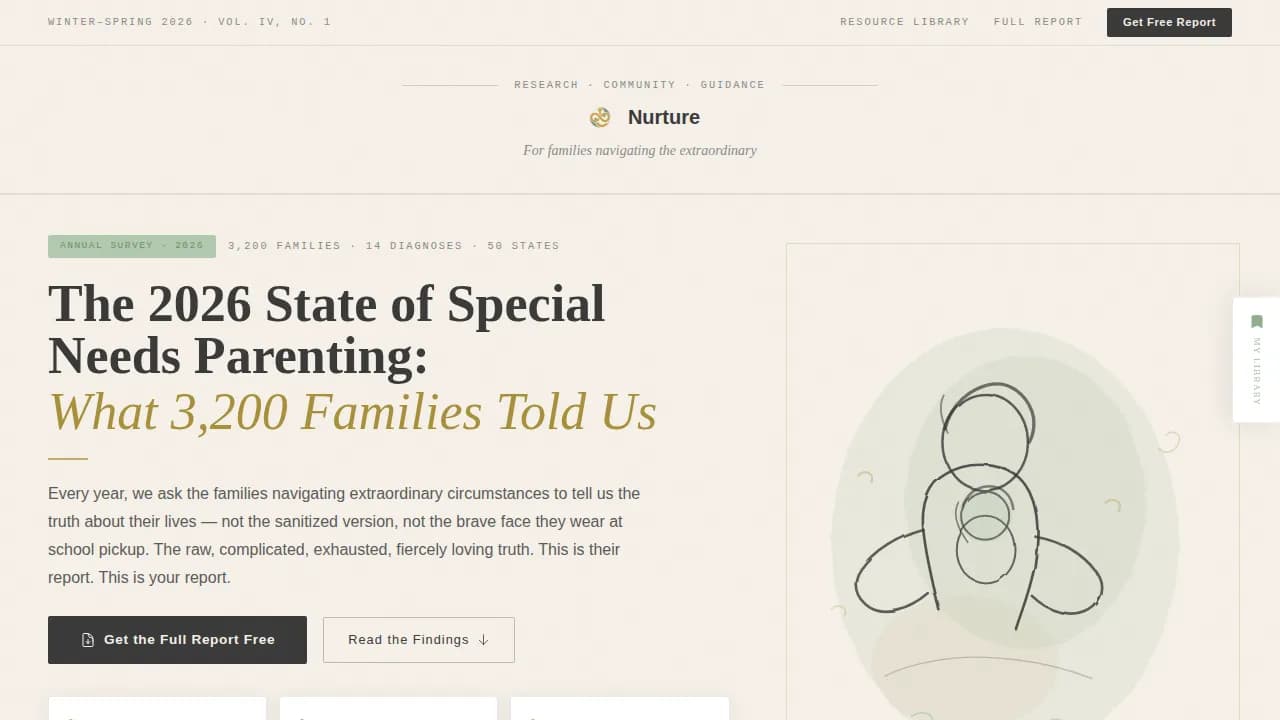
A broadsheet-style 60/40 asymmetric grid hero with a publication masthead, seasonal dateline, and an ink-portrait illustration column
Four content-rich body sections covering diagnosis experience, education and IEP navigation, caregiver burnout, and a resource library with an email-capture call to action
A persistent sidebar bookmark system in the 40-column that lets visitors save individual resource bundles to a personal "My Library" collection before entering any contact information
Feature List
The Nurture template is built around a specific editorial vision. Every feature below comes directly from the template's design and interaction brief.
Newspaper Masthead Hero Layout
The hero section is built as a broadsheet publication front page. "Nurture" is set in a seriffed editorial typeface across the top, accompanied by a seasonal dateline and a broadsheet-style lead headline referencing original research. The 60-column carries narrative weight, while the 40-column displays a hand-illustrated ink portrait with a celadon watercolor wash. Below the fold, three column teasers hint at the depth waiting further down the page, mimicking the front page of a Sunday magazine to immediately signal editorial credibility to parents and caregivers.
Asymmetric 60/40 Content Grid
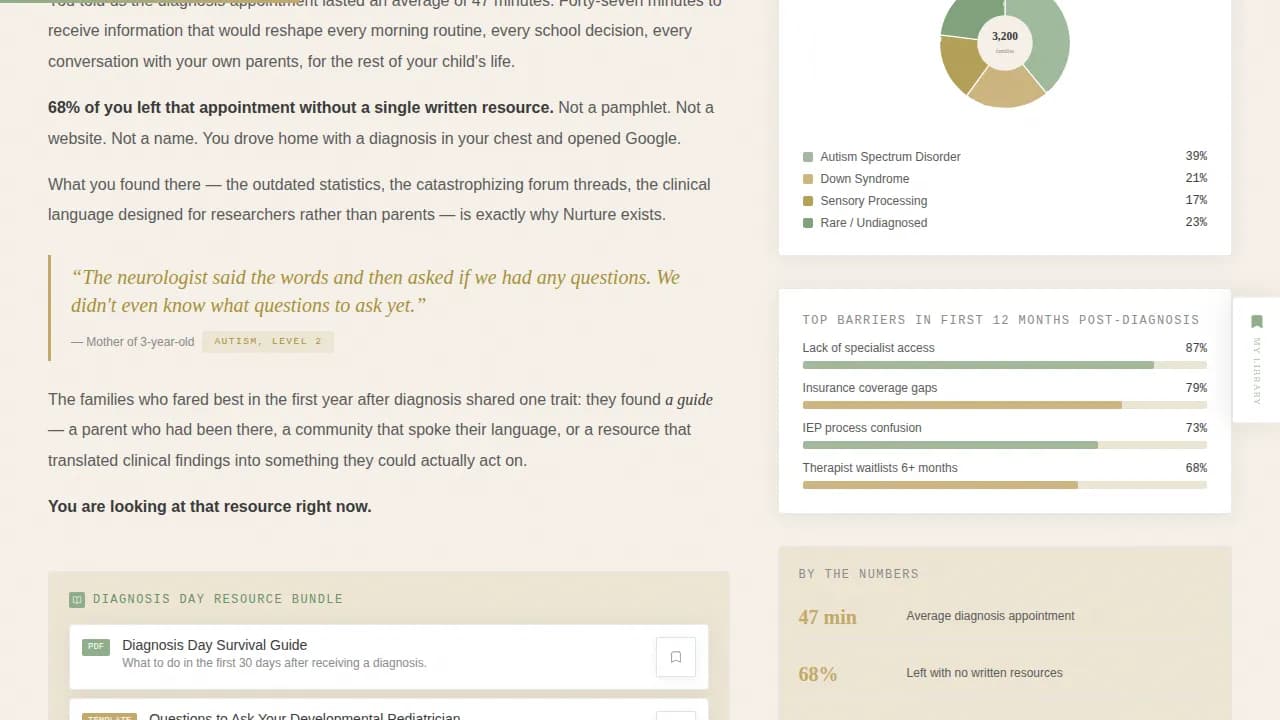
Every scroll section below the hero maintains a deliberate 60/40 split. The 60-column holds warm second-person narrative analysis drawn from survey findings, written to speak directly to the reader's daily life. The 40-column holds hand-drawn data visualizations, illustrated pie charts with brushstroke textures, and pull-quote cards from anonymous survey respondents. This layout structure gives the page a layered depth that helps children understand they are at the center of every research point while showing parents the evidence behind each claim.
Illustrated Data Visualization Columns
The template includes purpose-built 40-column slots for hand-drawn data visualizations. These brushstroke-styled charts, illustrated pie graphics, and annotated stat cards are designed to present findings from a 3,200-family survey in a visually warm, non-clinical format. Organizations focused on child's developmental progress, caregiver well being, and education outcomes will find these data slots particularly effective for demonstrating research depth without intimidating readers who are already navigating complex systems.
Curated Resource Bundle Sections
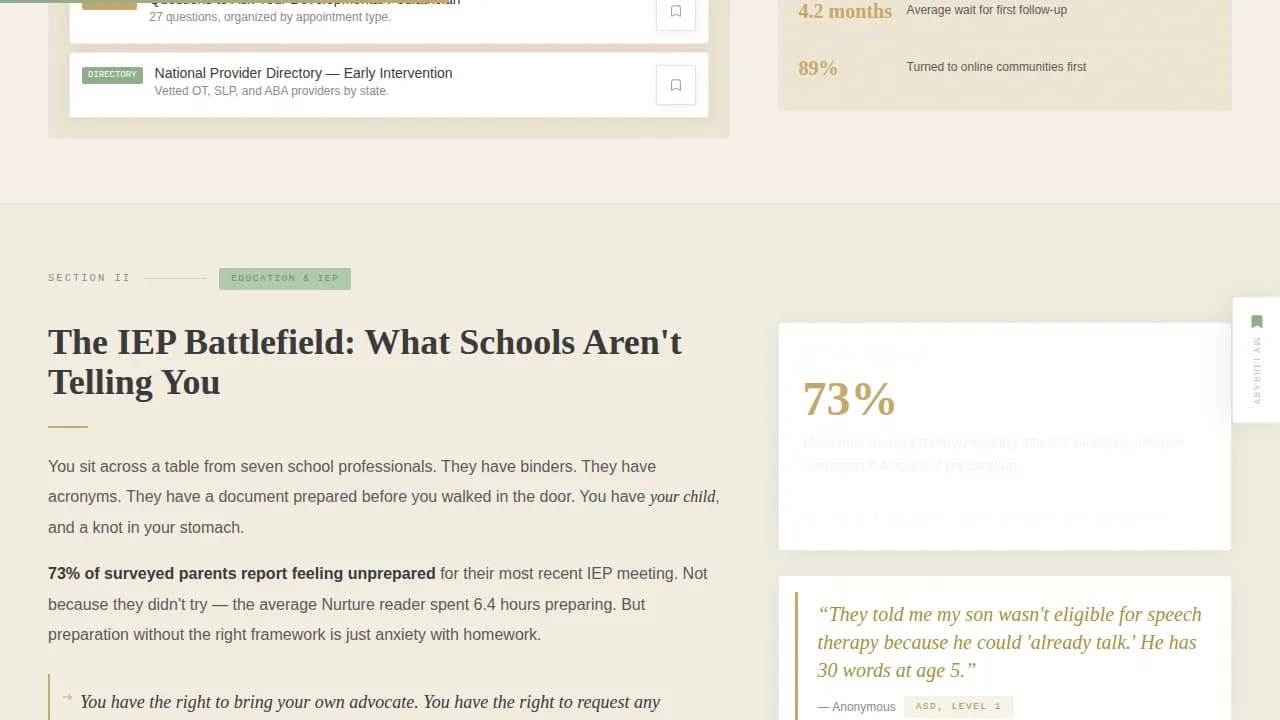
Each data section ends with a resource bundle component. These bundles are designed to hold downloadable PDFs, vetted provider directories, and script templates for IEP meetings. The bundles support families who need practical tools for daily activities and medical care coordination. Visitors can begin saving individual bundles to their "My Library" collection via a persistent sidebar bookmark icon in the 40-column, creating a low-friction path to value before any email is requested.
My Library Bookmark System
A persistent sidebar bookmark icon runs through the 40-column across all scroll sections. Visitors can save individual resource bundles to a personal "My Library" collection at any point in their session. This interaction model earns the eventual email-capture signup through accumulated value. It reflects the template's philosophy that trust must be built before it is requested, a principle that is especially important when the audience includes caregivers who are already stretched thin.
Email Capture with Diagnosis Personalization
The primary call to action, "Get the Full Report Free," appears after the third data section. The form collects only a first name and email address. An optional checkbox for "My child's primary diagnosis" is included. Selecting this option unlocks personalized resource recommendations in the post-signup welcome sequence, making the form feel less like a gate and more like the beginning of a tailored support relationship built around each child's unique needs and challenges.
Page Sections Overview
Section
Purpose
Publication Masthead
Establishes editorial identity and presents the lead research headline with an ink-portrait illustration
Survey Findings
Presents diagnosis-experience data in warm narrative and illustrated chart format
Education Battles
Covers IEP navigation struggles from survey data with pull-quotes and a downloadable resource bundle
Caregiver Burnout
Escalates emotional stakes with anonymous respondent cards and script template downloads
Report Download
Delivers the primary email-capture call to action after sufficient trust has been earned
Resource Library
Hosts the My Library sidebar system with categorized, bookmarkable resource bundles
Publication Footer
Closes with a minimal linear single-row footer styled as a publication colophon
Design & Branding System
The Nurture template uses a Japanese Zen color system interpreted through a Warm Artisan lens. The palette evokes a sun-lit pottery studio where every surface has been touched by hand. Handmade paper textures, visible brushstrokes, and loose ink illustration work together to signal warmth, credibility, and craft to parents and caregivers arriving after long, difficult days.
The four-color palette centers on shoji screen cream (#F5F0E8) for all backgrounds, washed ink charcoal (#3A3A3A) for body text with generous leading, tatami gold (#C4A96A) for headlines and pull-quote accents, and muted celadon (#8FAE8B) reserved for callouts, badges, and progress indicators that signal "here, this will help you"
Typography pairs Crimson Text as a seriffed editorial face for all masthead and headline text, DM Sans for warm, readable body copy, and JetBrains Mono for data labels, statistics, and research call-outs, creating a clear visual hierarchy that helps readers scan and absorb complex information quickly
Scroll-linked reveal animations, staggered section entries, and subtle parallax movement on illustrated elements give the page a tactile, handcrafted sense of motion that reinforces the artisan identity without distracting from the content
Mobile & Speed Optimization
The Nurture template is designed desktop-first, reflecting the real behavior of its audience: parents researching at night on laptops, caregivers reviewing IEP resources between meetings, and grandparents reading quietly at a kitchen table. A mobile fallback ensures the experience remains accessible and readable on smaller screens.
The asymmetric 60/40 grid collapses gracefully for mobile viewports, reordering the illustration and data visualization columns below the narrative text so the reading experience remains logical and unbroken
Static-first architecture, using server components for all content sections and client components only for the interactive My Library system and the email-capture form, keeps the page load lean and responsive even when resource bundles are numerous
How This Template Helps You Convert
The Nurture template does not ask for trust. It earns it. Every layout decision is designed to give caregivers something useful before presenting any request. The conversion architecture is layered, patient, and built around the emotional state of an audience that is already giving everything they have.
The My Library bookmark system allows visitors to save resource bundles and build personal collections before ever seeing a form, creating a sense of investment and value that makes the eventual email capture feel like a natural next step rather than an interruption
The "Get the Full Report Free" call to action appears only after three full data sections have demonstrated research depth, meaning the visitor who reaches the form has already engaged with diagnosis findings, IEP survey data, and caregiver burnout research and is primed to trust the offer
The optional diagnosis checkbox on the capture form gives parents and caregivers a reason to share more, framing personalization as a benefit rather than a data request, and opening a welcome sequence tailored to each child's unique situation
Other Information About This Template
The Nurture template reflects a broader understanding of what special needs parenting content genuinely requires. Below are additional details relevant to how this template supports your content strategy, audience, and editorial goals.
The nurture research backed special needs parenting landing page template is purpose-built for a niche that is chronically underserved by generic editorial themes. It treats the subject with the depth and empathy it demands, covering the full arc from initial diagnosis experience through ongoing education advocacy and caregiver self care.
Research shows that parents of children with special needs benefit enormously from content that combines emotional validation with actionable information. The template is structured to deliver both within the same scroll, moving from narrative warmth to downloadable tools without a jarring tonal shift.
The template's data sections are designed to reflect the kind of findings that organizations working on child's developmental well being, disease control guidance, or medical care navigation routinely publish. The illustrated chart slots can carry statistics drawn from government health bodies, peer-reviewed journals, or original platform surveys.
Supporting children across a wide range of diagnoses, including autism, Down syndrome, sensory processing differences, and rare conditions, requires a content structure that does not flatten their experiences into a single narrative. The template's section architecture allows publishers to segment findings by diagnosis category, keeping each resource bundle relevant to the specific child and family reading it.
Positive discipline strategies, visual schedules, role playing exercises, and communication strategies are among the evidence-based tools that caregivers most frequently search for online. The template's resource bundle slots are sized and labeled to hold exactly this kind of practical content, making it straightforward for publishers to organize and present these tools in a way that families can act on immediately.
Community resources and peer support connections matter deeply to this audience. The template's resource bundles can include links to expert-led forums, webinars, and peer support groups, creating positive connections between isolated families and the broader special needs community.
Many parents who visit a page like this are doing so because the formal systems around their child, schools, therapists, pediatricians, and insurance providers, have not given them what they need. The template is designed to fill that gap with content that is warm, specific, and grounded in real data. Empathy-based discipline content, guidance on how children learn across different learning styles, and tools for building social skills through role playing and group activities all fit naturally within the template's section structure.
The template's resource bundles can support content covering how toddlers and babies with early developmental concerns begin to develop new skills, how teachers can be approached as partners in a child's growth, and how caregivers can practice self care without feeling guilty for taking a moment away. These are the real life questions that bring families to this kind of platform in the first place.
Building positive connections between families who share similar experiences is a core function of the community layer this template supports. When caregivers can see pull-quotes from anonymous respondents who have faced the same challenges, they feel less alone. That sense of recognition is itself a form of support, and the template's design makes it visible at every scroll position.
Problem solving under stress is something every caregiver of a child with special needs practices daily. The template honors that reality by presenting information in a structured, scannable format, using clear headings, warm language, and a design system that does not add cognitive load to an already full mental plate.