Precision Team Staffing | Free Website Template | Rocket
The Align Family First Workforce Planning landing page template gives HR consultancies a warm, conversion-ready single-page layout built for mid-size companies facing retention pressure. A modular card grid, a coral-accented lead-gen form, a downloadable checklist gate, and an emotionally grounded visual identity work together to turn overwhelmed HR directors into qualified consultation leads.
by Rocket studio
Quick summary
This template is purpose-built for workforce planning consultancies that serve HR directors at 200 to 800 employee companies. It blends strategic HR data with an empathetic tone, delivers a modular card grid layout, and drives two conversion paths: a diagnostic form and a gated checklist download. The design feels warm enough to trust and structured enough to act on.
Who this template is for
HR consultants and advisory firms will feel at home here immediately. The layout is built for practices that help mid-size businesses align workforce planning with real employee lives, from flexible scheduling to caregiving leave design.
This template fits well if you serve any of these buyers:
- HR directors at companies with 200 to 800 employees who are dealing with resignation clusters and need actionable plans fast
- CFOs who want to understand the financial impact of turnover and need a clear case for investing in workforce planning
- Workforce planning consultants who want to align workforce priorities with long term business objectives and convert site visitors into booked consultations
What problem this template solves
Workforce planning consultancies often struggle to communicate both empathy and expertise on the same page. A generic site loses HR leaders the moment it feels corporate and cold. A purely emotional pitch loses the CFO who needs hard outcomes.
This template closes that gap by addressing these core friction points:
- No clear lead capture: the page includes a coral-bordered diagnostic form and a secondary gated checklist, giving visitors two natural entry points depending on where they are in the planning process
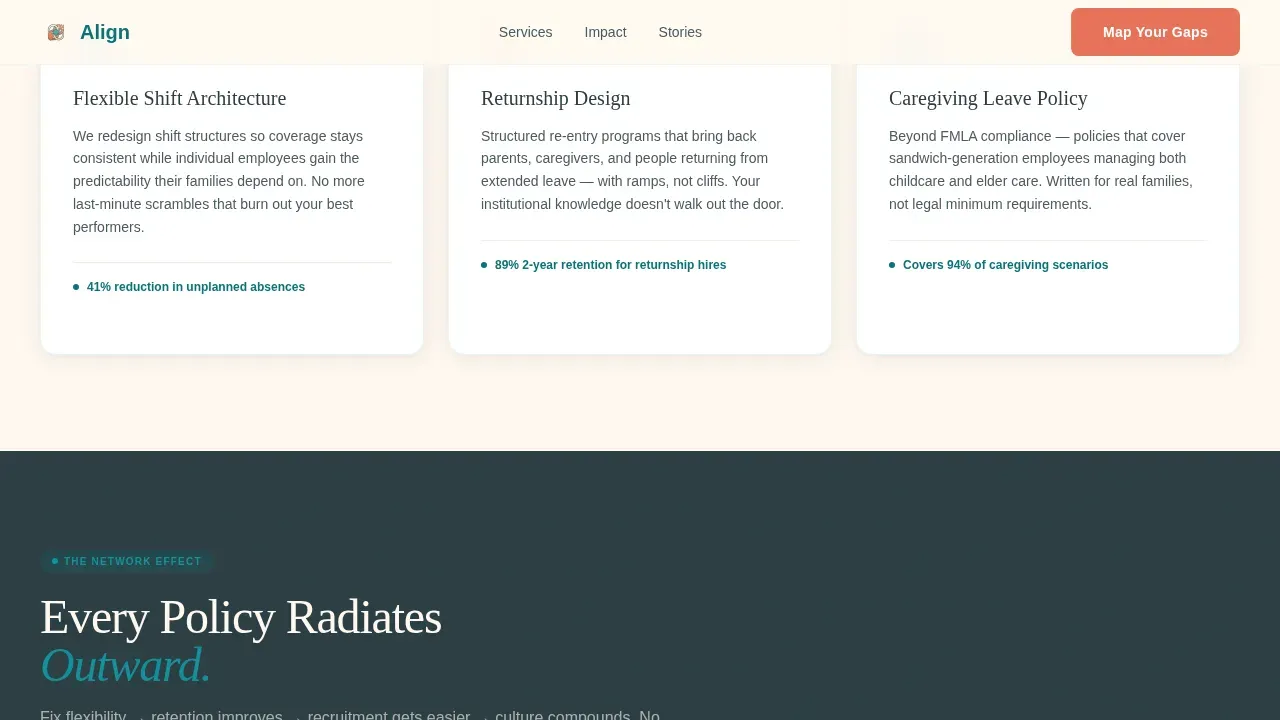
- Disconnected messaging: the Network Effect card grid visually shows how each workforce intervention connects to business outcomes, making the consultancy's value easy to understand at a glance
- Weak credibility signals: embedded testimonial cards from an HR director, a CFO, and a returning parent give social proof at every scroll depth
What you get with this template
You get a fully designed single-page layout that is ready to customize with your consultancy's content, color tokens, and copy. Every section has a defined purpose, and the card grid structure means you can update individual panels without redesigning the whole page.
Included in the template:
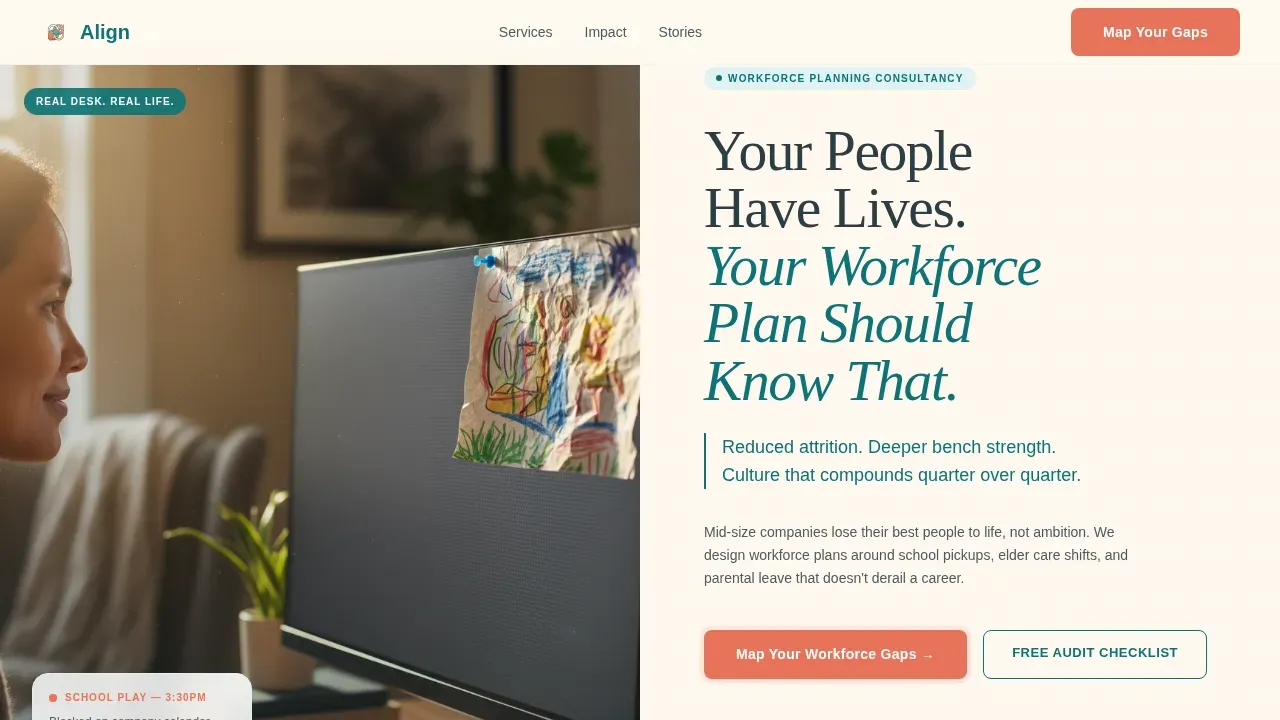
- A split hero section with a golden-hour photo placeholder on the left and a charcoal-on-cream headline on the right, built to showcase authentic imagery of real working environments
- A two-row modular card grid covering workforce interventions and their ripple effects, with teal hover connection lines that reveal how every workforce decision radiates outward
- A coral-bordered lead-gen card with a short diagnostic form and a secondary checklist download gate, both native to the grid layout
Feature list
This template includes the following built-in capabilities.
Split Hero with Emotional Headline
The hero occupies half the page width on each side. The left holds a warm, golden-hour photograph placeholder designed for authentic imagery rather than stock sterility. The right carries the headline and teal subtext that names clear outcomes: reduced attrition, deeper bench strength, and a culture that compounds. The split format immediately signals that this consultancy takes both people and results seriously.
Network Effect Card Grid
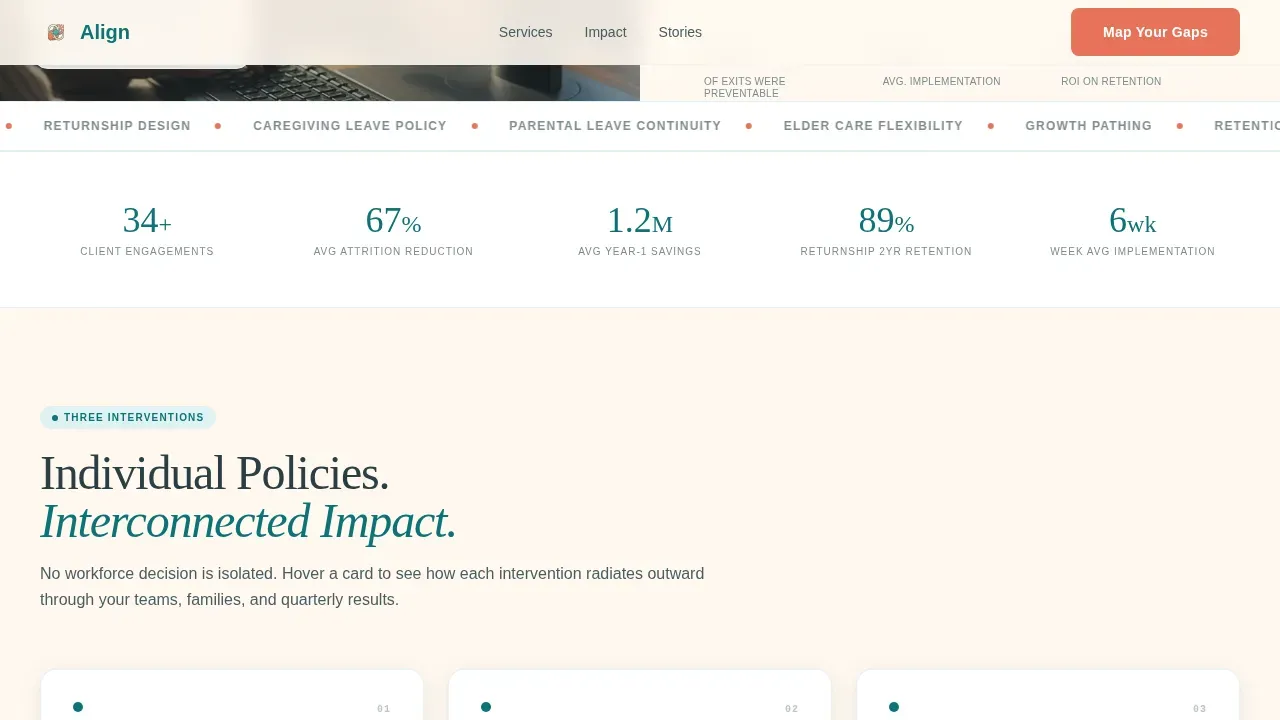
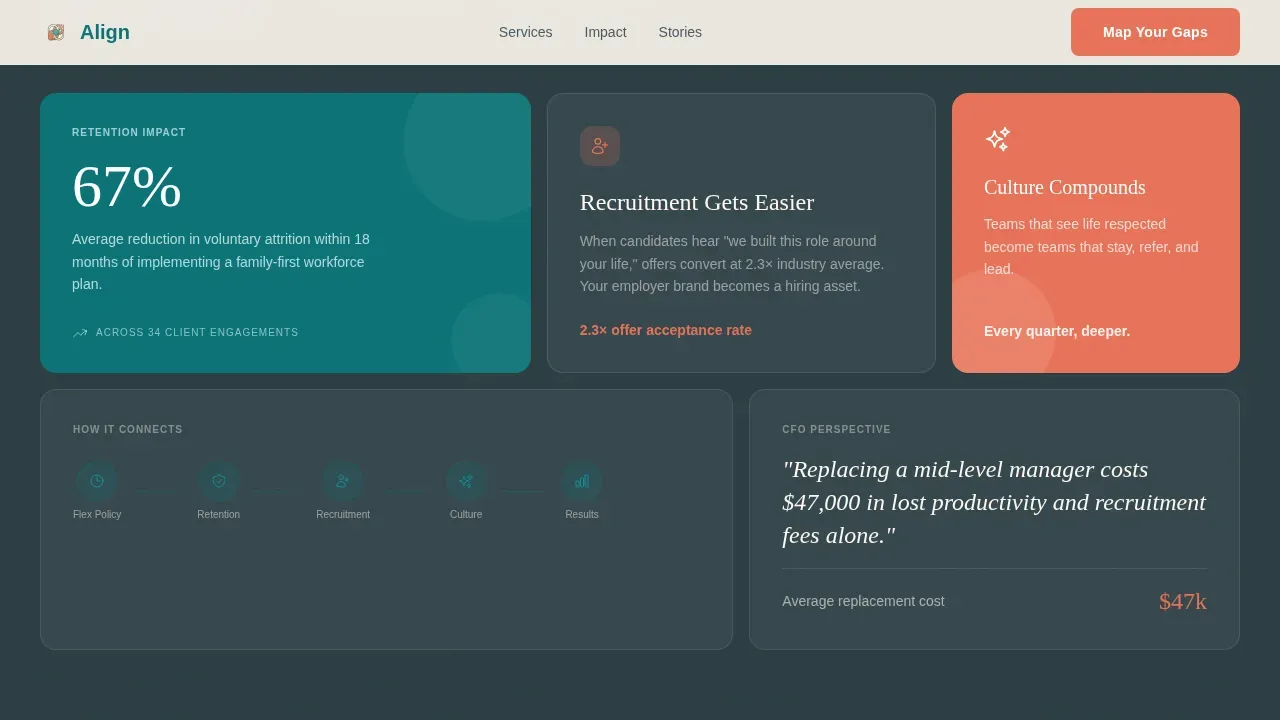
Two rows of modular cards represent each workforce intervention and its downstream impact. The first row covers flexible shift architecture, returnship design, and caregiving leave policy. The second row connects retention, recruitment, and culture cards with thin teal hover lines. This layout communicates visually that no workforce decision is isolated, which is a key consideration for HR teams evaluating strategic workforce planning support.
Embedded Testimonial Cards
Testimonial cards appear at irregular intervals inside the grid. Each features a specific outcome tied to a real role: an HR director in logistics, a CFO who quantified savings, and a returning parent who stayed five more years. Irregular placement prevents the social proof from feeling bolted on, keeping the reader inside the experience rather than skipping past a dedicated "quotes" row.
Coral-Bordered Lead-Gen Form Card
The diagnostic form sits inside its own card, bordered in heartbeat coral, positioned at grid center. It asks three short questions: company size range, top retention challenge (via dropdown covering parental leave, flexibility, burnout, and growth pathing), and work email. This focused structure reflects best-practice guidance: use a single, descriptive call to action rather than a generic button.
Gated Checklist Download
A secondary conversion path offers a downloadable Family-First Workforce Audit checklist, gated by email alone. This captures earlier-stage leads who are already nodding at the problem but are not ready for a direct conversation. The gate is lightweight and native to the grid, matching the overall page feel rather than interrupting it.
Teal Connection Lines on Hover
On desktop, thin teal lines animate between related cards on hover. This interaction reinforces the "Network Effect" creative direction: every flexible scheduling decision links to a retention outcome, every returnship design links to a recruitment advantage, and every caregiving leave policy links to culture. The animation is medium-weight and scroll-triggered for natural pacing.
Page sections overview
| Section | Purpose |
|---|---|
| Split Hero | Headline, photo, primary call to action |
| Services Card Row | Three workforce intervention cards |
| Impact Network Row | Retention, recruitment, culture connections |
| Testimonials in Grid | Social proof at irregular intervals |
| Lead-Gen Form Card | Diagnostic form, coral-bordered conversion card |
| Checklist Download Card | Email-gated secondary lead capture |
| Footer | Single-row linear footer with navigation |
Design & branding system
The visual identity follows the Teal Catalyst color system. Every color choice is deliberate: the palette reads like a well-lit dining room where serious conversations happen over coffee. Warm enough to trust, structured enough to act on.
Key design decisions:
- Deep decision teal (#0D7377) anchors headers, card borders, and hover connection lines; warm kitchen-table cream (#FFF8F0) dominates all backgrounds to reduce visual fatigue during long reading sessions
- Heartbeat coral (#E8735A) appears exclusively on calls to action, the form card border, and pull-quotes, so every coral element trains the eye toward a commitment
- Typography pairs Fraunces serif headlines with DM Sans body text, balancing editorial warmth with professional readability; grounding charcoal (#2C3E44) handles all body copy for strong contrast against cream
Mobile & speed optimization
The template is built desktop-first to match the research behavior of HR directors, with a fully responsive layout for smaller screens. The modular card grid reflows cleanly from multi-column to single-column on mobile.
Optimization choices built into the template:
- Server Components handle all static content sections, keeping the initial page load light for text-heavy consultancy copy
- Client Components are scoped only to the diagnostic form and hover interactions, so animation weight does not affect non-interactive sections
- Scroll-reveal animations are triggered progressively, ensuring readers on slower connections still see a polished experience as content loads in sequence
How this template helps you convert
Workforce planning consultancies need more than a beautiful page. They need a layout that moves HR directors from curiosity to commitment without feeling pushy.
This template is structured to convert through three clear mechanisms:
- The split hero creates immediate emotional resonance. The golden-hour photograph paired with an outcomes-focused headline speaks directly to the HR director who just read three exit interviews in a row. Relief is the first conversion catalyst.
- The Network Effect card grid builds intellectual confidence. By showing how each workforce intervention connects to business outcomes, the grid answers the CFO's unspoken question: what is the financial impact of doing this properly? Seeing the ripple effect from retention to recruitment to culture makes the consultancy's model legible and compelling.
- Two conversion paths respect different buyer stages. The diagnostic form captures decision-ready leads. The checklist download captures earlier-stage visitors. Neither path feels forced because both live natively inside the card grid, matching the page's visual rhythm.
Other information about this template
This template was designed with the full workforce planning consultancy context in mind. It reflects published best practices across strategic workforce planning, skills-first job architecture, and family-centered HR advisory work.
Additional context worth knowing before you customize:
- A skills-first job architecture organizes roles and career paths based on the skills required for success rather than traditional job descriptions; the template's services card row is structured to communicate this model clearly to HR teams who may be unfamiliar with it
- Workforce planning templates serve different purposes depending on company size and complexity; this layout works best for consultancies serving mid-market organizations where HR leaders need both empathy and a structured framework to justify investment to a leadership team
- The page supports messaging around succession planning, scenario planning, and career development because the card grid format lets you swap individual cards without disrupting the overall layout
- Conducting skills gap analyses, building a skills inventory, and assessing current workforce capabilities are all service areas the template's copy placeholders are designed to introduce without overwhelming first-time visitors
- The checklist download placeholder is built to gate a resource like a Family-First Workforce Audit, which naturally supports earlier-stage HR leaders who are identifying gaps but have not yet committed to a consultancy engagement
- Predictive analytics, cross functional collaboration framing, and resource allocation language can all be integrated into the impact network row cards, keeping the page aligned with how strategic HR leaders talk about workforce analysis internally
- Genuine, diverse imagery matters here: the hero photo placeholder is sized and cropped for real, high-quality photography of actual working environments rather than stock sterility, which builds the authentic credibility signal this audience needs
- The Align Family First Workforce Planning Landing Page Template is available as a ready-to-customize starting point on this platform, so HR consultancies can launch quickly without rebuilding the emotional and structural logic from scratch
Theme
Family First
Creative direction
Network Effect
Color system
Teal Catalyst
Style
Card Grid (Modular)
Direction
Lead Generation
Page Sections
Split Hero with Authentic Photo Placeholder
Network Effect Modular Card Grid
Coral-bordered Diagnostic Form Card
Gated Checklist Download Path
Embedded Testimonial Cards
Scroll-reveal Animations and Hover Interactions
Related questions
Can I update the card grid content without redesigning the whole page?
Does the template include both lead capture options out of the box?
Is this template suitable for a consultancy focused on succession planning and career development?
How does the Network Effect hover interaction work on mobile?
Who is the ideal buyer for this template?