Intimate Italian Gathering Landing Page Template
Tavola is a modular card-grid landing page built for intimate Italian supper clubs. It converts curious neighbors into confirmed Thursday night reservations through a cinematic hero image, an asymmetric pinboard grid of story-driven cards, a minimal booking form, and a sticky "Reserve Your Seat" call to action rendered in persimmon against a warm cream and charcoal palette.
by Rocket studio
Quick summary
Tavola is a single-page booking template crafted for a candlelit, communal Italian dinner experience. It guides guests from first impression to confirmed reservation through atmospheric visuals, neighborhood storytelling, and a frictionless booking form. Every section earns its room on the page by moving a curious visitor one step closer to the table.
Who this template is for
This template is ideal for anyone hosting an intimate, recurring dinner event where atmosphere and community matter as much as the food. It suits neighborhood supper clubs, pop-up dining concepts, and private dining hosts who dine guests at a communal table rather than individual restaurant tables.
- Supper club hosts and independent chefs who offer a curated, family-style dinner each week
- Pop-up restaurant operators and private dining hosts who need a dedicated booking space online
- Food-focused creative teams who want a landing page that feels as crafted as the meal itself
What problem this template solves
Most restaurant booking pages are built for volume. They list dozens of time slots, push guests through generic forms, and offer nothing that communicates the feeling of the room. For a supper club with only twelve seats, that approach is a mismatch. Guests arrive at the page unsure whether they belong, leave without booking, and the host loses a reservation they could not afford to lose.
Tavola solves this by leading with story rather than logistics. The page builds desire before it asks for a commitment.
- Guests who discover the page need to feel the warmth of the room before they reach the booking form
- Hosts need seating filled each week without relying on third-party reservation platforms that dilute the brand
- The template removes friction by collecting only a name, a phone number, and a preferred date, which is all a supper club actually needs
What you get with this template
You get a complete, launch-ready landing page built around a single conversion goal: filling every reserved seat at the table each Thursday. The layout is modular, so each card section stands on its own while the full page tells a coherent story from hero to footer.
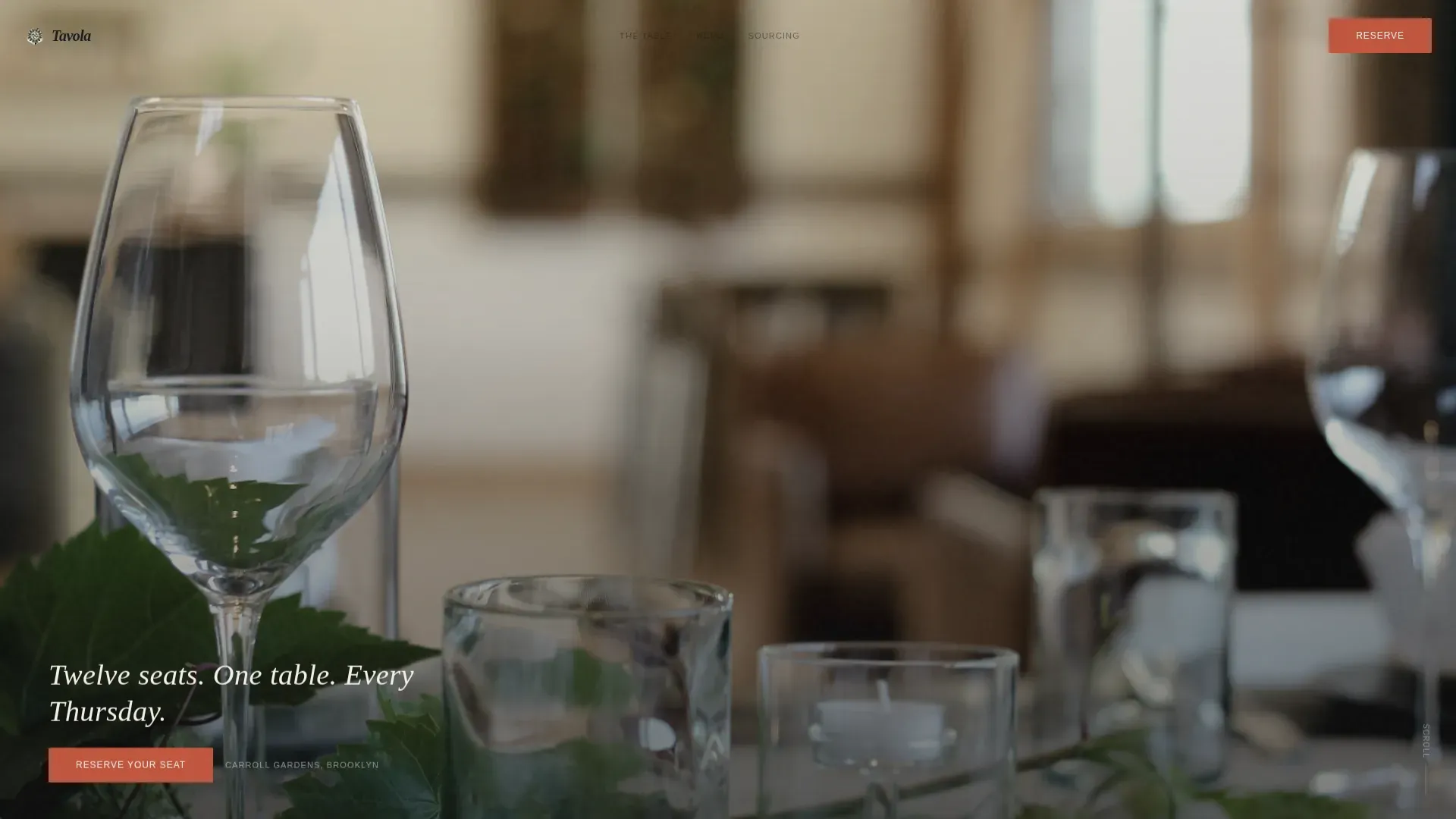
- A grain-heavy cinematic hero with a single serif headline and a scroll-triggered sticky call to action in persimmon
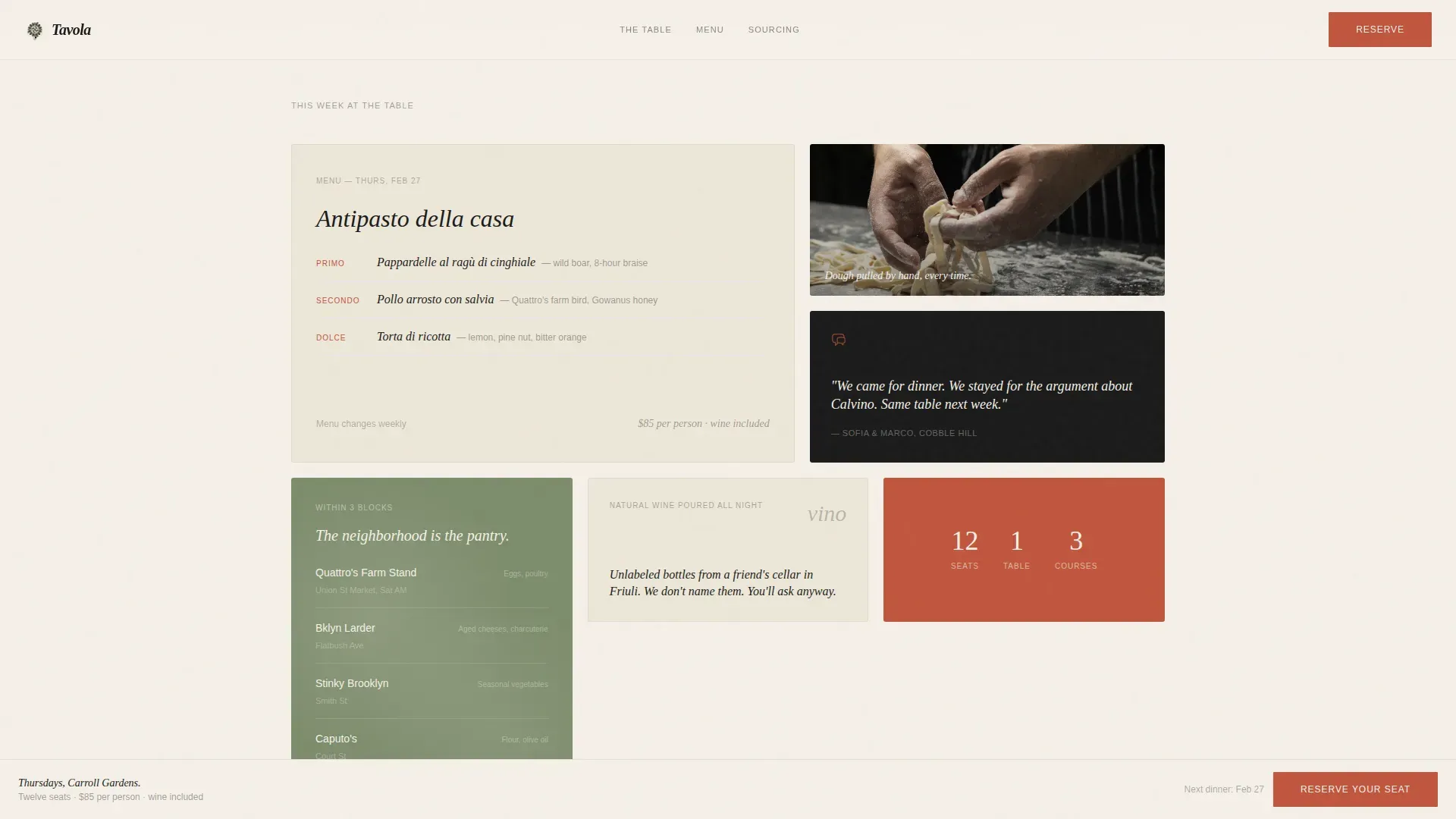
- An asymmetric pinboard card grid featuring a weekly menu card, a chef-hands image card, a local sourcing map card, a neighbor quote card, and a wine card
- A minimal booking form with a date carousel, a party size selector capped at four guests, a first name field, and a phone number field for text confirmation
Feature list
A paragraph introduces each capability below. Together they create a landing page that is honest about what the template delivers and precise about how it delivers it.
Cinematic Lifestyle Hero Section
The hero fills the viewport with a warm, grain-heavy lifestyle photograph taken at the communal table mid-service. Hands reaching for bread, wine catching candlelight, a host pouring from an unlabeled bottle. A single line of Fraunces serif type sits low on the image: "Twelve seats. One table. Every Thursday." This section sets the entire emotional tone of the page and tells guests exactly what kind of dinner event they are about to explore, before they read a single word of body copy.
Asymmetric Modular Card Grid
The card grid is the heart of the template. It functions like a pinboard in a restaurant vestibule, where each card is a self-contained vignette. One card holds the weekly menu written in a script font. Another shows the executive chef's hands pulling dough. A third maps the three-block radius where ingredients are sourced, land to table. A fourth carries a short neighbor quote with a first name and a street reference. A fifth is reserved for wine. Cards vary in size, density, and background wash, some image-heavy, some text-only on cream, creating an uneven grid that breathes and draws the eye across the space.
Sticky "Reserve Your Seat" Call to Action
After the first scroll, a persimmon-colored "Reserve Your Seat" button pins gently to the bottom of the viewport. It stays visible without interrupting the reading experience. Tapping it opens a minimal booking form: a short carousel of upcoming Thursday dinner dates, a party size selector from one to four guests, a first name field, and a phone number field. No email address is requested. Confirmation arrives by text, which feels like a message from a friend rather than an automated system. This keeps the booking event personal and on-brand.
Waitlist Collection Path
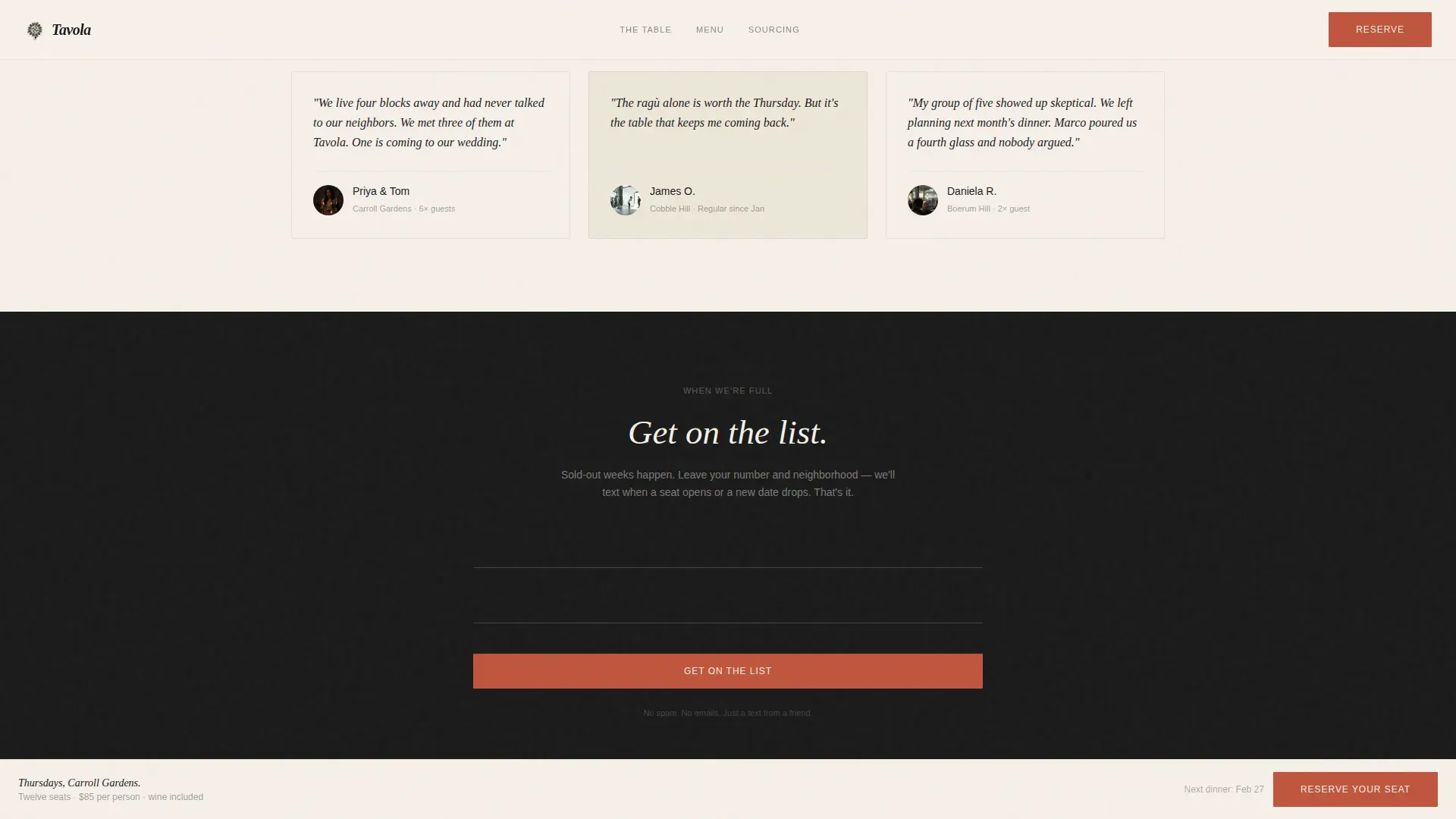
Below the main card grid, a secondary path reads "Get on the list" for weeks when every seat is already reserved. It collects a phone number and a neighborhood name in a single compact form. This builds both a waitlist and a community in one field. Hosts can use this list to fill cancellations quickly and to grow word-of-mouth reach across the surrounding area without paid advertising.
Neighbor Voices Section
The "Voices from the Block" section presents specific guest quotes with a first name and a street reference rather than anonymous reviews. This level of detail makes social proof feel local and real. It reflects the supper club's community character and helps new guests picture themselves at the table. The section is dedicated to short, warm testimonials that focus on the feeling of the room, the quality of the meal, and the fun of sitting beside strangers who become friends.
Neo-Retro Japanese Zen Design System
Every visual decision is made to feel like a 1970s Italian film poster printed on handmade Japanese paper. Shou sugi ban charcoal (#1A1A1A) carries all type. Washi paper cream (#F5F0E8) dominates the background like a linen tablecloth. Matcha stone (#7D8C6C) washes behind alternating cards. Persimmon glaze (#C1553D) appears only on buttons and hover states, reserved for moments when a finger should press. Fraunces handles all display headings. DM Sans handles body copy. The result is restrained, textural, and deliberately imperfect.
Page sections overview
| Section | Purpose |
|---|---|
| Cinematic Hero | Opens with lifestyle photograph and headline to set atmosphere |
| Modular Card Grid | Asymmetric pinboard featuring menu, chef, sourcing, quote, and wine cards |
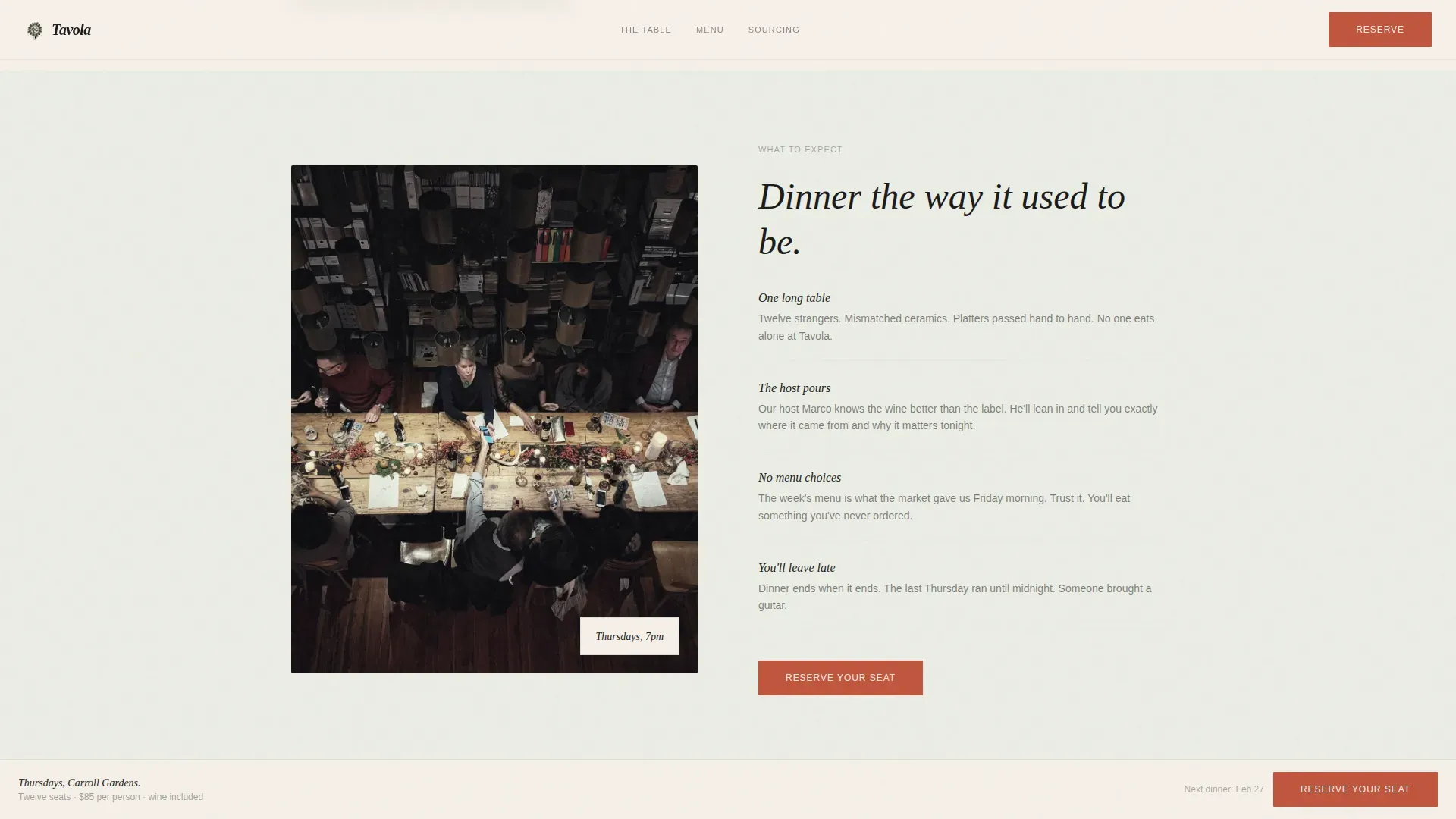
| The Table | Presents intimacy details: twelve seats, family-style service, communal dining |
| Voices from Block | Displays neighbor and guest quotes with name and street for local social proof |
| Reserve Your Seat | Hosts the booking form with date carousel, party size, name, and phone |
| Waitlist Sign-up | Collects phone number and neighborhood name for sold-out week waitlist |
| Footer | Linear footer pattern with essential links and contact reference |
Design & branding system
The design of this template is built around restraint. Every color, typeface, and spacing decision serves the atmosphere of the room rather than competing with it. The palette feels warm and analog. The typography is confident without being loud. The layout is imperfect by intention, which communicates authenticity rather than polish.
- Colors: cream (#F5F0E8) for backgrounds, charcoal (#1A1A1A) for all type, matcha stone (#7D8C6C) for alternating card washes, and persimmon (#C1553D) strictly for button and hover states
- Typography: Fraunces serif for display headings and emotional moments, DM Sans for body text and form labels
- Visual texture: grain overlay applied via SVG filter across the hero image to create an analog, film-like quality that reflects the handmade spirit of the supper club
Mobile & speed optimization
Over seventy percent of restaurant traffic comes from mobile devices, and supper club guests are especially likely to discover and book from their phones on a Saturday evening. This template is built mobile-first, which means every section, card, form, and sticky call to action is designed for a small screen before it is adapted upward for desktop.
- The sticky "Reserve Your Seat" button is sized and positioned for thumb reach on mobile, and the booking form fields are minimal by design: name, phone, date, and party size only
- All images in the card grid are lazy-loaded so the page begins rendering quickly without waiting for every photograph to arrive
- The grain texture is delivered via an SVG filter rather than a canvas element or a large image file, keeping the visual effect lightweight
How this template helps you convert
This template is built around one specific conversion goal: filling twelve reserved seats at the communal dinner table each week. Every design and copy decision supports that goal without distraction.
- The hero section creates emotional desire before the guest encounters any logistical information. They want to be in that room before they know the date or the price. The headline reinforces scarcity naturally: twelve seats, one table, every Thursday.
- The modular card grid builds trust through specificity. A weekly menu card featuring three to five seasonal dishes, a sourcing map that names the specific area where ingredients are gathered, and neighbor quotes with real street references all work together to make the event feel credible and located in a real place.
- The sticky call to action and the minimal booking form remove every unnecessary step between desire and commitment. The form asks only for essentials. The waitlist path captures guests who arrive too late for the current week, turning a missed booking into a future reservation and a loyal community member.
Other information about this template
This section covers additional context that helps hosts understand how the template fits into a broader supper club operation, from weekly event hosting to community building and long-term dining traditions.
The template is well suited to a host who runs a recurring dinner event and wants to build loyal customers over time rather than chasing new guests each week. The waitlist form is a practical tool for that. Guests who join the list are already warm. They have seen the menu, read the neighbor quotes, and pictured the room. Converting them from waitlist to reservation is a short step.
The modular card structure is flexible enough to support seasonal menu changes, special event nights, and themed dinner weeks without rebuilding the page. Swap the menu card content, update the date carousel in the booking form, and the page reflects the new week instantly.
For hosts who also offer brunch or a Sunday version of the supper club format, the template's card grid can accommodate additional event cards without disrupting the visual rhythm of the layout. The grid breathes unevenly by design, so adding or removing a card feels natural rather than mechanical.
The booking form is designed with food and beverage minimums in mind. Hosts can state food and beverage minimums clearly in the form copy or in a supporting detail card, so guests arrive with accurate expectations about the meal cost and what is included. Stating food and beverage minimums upfront reduces confusion and builds trust before the dinner begins.
The template also supports a secondary use case: hosting the page as a site for private dining inquiries. A small group celebrating a birthday, exchanging vows at an elopement dinner, or hosting a business meal in a dedicated room away from the main dining room can all reach out through the booking form or the waitlist field. The intimate seating structure and the communal table make this the perfect place for events where connection matters more than scale.
The template's neighborhood storytelling approach aligns with how supper clubs like Tavola rely on storytelling to build a sense of community and evoke emotional connections. Guests who dine once tend to return, and the page is crafted to serve that cycle: discover, book, dine, return, bring friends.
Hosts who want to extend their reach can use the template's visual assets and quote section as a foundation for social media marketing, sharing card images and neighbor quotes across platforms to attract new guests who find the supper club through a post rather than a search.
The template's attention to detail in the design system, from the grain overlay to the mismatched card sizes, is a direct reflection of the supper club's character. The beauty of this approach is that the page itself becomes a preview of the experience. A guest who scrolls through it already knows they will enjoy the dinner.
- The booking form collects only what is necessary: date, party size, first name, and phone number, which keeps the form short and the conversion rate high
- The waitlist field collects a phone number and a neighborhood name, building both a contact list and a map of the supper club's community area
- The template is ready to use as a standalone landing page for a recurring weekly dinner event, a seasonal pop-up, or a private dining inquiry site
Theme
Neo-Retro
Creative direction
Local & Neighborhood
Color system
Japanese Zen
Style
Card Grid (Modular)
Direction
Booking/Scheduling
Page Sections
Cinematic Grain Hero with Sticky Call to Action
Asymmetric Modular Card Grid
Minimal Booking Form with Date Carousel
Waitlist and Community Collection
Neighbor Voices Social Proof Section
Neo-retro Japanese Zen Visual System
Related questions
Can I update the weekly menu card without rebuilding the page?
Does the booking form support groups larger than four guests?
Can I adapt this template for a brunch, Sunday dinner, or other recurring dining event?
How does the waitlist path work for sold-out dinner weeks?
Is this template suitable for a private dining room or a dedicated event space inquiry?