Palliative Care Medicine Specialist Professional Website Template
Palliate is a hub and spoke landing page template built for palliative care research centers. It pairs a half-page photo and text hero with eight anchor-navigated audit sections, a floating self-scoring assessment, and a PDF download gate. The design uses a calm teal, sage, and coral palette to communicate clinical authority without feeling sterile.
by Rocket studio
Quick summary
Palliate is a single-page clinical hub built for palliative care research centers that need to engage hospice medical directors, oncology fellows, and hospital administrators. The template structures an 8-domain program audit as a guided scroll experience, then converts engaged visitors through a scored assessment and a PDF checklist gate.
Who this template is for
This template is built for organizations that translate palliative care research into practical clinical tools. It works best when the audience arrives with specific professional questions, not general curiosity.
- Hospice medical directors and oncology fellows looking for evidence-backed protocol guidance
- Hospital system administrators and care quality officers evaluating program gaps
- Palliative care research centers publishing benchmark data from large patient datasets
What problem this template solves
Most palliative care programs lack a structured way to show clinicians exactly where their practice falls short. A general information page does not move a medical director to act. This template solves that by framing the entire page as a diagnostic tool.
- Clinicians scroll through eight audit domains and self-identify gaps before ever filling out a form
- The conversion path matches professional intent, offering a scored gap analysis rather than a generic newsletter signup
- The design carries calm authority that fits the emotional weight of the subject matter
What you get with this template
You get a complete, fully structured landing page ready to be customized for your palliative care research center. Every section is purpose-built for clinical professionals who read quickly and decide carefully.
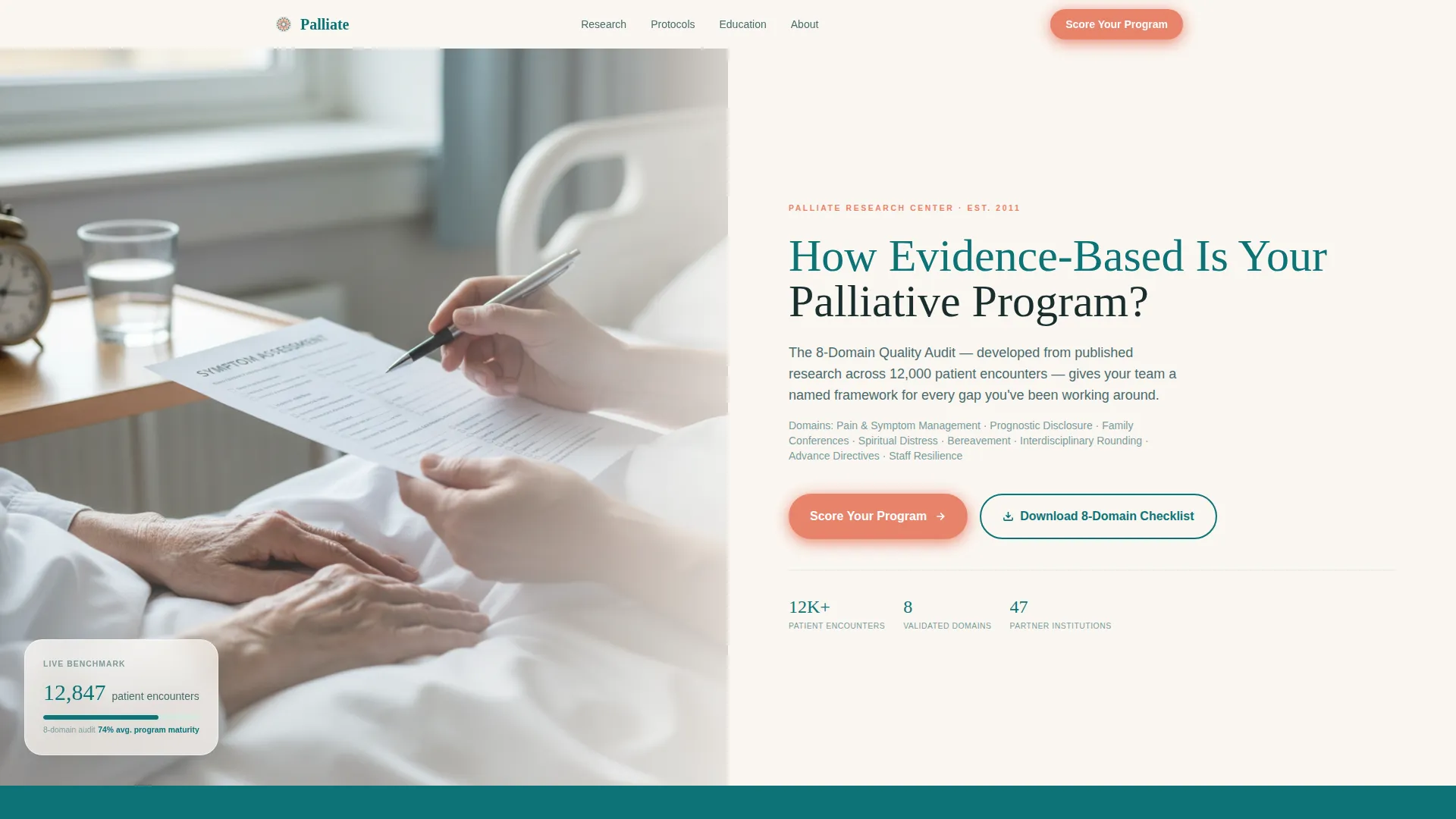
- A half-page hero with a photo and text split, an 8-domain audit headline, and a primary "Score Your Program" call to action
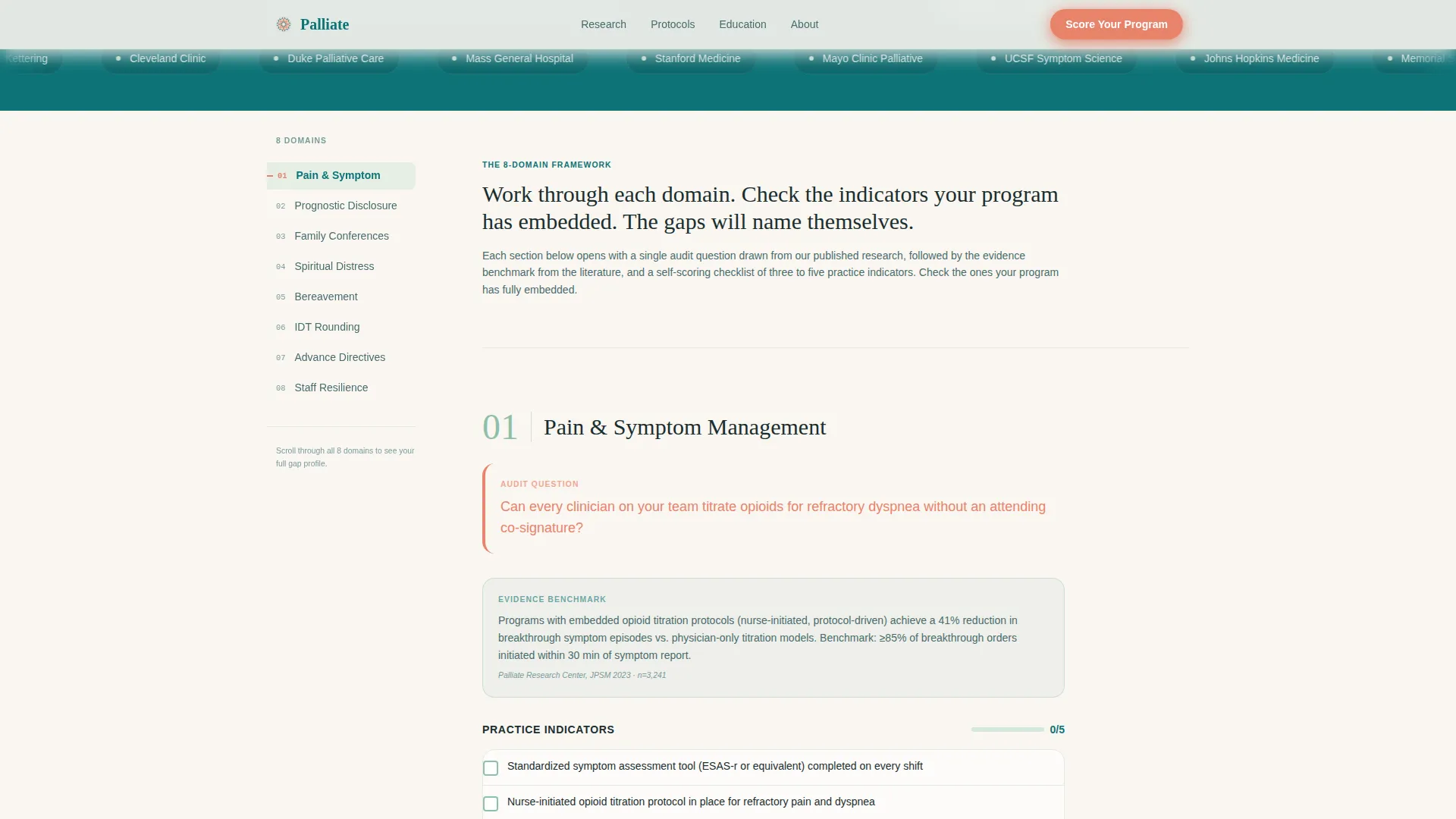
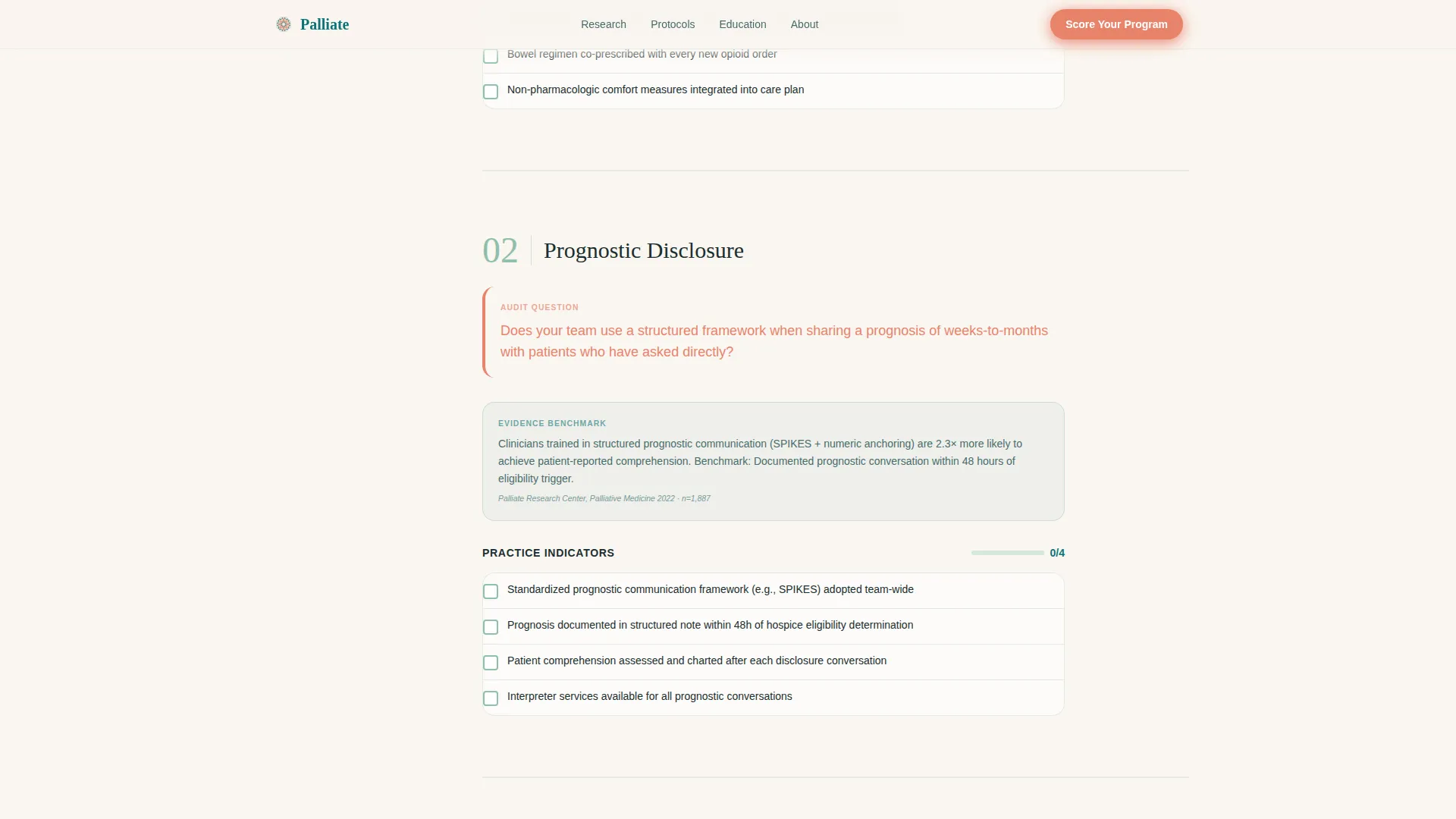
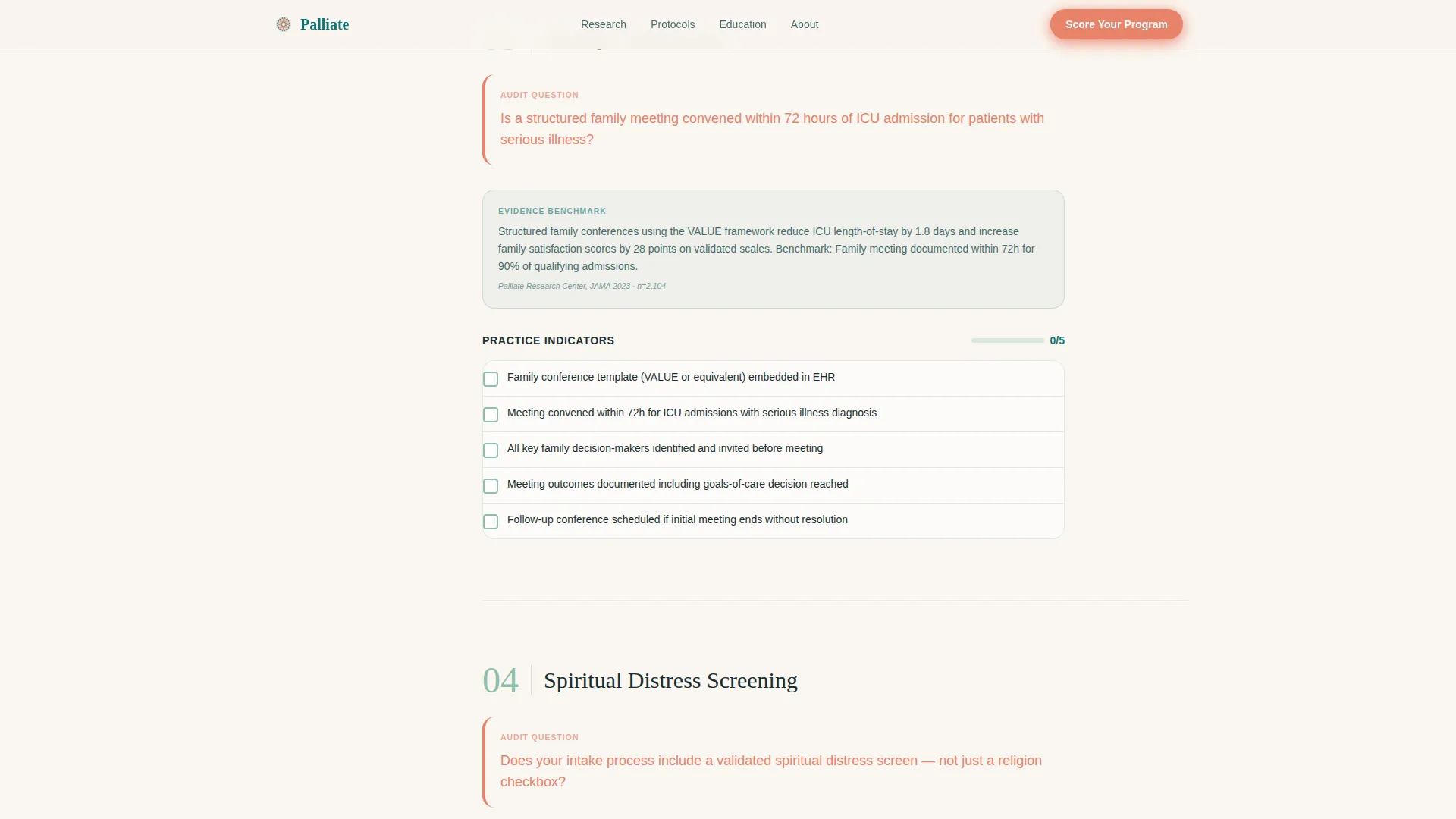
- Eight anchor-navigated spoke sections, each with an audit question, an evidence benchmark, and a three-to-five item self-scoring checklist
- A floating assessment button, a scored modal quiz, and a PDF checklist download gate with a simple name-and-role form
Feature list
This template is built around high-interactivity clinical engagement. Every feature listed here comes directly from the design brief.
Sticky Anchor Navigation Rail
A fixed left-rail navigation highlights the active domain as the visitor scrolls. Each of the eight palliative care quality domains is reachable with a single click, keeping orientation clear across a long scroll.
Eight-Domain Audit Scroll
Each spoke section opens with a single audit question styled in coral, followed by the published evidence benchmark and a self-scoring checklist of three to five practice indicators. The cumulative scroll builds a case that most programs have gaps they have not yet named.
Floating "Score Your Program" Button
The floating call-to-action button emerges after the visitor engages with at least two spoke sections. It triggers a scored assessment modal covering care setting type, average daily census, and eight scored questions mirroring the spoke domains.
Scored Assessment Modal
The assessment uses a three-option scale, Not Yet, In Progress, and Embedded, across all eight domains. On completion, the visitor enters an institutional email address to receive a personalized gap analysis document benchmarked against the center's national dataset.
PDF Checklist Download Gate
A secondary conversion path offers the full 8-domain checklist as a downloadable document. It requires only a name and professional role, catching visitors who want the tool before they are ready for the full assessment.
Clinical Photo and Text Hero
The header uses a half-page split layout. The left side holds a close-up photograph of two pairs of hands at a bedside table with natural window light. The right side carries the primary headline and a subline naming the 8-domain audit framework.
Page sections overview
| Section | Purpose |
|---|---|
| Hero split header | Introduce the 8-domain audit framework and present the primary "Score Your Program" call to action |
| Pain & Symptom domain | Audit opioid titration and symptom burden management practices against published benchmarks |
| Prognostic Disclosure domain | Evaluate clinician communication of prognosis against evidence standards |
| Family Conferences domain | Score family meeting frequency and documentation against quality indicators |
| Spiritual Distress domain | Assess screening protocols for spiritual and existential distress in care settings |
| Bereavement Follow-Through domain | Review post-death family outreach and bereavement support practices |
| Interdisciplinary Rounding domain | Audit team rounding frequency and interdisciplinary documentation quality |
| Advance Directive domain | Score advance directive completion rates against national benchmarks |
| Staff Resilience domain | Evaluate support structures for clinician wellbeing and moral distress |
| Research credibility block | Anchor the center's authority with the 12,000-encounter dataset and published citations |
| Floating assessment button | Emerge after two domain interactions and drive scored program evaluation |
| PDF download gate | Capture name and role in exchange for the downloadable 8-domain checklist |
| Footer row | Provide linear single-row site links and contact information |
Design & branding system
The visual identity follows an Educational Guide theme built around the Teal Catalyst color system. The palette is clinical without being cold, and warm without leaning sentimental.
- Deep teal (#0D7377) anchors headers and navigation; soft sage (#B5D5C5) washes section backgrounds; warm linen white (#FAF6F1) fills body panels; quiet coral (#E8836B) marks interactive elements and assessment prompts exclusively
- Typography pairs DM Sans for body text with Fraunces as the serif display face for headlines, producing a pocket-guide aesthetic that signals rigor without formality
- Scroll reveal animations and sticky nav highlighting keep the page feeling alive without distracting from clinical content
Mobile & speed optimization
The template is built desktop-first to match the primary audience of clinicians at workstations. A mobile-responsive fallback ensures the page remains functional when accessed from other devices.
- Static-first architecture uses server components for content delivery and reserves client-side rendering for interactive assessment elements only
- Medium animation intensity keeps scroll reveals and sticky highlighting smooth without adding unnecessary load to the page
- The floating button and assessment modal are designed to work cleanly on both large and small screens
How this template helps you convert
The entire page is designed as a diagnostic funnel. Visitors self-select their level of engagement and the template meets them at each stage with an appropriate ask.
- The hero places the "Score Your Program" call to action before any scroll commitment, capturing high-intent visitors immediately on arrival
- The eight audit domains build cumulative self-awareness of program gaps, so by the time the floating button appears the visitor already understands why the assessment matters
- The two-path conversion system, a full scored assessment for high-intent visitors and a PDF checklist gate for early-stage visitors, ensures no qualified lead leaves without an offer that fits their readiness
Other information about this template
This template is specifically designed for the palliative care medicine space and the educational clinical hub use case. A few additional details are worth knowing before you customize it.
- The template is categorized under Health and Medical with a Palliative Care Medicine subcategory, so the section copy and audit structure reflect USA clinical context, English language, and standard date formatting
- The footer uses a linear single-row pattern keeping the page focused on the primary conversion paths rather than deep site navigation
- The assessment modal and PDF gate form are built with high-interactivity components that require customization to connect to your preferred email delivery or document hosting setup
- The 8-domain framework reflects the brief's published research grounding, covering Pain and Symptom Management, Prognostic Disclosure, Family Conferences, Spiritual Distress Screening, Bereavement Follow-Through, Interdisciplinary Rounding, Advance Directive Completion, and Staff Resilience
Theme
Educational Guide
Creative direction
Checklist & Audit
Color system
Teal Catalyst
Style
Hub & Spoke (Anchor Nav)
Direction
Quiz/Assessment
Page Sections
Sticky 8-domain Navigation Rail
Self-scoring Audit Checklists
Floating Assessment Call to Action
Scored Program Assessment Modal
PDF Checklist Download Gate
Clinical Half-page Hero Layout
Related questions
Who is this landing page template designed for?
What are the eight audit domains covered in the template?
How does the scored assessment conversion path work?
Can visitors access the checklist without completing the full assessment?
Is this template suitable for a hospital system rather than a standalone research center?