Community Council Landing Page Template
Panchayat is an editorial landing page template built for khap panchayats and community councils. It presents a living roster of named council members, a community photo mosaic, dated resolution records, and petitioner testimonials. The design feels like a government gazette printed on handmade paper, and the click-through structure directs visitors to submit petitions with quiet confidence.
by Rocket studio
Quick summary
Panchayat is a civic editorial landing page template for village councils and community governance bodies. It leads with a user-generated photo mosaic, builds trust through environmental council portraits and saffron pull quotes, surfaces dated resolution records, and closes with a clear petition call to action. The template channels visitors to an external petition portal without placing any form on the page.
Who this template is for
This template is built for rural governance bodies and community councils that need to present themselves with authority, accountability, and human warmth. It works especially well when your audience arrives with a problem and needs to trust the institution before taking action.
- Khap panchayats and elected gram sabha councils seeking a professional web presence
- Community organizations handling land disputes, family mediation, or trade disagreements
- Block-level coordinators and rural nonprofits documenting council proceedings for public accountability
What problem this template solves
Most panchayat and community council pages either look too bureaucratic to invite participation or too informal to command trust. Visitors with real grievances need to see real people and real outcomes before they will submit a petition or follow a process.
- Farmers, shopkeepers, and families do not know who to approach or whether the council will actually act
- Councils struggle to show proof of past resolutions in a way that feels credible and accessible
- The gap between arriving on a page and committing to a petition submission is often too wide without visible human accountability
What you get with this template
You get a fully structured, single-page editorial layout that introduces the council, its members, and its record of action in a logical scroll sequence. Every section is designed to reduce hesitation and build forward momentum toward the petition portal.
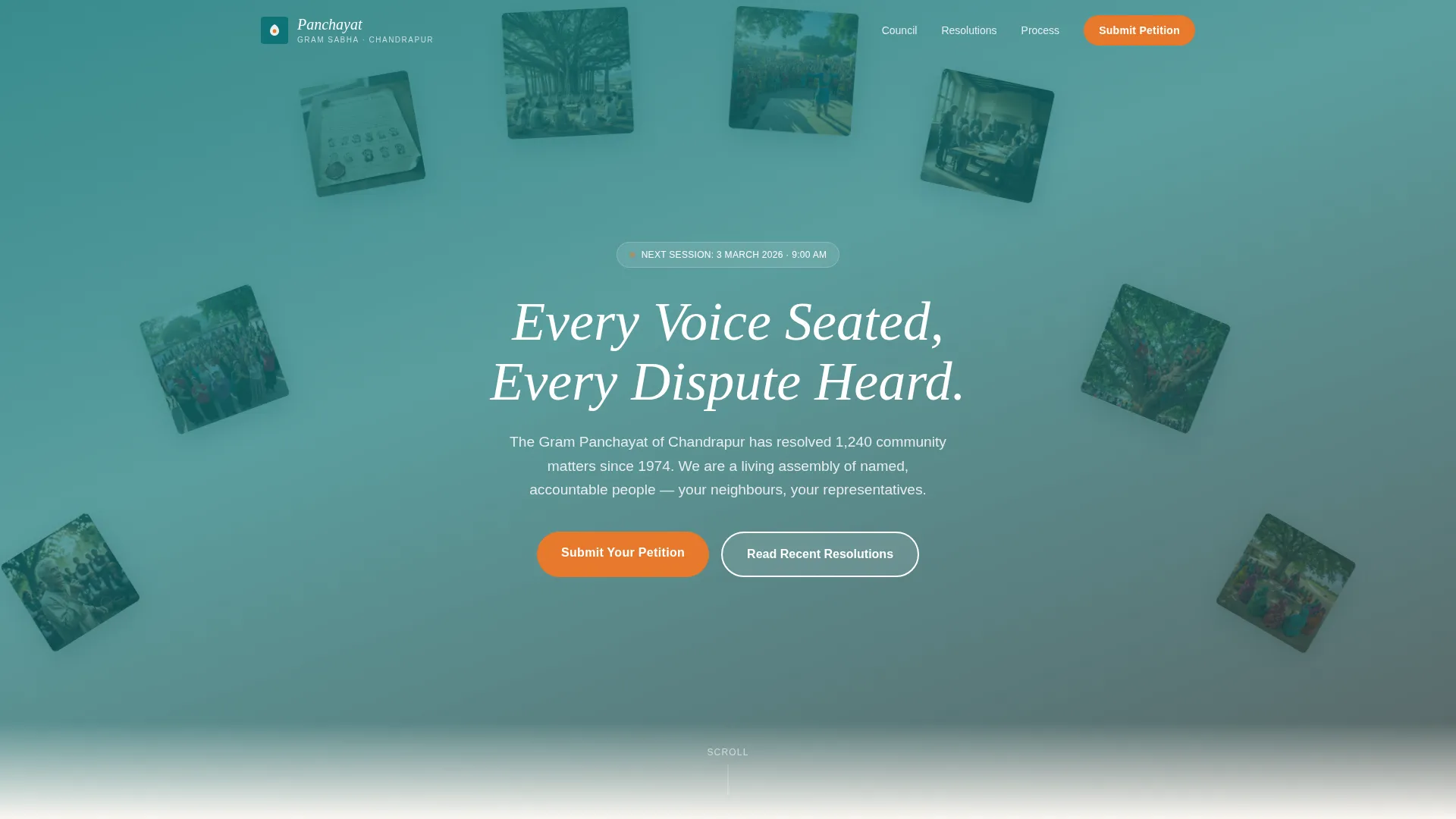
- A Ken Burns photo mosaic header with a translucent teal overlay and constitutional headline
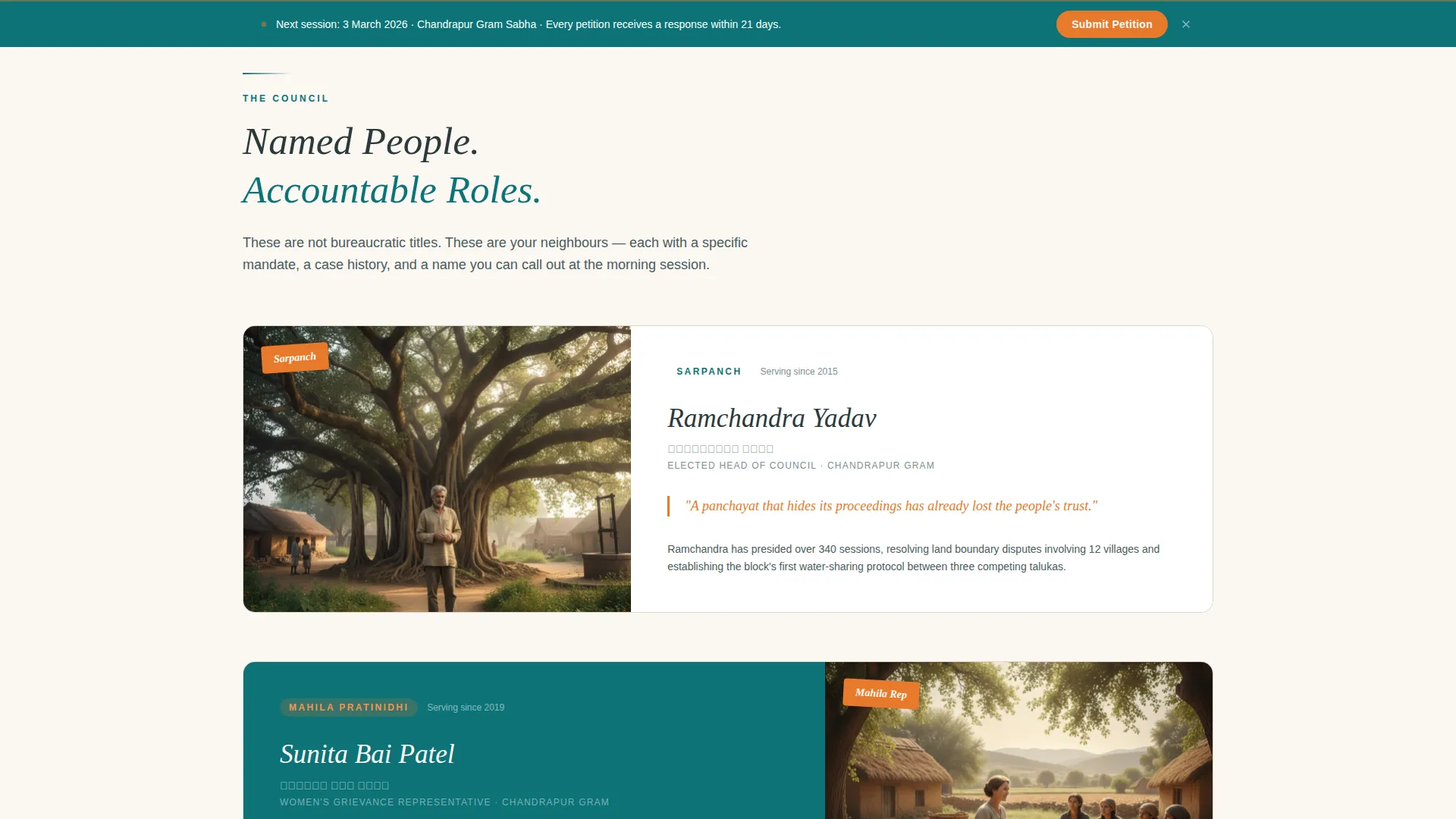
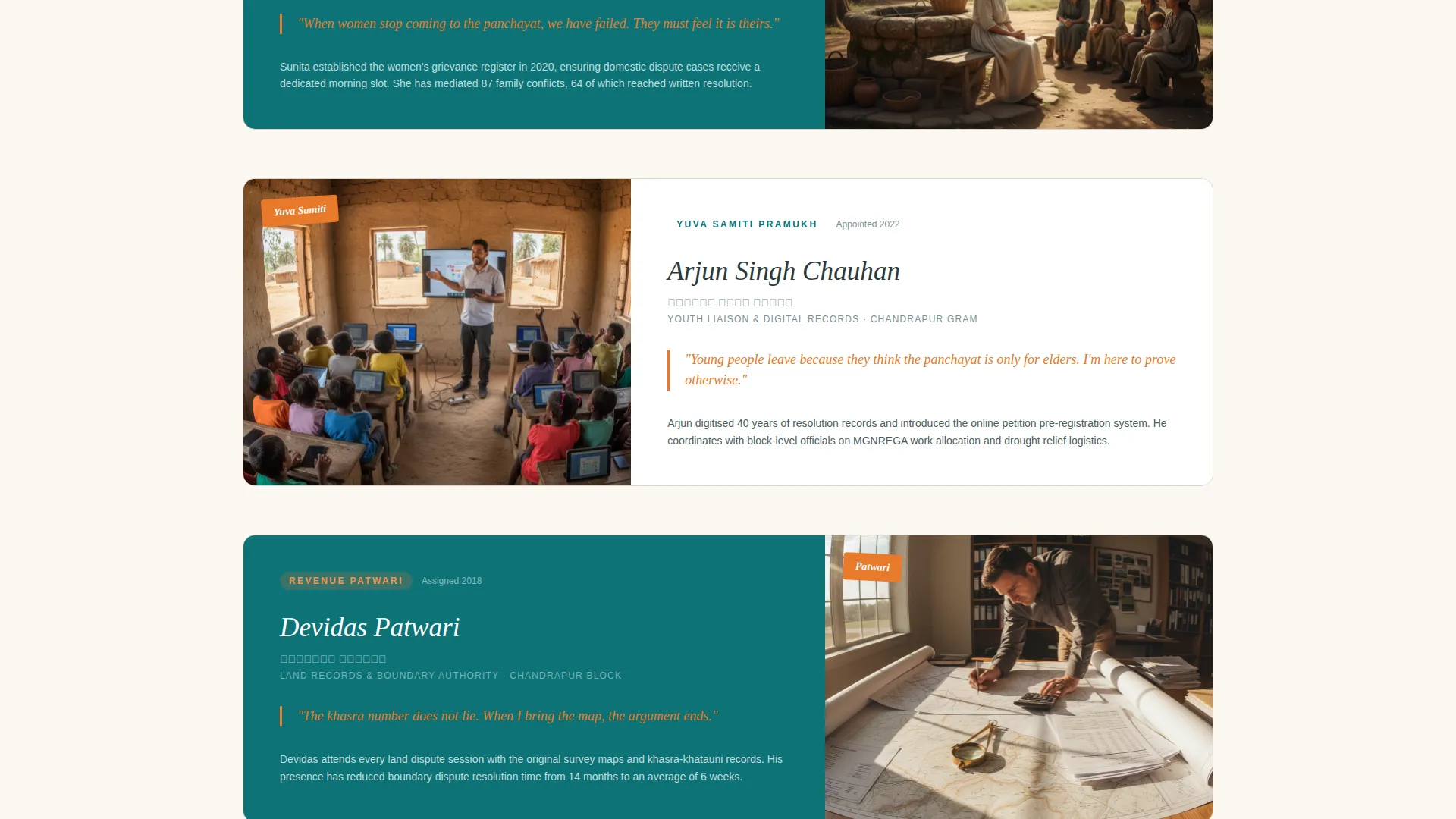
- Environmental portrait profiles for up to four council members with saffron pull quotes beside each
- Editorial resolution cards, named community testimonials, a three-step case process section, and a sticky call-to-action footer bar
Feature list
UGC Photo Wall Header with Ken Burns Animation
The header is a dense, overlapping mosaic of community-submitted photographs. A slow Ken Burns drift reveals new faces continuously, and a translucent teal overlay carries the headline "Every Voice Seated, Every Dispute Heard" in a sturdy serif typeface. The header makes collective participation the visual lead, not a single individual or institutional logo.
Environmental Council Member Profiles
Four profile blocks scroll down the page, each featuring a council member photographed in their working environment, not in a studio. Each profile includes a saffron pull quote styled like editorial marginalia, reinforcing that these are real, named, accountable people. Roles profiled include the Sarpanch, the women's grievance representative, the youth liaison, and the revenue official who manages land records.
Dated Resolution Cards
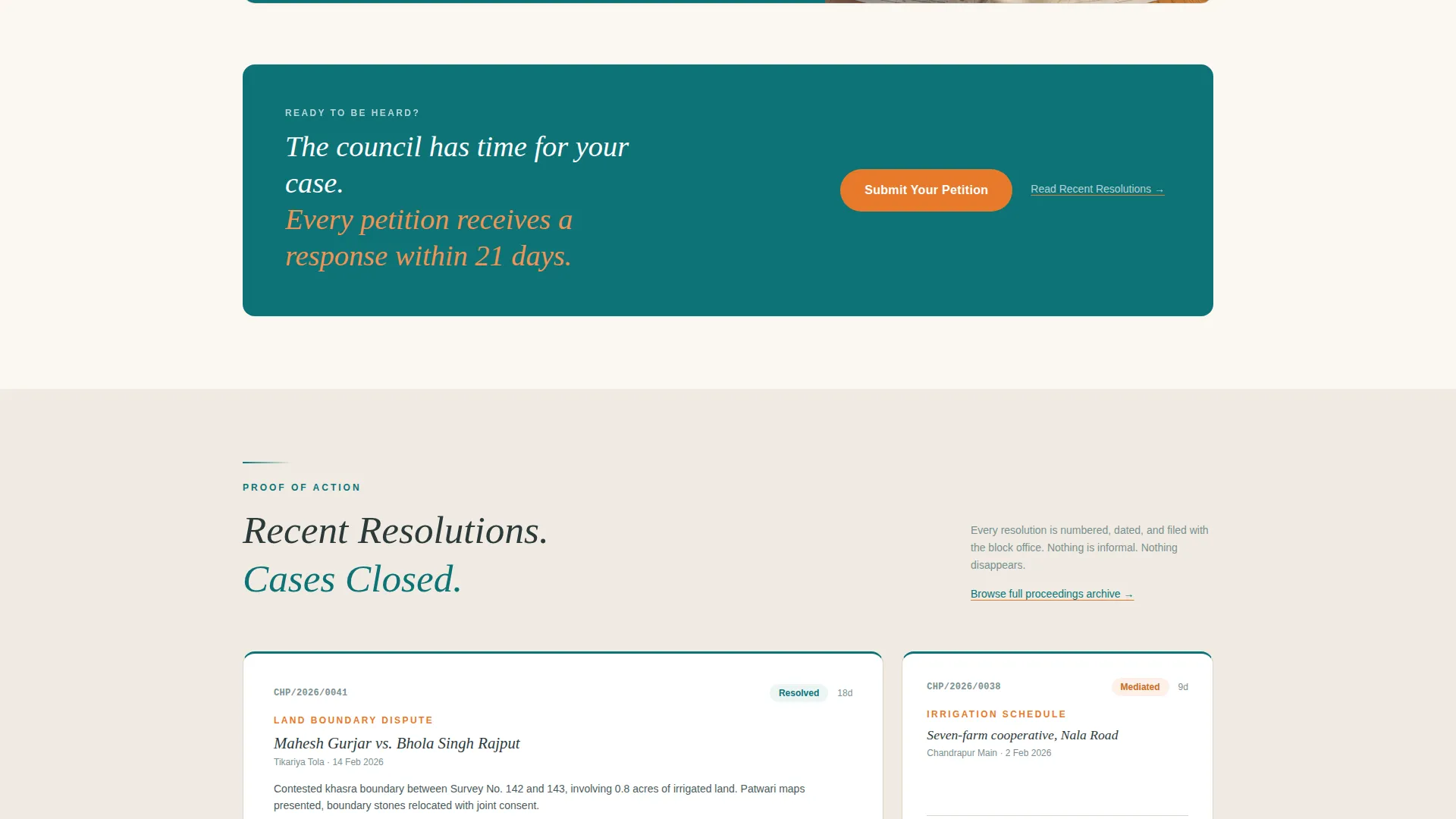
An editorial card section surfaces recent council decisions with dates and documented outcomes. This section functions as visible proof of action, giving first-time visitors the evidence they need before committing to the petition process. Cards are styled consistently with the gazette-on-handmade-paper visual identity.
Named Petitioner Testimonials
A community voices section presents testimonials from people who have brought cases before the council. Each testimonial includes a name and village attribution, grounding the social proof in real, identifiable community members rather than anonymous quotes.
Asymmetric Three-Step Case Process
A visual process section explains how to bring a case in three clear steps. The layout is asymmetric to maintain the editorial feel and avoids the generic numbered-list look of bureaucratic instruction pages. This section makes the process feel approachable before the visitor reaches the petition call to action.
Sticky Call-to-Action Footer Bar
A persistent footer bar carries the primary "Submit Your Petition" call to action in saffron text against a teal background. It remains visible as the visitor scrolls, ensuring the petition portal link is always one tap away without interrupting the editorial reading experience.
Page sections overview
| Section | Purpose |
|---|---|
| Hero Photo Mosaic | Establishes collective identity with a UGC photo wall and constitutional headline |
| Council Roster Profiles | Builds human trust through environmental portraits and pull quotes |
| Recent Resolutions Cards | Proves council action with dated, documented outcomes |
| Community Voices | Reinforces credibility with named petitioner testimonials |
| How to Bring Your Case | Reduces friction with a clear three-step process visual |
| Sticky Footer Bar | Keeps the petition call to action persistent throughout the scroll |
Design & branding system
The visual identity follows a Civic Service editorial direction. Typography pairs Instrument Serif for headlines with DM Sans for body text, producing a government gazette feel on a warm, handmade-paper background.
- Color palette: deep institutional teal (#0D7377) for headers and dividers, khadi white (#FAF7F2) for reading spaces, activated saffron (#E8792B) for calls to action and pull quotes, and governance charcoal (#2C3A3B) for body text and structural lines
- Portrait photography is environmental rather than studio-shot, and all pull quotes appear in saffron beside their subject in a magazine marginalia style
Mobile & speed optimization
The template is built with a mobile-first priority, acknowledging that many village visitors arrive on low-end Android devices with variable connectivity. Layout decisions favor vertical scroll and touch-friendly tap targets throughout.
- Images in the photo mosaic use lazy loading to reduce initial data load on slower connections
- Static content sections use Server Components to keep the page lightweight and fast to render on first arrival
How this template helps you convert
The click-through structure is designed to earn trust incrementally before asking for any commitment. Visitors never encounter a form on this page; the ask comes only after the council's people and record have made the case.
- The photo mosaic and profile roster establish a named, human assembly first, so visitors feel they are approaching real people rather than an institution
- The resolution cards and testimonials provide documented proof of outcomes mid-scroll, giving hesitant visitors the evidence they need before the primary call to action appears
- The sticky footer bar and the mid-scroll "Read Recent Resolutions" editorial anchor keep the path to the petition portal visible without creating pressure, matching the pacing of a council morning where trust builds before action is taken
Other information about this template
This template is categorized under Community and Nonprofit, with a specific focus on Indian community organizations and the khap panchayat and community council niche. It supports Hindi and English bilingual naming conventions and is designed with Indian village and state context in mind, including Indian name formats and rupee-denominated references where relevant.
- The template style is Editorial and Magazine, and the theme is Civic Service with a Teal Catalyst color system
- Animation complexity is set at a medium level: GSAP-powered scroll reveals and stagger entrances are included alongside the Ken Burns photo mosaic drift
- Hover states are applied to portrait cards and resolution cards, and the sticky call-to-action bar remains active across all scroll positions
- The footer follows a linear single-row pattern keeping the bottom of the page clean and uncluttered
Theme
Civic Service
Creative direction
Team & People
Color system
Teal Catalyst
Style
Editorial/Magazine
Direction
Click-Through
Page Sections
UGC Photo Wall with Ken Burns Drift
Environmental Council Member Portraits
Dated Resolution Evidence Cards
Named Community Testimonials
Asymmetric Three-step Process Section
Persistent Sticky Call-to-action Bar
Related questions
Does this template include a petition form on the page?
How many council member profiles does the template support?
What kind of photography works best for the header mosaic?
Can the template support bilingual Hindi and English content?
Is the sticky call-to-action bar visible on mobile devices throughout the scroll?