Community Reentry Fundraising Event Landing Page Template
The Pardon community reentry fundraising event landing page template is a single-column flow landing page built for prison reform nonprofits. It channels neighborhood generosity into reentry programs, bail funds, and family visitation grants. With a nature-inspired Forest Trust color system, mosaic hero, scroll-linked storytelling, and a focused event registration form, it turns visitors into active community participants.
by Rocket studio
Quick summary
This is a purpose-built nonprofit landing page for community reentry fundraising. It guides visitors through a single-column scroll that moves from city-wide impact numbers to one person's letter written from inside. The page ends with a clear event registration form and a secondary donate path. Every design choice serves one mission: making second chances feel local, personal, and worth showing up for.
Who this template is for
This landing page is built for organizers, advocates, and neighbors who believe reentry is a community responsibility. It fits any nonprofit, community group, or civic team running a fundraising campaign around prison reform, bail funds, or reentry support.
- Church deacons and community organizers planning benefit dinners or neighborhood fundraising events
- Public defenders and legal aid teams sharing campaign links with client families
- Local business owners and volunteers ready to get involved in reentry support programs
What problem this template solves
Most charity landing pages struggle to make the cause feel real and close to home. Visitors arrive, skim broad statistics, and leave without acting. This template solves that by narrowing the story with every scroll, moving from the city to the neighborhood to a single family to one person's letter.
- Visitors leave donation pages without connecting emotionally to the cause
- Generic nonprofit landing pages fail to communicate urgency or local relevance
- Busy organizers need a focused event page that drives registration, not distraction
What you get with this template
You get a complete, ready-to-customize single-column landing page designed to convert visitors into registered event attendees and donors. Every section is structured to build trust and encourage action before asking visitors to fill out the form.
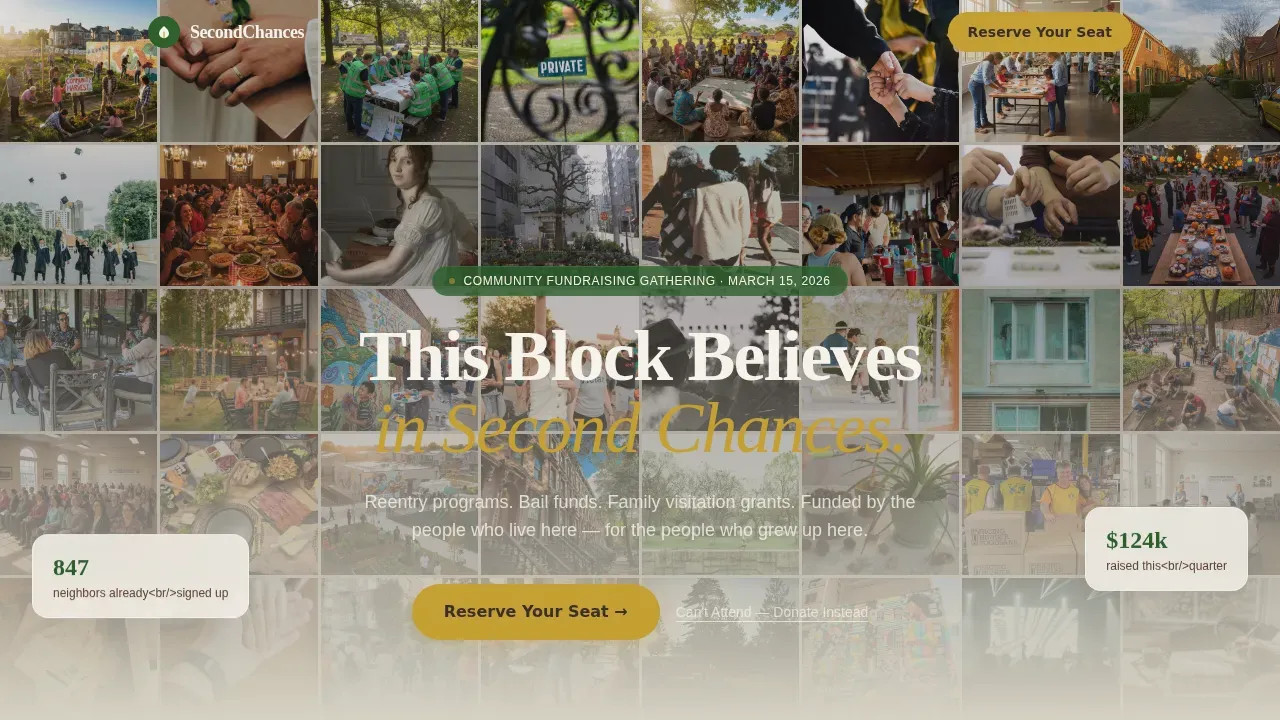
- A Community Mosaic hero with a tiled photo collage and fade-in headline
- A scroll-linked storytelling flow with city metrics, neighborhood narrative, a personal letter section, and community testimonials
- An event registration form with guest count, neighborhood or zip code field, and an "I can bring" dropdown for food, supplies, or volunteer hours
Feature list
This landing page packs purpose-built tools into a clean, single-column structure. Each feature is grounded in what the template actually delivers.
Community Mosaic Hero Section
The hero tiles dozens of real neighborhood images into a composite that resolves into a local map outline at full width. A headline fades in over the mosaic: "This Block Believes in Second Chances." Floating glass stat cards present city-wide impact metrics above the fold, giving visitors an immediate picture of the campaign's reach.
Scroll-Linked Impact Zoom
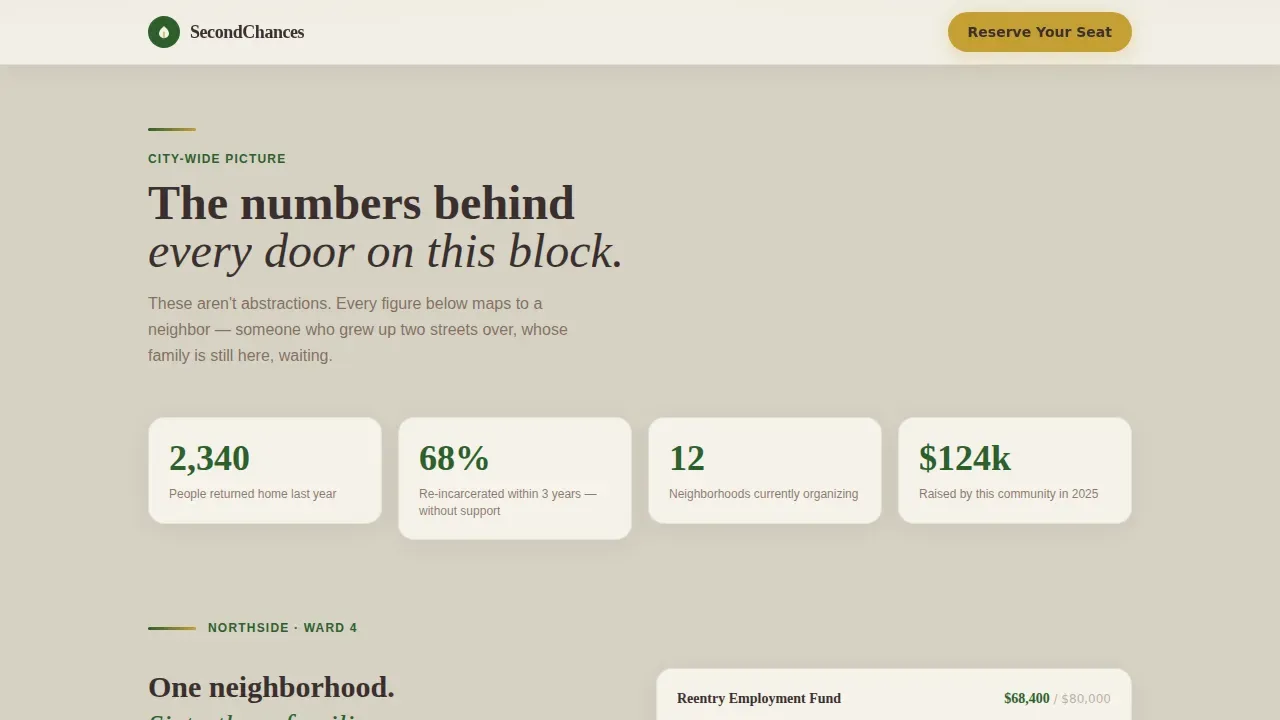
Each section narrows geographic and emotional focus as the user scrolls. The flow moves from city-wide donations data to a specific neighborhood story, then to a single family, and finally to one person's handwritten letter. This structure evokes strong emotions and makes the mission impossible to abstract away.
Personal Letter Story Section
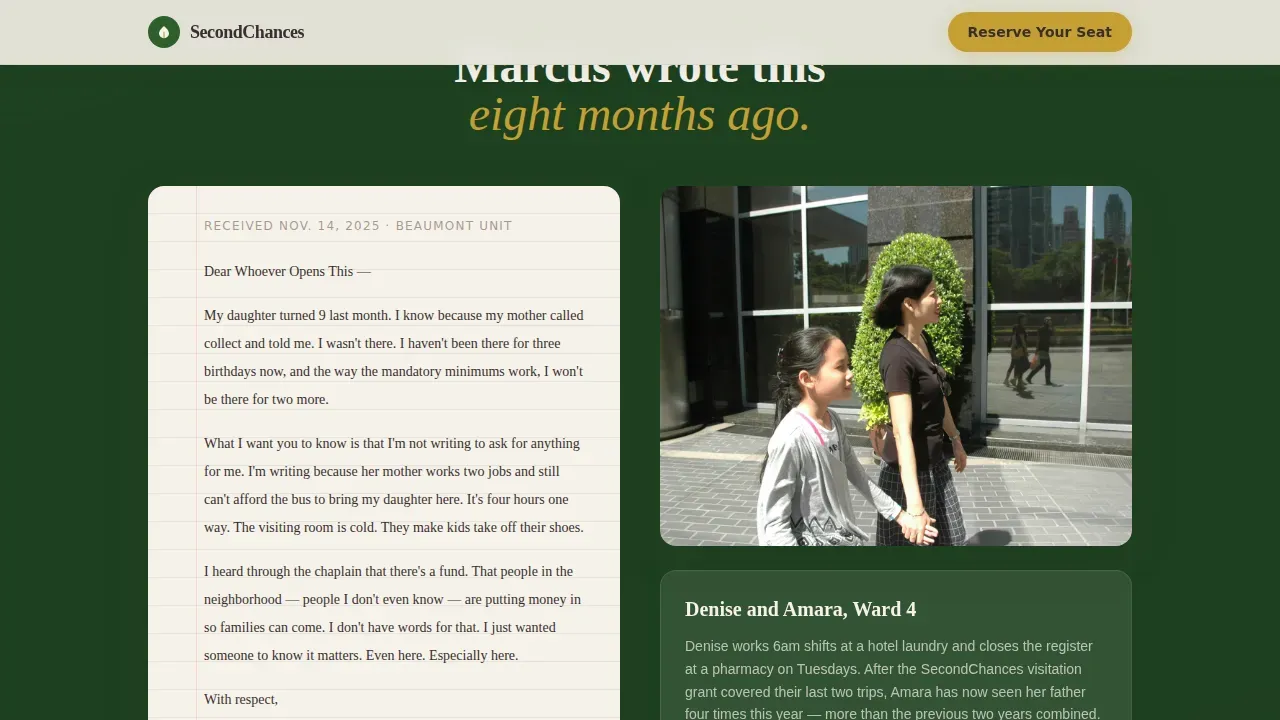
A dedicated section presents one incarcerated person's story using a handwritten letter aesthetic. This element draws on the principle that compelling narratives of success create a deeper emotional connection than broad metrics alone. It is the emotional heart of the page.
Community Voices Testimonials Block
Three named social proof testimonials appear from a deacon, a public defender, and a local business owner. Sharing testimonials from recognizable community roles builds credibility and helps potential donors see themselves reflected in the cause. This section uses role descriptions and neighborhood context to highlight authentic voices.
Event Registration Form with Fallback
The primary form collects name, neighborhood or zip code, guest count, and an optional "I can bring" dropdown. A secondary text link beneath the main button reads "Can't Attend, Donate Instead," keeping donation landing paths open without cluttering the form. Streamlined donation forms like this consistently reduce drop-off and encourage more completed registrations.
Per-Program Progress Indicators
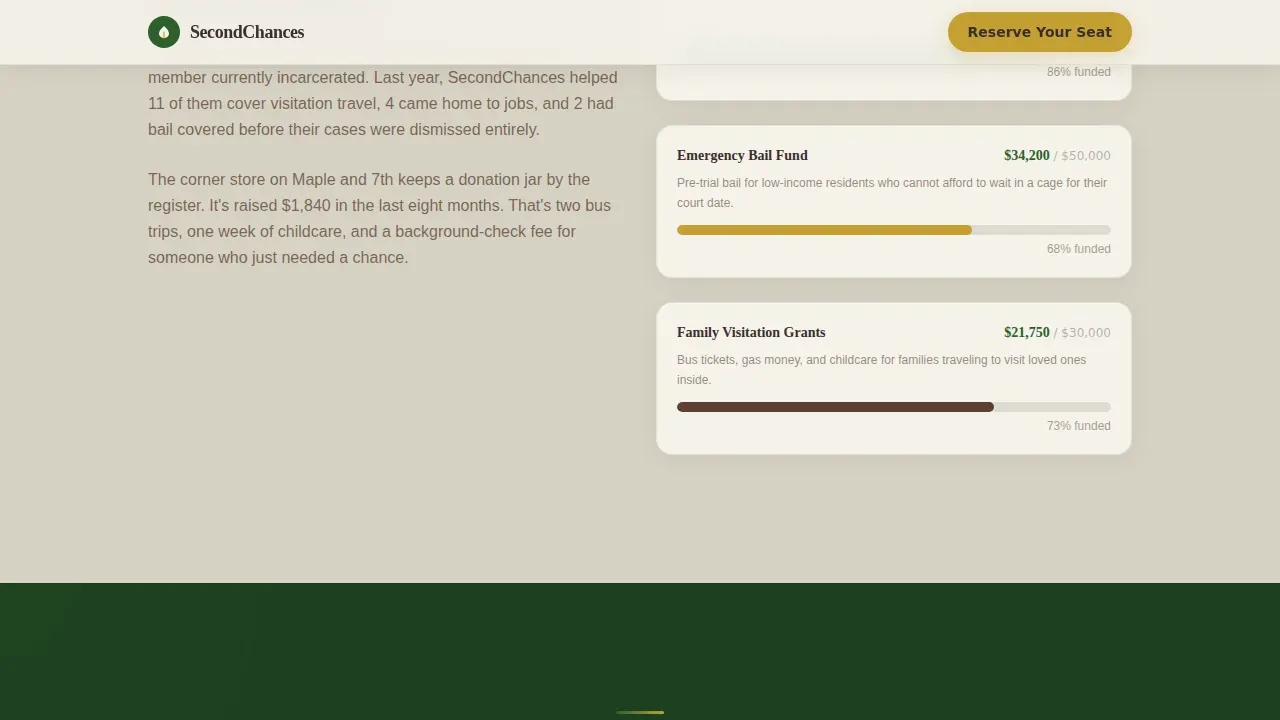
Canopy green progress bars track fundraising goals and donation goals for each program area, including reentry services, bail funds, and family visitation grants. These visual metrics let donors see exactly where money is going and how close each campaign is to its target.
Page sections overview
| Section | Purpose |
|---|---|
| Hero Mosaic | Opens with community images, headline fade-in, and floating stat cards |
| Impact Zoom | Moves from city-wide numbers to a specific neighborhood story |
| The Letter | Presents one person's handwritten letter for maximum emotional intimacy |
| Community Voices | Displays three social proof testimonials from trusted community roles |
| Event Registration | Hosts the primary registration form and secondary donate link |
| Footer | Linear single-row footer with organization links and contact info |
Design & branding system
The visual identity follows a Nature-Inspired theme built on the Forest Trust color system. The palette feels like bark peeling back to reveal living wood: grounded, patient, and quietly persistent. Fraunces serif headlines pair with DM Sans body text for warmth and readability. New-growth gold buttons draw the eye to every action point, consistent with best practices for contrasting call-to-action elements.
- Forest Trust colors: deep root brown (#3B2F2F) for body text, canopy green (#2D5F2D) for section transitions and progress bars, morning fog gray (#D6D2C4) for backgrounds, and new-growth gold (#C4A035) for buttons and donation indicators
- Fraunces serif headlines communicate warmth and community; DM Sans body text keeps descriptions readable and clear
- Images and videos support the overall story at every scroll depth, with parallax motion on the hero mosaic and staggered scroll-linked reveals throughout
Mobile & speed optimization
Over 60% of online searches happen on mobile devices, and this template is built mobile-first. The page is designed so that visitors arriving from a text message link, a church bulletin share, or a social media post land on a fully responsive, fast-loading experience. A mobile-friendly layout ensures the registration form and donation forms are easy to access and fill out on any screen size.
- The mobile layout stacks all single-column sections cleanly, keeping the form visible and easy to complete without zooming or horizontal scrolling
- 70% of internet users are likely to return to a page optimized for mobile; 60% will not recommend a site with a poor mobile experience
- Fast-loading static sections use server-rendered components, while the form and animations run as client components to keep the page responsive and smooth
How this template helps you convert
A landing page works best when it removes every reason to leave before the visitor acts. This template is designed with that principle at its core. Distractions are minimized: there are no standard navigation menus or external links pulling visitors away from the primary event registration goal.
- The page opens with a bold, emotive headline and a prominent call-to-action button above the fold, capturing attention before visitors scroll. A fundraising thermometer shows real-time progress toward donation goals, encouraging visitors to contribute before the event fills up.
- Social proof testimonials and per-program metrics build trust at the exact moment visitors consider whether to sign up. Including a "Can't Attend, Donate Instead" fallback means the page can convert visitors who cannot attend in person into donors, broadening the campaign's reach without adding a second page.
- The registration form is intentionally short. Reducing form fields is one of the most effective practices for increasing completion rates. Visitors can fill out the form in under a minute, and the optional "I can bring" dropdown invites volunteers and neighbors to contribute beyond money.
Other information about this template
This template is part of a growing library of nonprofit landing pages built for civic and community-focused campaigns. It is a standalone webpage, separate from any main website, designed with a single focused objective: converting visitors into registered attendees and active donors. No-code tools make it straightforward to customize the page without technical knowledge, so your team can promote the event quickly and update content in real time.
- The template can be shared as a direct link across social media platforms including Facebook, text messages, and email, driving traffic from multiple channels to one focused campaign page
- Funds raised through the campaign can be allocated toward transitional housing, job training, legal aid, bail funds, and family visitation grants, giving donors a concrete description of where their money goes
- Supporting reentry programs reduces recidivism and strengthens the whole community; this template is built to communicate that idea clearly and move more people to act
- No credit card required to access the template and begin customization; your team can create a working event page and share it the same day
Theme
Nature-Inspired
Creative direction
Local & Neighborhood
Color system
Forest Trust
Style
Single Column Flow
Direction
Event Registration
Page Sections
Community Mosaic Hero with Stat Cards
Scroll-linked Impact Storytelling Flow
Personal Letter Story Section
Social Proof Testimonials Block
Event Registration Form with Donate Fallback
Per-program Progress Indicators
Related questions
Who is this landing page template designed for?
Can I use this page to collect donations if someone cannot attend the event?
How does the storytelling structure help my fundraising campaign?
Is this template mobile friendly for visitors sharing it by text or social media?
What sections are included in this landing page template?