Prison Reform Grassroots Organization Landing Page
Parole is a masonry-layout landing page built for grassroots prison reform organizations. It pairs a full-viewport serif manifesto header with a scroll-driven timeline grid that moves from archival beginnings to live legislative impact. Two clear calls to action guide visitors toward the Model Bill and organizer visit requests, earning each click through accumulated evidence before asking for it.
by Rocket studio
Quick summary
Parole is a single-page, masonry-layout template designed for grassroots criminal justice reform collectives. The page opens with a raw, full-viewport quote from a founding organizer, then unfolds a visual timeline from petition signatures to legislative testimony. Every design decision, typography, color, tile pacing, serves one goal: making a visitor feel the weight of the work before they decide to join it.
Who this template is for
This template is built for organizations doing on-the-ground sentencing reform work. It speaks directly to the people already in the room: the ones drafting bills, running re-entry programs, or sitting across from families who need answers.
- Public defenders, re-entry program coordinators, and families of incarcerated people who need a page that meets them with honesty and urgency
- Church coalition leaders and policy advocates looking to bring organizers to their statehouses
- Grassroots nonprofit teams who want a page that builds trust through evidence, not promises
What problem this template solves
Most nonprofit landing pages fail the people they most need to reach. They lead with donation asks before earning attention, or they present polished graphics that feel distant from lived experience. Visitors who arrive already exhausted, carrying caseloads, long drives, and years of waiting, need something different.
- A page that feels like a letter rather than a brochure, so visitors stay long enough to engage
- A visual structure that builds a credible, chronological story instead of scattering disconnected impact claims
- Clear action paths for different visitor types, so a coalition leader and a public defender both find their next step
What you get with this template
You get a fully structured, single-page layout with five distinct sections, each carrying a specific role in moving visitors from witness to participant. The design is production-ready with a defined color system, two-typeface pairing, and scroll-triggered animation logic already scoped out.
- A full-viewport manifesto header, masonry timeline grid, persistent call-to-action band, coalition action section, and impact data strip
- Deep evergreen, worn parchment, iron gate charcoal, and hopeful amber applied consistently across every section
- Fraunces serif headlines paired with DM Sans body text for an archival, civic weight that still reads cleanly on screen
Feature list
Full-Viewport Manifesto Header
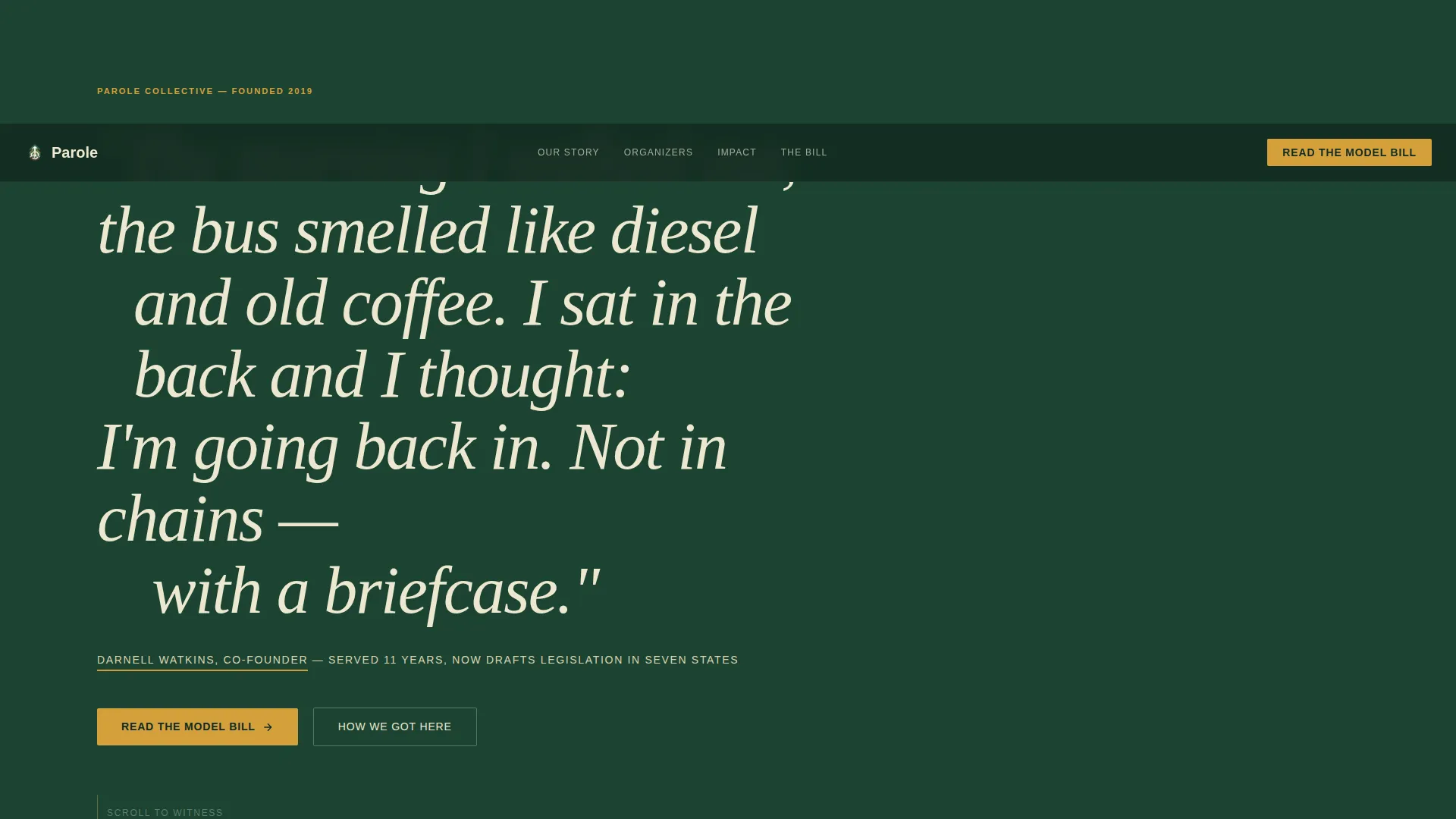
The header fills the entire screen with a single founding-member quote set in large Fraunces serif type against deep evergreen. Left-aligned text with heavy margins recreates the feeling of a handwritten letter. A thin amber underline beneath the attribution is the only decoration. The primary "Read the Model Bill" call to action appears here first, in amber, before any other content competes for attention.
Scroll-Driven Masonry Timeline Grid
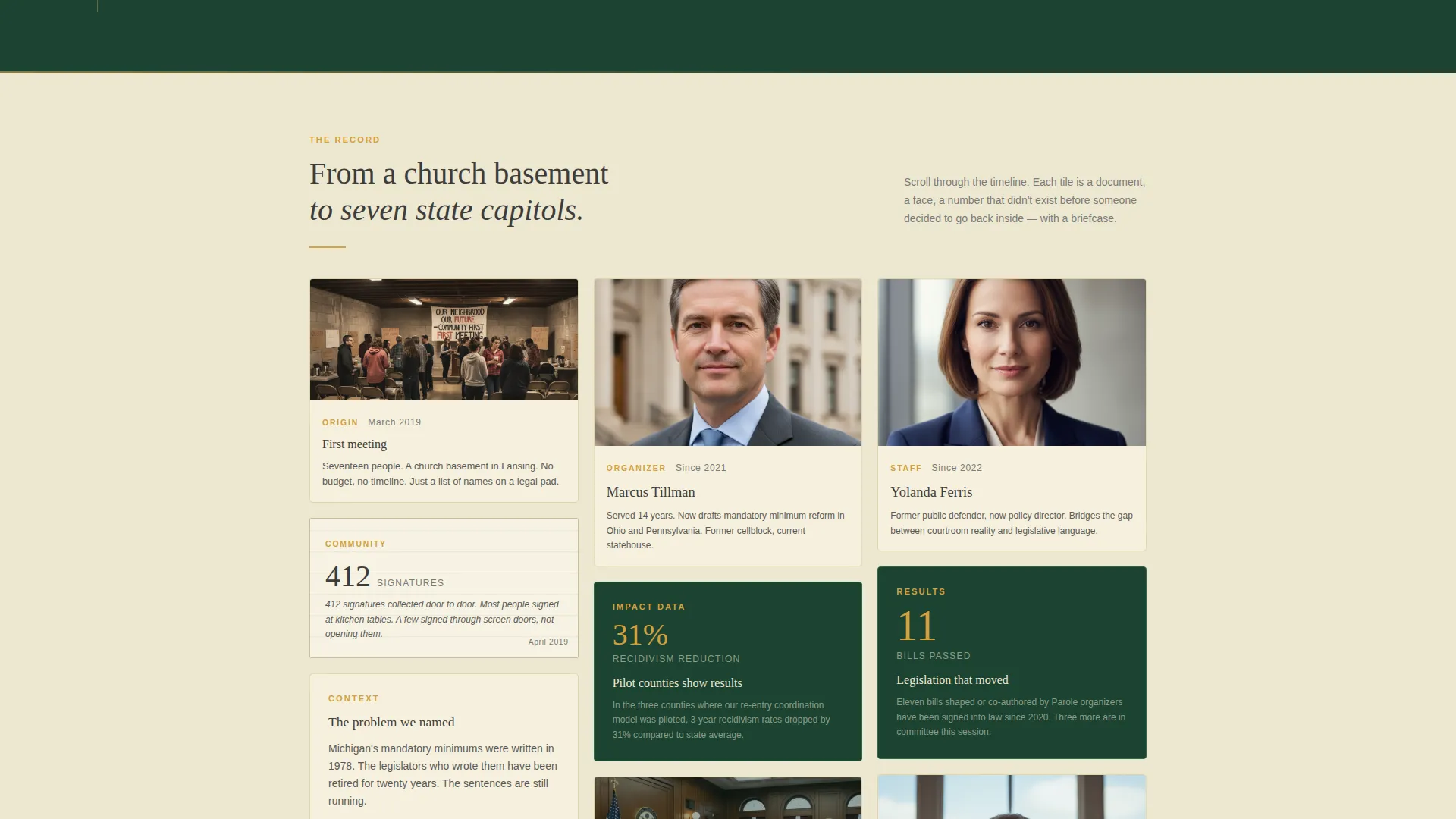
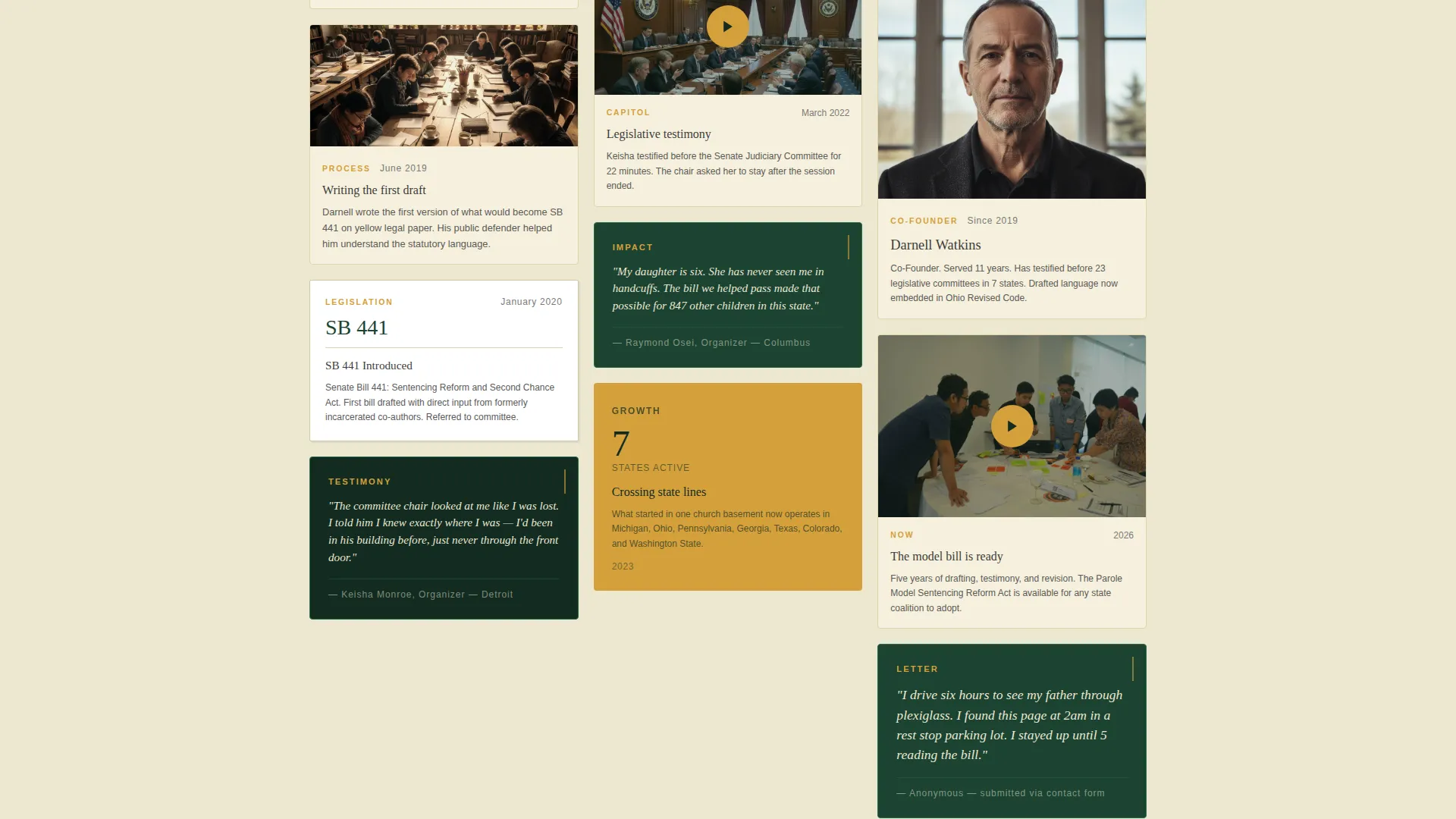
The masonry grid is organized as a chronological narrative, not a random content feed. Early tiles are small and dense, showing archival material: scanned petition signatures, grainy community meeting photos, and screenshots of the first bill introduced. As the visitor scrolls, tiles grow larger and more vivid, surfacing legislative testimony video, full-color organizer portraits, and recidivism data cards. The grid physically widens as the story moves from struggle to traction.
Persistent Call-to-Action Band
After the third row of masonry tiles, an amber band reintroduces the "Read the Model Bill" button. The button remains visible as visitors continue scrolling, so the primary action is never more than a glance away. This placement is deliberate: by that point in the page, the visitor has already moved through enough evidence that clicking feels earned rather than pressured.
Coalition Action Section
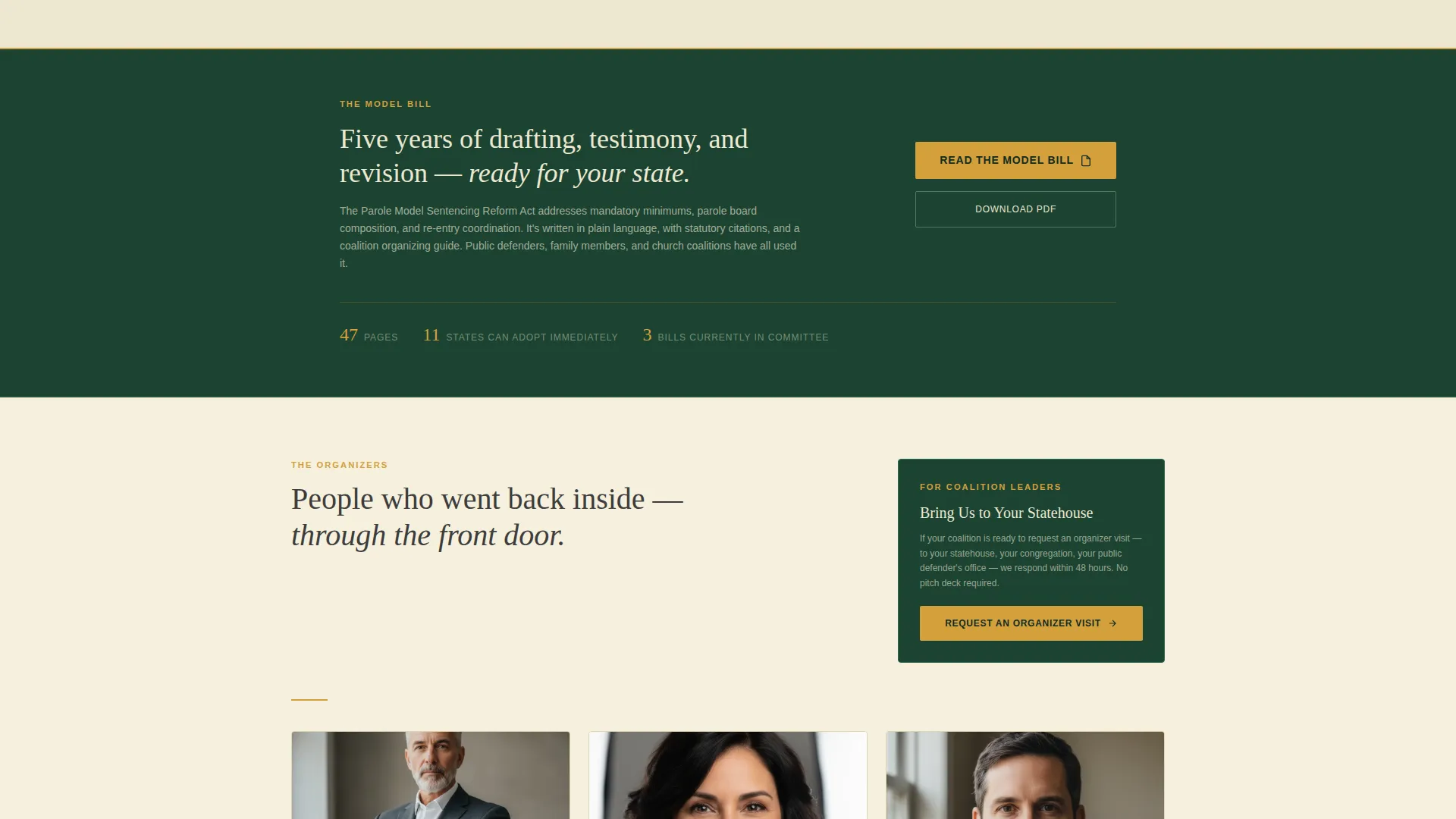
A dedicated section targets coalition leaders with the secondary path: "Bring Us to Your Statehouse." Organizer portraits anchor this section, connecting the request to specific, named people rather than an abstract organization. This section converts engaged visitors into active campaign partners, not just supporters.
Impact Data Strip
A focused strip presents recidivism reduction statistics and a count of bills introduced in pilot counties. Counter animations bring the numbers to life on scroll. The data is positioned near the bottom of the page, where visitors who have read through the full story are most ready to act on it.
Page sections overview
| Section | Purpose |
|---|---|
| Manifesto Hero Header | Opens with a founding quote and the primary call to action |
| Masonry Timeline Grid | Builds a chronological story from archival content to live impact |
| Persistent call to action Band | Keeps "Read the Model Bill" visible after the third tile row |
| Coalition Action Section | Targets coalition leaders with the organizer visit request path |
| Impact Data Strip | Presents recidivism stats and bill counts with counter animations |
| Linear Single-Row Footer | Closes the page with organizational anchoring information |
Design & branding system
The Forest Trust color system gives this template its particular civic weight. Evergreen anchors the header and footer with institutional authority. Parchment breathes across the content grid, making it feel like archival paper rather than a screen. Charcoal carries all body text for legibility without coldness. Amber appears sparingly, reserved for calls to action and pull quotes, so every time it appears it reads like a door opening rather than a decoration.
- Fraunces (serif) for headlines: unhurried, weighty, historically resonant; DM Sans for body: clean and readable across tile sizes
- Scroll-triggered masonry reveals, staggered tile entries, hover states on tiles, and amber flash moments create a medium-animation experience that feels alive without distracting
- The Civic Service visual theme connects courthouse gravity with old-growth patience, a combination that signals permanence rather than trend
Mobile & speed optimization
The template is designed desktop-first, which reflects where the primary audience, public defenders, coalition staff, and policy advocates, typically works. Full mobile support is built into the layout so families and re-entry participants who arrive on phones encounter the same narrative momentum.
- Server Components handle all static content sections, keeping the initial load clean and fast
- Client-side components are scoped to scroll animations and interactive elements only, so heavier interactivity does not block the core content
- The masonry grid reflows gracefully at smaller viewports, preserving the timeline narrative even when tile sizes shift
How this template helps you convert
This template treats conversion as something that must be earned. Visitors are made witnesses before they are asked to act, and by the time a call to action is unavoidable, they have already moved through a complete story.
- The amber "Read the Model Bill" link appears in the manifesto header before any scroll, capturing visitors who arrive ready to engage immediately, then the persistent call to action band catches those who needed the full story first.
- The masonry timeline builds progressive trust by moving from low-stakes archival content to high-credibility legislative testimony and data, so every scroll deepens commitment rather than demanding it.
- The coalition action section separates two distinct visitor journeys, bill readers and organizer requesters, giving each audience a specific next step that matches their level of readiness.
Other information about this template
Parole is categorized under Community and Nonprofit, with a specific focus on prison reform nonprofit work and grassroots criminal justice advocacy. The Click-Through landing page direction means the page's entire job is to earn a deliberate click to a deeper campaign hub, not to serve as a standalone information resource. The Origin Story creative direction and Quote/Manifesto header concept are both intentional structural choices, not decorative ones. They exist because the audience for this page carries real skepticism built from years of broken institutional promises, and a timeline narrative is one of the few formats that can move that audience.
- This template is suitable for organizations running sentencing reform campaigns, re-entry advocacy initiatives, or coalition-building efforts across state legislatures
- The masonry layout supports a wide range of tile content types: photos, video embeds, data cards, petition screenshots, and testimony fragments
- The social proof layer, organizer portraits, petition signature counts, bill screenshots, and recidivism data, is built into the section structure rather than added as an afterthought
Theme
Civic Service
Creative direction
Origin Story
Color system
Forest Trust
Style
Masonry/Pinterest
Direction
Click-Through
Page Sections
Full-viewport Manifesto Header
Scroll-driven Masonry Timeline Grid
Persistent Call-to-action Band
Coalition Action Section
Impact Data Strip with Counter Animations
Related questions
Who is the primary audience for this landing page template?
What types of content can the masonry timeline grid hold?
What are the two calls to action built into this page?
Is this template suitable for visitors on mobile devices?
Does the page include built-in social proof?