Home Health & Hospice Booking Website Template
Passage is a hub and spoke landing page template built for hospice care providers. It leads with three human-scale trust metrics, guides crisis-state visitors through an honest problem-to-solution arc, and closes with a minimal three-step booking form. The warm Healing Space design and anchor navigation make it easy for overwhelmed families to reach out fast.
by Rocket studio
Quick summary
Passage is a single-page hospice care landing page template designed to meet families at their most frightening moment. It opens with quiet, data-backed credibility, names the visitor's fear directly, walks through what real care looks like, and then offers the smallest possible next step: a conversation, not a commitment.
Who this template is for
This template is built for hospice and palliative care providers who need to reach families during a crisis window. It suits organizations that prioritize warmth, clarity, and after-hours responsiveness over clinical brochure language.
- Adult children of terminal patients and grieving spouses who need immediate guidance
- Hospital discharge planners looking for a provider they can trust to answer at any hour
- Hospice care teams that want their landing page to reflect the quality of their in-person care
What problem this template solves
Families searching for hospice care are not browsing. They are standing in a hospital parking lot, reading a discharge sheet, or sitting in the dark at 2 a.m. Most hospice landing pages serve the organization, not the visitor. They list certifications, show stock photography, and bury the phone number.
- Families feel confused by medical jargon and overwhelmed by long intake forms
- Visitors who arrive in crisis abandon pages that ask too much or feel too cold
- Providers lose trust before a single call is made because the page does not reflect their actual compassion
What you get with this template
You get a complete, conversion-focused hospice landing page built around a structured hub and spoke layout with sticky anchor navigation. Every section serves a specific purpose in the visitor's emotional journey, from first fear to first contact.
- A hero section with three display-scale trust metrics and a single anchoring tagline
- A four-spoke content arc covering the problem, the first 24 hours of care, ongoing support, and family testimonials
- A three-step scheduling form and a direct phone call-to-action styled for urgency
Feature list
This template is built from specific design and interaction decisions documented in the source brief. Each feature below reflects what is directly included.
Trust Metrics Hero
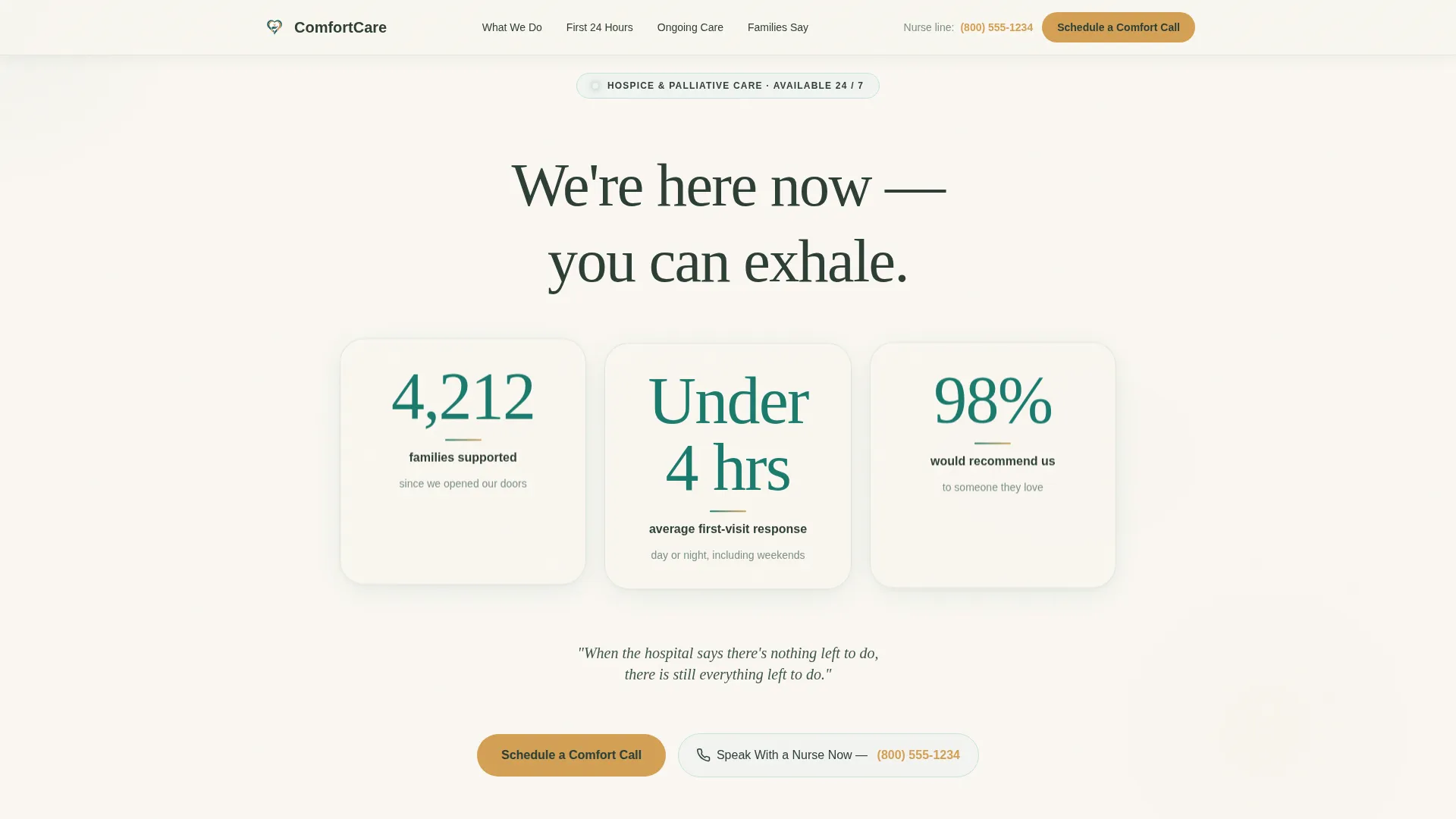
The hero section displays three large numerals in warm serif type: families supported, average first-visit response time, and recommendation rate. No stock photography. No stethoscopes. Just the evidence, set against linen white, letting the visitor's own situation fill the emotional space.
Sticky Anchor Navigation
A persistent navigation bar follows the visitor through every spoke of the page. The primary call-to-action button, "Schedule a Comfort Call," stays visible at all times. Visitors never have to scroll back to act.
Problem and Solution Arc
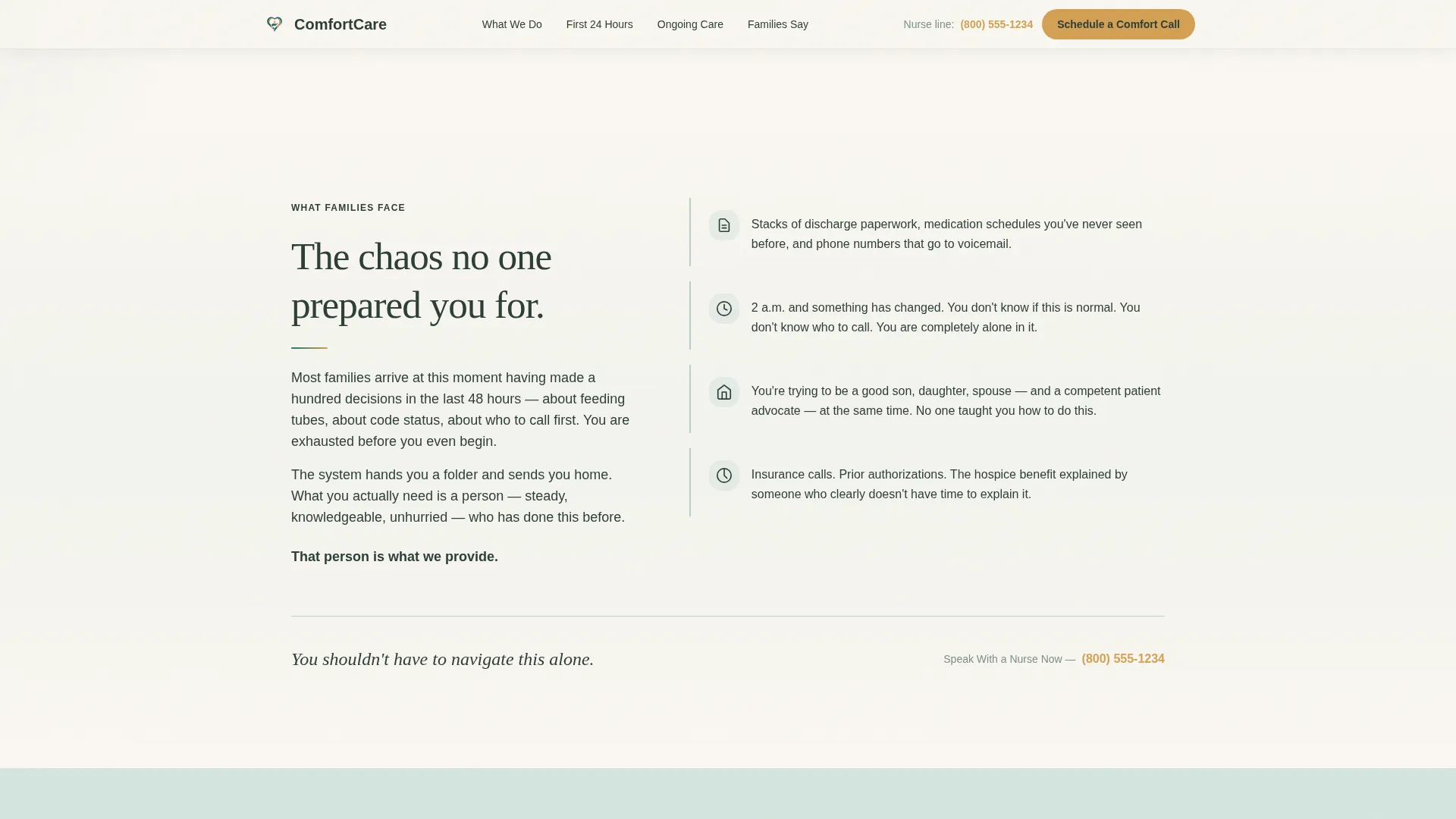
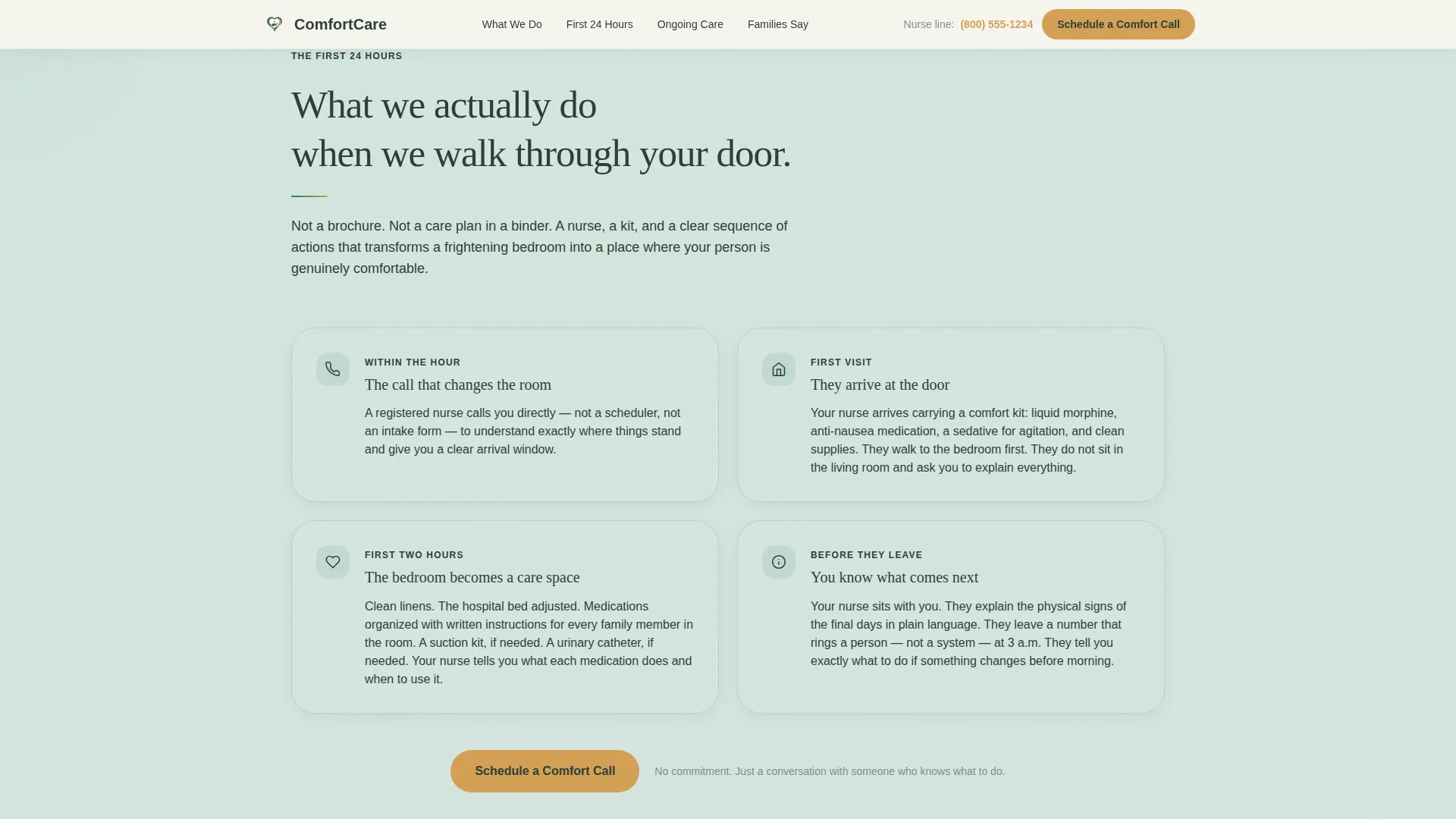
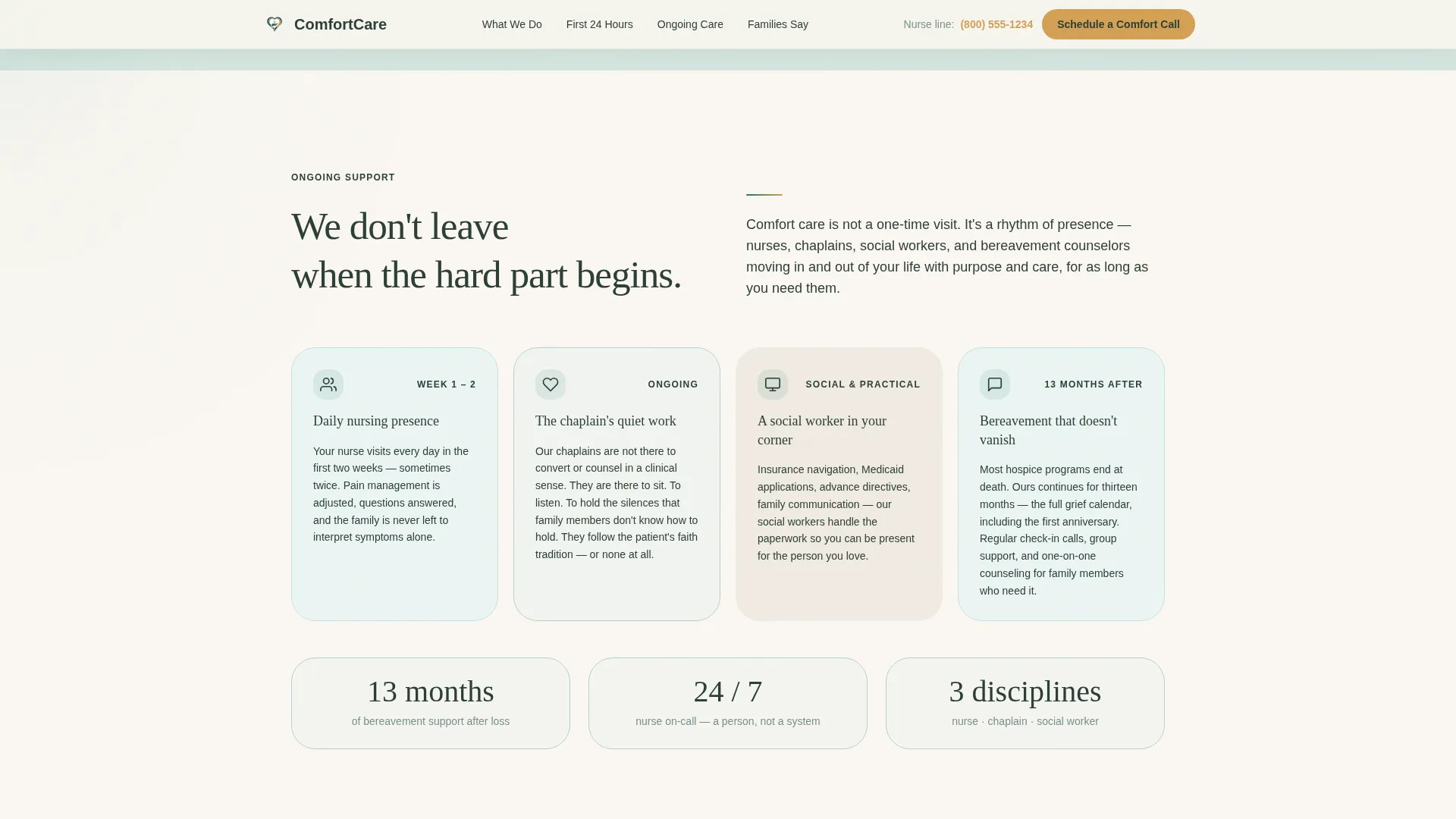
Four sequential content spokes guide the visitor from fear toward trust. The first names the chaos families feel. The second describes the care team's physical arrival in the first 24 hours. The third covers the ongoing rhythm of visits, chaplain presence, and bereavement support. The fourth presents testimonial pull quotes on sage cards.
Three-Step Booking Form
The scheduling form asks only what is necessary. Step one is the patient's current situation via a dropdown. Step two is a preferred callback window. Step three collects a name and phone number. Nothing else. The low barrier is intentional.
Direct Phone Call-to-Action
A secondary contact path is styled as a large, amber-tinted phone number with the label "Speak With a Nurse Now." It is designed for visitors who are too overwhelmed or too urgent to complete a form.
Testimonial Pull Quotes
Family voice cards are presented in a handwritten-style format on sage-toned backgrounds. Each quote is attributed with a first name and the person's relationship to the patient, such as "Margaret, daughter," making them feel personal rather than promotional.
Page sections overview
| Section | Purpose |
|---|---|
| Hero metrics display | Builds immediate trust with three human-scale statistics and a grounding tagline |
| The problem spoke | Names the visitor's fear directly, covering medication confusion, insurance stress, and overnight isolation |
| First 24 hours spoke | Describes the care team's physical arrival, what they carry, and what they set up |
| Ongoing support spoke | Covers visit rhythm, chaplain role, and thirteen months of bereavement continuity |
| Family voices spoke | Presents attributed pull quotes on sage cards for peer-level reassurance |
| Booking form section | Offers a three-step, low-friction scheduling path with a direct phone alternative |
| Single-row footer | Provides essential contact and organizational information in a clean, minimal layout |
Design & branding system
The Healing Space visual theme removes every element that feels clinical or institutional. The color system, typography choices, and layout decisions all work together to create a page that feels like a private, quiet room rather than a healthcare form.
- Deep therapeutic teal (#1A7A6D) anchors the primary interface and navigation; soft sage (#D5E5DF) washes section backgrounds; warm linen white (#FAF7F2) provides open breathing room; quiet amber (#D4A054) marks every actionable element including buttons and phone numbers
- Fraunces, a warm serif typeface, handles all display and headline text; DM Sans handles body copy for clean readability at smaller sizes
- Animations use IntersectionObserver scroll reveals and staggered entrance effects to bring content in gently, matching the emotional tone of the page
Mobile & speed optimization
The template is designed mobile-first, reflecting the reality that many visitors arrive from a hospital parking lot or a late-night phone search. The layout and interactive components are built to work clearly on a small screen without friction.
- The anchor navigation and phone call-to-action remain accessible on mobile without requiring zoom or horizontal scrolling
- Static sections use server components to keep the initial page load light, with JavaScript limited to the booking form and animation triggers
- The three-step form is thumb-friendly and requires only a dropdown, a time preference selection, and two text fields
How this template helps you convert
Every structural decision in this template is made to reduce the distance between a frightened visitor and a first conversation with your team.
- The hero metrics lead with proof before any ask, so visitors feel confident about the provider before reading a single paragraph of description.
- The problem spoke names the visitor's specific fear aloud, which creates immediate recognition and lowers the emotional barrier to continuing down the page.
- The sticky "Schedule a Comfort Call" button and the prominently displayed phone number give visitors two different paths to contact, depending on how much time and composure they have in the moment.
Other information about this template
This template is well suited for hospice care providers who want a page that reflects the standard of their in-home work. It is equally relevant for palliative care teams, comfort care programs, and end-of-life care organizations that serve both patients and the families around them.
- The hub and spoke layout with anchor navigation supports clear orientation on long single-page designs, keeping visitors from feeling lost as they scroll
- The thirteen-month bereavement continuity message in the ongoing support spoke is a meaningful differentiator for providers who offer extended grief counseling
- The footer follows a linear single-row pattern, keeping the page's close as calm and uncluttered as its opening
Theme
Healing Space
Creative direction
Problem→Solution Arc
Color system
Teal Catalyst
Style
Hub & Spoke (Anchor Nav)
Direction
Booking/Scheduling
Page Sections
Trust Metrics Hero Section
Sticky Anchor Navigation Bar
Four-spoke Problem to Solution Arc
Minimal Three-step Booking Form
Urgent Phone Call-to-action
Handwritten-style Testimonial Cards
Related questions
Who is this landing page template designed for?
Can I customize the booking form questions?
Does the page include more than one way to contact the provider?
How many testimonials does the template support?
Is this template suitable for a provider that also offers palliative care?