Dog Complete Blog Website Template
The Wiener landing page template is built for dachshund health and genetics blogs that take the long-backed, short-legged body seriously. A warm botanical palette, animated SVG spine illustration, masonry card grid, and embedded lead capture make it the go-to starting point for owners, rescue fosters, and breeders who want a site as caring as the dog curled up beside them.
by Rocket studio
Quick summary
Wiener is a masonry-style landing page template designed for dachshund health and genetics content creators. It pairs a botanical color system with a Day-in-the-Life scroll structure, moving readers from spine-health basics through coat genetics and evening test results to bedtime anxiety care. The primary goal is email list growth through warm, evidence-led content that earns every click.
Who this template is for
This template is built for people who are genuinely serious about the dachshund breed and want their website to reflect that care. It suits content creators who already know that a doxie is not just a pet but a daily responsibility with specific medical considerations. Whether you run a blog, a rescue resource, or a breeder education hub, this layout was designed around you.
- First-time dachshund owners who are Googling symptoms like "my dachshund won't jump anymore" and need clear, trustworthy health guidance fast, usually on a phone in a vet waiting room.
- Rescue fosters piecing together incomplete medical histories for a doxie that arrived without paperwork, needing reliable context about hereditary conditions, coat type clues, and spinal risk.
- Breeders and breed researchers cross-referencing health screenings, OFA results, and genetic test data before making pairing decisions, who need a platform that treats their questions with the same seriousness they bring to them.
What problem this template solves
Most pet blog templates are built for general audiences. They look clean but feel cold, and they have no sense of the specific anxieties a dachshund owner carries. When your reader is a first-time doxie puppy parent who just noticed their pup dragging a back leg, a generic wellness blog template will not hold them or earn their trust. This template solves the gap between warm content and medically credible design.
- Scattered, generic pet blog layouts do not reflect the niche depth that dachshund health topics require, from intervertebral disc disease risk to dapple coat genetics. This template organizes complex information into a browsable, scroll-driven masonry grid that feels purposeful rather than overwhelming.
- Weak lead capture is one of the biggest missed opportunities for health-focused pet blogs. The template solves this with a sticky email form that reappears naturally every third card cluster, offering a free weekly brief and a downloadable IVDD risk checklist without interrupting the reading flow.
- Trust deficits plague newer blogs in the pet health space. The template includes social proof placements for reader counts, article counts, and expert contributor badges, giving first-time visitors a reason to stay and subscribe before they finish their first scroll.
What you get with this template
You get a fully structured, single-page masonry landing page built specifically for a dachshund health and genetics blog. Every section flows from one natural life-moment to the next, guiding your reader deeper into the content and closer to signing up. The design, layout logic, and conversion structure are all built in.
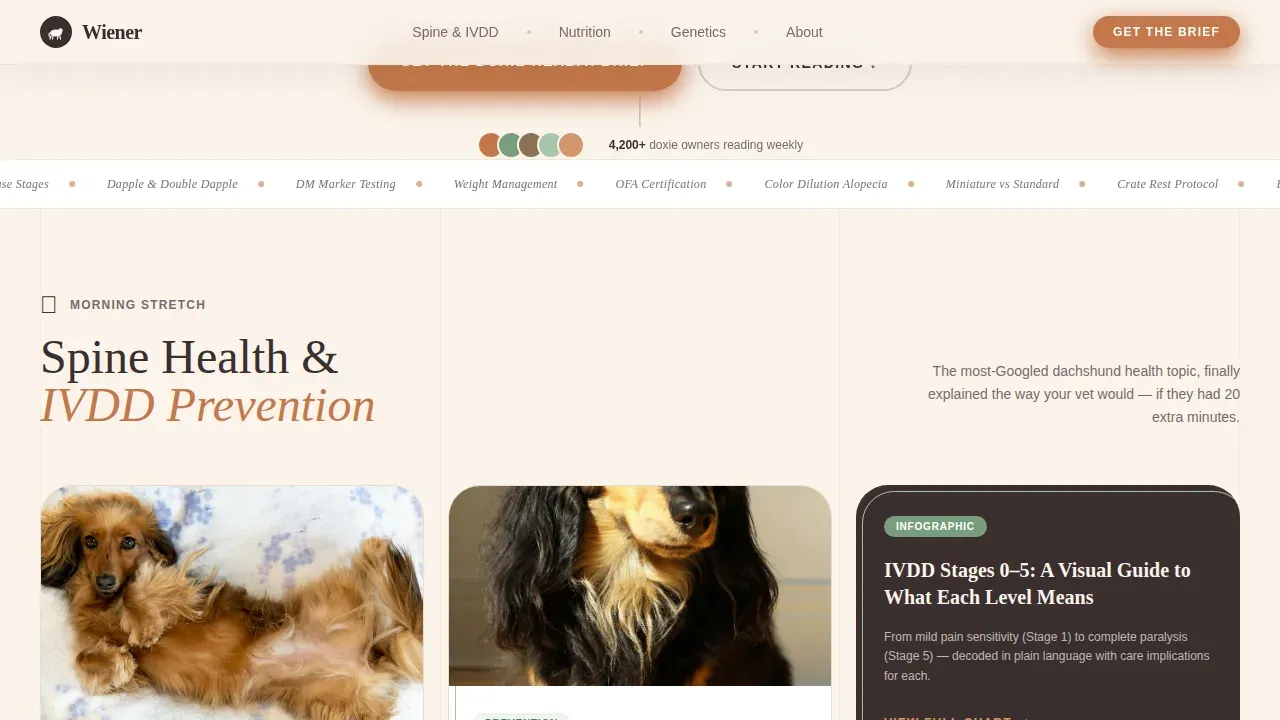
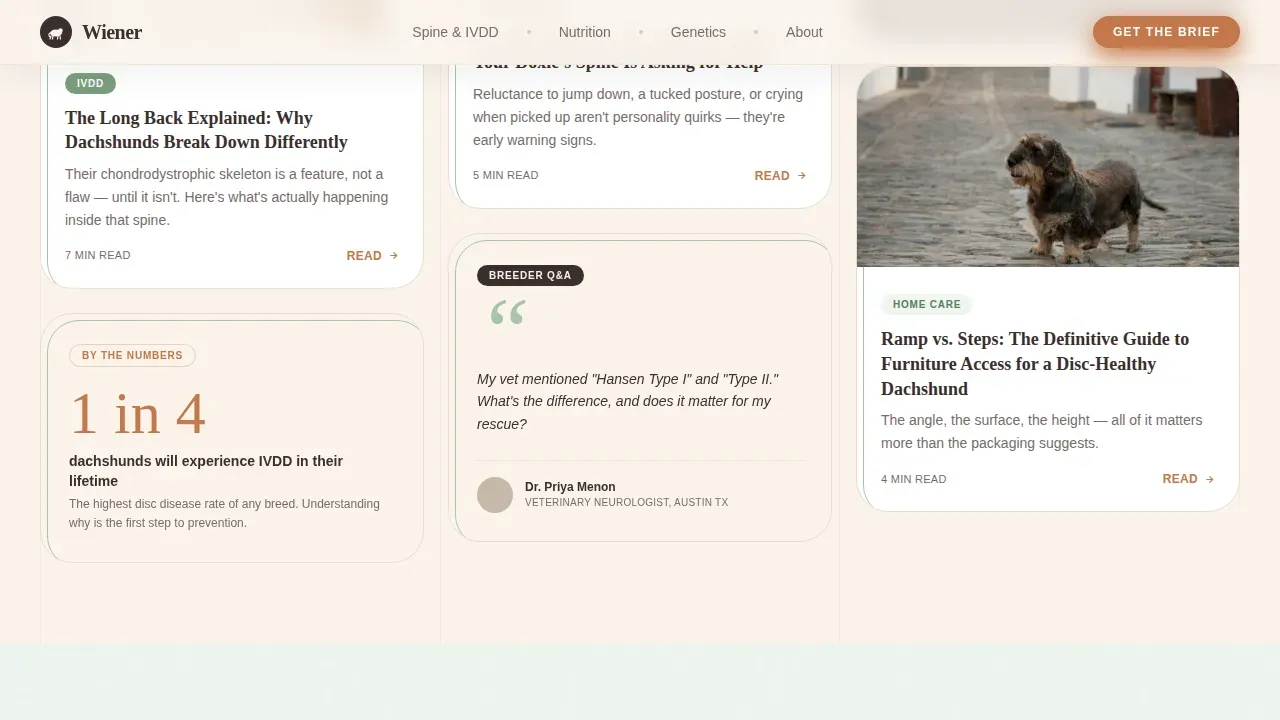
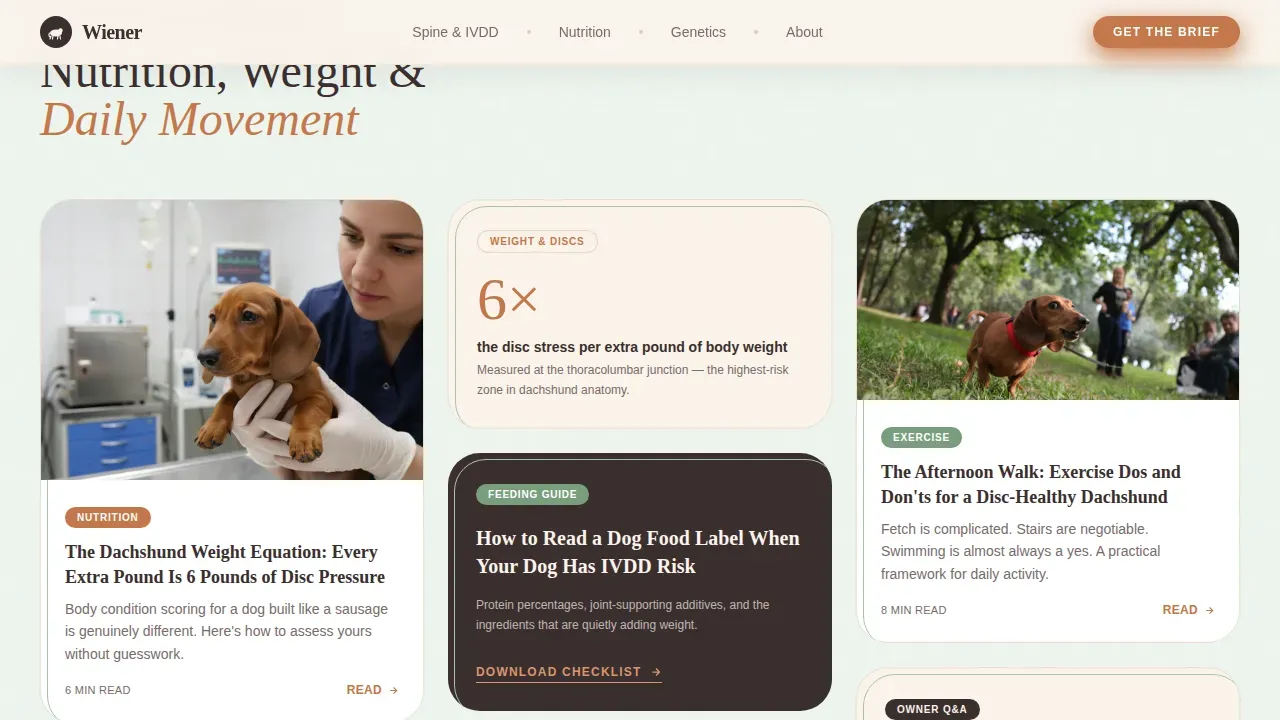
- Five thematic masonry card clusters organized around a dachshund's day: morning spine health, mealtime nutrition, the afternoon walk, the evening genetics deep-dive, and bedtime mental health. Each cluster holds articles, infographics, mini-video cards, and breeder question-and-answer cards arranged in a browsable Pinterest-style grid.
- Dual lead capture paths: the primary call to action is "Get the Doxie Health Brief," a free weekly email offer captured via a sticky form that reappears every third cluster; the secondary path gates a downloadable IVDD risk checklist PDF behind the same first-name-and-email form.
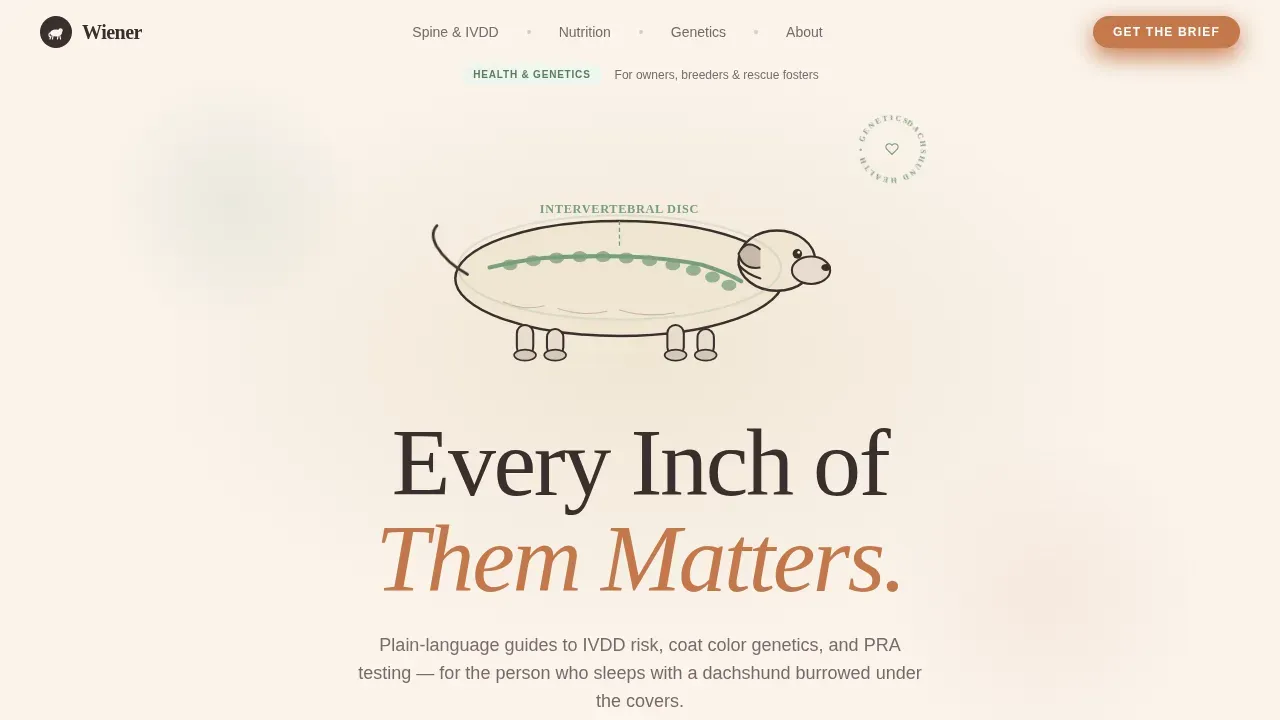
- Animated hero section featuring a hand-drawn SVG dachshund whose spine illuminates vertebra by vertebra in soft fern green before resolving into a healthy, tail-wagging whole dog, plus a fade-in headline and a scrolling marquee ticker below it.
Feature list
This section covers the core built-in features that define how the Wiener landing page template looks, functions, and converts.
Animated SVG Spine Illustration Hero
The hero opens with a custom hand-drawn dachshund illustration rendered in loam ink on cream. The spine illuminates vertebra by vertebra in soft fern green light, then the dog resolves into a healthy, wagging whole animal. The headline "Every Inch of Them Matters" fades in below the animation. A scrolling marquee ticker sits beneath the headline to reinforce key health messages and keep eyes moving. This opening is charming and medically literate at the same time, setting the tone for everything that follows.
Day-in-the-Life Masonry Grid Structure
The full scroll is organized around a single dachshund's day, moving from morning stretch through mealtime, the afternoon walk, the evening genetics email, and bedtime burrowing. Each life moment is its own masonry card cluster. Readers browse laterally within a cluster before scrolling into the next. The science deepens as the page progresses, but the tone stays warm and grounded throughout. Cards include article previews, infographic tiles, mini-video placeholders, and breeder question-and-answer panels, all pinned together in a flexible Pinterest-style grid.
Sticky Lead Capture with Dual Conversion Paths
The primary conversion path is a sticky email capture card offering the "Get the Doxie Health Brief," a free weekly email translating new dachshund genetics research into plain language. The form asks for a first name and email only. This card reappears naturally every third masonry cluster. The secondary conversion path offers a downloadable IVDD risk checklist PDF behind the same email capture form. Both offers feel like a natural extension of the content already visible on the page, not an interruption.
Scroll-Reveal Stagger and Hover Depth Cards
The template uses scroll-reveal stagger animations to bring card clusters into view as the reader scrolls down. Each card features hover depth effects that lift the card slightly, adding tactile feedback to the browsing experience. These micro-interactions make the masonry grid feel alive and encourage lateral exploration within each thematic cluster before the reader moves deeper into the page.
Social Proof and Credibility Placements
The bedtime and trust section near the bottom of the page includes dedicated placements for reader count displays, article count badges, and expert contributor credentials. These elements give first-time visitors a concrete reason to trust the content they have already been reading. Testimonials from dachshund owners who have navigated health issues and from breeders who rely on the content for genetic reference can be placed directly within these social proof blocks.
Botanical Design System with Family First Theme
The visual identity is built on a botanical palette that feels like an herb garden in late May. Soft fern green anchors section backgrounds and category tags. Terracotta warms buttons and hover states. Cream linen spreads across the base. Deep loam grounds all body text. Fraunces serif handles display headings and DM Sans handles body copy. The illustration style runs throughout, warm, slightly imperfect, somewhere between a veterinary textbook and a children's picture book.
Page sections overview
| Section | Purpose |
|---|---|
| Hero animation block | Opens with SVG dachshund spine illustration, fade-in headline, and marquee ticker |
| Morning masonry cluster | Spine health and IVDD prevention cards with checklist call to action |
| Mealtime and walk cluster | Nutrition, weight, and exercise cards with embedded lead capture form |
| Evening genetics cluster | Coat genetics, PRA, DM marker cards and breeder question-and-answer panels |
| Bedtime and trust section | Mental health cards, about and credibility block, IVDD PDF download call to action |
| Single-row footer | Linear footer with links and secondary navigation |
Design & branding system
The Wiener template uses a Botanical color system matched to a Family First theme. The visual result feels lived-in and warm without sacrificing clarity or credibility. Every color and type choice reinforces the feeling of sitting on a sun-warmed kitchen floor with a miniature dachshund in your lap.
- Color palette: soft fern green (#7A9E7E) for section backgrounds and category tags; warm terracotta (#C4784A) for buttons and hover states; cream linen (#FAF3EB) as the base canvas; deep loam (#3B2F2F) for all body text. No harsh pure black anywhere on the page.
- Typography: Fraunces (serif display) for headings and emotional anchors; DM Sans for body copy and form labels. The pairing reads warmly at large sizes and cleanly at small ones, which matters when your reader is using a phone at the vet.
- Illustration system: hand-drawn, loam-ink-on-cream style throughout. No stock photography. No cartoon clip art. The illustration approach echoes a veterinary textbook reimagined by a children's book artist, precise enough to be trusted and warm enough to feel like home.
Mobile & speed optimization
Over 70 percent of traffic to pet health sites arrives from mobile devices, most of it from owners who are mid-worry, Googling on a phone while a dog rests in their lap or sits in the car outside a vet clinic. The Wiener template is designed mobile-first from the ground up.
- Mobile-first masonry layout: the card grid stacks and reflows cleanly for smaller screens. Card clusters remain browsable and readable on phone widths without requiring horizontal scrolling or zooming.
- Lazy-loaded images and static content: images across the masonry grid are lazy-loaded so the page begins rendering useful content immediately. The overall architecture favors static content delivery, keeping initial load light even on slower mobile connections.
- Touch-friendly interactions: hover depth effects translate to tap feedback on mobile. The sticky lead capture form is thumb-reachable and uses minimal required fields, first name and email only, to reduce friction during an already stressful moment.
How this template helps you convert
The Wiener template earns conversions by giving value before asking for anything. Every visible card in the masonry grid contains genuinely useful dachshund health content. By the time the sticky email form appears, the reader already trusts the blog. The email feels like getting more of what is already helping, not a sales pitch.
- Useful-content-first structure: the masonry grid leads with articles, infographics, and breeder question-and-answer cards that answer real questions dachshund owners are already asking, from IVDD prevention to dapple genetics risks. The reader arrives with a question and finds an answer before they even encounter a form, which builds the trust that makes signing up feel obvious.
- Friction-reduced dual capture: the sticky "Get the Doxie Health Brief" card and the IVDD risk checklist PDF share the same minimal form. Both offers are embedded naturally in the scroll flow, not forced as popups. The form asks for first name and email only, removing every barrier that might cause a worried doxie owner to click away instead of signing up.
- Social proof anchoring near exit: reader counts, article counts, and expert contributor badges appear in the lower trust section, just before the bedtime cluster. A reader who has scrolled that far is already engaged. Seeing credibility signals at that moment converts curiosity into commitment.
Other information about this template
The Wiener template draws content inspiration from several overlapping areas of dachshund knowledge. Understanding these topics helps you make the most of every section in the masonry grid and fill each card cluster with content your readers will return to.
- Dachshund breed basics: the dachshund breed comes in two sizes recognized by the American Kennel Club (AKC), miniature and standard. Standard dachshunds typically weigh 16 to 32 pounds and stand 8 to 9 inches at the shoulder. Miniature dachshunds weigh up to 11 pounds and stand 5 to 6 inches at the shoulder. The AKC and the dachshund club community recognize three coat types: smooth coat, wirehaired, and longhaired. Long haired dachshunds have longer hair on the neck, chest, and ears that may be wavy. Wirehaired dachshunds have a rough outer coat and a softer undercoat. The breed has 2616 possible coat color and pattern combinations, including solid red, cream, black, chocolate, gray, dapple, and piebald. This extraordinary variety across miniature and standard dachshunds gives your content almost endless coat-type article possibilities.
- IVDD and back health: intervertebral disc disease (IVDD) affects roughly one in four dachshunds in their lifetime. It is a hereditary condition that dachshunds are born with, passed from parents to pups. Hansen Type I IVDD is the most common cause of disc herniation in the breed. Dachshunds that are overweight face a higher risk of back problems, including IVDD, because too much weight places additional pressure on the spine. In severe cases, IVDD can cause paralysis. Highly or moderately active dachshunds are about half as likely to experience an IVDD incident compared to sedentary dogs. Ramps and steps to prevent jumping off beds and furniture are among the simplest preventative tools an owner can use. Early spaying and neutering has been linked to increased IVDD risk, particularly in females, a topic that prompts strong engagement from dachshund owners and breeders alike.
- Nutrition and weight management: a balanced diet fed in measured portions is essential for keeping a doxie at a healthy weight. Dachshunds are prone to obesity, and carrying too much weight turns their long bodies and short legs into a setup for spinal injury. High-quality dog food in controlled portions, combined with at least two half-mile walks each day, supports the active lifestyle that keeps the spine healthy. Some research suggests that certain diets may positively affect disc health, making nutrition a rich topic for the mealtime card cluster.
- Dapple genetics and coat color: dapple dachshunds carry the merle gene, which creates a unique coat pattern featuring spots and splashes of diluted color. The dapple pattern can also affect eye color, sometimes producing heterochromia. Single dapple dachshunds face fewer health risks than double dapples. Breeding two dapple dachshunds together produces double dapple offspring, which face serious health risks including blindness, deafness, and skin vulnerability. Ethical breeders avoid this practice. The dapple coat pattern is connected to a genetic mutation in the merle gene, making it one of the most important coat-related topics for both the evening genetics cluster and the breeder question-and-answer cards. Color dilution alopecia is a separate but related condition worth covering for long haired dachshunds and smooth coat varieties alike.
- Breeding practices and health screenings: choosing a responsible breeder matters enormously for the long-term health of a dachshund puppy. Health screenings before breeding, including back screening of parent dogs, help predict whether a future pup will carry elevated IVDD risk. A responsible breeder selects mates with a combined low risk of disk calcifications. Breeders who raise pups in a family setting generally produce better-socialized dogs. Asking breeders about their breeding practices, health guarantees, and genetic test results is a baseline expectation for any potential dachshund owner. The AKC and affiliated dachshund club organizations provide breeder guidelines and breed standard documentation that ethical breeders follow.
- Grooming and daily care: grooming needs vary significantly by coat type. Long haired dachshunds should be brushed regularly, at least several times per week, to prevent tangles on the neck, ears, and chest. Wirehaired dachshunds need periodic stripping or trimming in addition to being brushed regularly. Longhaired varieties in general require more grooming maintenance than smooth coat dogs. Dachshunds are naturally clean, moderate shedders with no strong odor, but their ears should be checked and cleaned regularly to prevent infections. Crate training early in a dachshund puppy's life helps with potty training and gives the dog a safe, calm retreat that supports anxiety management, which connects directly to the bedtime cluster's mental health content.
- Training and personality: dachshunds are highly intelligent and famously stubborn. Consistent training using positive reinforcement works far better than correction-based methods. Crate training is particularly useful for potty progress with a dachshund puppy. Not everyone finds dachshunds easy to train on the first attempt, and acknowledging this honestly builds reader trust. Their playful nature and bold personality make them outstanding companions. They are excellent family pets and generally friendly with other pets when socialized early. Their playful temperament and curiosity suit an active lifestyle in almost any living situation, from apartments to rural homes, as long as proper care is maintained.
- Broader dog breed comparisons: unlike other breeds such as golden retrievers or other small dogs, dachshunds have a very specific set of structural vulnerabilities tied directly to their long bodies and short legs. These same genetics that make them unmistakable also make them different breed considerations for any vet, trainer, or owner coming from experience with other dog breeds. Not everyone who loves dogs is prepared for the unique care demands of miniature dachshunds or standard dachshunds. Content that contextualizes what is different breed-specific about dachshunds versus other breeds, rather than treating them like a different breed category entirely, helps readers make confident, informed decisions.
- Daschund spelling note: the alternate spelling daschund is a frequent search typo used by readers looking for the same health information. Your content can serve this audience without needing to duplicate articles.
- Dachshund health UK audience: dachshund health UK readers share many of the same concerns as US-based owners, particularly around IVDD, coat genetics, and breeding practices. The template's content structure and tone translate naturally for international audiences, even though the project defaults to US-centric vet references and USD-implicit pricing.
- The wiener trusted dachshund health and genetics blog landing page template is named after the most affectionate nickname in the dachshund owner community, the wiener dog, a term of endearment that perfectly captures the body shape, the personality, and the love that drives readers to your blog in the first place.
Theme
Family First
Creative direction
Day-in-the-Life
Color system
Botanical
Style
Masonry/Pinterest
Direction
Lead Generation
Page Sections
Animated SVG Dachshund Spine Hero
Day-in-the-life Masonry Card Grid
Sticky Dual Lead Capture System
Scroll-reveal and Hover Depth Interactions
Social Proof and Credibility Section
Botanical Family First Design System
Related questions
Who is the Wiener landing page template designed for?
What are the two conversion paths built into the template?
Does the template include the animated dachshund spine illustration?
How is content organized across the page?
Can the template handle both miniature dachshund and standard dachshund content?