Immigration Law Professional Website Template
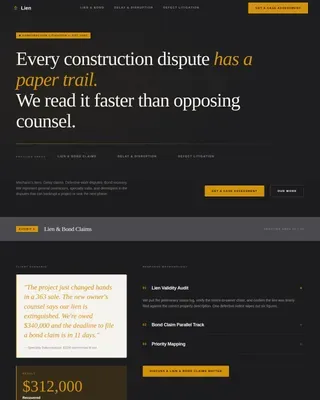
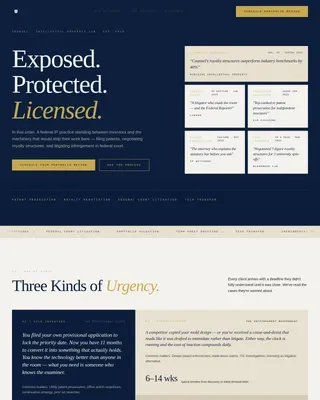
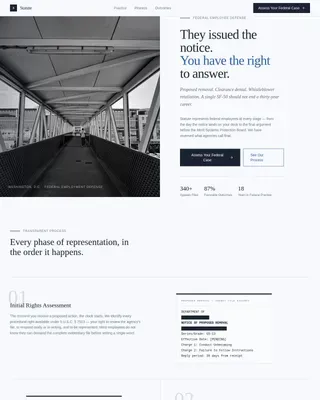
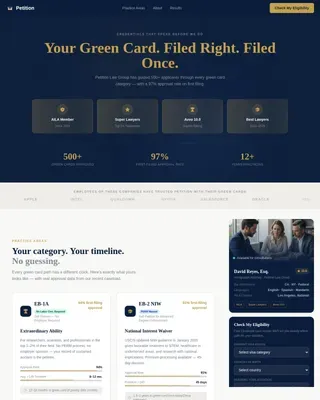
This petition-focused family immigration law landing page template is built for attorneys who reunite families across every case type. It pairs a commanding Stacked Type Tower hero with three expert panel sections, real case timelines, and dual call-to-action paths. The Institutional Authority design uses deep charcoal, warm amber, and parchment ivory to project both federal gravitas and personal warmth.
by Rocket studio
Quick summary
This is a single-page, split-screen landing page template designed for a family-based immigration law firm. It combines a bold typographic hero with scroll-driven expert panels, real case milestone timelines, and two conversion paths. The Charcoal and Amber color system projects federal authority while amber warmth signals that someone here genuinely fights for your family.
Who this template is for
This template is built for family immigration attorneys and law firms whose practice centers on reuniting spouses, parents, and children across international borders. It suits firms that handle a wide range of case types and want a single landing page that earns trust before asking for a consultation booking.
- Immigration lawyers who file Form I-130, Petition for Alien Relative, and manage consular processing from start to finish
- Firms serving U.S. citizens sponsoring immediate relatives, lawful permanent resident spouses, and adult children in preference category backlogs
- Practices that want a high-authority, conversion-focused landing page without starting from a blank canvas
What problem this template solves
Family immigration law is dense and emotionally charged. Potential clients arrive anxious, confused about preference categories, and unsure whether their immigration case qualifies for legal help. Most law firm pages fail to communicate case-type fluency, so visitors leave before booking. This template solves that problem directly.
- It demonstrates deep expertise across spousal petitions, parent and sibling preference categories, and Requests for Evidence (RFE) responses before ever asking for a commitment
- It gives visitors two clear paths: a primary call-to-action button to start a petition consultation, and a secondary eligibility quiz that pre-qualifies their relationship category and priority date
- It replaces vague legal language with plain-language case timelines that show how a family petition moves from filing to reunion, reducing visitor anxiety and building real confidence
What you get with this template
You get a fully structured, single-page layout built around the Institutional Authority theme and Expert Panel creative direction. Every section has a defined purpose, and the visual hierarchy guides visitors from emotional hook to consultation booking in a deliberate sequence.
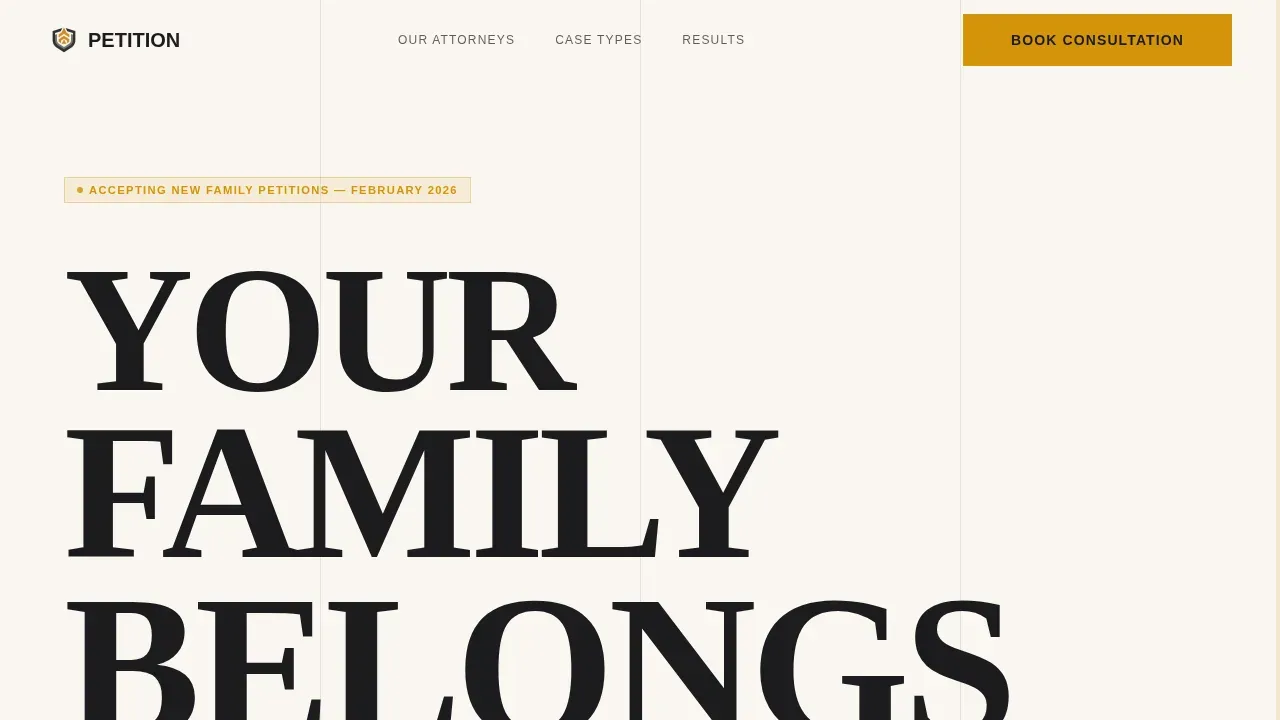
- A Stacked Type Tower hero block with the headline "YOUR / FAMILY / BELONGS / TOGETHER," a primary call-to-action button, and a founding-year credibility line
- Three 50/50 split-screen expert panels, each dedicated to a specific practice area, separated by real I-130 case timeline strips that show the immigration process step by step
- A full-width final call-to-action block, an eligibility quiz path, and a linear single-row footer
Feature list
Stacked Type Tower Hero
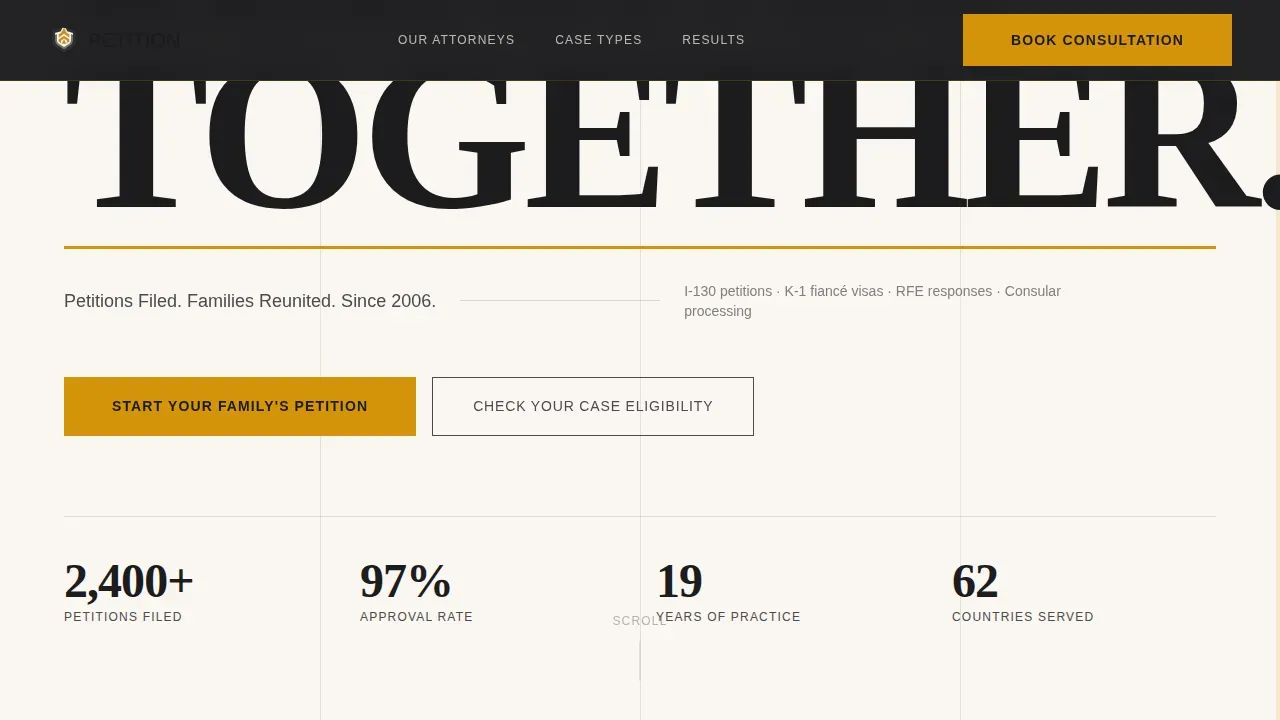
The hero fills the full viewport with enormous serif letterforms stacked vertically in deep charcoal on parchment ivory. A thin amber rule underlines the final word. Below it, a single iron-gray line reads "Petitions Filed. Families Reunited. Since 2006." Typography alone carries the authority here. No imagery competes for attention.
Expert Panel Split-Screen Sections
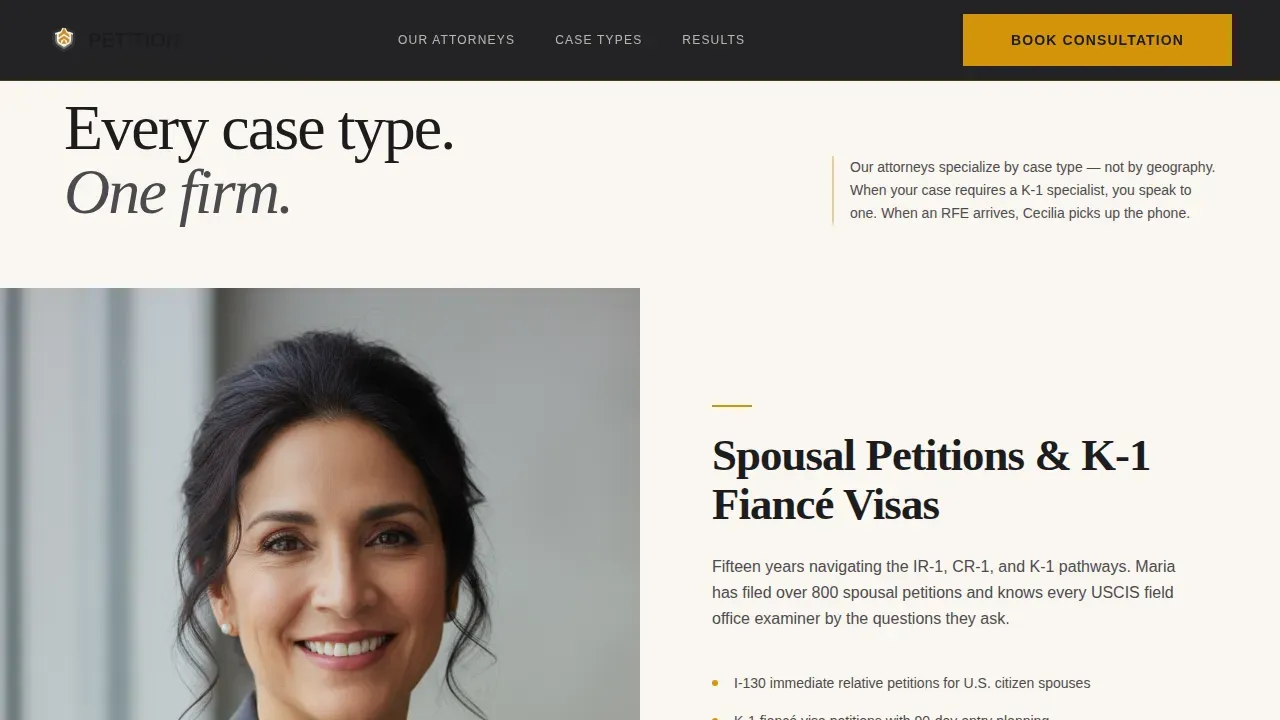
Three 50/50 split-screen panels introduce the attorney and senior paralegals as subject-matter voices. Each panel pairs a portrait with a focused description of that professional's expertise: spousal petitions and K-1 fiancé visas, parent and sibling family preference categories, and RFE responses with USCIS interview preparation. Hover states activate on each panel for interactivity.
Real Case Timeline Strips
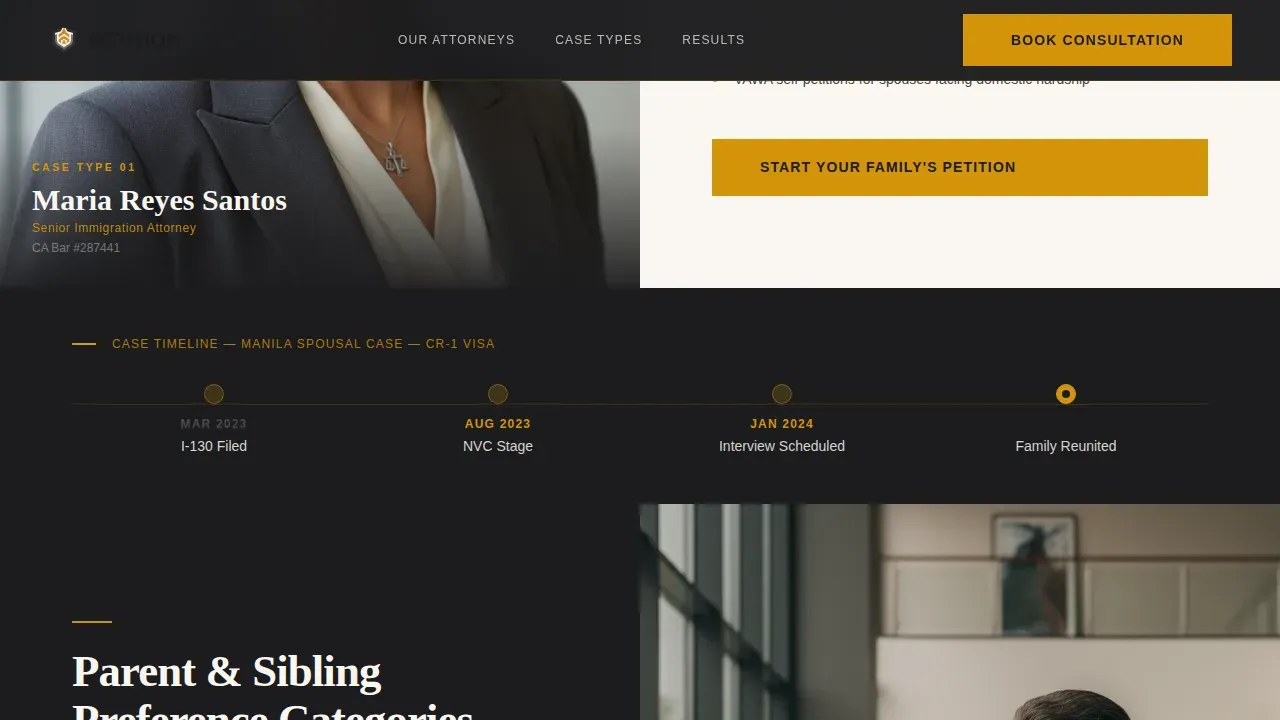
Between every expert panel, a horizontal case timeline strip displays a real milestone sequence. For example: "I-130 filed March 2023 → National Visa Center stage August 2023 → Interview scheduled January 2024 → Family reunited February 2024." These strips give the scroll a rhythm of proof, transforming abstract expertise into documented outcomes that visitors can recognize and trust.
Dual Call-to-Action Conversion Paths
The primary call-to-action, "Start Your Family's Petition," appears first beneath the hero and repeats in amber after every expert panel. A secondary path, "Check Your Case Eligibility," links to a short quiz that identifies the visitor's relationship category and priority date before directing them to the same consultation booking page with context already filled in.
Cinematic Scroll Animation
The template uses medium-intensity animations throughout: a cinematic entrance for the hero block, scroll-triggered reveals for each expert panel, and staggered entrances that build tension and pacing as the visitor moves down the page. Call-to-action buttons carry a magnetic hover effect. Case timeline items reveal progressively on scroll.
Institutional Authority Color and Typography System
Fraunces serif drives all headline and tower typography. DM Sans handles body copy and interface text. The four-color palette of deep charcoal, warm amber, parchment ivory, and iron gray is applied with purpose: charcoal anchors header blocks, amber marks accent lines and call-to-action elements, parchment ivory fills content panels, and iron gray handles secondary type and divider rules.
Page sections overview
| Section | Purpose |
|---|---|
| Hero Tower Block | Establish authority and present the primary call-to-action above the fold |
| Expert Panel One | Introduce spousal petition and K-1 fiancé visa expertise in a split-screen format |
| Case Timeline One | Show a real I-130 to reunion milestone sequence between panels |
| Expert Panel Two | Cover parent and sibling family preference categories with attorney voice |
| Case Timeline Two | Display a second real case milestone strip to reinforce proof rhythm |
| Expert Panel Three | Address RFE responses and USCIS interview preparation |
| Case Timeline Three | Provide a third milestone timeline to close the credibility sequence |
| Eligibility Quiz call to action | Offer a secondary path that pre-qualifies relationship category and priority date |
| Final call to action Block | Present a full-width amber call-to-action to drive consultation bookings |
| Linear Footer | Deliver a single-row footer with essential firm links |
Design & branding system
The visual identity follows an Institutional Authority theme. The overall feel is a federal courthouse lobby: terrazzo floors, brass fixtures, and tall windows softened by golden afternoon light. Every design decision signals that this firm is serious, experienced, and on the client's side.
- Color system: deep charcoal (#1C1C1E) for backgrounds and headers, warm amber (#D4940A) for accent lines, case status indicators, and call-to-action elements, parchment ivory (#FAF6F0) for content panels and body text regions, iron gray (#4A4A4F) for secondary type and dividers
- Typography: Fraunces serif for all headlines and the stacked tower, DM Sans for body copy and interface text; type is set at commanding sizes that fill the full screen width
- Scroll experience: staggered panel entrances, scroll-triggered reveals, and a magnetic call-to-action button effect build pacing and draw the visitor downward through escalating credibility
Mobile & speed optimization
The template is designed desktop-first to match the consultation booking flow, and it is fully responsive across all screen sizes. The layout reflows cleanly so every section remains readable and functional on smartphones and tablets.
- The split-screen expert panels stack vertically on smaller screens, keeping portrait and expertise content readable without horizontal scrolling
- Call-to-action buttons remain full-width and tap-friendly on mobile, and the eligibility quiz path is accessible at every breakpoint
- Server Components handle static content rendering, while Client Components manage animations, keeping the interactive experience smooth without overloading the page
How this template helps you convert
This template is built specifically for click-through conversion, meaning its single purpose is to drive visitors to a detailed consultation booking page. It earns the click by building credibility progressively, so visitors arrive at the booking page already convinced.
- The Stacked Type Tower and founding-year credibility line establish trust immediately above the fold, capturing attention before visitors can scroll away
- Each expert panel plus case timeline pairing escalates the firm's demonstrated case-type knowledge, so visitors recognize their own family petition situation in the content and feel confident the firm has handled a case exactly like theirs
- The dual call-to-action system meets visitors wherever they are: those ready to act click "Start Your Family's Petition," while those still evaluating their immigration options take the eligibility quiz path, which deposits them on the same booking page with their relationship category already identified
Other information about this template
This template is a strong fit for the petition trusted family immigration law landing page template use case, covering the full spectrum of family based immigration from initial filing through final approval. Below are additional details relevant to how this template supports real-world immigration law practice content.
- The template's content structure naturally accommodates key topics such as adjustment of status, consular processing, immigrant visas, and the distinction between immediate relatives and family preference categories
- Family immigration lawyers can use the expert panel sections to explain how Form I-130, the Petition for Alien Relative, works as the primary document for establishing a qualifying relationship between a petitioner and an alien relative
- U.S. immigration law separates immediate relatives (spouses, unmarried children under 21, and parents of U.S. citizens over 21) from family preference categories (married children, siblings, and relatives of permanent residents), and the template's panel structure maps naturally to this distinction
- Content panels can address supporting documents such as birth certificates, marriage certificates, and financial records needed to establish a family relationship and demonstrate lawful status
- The eligibility quiz section is well-suited to explaining priority date logic, preference categories, and how a pending petition moves through the National Visa Center stage toward a visa number becoming available
- Attorneys can use the timeline strips to show how adjustment of status and consular processing differ, helping visitors understand their specific immigration process path
- The Affidavit of Support (Form I-864) is a critical element in family based petitions; the template's content areas support clear explanation of income eligibility requirements and what happens if this document is missing or incomplete
- Common challenges such as prior immigration violations, criminal records, unlawful presence, and inadmissibility issues can be addressed in the expert panel dedicated to RFE responses and USCIS interview preparation
- The template's written statement areas and process description blocks support plain-language explanation of the women act protections, USCIS filing fees, the current fee schedule, and what immigration officials look for in a properly filed petition
- Green card holders who can only petition for spouses and unmarried children will find relevant content space in the spousal petition expert panel
- The secondary eligibility quiz path supports stress free lead capture by asking only essential information before routing visitors to the booking page, helping avoid delays in the consultation process
- Immigration services content can be localized with additional information relevant to specific home country consular posts, making the template adaptable for firms serving Filipino, Mexican, or other diaspora communities
- Letters of support submitted to an immigration judge or USCIS officer are not required in every immigration case, but the template's content structure allows firms to explain when a written statement of this kind adds immigration benefit to a pending case
- The template supports clear explanation of lawful permanent residence pathways, permanent resident status maintenance, and the difference between a green card and full citizenship
- Firms can use the frequently asked question section within the template to cover immigration status questions, case status tracking, and how small errors in paperwork can create unnecessary delays or trigger requests for additional information
Theme
Institutional Authority
Creative direction
Expert Panel
Color system
Charcoal & Amber
Style
Split Screen (50/50)
Direction
Click-Through
Page Sections
Stacked Type Tower Hero
Expert Panel Split-screen Layout
Real Case Timeline Strips
Dual Conversion Call-to-action System
Cinematic Scroll Animation System
Institutional Authority Branding System
Related questions
Who is this landing page template designed for?
What sections are included in the template?
Can I customize the case timelines and attorney panel content?
What visual style does this template use?
Does the template support both adjustment of status and consular processing content?