Concert Piano Technician Landing Page Template
The Temperament landing page template is built for solo piano technicians who serve everyone from church music directors to concert venue managers. It pairs a half-page hero photograph with a three-tier comparison table, case study narratives, and brass-accented calls to action. The result is a single-page experience that earns trust before the visitor ever clicks "Schedule a Tuning."
by Rocket studio
Quick summary
Temperament is a single-page landing page template designed for a solo piano tuner and technician. It opens with a dramatic half-page hero, moves through a narrative comparison table contrasting three service tiers, and closes with a pinned brass call-to-action routing visitors to a dedicated booking page. The Corporate Precision visual identity, deep navy, polished brass, pressed ivory, gives the page the quiet authority of a recital hall at the moment every string finally locks into tune.
Who this template is for
This template speaks directly to skilled piano technicians who want a professional web presence that matches the seriousness of their craft. It is built for independent practitioners with a defined service radius and a client list that spans domestic uprights to stage grands. If you arrive with a tuning lever, a felt mute strip, and decades of pitch memory, this page was designed around your story.
- Church music directors, private piano teachers, and venue managers are the visitors this page is designed to convert into booked appointments.
- Solo piano technicians who need to communicate three distinct service tiers, from routine pitch correction to full mechanical restoration, without building a multi-page site.
- Independent practitioners who want case study evidence and embedded client quotes to do the selling before the booking click.
What problem this template solves
Piano tuning is a very subject-specific service where trust is earned slowly and lost instantly. A prospective client, a pianist nervous about a drifting A4, a venue manager with a nine-foot Yamaha CF going out of tune before soundcheck, needs to feel the technician's competence before picking up the phone. Generic service pages fail here. They list bullet points, skip the story, and leave visitors unsure what tier of service their instrument actually needs.
- Visitors arrive unsure whether they need basic pitch correction, concert prep, or a full restoration. The comparison table answers that question immediately, with narrative cells that describe real instrument outcomes rather than abstract checkmarks.
- Most single-service pages miss the chance to escalate trust as the visitor scrolls. This template threads a case study narrative through the comparison architecture, so each tier proves itself with a before-and-after account, a client quote, and a photograph of the actual instrument.
- Visitors who are not yet ready to book need a soft exit that still ends at conversion. The secondary assessment link captures uncertain visitors and routes them through a guided diagnostic that still terminates at the booking page.
What you get with this template
You get a complete, single-page layout that tells a technician's story from first impression to booking click. Every section is purposeful. Nothing is decorative for its own sake. The page is built desktop-first, which aligns with how church directors, private teachers, and venue managers typically research services at a desk.
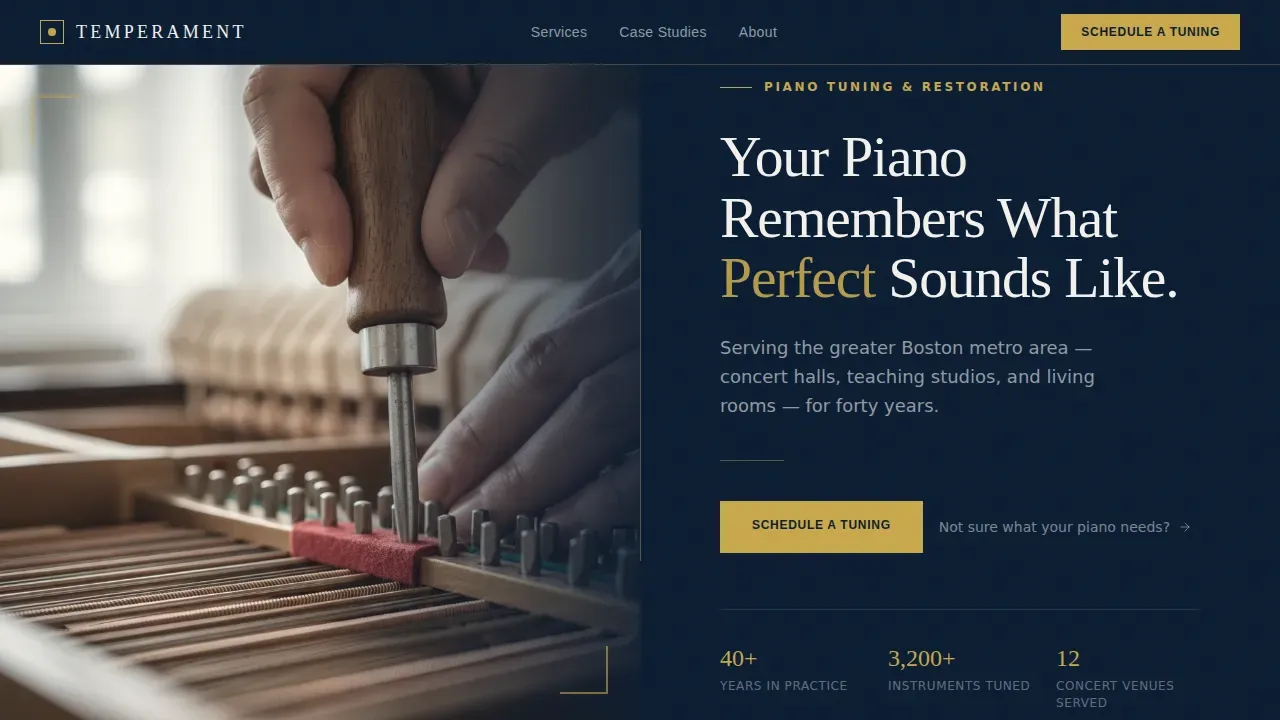
- A half-page hero with a high-contrast photograph of hands on a tuning pin, paired with a weighted serif headline and a subline naming the service radius and years in practice.
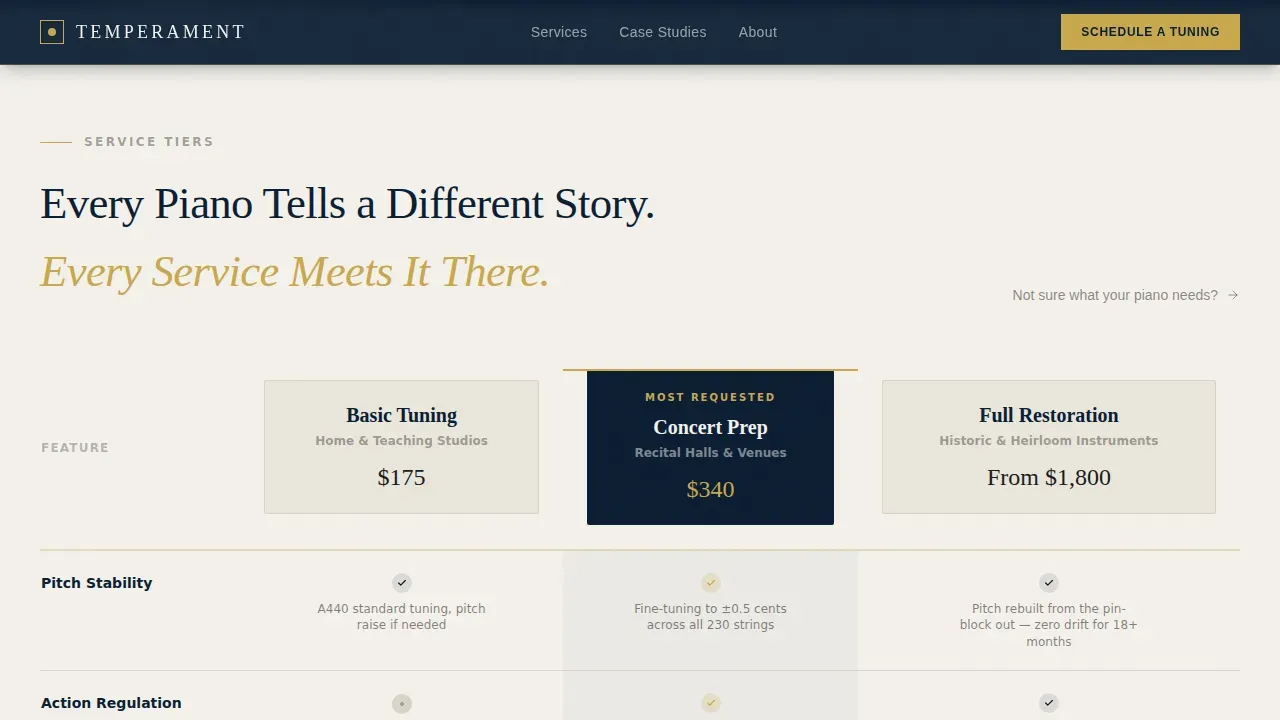
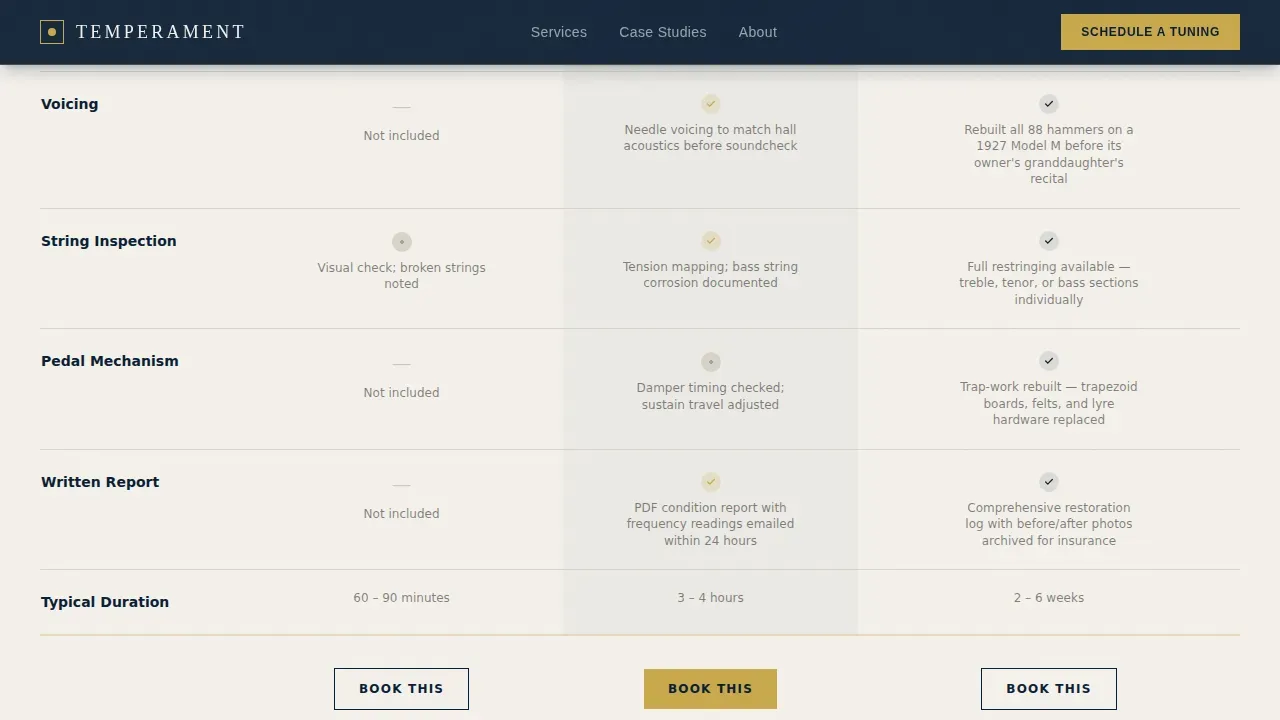
- A three-column comparison table contrasting Basic Tuning, Concert Prep, and Full Restoration across rows including pitch stability, action regulation, voicing, and string replacement, each cell containing a one-line narrative outcome rather than a plain checkmark.
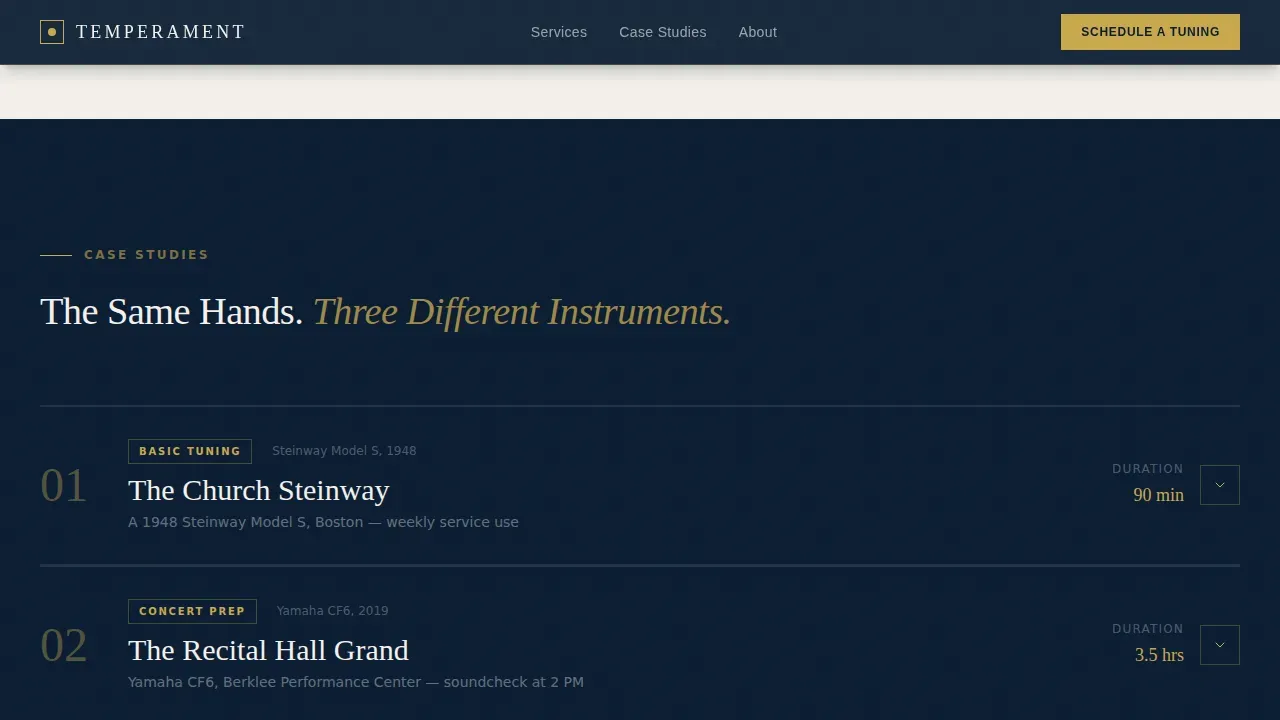
- Three expandable case study rows, each containing a before-and-after frequency spectrum view, an embedded client quote, and a photograph of the actual instrument serviced.
- A sticky navigation bar with the primary call-to-action pinned in polished brass, repeating at the close of each case study row, and a secondary text link for the 60-second diagnostic assessment.
- A Trust and Credentials section surfacing 40 years of practice, client types served, and instrument models handled.
- A footer built on the Vercel Horizontal Flow pattern.
Feature list
This section covers the core functional and design features built into the Temperament template. Each feature is grounded in the source brief and reflects a deliberate decision about how piano tuning services are sold online.
Half-Page Hero with Tuning-Pin Photography
The header is a split composition. The left side holds a tightly cropped, high-contrast photograph of hands mid-adjustment on a tuning pin, the lever angled at two o'clock, strings converging into shallow depth of field, a single felt wedge muting the neighboring unison. The right side carries the headline "Your Piano Remembers What Perfect Sounds Like" set in a weighted Fraunces serif against dress-navy. There is no animation and no motion. The stillness of the image projects the quiet authority of a craftsman who has been playing this exact moment across forty years of tuning visits.
Narrative Comparison Table
The three-tier comparison table is the structural centerpiece of the page. It contrasts Basic Tuning, Concert Prep, and Full Restoration across rows such as pitch stability, action regulation, voicing, and string replacement. Rather than plain checkmarks, each cell carries a one-line story drawn from real instrument work. For example, a cell might read: "Rebuilt all 88 hammers on a 1927 Model M before its owner's granddaughter's recital." This format lets visitors immediately hear the difference between tiers and self-select the service they need, without requiring a consultation call first.
Expandable Case Study Rows
Below the comparison table, each service tier expands into a mini case study. The narrative escalates: from a simple pitch correction at the bottom note of a domestic upright, through concert tuning preparation for a recital grand, up to a full mechanical resurrection involving strings, hammers, and soundboard work. Each case study includes a before-and-after frequency spectrum, a client quote, and a photograph of the actual instrument. This escalating proof structure lets a pianist or venue manager see that the same hands handle both everyday tuning visits and high-stakes concert preparation.
Sticky Brass Call-to-Action Navigation
The primary call-to-action, "Schedule a Tuning", is pinned in polished brass at the top navigation bar throughout the entire scroll. It reappears at the close of each case study row. No booking form lives on the landing page itself. Trust is built through visible expertise first. By the time a visitor reaches the final call-to-action, the only remaining question is which date to choose. A secondary text link, "Not sure what your piano needs? Take the 60-second assessment", catches undecided visitors and routes them to a guided diagnostic that still ends at the booking page.
Trust and Credentials Block
A dedicated section surfaces the credentials and context that turn a visitor into a confident client. Forty years of practice, the range of client types served (church music directors, private teachers, venue managers), and the instrument models handled (living room uprights through recital hall grands) are all presented here. Piano technicians who highlight their depth of experience alongside specific instrument references and client types build authority faster than generic credential lists.
Corporate Precision Visual System
The entire page runs on the Navy Authority color system. Dress-navy (#0B1D33) anchors primary backgrounds. Polished brass (#C9A84C) marks accent lines, dividers, table row hover states, and call-to-action buttons. Pressed-ivory (#F4F1EB) provides content surface contrast. Regulation black (#1A1A1A) carries body text. Fraunces sets all headlines; DM Sans handles body copy and interface text. Low-to-medium scroll reveal animations and table row hover states keep the interaction layer purposeful without distracting from the content.
Page sections overview
| Section | Purpose |
|---|---|
| Hero Split Layout | Establish craft authority with tuning-pin photography and headline |
| Comparison Table | Contrast three service tiers with narrative outcome cells |
| Case Study Rows | Expand each tier into a before-and-after instrument story |
| Trust and Credentials | Surface 40 years of practice and client range |
| Call-to-Action Close | Drive booking with primary button and assessment text link |
| Footer Horizontal Flow | Close the page with contact and navigation context |
Design & branding system
The Temperament template runs a Corporate Precision design system built around the Navy Authority color palette. The palette was chosen to feel like opening a grand lid in a wood-paneled recital hall, brass hinges catching light against lacquer so dark it absorbs the room. Every color decision reinforces the idea that the person behind this page is a serious craftsman, not a casual handyman.
- Dress-navy (#0B1D33) for primary backgrounds, polished brass (#C9A84C) for accent lines, dividers, and hover states, pressed-ivory (#F4F1EB) for content surfaces, and regulation black (#1A1A1A) for body text.
- Fraunces serif for all headlines, delivering the weighted authority that suits a decades-long professional practice; DM Sans for body copy and interface text, keeping navigation and table content clean and readable.
- Low-to-medium animation intensity: scroll reveals bring content into view naturally, and table row hover states highlight tier differences without distracting motion.
Mobile & speed optimization
Although the page is built desktop-first to serve the primary audience of venue managers and music directors researching at a desk, mobile support is included. The layout adapts cleanly from a wide-side desktop composition to a stacked mobile view without losing the visual hierarchy.
- The half-page hero transitions from a side-by-side split to a stacked image-above-text composition on narrower screens, keeping the tuning-pin photograph prominent.
- The comparison table is designed to scroll horizontally on mobile, preserving all three tier columns and their narrative cells without collapsing content into hidden accordions.
- Static-first architecture with Server Components handling all content delivery, keeping the page load light regardless of the rich visual content.
How this template helps you convert
A landing page for concert-grade temperament tuning must blend technical precision with musical artistry. The Temperament template is built specifically around this challenge. It does not ask visitors to trust a list of services. It asks them to read a story, recognize their instrument in a case study, and click with confidence.
- The comparison table answers the visitor's first question, "What service do I actually need?", before they have to ask it. Narrative cells make the difference between tiers concrete, so visitors self-qualify and arrive at the booking page already knowing their tier.
- The escalating case study sequence builds trust incrementally. By the time a visitor finishes reading about a full mechanical restoration, they have already seen proof of precision work at every level, from a routine pitch correction to rebuilding all the notes in a century-old action.
- The secondary assessment link acts as a conversion safety net. Visitors who are not yet ready to commit to a specific tier are routed to a guided diagnostic that still ends at the booking page, reducing drop-off without adding friction to the primary path.
Other information about this template
The Temperament template is informed by a deep body of craft knowledge that shapes every content decision on the page. Understanding this context helps you customize the template to match your own technical depth and client base. Piano tuning became a formal profession following a major technical evolution in keyboard instruments during the 18th century and the widespread adoption of equal temperament. Johann Sebastian Bach famously explored this concept in The Well-Tempered Clavier, a work that demonstrated how a single keyboard instrument could play comfortably in all twelve major and minor keys when temperament was handled correctly.
Equal temperament works by slightly narrowing each fifth so that all the notes are evenly distributed across the octave. This means no pure fifth is perfectly beatless, but the trade-off is that all twelve major and minor scales become equally playable. In practice, a temperament concert-grade piano tuner establishes this system precisely in the piano's middle octave, then extends it upward and downward through tune octaves that preserve the interval relationships set in the center. The relationship between contiguous major thirds is one of the primary checks a technician uses to verify that the temperament octave is correctly set before extending to the rest of the instrument.
Different temperaments can influence the piano sound in ways that matter to musicians playing baroque music, chamber music, or other styles where key color is meaningful. Historical temperaments such as meantone and well-tempered systems, the kind Johann Sebastian Bach explored in The Well-Tempered Clavier, can give each key a distinct tonal character. Equal temperament standardized the intervals so every key sounds identical, which is why it became the dominant system for classical music performance. A technician who understands these other temperaments and can discuss them with a pianist or a bass player in a chamber ensemble brings a different level of service than one who simply applies a default tuning sequence.
The Bisecting Beat Speed Window is one approach to setting a temperament sequence precisely. It works by bracketing beat speeds between intervals, for example, checking that a major third beats at a rate that falls between the rates of two surrounding pure fifth intervals, and adjusting until the temperament sequence locks into a consistent progression. This approach draws on the technician's ability to hear beats clearly and track their speed as they ascend the scale. Tuning a piano by ear requires the technician to listen for the progression of beats in intervals, ensuring they increase in speed in a predictable pattern. Interval checks, including contiguous major thirds, perfect octaves, and various intervals across the scale, confirm that all the notes are consistent before the technician moves on.
Concert-grade electronic tuning devices, sometimes abbreviated as ETDs, are used alongside aural methods in high-stakes environments. These devices measure the specific string characteristics of a piano and apply stretch tuning that accounts for inharmonicity, the tendency of real piano strings to vibrate at frequencies slightly sharper than pure mathematical ratios predict. The m3/M3 equality check, which compares minor third and major third beat speeds, is one of the most precise ways to determine whether the final pitch of a note is correct during the fine tuning phase. Most techs use a combination of aural skill and electronic measurement depending on the instrument and the performance environment.
Piano tuning can change drastically with humidity and temperature shifts, which is why piano technicians often tune an instrument multiple times before a concert to ensure stability. The process also involves considering the acoustics of the performance space, a piano that sounds good in a practice room may need subtle adjustments when placed on a reflective concert stage. The role of a piano technician extends well beyond pitch: voicing modifies the piano sound's color, expression, dynamics, and volume range. A technician must engage in deep exchanges with artists to understand their sound preferences and interpret them accurately into the instrument. The page's case study architecture provides natural space for this kind of narrative, a great post in the context of a case study is one that shows both the technical action taken and the musical outcome the client experienced.
This template was designed with reference to tuning knowledge shared by practitioners including Jason Kanter, whose writing on temperament sequence methodology and aural tuning has informed how technicians communicate their process to clients. Displaying credentials such as Registered Piano Technician status can build further authority for a service page of this kind. A follow-up maintenance program, referenced in the Trust section, reinforces the point that piano tuning is not a one-time event but an ongoing relationship between the technician and the instrument.
- The page layout accommodates credential display including certification status, years of practice, and instrument model references.
- Content areas for client testimonials are built into each case study row, supporting social proof from professionals and named instrument owners.
- The secondary assessment link and the diagnostic flow it connects to give the page a complete conversion path for visitors at every stage of readiness.
- The template uses Fraunces for headlines and DM Sans for body text, both available through standard web font delivery.
- The footer follows Vercel Horizontal Flow pattern three, providing clean horizontal navigation and contact context at the close of the page.
Theme
Corporate Precision
Creative direction
Case Study Narrative
Color system
Navy Authority
Direction
Click-Through
Page Sections
Narrative Comparison Table with Three Service Tiers
Expandable Case Study Rows Per Tier
Sticky Brass Call-to-action with Assessment Link
Half-page Hero with Tuning-pin Photography
Trust and Credentials Section
Corporate Precision Visual Identity
Related questions
What types of piano technicians is this template designed for?
Does the landing page include a booking form?
Can the comparison table be customized to reflect my own service tiers?
How does the case study section work on the page?
Is this template suitable for a pianist or music school, or only for technicians?