Rugby Booking Website Template
The Scrum rugby venue landing page template is built for floodlit complexes that host everyone from grassroots club sides to corporate away-days. A bento grid layout, Dopamine Pop colour system, and category-specific calls to action make every booking type instantly visible. The result is a high-energy, conversion-focused page that turns first-time visitors into confirmed bookings.
by Rocket studio
Quick summary
The Scrum template is a single-page bento grid landing page designed for a rugby venue that handles multiple booking types simultaneously. It converts club secretaries, corporate planners, academy directors, and wedding organisers through category-specific tiles, a sticky booking bar, and a date-picker modal. The visual identity is industrial-dark with electric chartreuse headlines and coral urgency cues that capture the raw energy of a floodlit Saturday match.
Who this template is for
This template is built for rugby venues and multi-use sports complexes that need to deal with several distinct visitor types at once. Not every person arriving on the page wants the same thing, and the bento grid structure makes sure each group finds a clear, relevant path forward without getting lost in a wall of generic text.
The template serves organisations that host everything from grassroots leagues and county development camps to corporate hospitality suites and industrial-chic private functions. If your venue is open from September through April and every week brings a different mix of bookings, this structure fits that reality directly.
- Club secretaries and sports coordinators booking league fixtures and post-match functions
- Corporate event planners seeking away-days with built-in adrenaline and catering support
- Wedding planners, academy directors, and private function organisers looking for a venue that stands apart from the rest
What problem this template solves
A rugby venue that serves multiple audiences faces a specific and frustrating challenge. A single, undifferentiated page forces every visitor, whether they are a club secretary hunting for a pitch or a wedding planner eyeing the pavilion, through the same linear journey. Most will lose interest and leave before finding what they need. That is a costly anti pattern for any booking-led business.
The Scrum template solves this by presenting every booking category simultaneously inside an asymmetric bento grid. Each tile is self-contained, purpose-labelled, and carries its own call to action. There is no guesswork. Visitors do not need to scroll endlessly or sit through irrelevant content before they find the conversation they came to have.
- Multiple audiences arrive at one page and each one sees an immediately relevant booking category without friction
- Availability is signalled live through pulsing coral badges, reducing the effort required to check open slots
- A sticky bottom bar holds a universal call to action so that no visitor, at any scroll depth, is ever lost without a next step
What you get with this template
You get a fully structured, single-page landing page built around six booking categories arranged in an asymmetric bento grid. The template is designed to handle the full spectrum of a busy rugby venue's calendar, from grassroots pitch hire through to premium pavilion events. Every section, tile, and call to action is pre-configured for a specific conversion goal.
The design system is complete and production-ready. Typography, colour assignments, animation behaviour, and interaction states are all specified. You are not starting from scratch; you are starting from a framework that already knows what job it needs to do.
- A six-category bento grid with staggered pop-in animation, a looping video tile, bold stat displays, and live availability badges
- A sticky bottom bar with a universal date-picker modal that filters across all booking categories
- A full visual identity including the Dopamine Pop colour palette, Fraunces display headings, and Manrope body text
Feature list
This template packs a precise set of capabilities drawn directly from its brief. Each feature below is present in the design as described.
Dark Full-Bleed Hero with Typewriter Headline
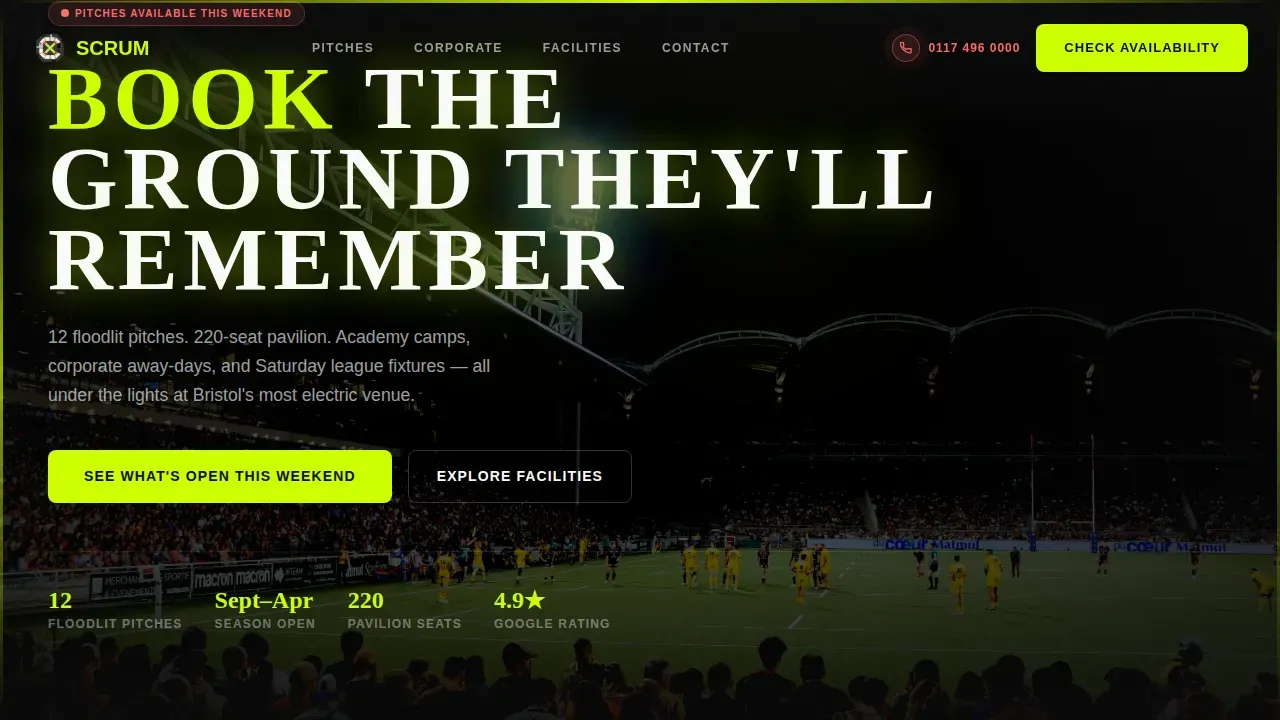
The header is a cinematic, full-bleed night-pitch photograph shot from behind the posts at ground level. A ball carrier is mid-dive, floodlights explode into lens flare above, and breath is visible in the cold air. The headline "BOOK THE GROUND THEY'LL REMEMBER" types itself in one sharp burst, letter-spaced wide and glowing against the near-total darkness. A chartreuse glow pulses at the edges of the viewport, mimicking stadium LED boards warming up. This opening sets the tone immediately and tells every visiting person exactly where they have landed.
Asymmetric Six-Category Bento Grid
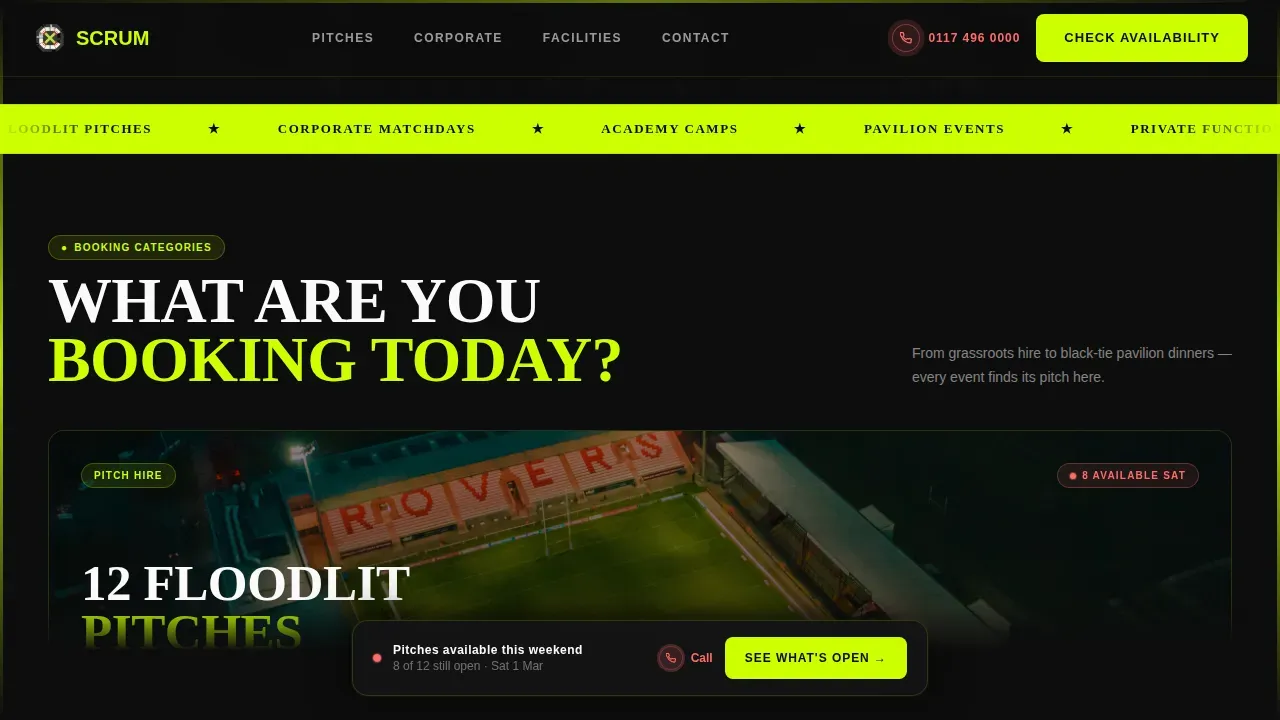
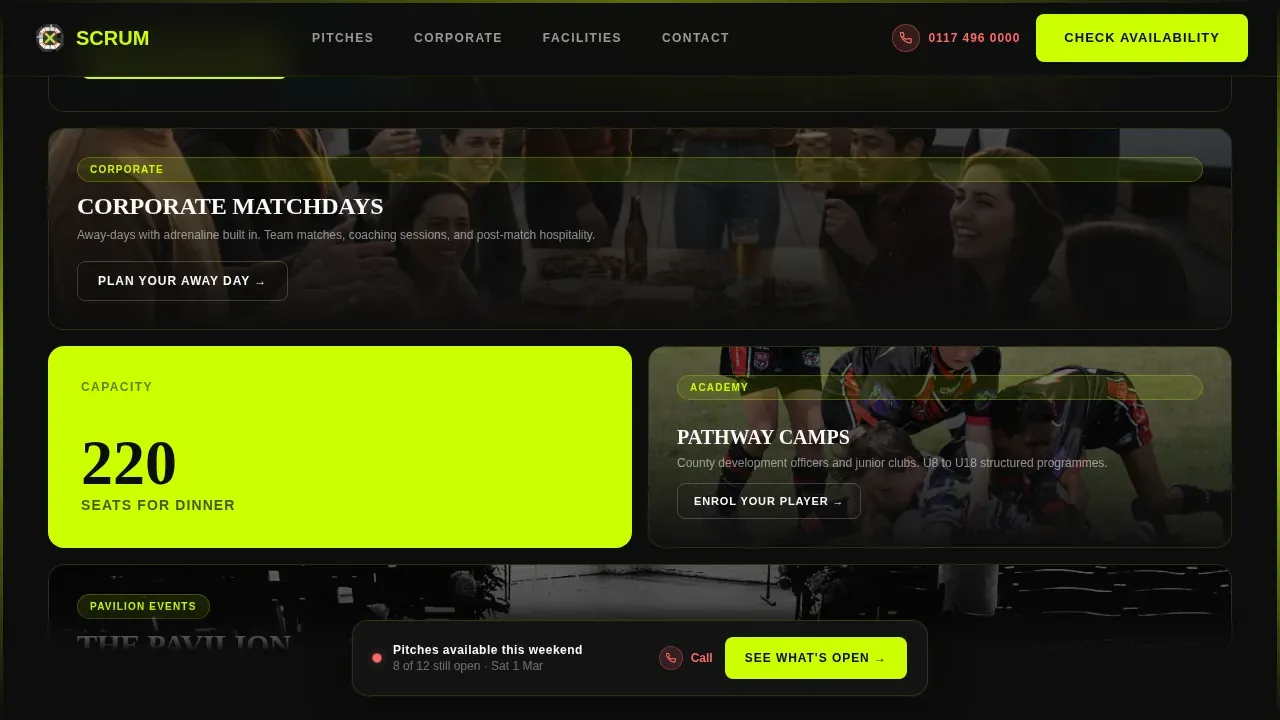
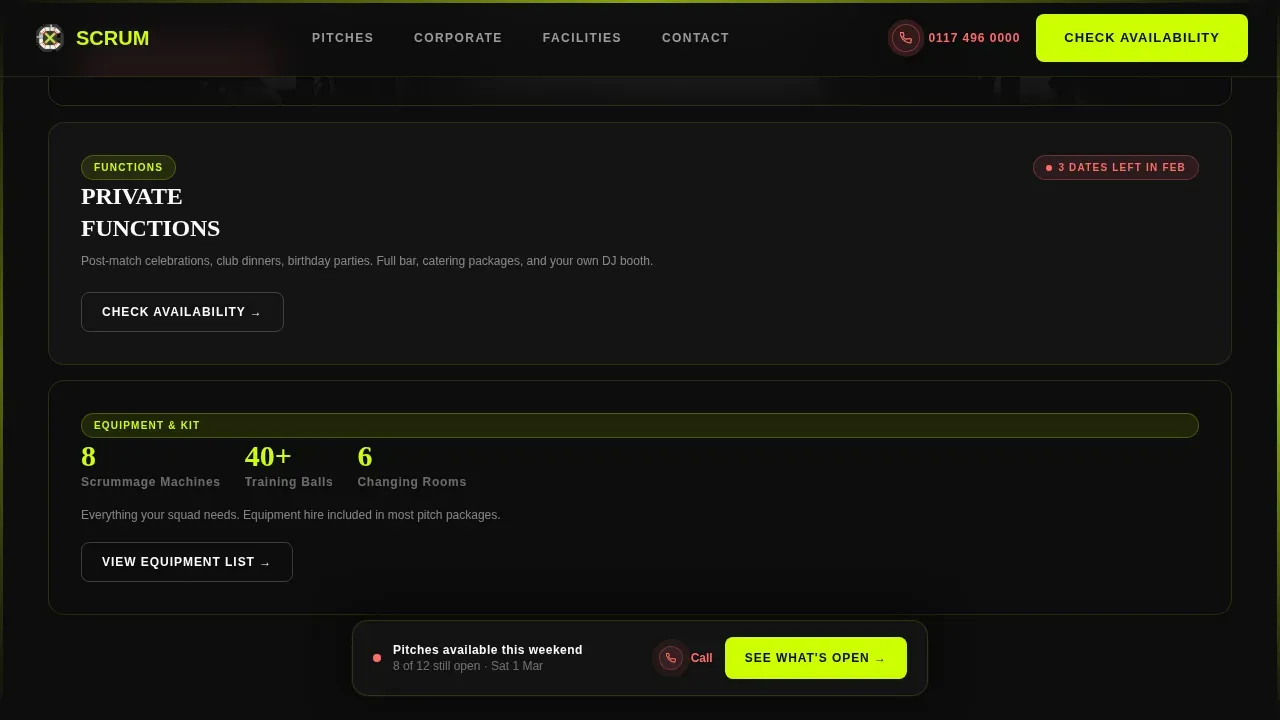
The bento grid is the core of this landing page. Six booking categories sit inside unequal-sized tiles: Pitch Hire, Corporate Matchdays, Academy Camps, Private Functions, Pavilion Events, and Equipment and Facilities. The largest tile showcases a looping video clip of the venue in action. Smaller tiles use bold typography and a single stat, for example "12 Floodlit Pitches" or "Seats 220 for Dinner," to make the scale and capability of the venue immediately legible. Tiles animate with a kinetic bounce on scroll entry, using a staggered pop-in so that each one arrives with energy rather than sliding quietly into view.
Category-Specific Calls to Action per Tile
Each bento tile carries its own call to action tailored precisely to its booking type. "Reserve a Pitch" speaks to a club secretary. "Plan Your Away Day" speaks to a corporate planner. "Enrol Your Player" speaks to an academy director. "Check Availability" speaks to a function organiser. This approach means that every person on the page sees language matched to their actual need, reducing the friction between interest and action. A high-energy design that focuses each tile on a distinct conversion goal is what separates this template from generic venue pages.
Sticky Bottom Bar with Universal Date-Picker Modal
A sticky bottom bar stays fixed as the visitor scrolls. It holds the universal call to action "See What's Open This Weekend," which opens a date-picker modal. The modal asks for date first, then event type, then estimated headcount, keeping the process light and fast. This design keeps friction featherlight because it asks only for essential information. A secondary path on the bar shows a phone number with a pulsing coral ring icon for club secretaries or team leaders who would rather just call and talk the booking through directly.
Animated Stats Bar with Count-Up Numbers
Below the bento grid sits an animated stats bar. Numbers count up on scroll entry, displaying the venue's scale in simple, memorable figures. Stats like the number of floodlit pitches and the dinner-seating capacity of 220 give every visitor a quick, tangible sense of what the venue can handle. This section is especially effective for corporate planners who need to match venue capacity to group size before they even begin a conversation with the booking team.
Testimonial Spotlight Cards
Three testimonial spotlight cards represent the three primary client types: a rugby club, a corporate team, and a wedding booking. Each card uses a photo and a direct quote, providing social proof that the venue delivers for different occasions. Social proof established through testimonials from past attendees, alongside visual elements like crowd photos, is one of the most effective trust signals on a booking-focused page. The spotlight hover interaction adds a layer of interactivity that keeps the section engaging rather than static.
Page sections overview
| Section | Purpose |
|---|---|
| Hero Full-Bleed | Cinematic night-pitch photo, typewriter headline, chartreuse edge glow |
| Bento Grid | Six booking category tiles with staggered bounce animation and live badges |
| Animated Stats Bar | Count-up figures showing venue scale and capacity |
| Testimonial Cards | Spotlight social proof from club, corporate, and wedding clients |
| Location & Facilities | Asymmetric split layout with photo and details grid |
| Sticky Booking Bar | Universal call to action with date-picker modal and phone fallback |
| Footer | Linear single-row footer with key links |
Design & branding system
The visual identity is built on what the brief calls a Dopamine Pop colour system, channelled through a Festival Energy creative direction. The idea is that the page should feel like walking through the tunnel onto a floodlit pitch at night, boots on concrete, lights buzzing alive, grass impossibly green against the black sky. Every design decision supports that sense of charged anticipation.
The typographic pairing of Fraunces for display headings and Manrope for body text strikes the right balance between editorial authority and clear readability. Fraunces carries the weight of a big-match programme cover. Manrope keeps body content legible and clean.
- Colour palette: deep pitch black #0D0D0D for backgrounds, electric chartreuse #CCFF00 for headlines and hover states, hot coral #FF6B6B for urgency buttons and availability badges, and clean kit white #FAFAFA for card surfaces and body text
- Typography: Fraunces for all display and serif headings; Manrope for body copy and utility text
- Visual style: industrial dark with festival energy; floodlit photography; bento tile surfaces in kit white against the black field
Mobile & speed optimization
The template is built desktop-first because its primary users, corporate event planners and club secretaries, are most often working at a desk when they research and book venues. The layout is, however, fully responsive and adapts cleanly across all screen sizes. A mobile-first design approach is essential for any public-facing page, and the bento grid reflows gracefully for smartphone users who may be checking availability pitch-side on a Saturday morning.
Animation is handled through CSS and Intersection Observer, which means the page does not rely on heavy JavaScript libraries to deliver its kinetic bounce effects. This keeps the experience fluid without unnecessary overhead. Fast loading times matter especially on mobile devices, achieved here by keeping the animation layer lightweight and the design decisions deliberate rather than decorative for decoration's sake.
- Animation layer built with CSS transitions and Intersection Observer, avoiding heavy third-party libraries
- Fully responsive bento grid that reflows across desktop, tablet, and mobile breakpoints
- Sticky bottom bar and date-picker modal tested across device sizes to ensure the booking path is always accessible
How this template helps you convert
Conversion on a multi-audience booking page is not one single action. It is a series of small, low-friction steps that lead each visitor type toward a specific commitment. The Scrum template is designed with that reality in mind, and every structural decision from the hero to the footer works toward it.
The template answers the fundamental questions every visitor arrives with: who is this for, what can I book, when is it available, and where do I go next? These questions map directly to the principle that a landing page should answer who, what, when, and where with a clear call to action positioned above the fold. The hero does that job immediately. The bento grid extends it into specific booking lanes. The sticky bar keeps the exit always open toward a booking rather than away from the page.
- The hero captures attention and signals venue quality within the first three seconds, using a full-bleed floodlit photograph and an animated headline that communicates scale and energy before a single word of body copy is read
- The bento grid splits visitors into their relevant booking lane immediately, giving each group a tile, a stat, and a call to action that matches their specific task, so that no visitor is forced to read through content meant for a different audience before reaching their own
- The sticky bottom bar and date-picker modal reduce the final step to three fields, date, event type, and headcount, removing every unnecessary barrier between interest and a confirmed booking
Other information about this template
This section covers additional context that helps buyers understand where this template sits in the broader landscape of rugby venue pages and agile-influenced design thinking.
Rugby as a sport has a long and layered history that shapes the culture of every club that plays it. Rugby emerged as a product of British imperialism in the mid-nineteenth century. The first rugby clubs outside of England were established in the British colonies during the 1860s. Rugby union was introduced to Shanghai in the 1860s, reflecting how far British colonial influence carried the game. The Rugby Football Union (the RFU) was established in 1871, formalising the rules and governance of rugby in England. The split between rugby union and rugby league occurred in 1895 due to disagreements over player payments and professionalism. Rugby league was founded in 1895 as a response to the need for working-class players to receive compensation for time lost from work. The first Rugby League World Cup was held in France in 1954, a significant milestone in the sport's international development. Rugby became a unifying cultural practice in the British Empire, promoted by the ideals of Muscular Christianity. The Southern Rugby Union was formed in Australia in 1874, marking the formal establishment of rugby as an organised sport in that region. The first British rugby tour to Australia took place in 1899, which was controversial due to emerging questions around professionalism.
Rugby has evolved into a sport with different codes, including rugby union and rugby league, each with its own rules and governing bodies. The cultural significance of rugby is evident in its role in fostering camaraderie and community among players and fans. Rugby provides a platform for individuals from diverse backgrounds to come together, promoting inclusivity and teamwork. Rugby fosters camaraderie and community building among players and teams across every level of the game. Players often form long-lasting friendships through their shared experiences in rugby, both on and off the field. Rugby clubs often engage in community service activities, enhancing their connection with local communities. Rugby socials are unique gatherings where players from opposing teams come together after matches to socialise and build friendships. The culture of rugby includes traditions such as singing songs during socials, which fosters a sense of belonging. Rugby matches often serve as a means of cultural exchange, bringing together players from different regions and backgrounds.
From a design and delivery perspective, this template reflects principles that will be familiar to anyone who has worked in agile team environments. The scrum in rugby and the scrum in agile software development share the same core idea: a cross functional group of people organising around a shared goal, with clarity of roles and a commitment to forward progress. The agile manifesto describes values around individuals and interactions, working software, customer collaboration, and responding to change, values that translate directly into good landing page design. A landing page that adapts its messaging to each visitor type, reduces unnecessary process, and removes anti pattern barriers to conversion is, in a real sense, applying agile ideas to web design.
The scrum guide, which is the definitive reference document for the scrum framework, describes the scrum master as someone who serves the team by removing obstacles and facilitating progress. In agile software development, the product owner is responsible for defining what the team builds and in what order. Scrum is a framework that helps teams work together to deliver products incrementally and iteratively, using time-boxed sprints and regular reflection. Scrum encourages teams to inspect and adapt their processes regularly to improve efficiency and effectiveness. Estimation in scrum is typically done using story points, which measure task complexity rather than raw time. Scrum practices such as daily stand-ups are designed to foster transparency and accountability within teams, allowing teammates to share progress and identify obstacles. Effective scrum implementation requires a cultural shift within organisations to support agile principles. Scrum can be misapplied in organisations that do not fully understand its principles, leading to frustration and inefficiency, which is an important anti pattern to guard against. The agile manifesto and the broader agile movement have shaped how teams across many industries, not just software development, think about delivering value. Agile methodologies encourage teams to self-organise, which leads to increased ownership and accountability among team members. Regular retrospectives in agile teams provide opportunities for members to reflect and identify areas for improvement. The role of the scrum master is to facilitate team collaboration and ensure that the scrum framework is followed, helping to remove obstacles that hinder progress. Collaboration in agile is not just about tools and processes but about fostering a culture of trust and respect among team members. Agile project management emphasises collaboration, communication, and adaptability over strict adherence to processes.
From a page design standpoint, urgency tools such as live availability badges and limited capacity messaging encourage quicker booking decisions. Countdown timers can create urgency by showing time remaining for early-bird pricing when applicable. Ticket tiering, or in this case booking-tier messaging, should clearly define different event options to assist visitors in selecting the right category. The call to action should use action-oriented language and feature a contrasting colour for visibility, which is exactly why coral is used for urgency buttons here. A visual hierarchy using what designers call the F-pattern can guide the user's attention and improve navigation across a complex page like this one. Social sharing buttons can encourage users to share their ticket purchases or event bookings on social media platforms, extending reach organically. PosterMyWall and Canva provide customisable, drag-and-drop templates for rugby events if you need supplementary promotional assets alongside this landing page. TemplateMonster offers specialised rugby responsive landing page templates for event promotion, representing one reference point in the wider market. WordPress offers tools like SeedProd and Elementor for building customisable event pages if your workflow requires a content management system integration beyond this template's scope.
This template is also well-suited to venues that support women's teams and mixed-gender programmes, not just the traditional men's sides that have historically dominated rugby's public image. Academy camps for county development officers often include junior pathways and women's teams equally, and the Enrol Your Player tile is broad enough to support that context. The template's inclusive design language means that no specific group is inadvertently excluded from the booking conversation.
For anyone who is a huge fan of the sport and wants to know where it sits globally: rugby is played at competitive level across the world, from England and Wales through to Australia, New Zealand, South Africa, and beyond. Other sports such as american football and soccer share some structural similarities with rugby in terms of field size, team organisation, and the physical demands on players, but rugby has its own distinct rules and culture. American football, for example, uses a forward pass as a core play, whereas rugby rules prohibit forward passes entirely. Soccer, or association football, shares the same British origins as rugby but split from it in the mid-nineteenth century when the Football Association codified its own rules. Football in the broad sense refers to a family of sports, but rugby stands apart by the demands it places on every position across the fifteen players on a union side or thirteen in a league game.
Books on scrum provide an exhaustive resource covering the why and the how of the entire framework. Essential Scrum: A Practical Guide to the Most Popular Agile Process by Kenneth S. Rubin is considered a premier reference for understanding scrum. AI-powered no-code tools like Rocket.new allow users to build production-ready apps from natural language prompts, representing a newer wave of development tools that complement agile delivery. No-code and low-code platforms are becoming increasingly popular among product managers and small businesses for rapid application development.
- The scrum book the ground they'll remember rugby venue landing page template is designed for venues that need to convert multiple distinct visitor types from a single page
- Social proof is built into the design through testimonial spotlight cards and capacity stats that function as trust signals across all visitor types
- High-resolution, action-packed imagery and video clips within the bento tiles capture the atmosphere of the event and the venue
- The hero section includes a high-quality action shot, with the date-picker modal positioned to answer match details, timing, and venue questions immediately above the fold
- An effective landing page template for a rugby venue requires a high-energy design, and the Dopamine Pop palette with Launch Energy creative direction delivers exactly that
Theme
Festival Energy
Creative direction
Launch Energy
Color system
Dopamine Pop
Style
Bento Grid
Direction
Marketplace/Multi
Page Sections
Dark Full-bleed Hero with Animated Headline
Six-category Asymmetric Bento Grid
Category-specific Calls to Action
Sticky Bar and Date-picker Modal
Animated Stats Bar and Testimonial Cards
Dopamine Pop Colour System and Festival Energy Direction
Related questions
Who is this rugby venue landing page template built for?
Does the template support multiple calls to action on one page?
What information does the date-picker modal collect from visitors?
Can this template work for venues that host women's teams and junior academies?
How does the Dopamine Pop colour system reflect a rugby venue's identity?