Plaga — Expert Pest Management Landing Page Template
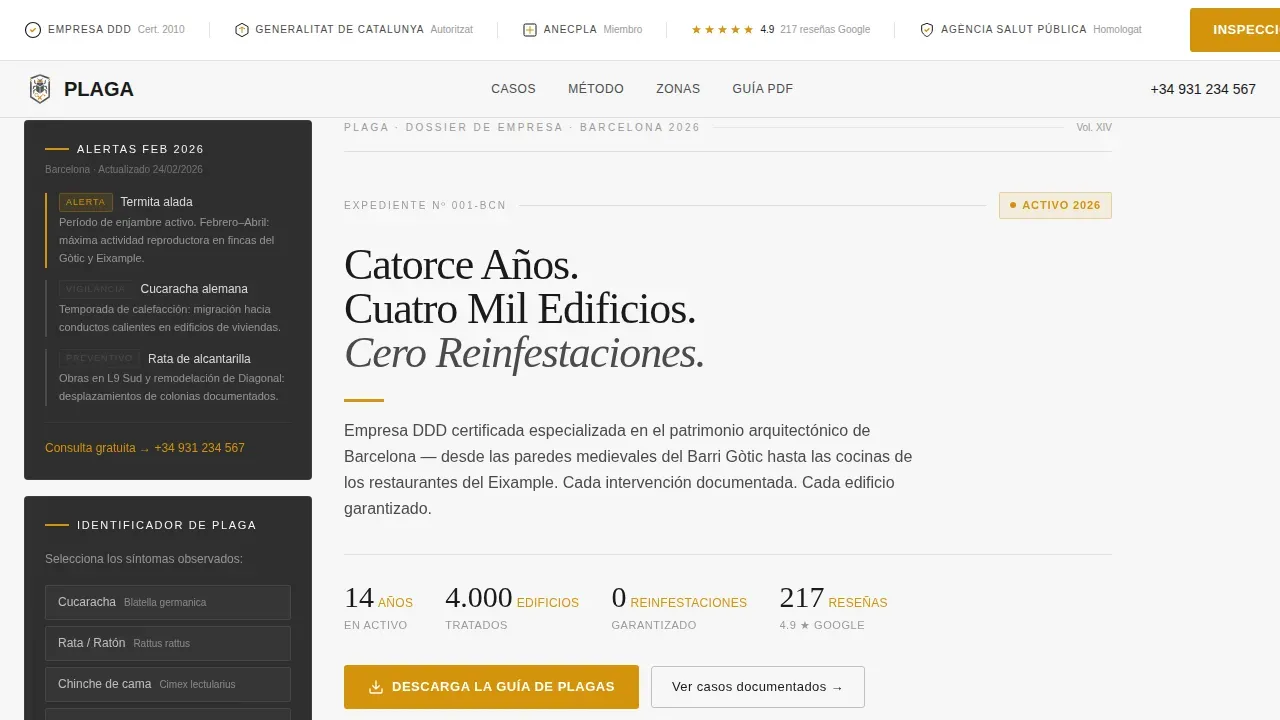
Plaga is an editorial-style pest control landing page template built for licensed extermination businesses serving complex urban properties. It pairs forensic-dossier design with a sidebar companion layout, driving two conversion paths: a gated PDF guide download and a free inspection booking form. Credentials, case studies, and contextual sidebar tools do the selling before a visitor ever picks up the phone.
by Rocket studio
Quick summary
This pest control landing page template turns a service business into a credible editorial authority. It uses a monochrome steel design system, a sidebar companion layout, and three detailed case study features to convert skeptical property managers, community presidents, and restaurant owners into booked inspection clients.
Who this template is for
This landing page is built for pest control service businesses that need more than a basic web presence. It works best when your pest control company serves demanding urban clients who require documented proof before they commit.
- Community presidents managing shared fincas or multi-unit residential buildings facing chronic pest infestations
- Restaurant owners under health authority inspection pressure who need a certified pest control service on record
- Property managers running short-term rental pisos who need fast, verifiable pest management solutions between guest stays
What problem this template solves
Many businesses overlook the power of well-optimized landing pages, losing potential leads due to ineffective design or unclear messaging. A generic pest control website rarely communicates the depth of expertise that high-stakes clients demand. This template solves that gap.
- It replaces vague service claims with structured case study narratives that show the call, the intervention, and the certified resolution
- It positions certifications and licensing marks as the primary visual proof, removing the need for lifestyle photography
- It surfaces a contextual sidebar with a pest identifier widget and neighborhood risk lookup so visitors find relevant information instantly
What you get with this template
You get a fully structured pest control landing page designed around evidence-first storytelling and two clear conversion paths. Every section is built to move a cautious visitor from skepticism to action.
- A header credential ribbon displaying certification seals, licensing marks, and review aggregates as the page's primary trust signal
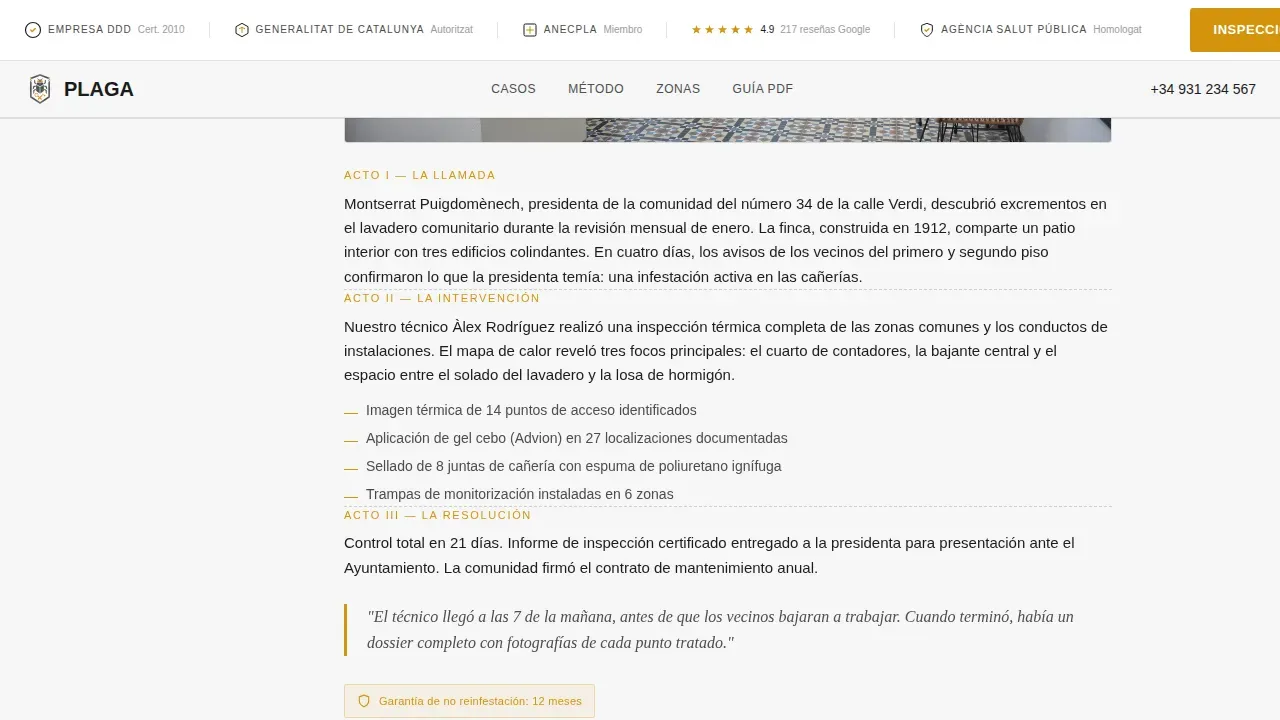
- Three magazine-style case study features running the main content column, each structured as a three-act investigation
- A sticky sidebar with a pest identifier widget, a postal code neighborhood risk lookup, and a seasonal alert panel
Feature list
This landing page template ships with purpose-built components that support every step of the pest control marketing funnel. Each feature is grounded in the design and interaction brief.
Editorial Case Study Narrative Column
Three investigative-style pest control case studies run the main content column. Each follows a call, intervention, and resolution structure. Measurable outcomes such as a 95% reduction in infestations within 30 days or zero recurrence over six months are displayed as case-status indicators in hazard amber. The format acts as a proof point rather than a general service page, giving visitors the evidence they need to book.
Award Badge Header Ribbon
The header presents a horizontal ribbon of credential marks: DDD certification seals, Generalitat de Catalunya licensing, ANECPLA membership crests, and a Google review aggregate shield. No hero image is used. The credentials are the visual, and this restraint signals the same professionalism visitors are hiring for. Displaying local licenses and eco-friendly certifications reassures visitors of the pest control company's expertise before they read a single word of copy.
Dual Conversion Path Design
The primary call to action is a gated PDF guide download, captured behind an email field, a property type selector, and an optional postal code. The secondary call to action, a free inspection booking form with a date picker and phone field, appears in the sidebar after the visitor has scrolled through at least two full case studies. This read-depth trigger earns the ask with evidence rather than urgency, improving conversion rates naturally.
Sticky Sidebar Companion Tools
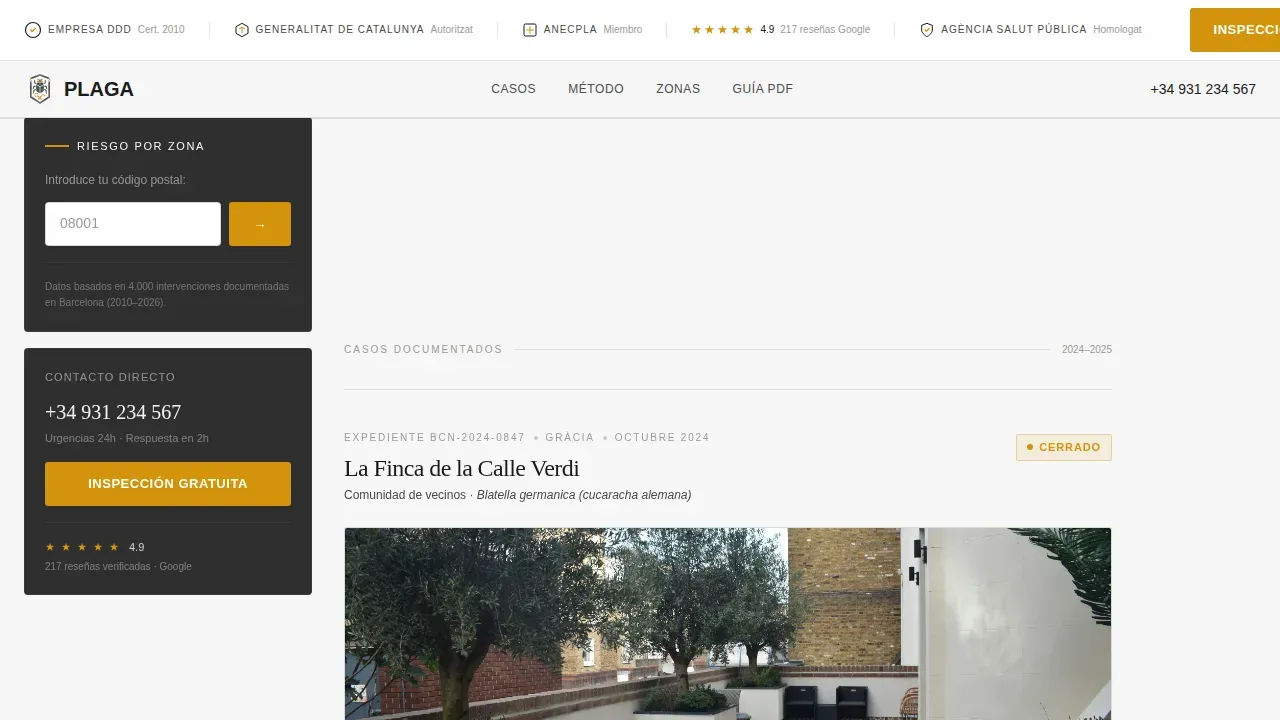
The sidebar runs alongside the main case study column and stays contextually useful throughout the scroll. It includes a pest identifier widget, a neighborhood risk lookup by postal code, and a sticky seasonal alert panel. These tools give users immediate, relevant information and keep the page active between case study sections.
Monochrome Steel Visual System
The design uses foundry black for body text, brushed graphite for sidebar backgrounds and secondary type, and surgical white for the main content column. A single hazard amber accent is reserved exclusively for calls to action, pull-quote rules, and case-status indicators. The palette feels like a forensic report printed on heavy matte stock, authoritative and clinical.
Page sections overview
| Section | Purpose |
|---|---|
| Credential badge ribbon | Display certifications and review trust signals |
| Editorial headline block | Set authority with zero-image, type-only hero |
| Case study one | Gràcia finca call, intervention, resolution |
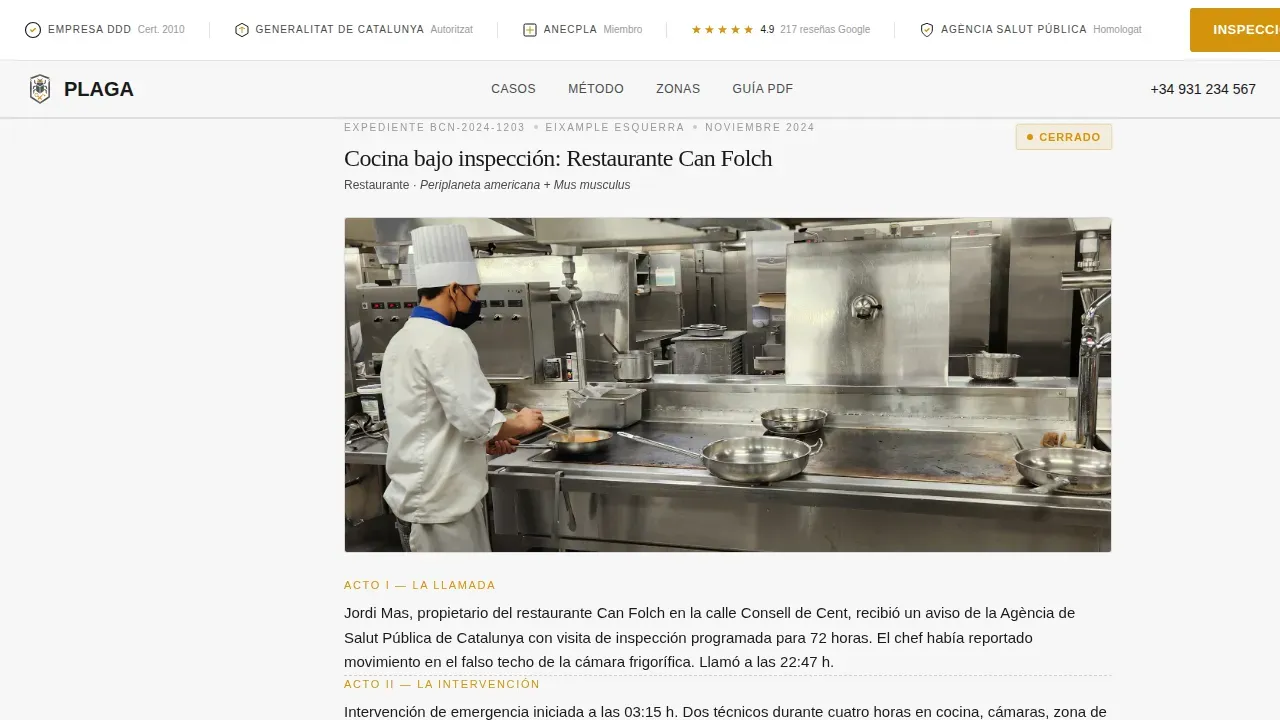
| Case study two | Eixample restaurant inspection narrative |
| Case study three | Barceloneta piso turístico resolution report |
| Pest identifier widget | Sidebar tool for species identification |
| Neighborhood risk lookup | Postal code pest risk by district |
| Seasonal alert panel | Sticky sidebar contextual pest warnings |
| PDF guide gate | Primary lead capture with property selector |
| Inspection booking form | Secondary call to action surfaced after case studies |
| Footer row | Minimal single-row dark footer |
Design & branding system
The design follows an editorial magazine theme built on a monochrome steel color system. Typography uses Fraunces for serif headlines and DM Sans for body copy and interface elements, giving the page a forensic-dossier authority that feels earned rather than designed.
- Foundry black (#1A1A1A) for body text and dividers, brushed graphite (#4A4A4A) for sidebars and secondary type, surgical white (#F7F7F7) for the main content column
- Hazard amber (#D4930D) reserved exclusively for calls to action, pull-quote rules, and case-status indicators to maintain visual discipline
- Scroll-linked reveal animations and a sticky sidebar create a page-turn reading experience without distracting from the case study content
Mobile & speed optimization
The landing page is designed desktop-first to support the sidebar companion layout. On smaller screens, the layout stacks gracefully so pest control services remain accessible to all visitors regardless of device.
- The sidebar tools collapse into inline modules on mobile, preserving the pest identifier and postal code lookup without breaking the reading flow
- Client-side interactive components, including the property type selector and date picker, load only where needed to keep the page static-first
- The read-depth trigger for the inspection booking call to action adapts to scroll depth on both desktop and mobile sessions
How this template helps you convert
A landing page plays a crucial role in turning casual visitors into real customers. This template is structured so that every design and content decision builds toward one of two conversion actions: the PDF guide download or the inspection booking.
- The credential ribbon and editorial headlines establish authority immediately, so visitors trust the pest control service before they reach the first case study
- The three case study features build progressive evidence, showing how previous spray-only methods failed and how targeted Integrated Pest Management practices delivered results, which motivates visitors to book
- The dual call to action system captures visitors at different intent levels: those researching pest management solutions download the guide, while those ready to act book directly from the sidebar form
Other information about this template
This template is well suited for pest control businesses running paid search campaigns. Landing pages built for Google Ads perform best when they match the specificity and authority of the ad copy, and this template's editorial design and credential-led structure support that alignment. A strong sales funnel is critical for pest control companies to maintain customer engagement and drive conversions, and this page supports that funnel from first visit through lead capture.
- Email marketing campaigns can drive traffic directly to the PDF guide gate, making it easy to build a segmented list by property type
- Online reviews and social proof displayed in the credential ribbon help convert search traffic that arrives from local search results
- The template can support integration into a broader pest control website as one of several service pages, or stand alone as a dedicated campaign landing page
- Pest control companies must embrace effective digital marketing strategies to thrive, and this landing page gives any pest control company a credible, conversion-focused starting point
- Users who love clear, action-driven design and want to build authority in a competitive local market will find this template fits naturally into their marketing strategy
- The Plaga editorial pest control case study landing page template is the reference model for this design system, combining editorial restraint with high-converting pest control landing page structure
Theme
Editorial Magazine
Creative direction
Case Study Narrative
Color system
Monochrome Steel
Style
Sidebar Companion
Direction
Content/Resource
Page Sections
Editorial Case Study Narrative Column
Award Badge Header Ribbon
Dual Conversion Path Design
Sticky Sidebar Companion Tools
Monochrome Steel Visual System
Related questions
Who is this pest control landing page template best suited for?
Can I use this template as a standalone page or as part of a larger pest control website?
How does the dual call to action system work?
What makes this landing page different from a standard pest control service page?
Does this template support pest management solutions for different property types?