Pharmaceutical Manufacturing Directory Website Template
Plate is a pharmaceutical-grade electroplating landing page built for process engineers, quality directors, and procurement leads. It uses a zigzag Industry Report layout, a Warm Stone color system, and a cinematic full-bleed hero to present corrosion data, nickel electroless specs, and 21 CFR Part 211 compliance timelines. Every section earns the final click through stacked technical proof.
by Rocket studio
Quick summary
Plate is a single-page, click-through landing page template designed for a pharmaceutical-grade electroplating facility. It presents technical proof in a scrollable Industry Report format, guiding process engineers and quality directors from corrosion failure data through compliance documentation and toward a capabilities review. The design is warm, industrial, and built to earn trust before asking for a click.
Who this template is for
This template is built for industrial B2B facilities operating in pharmaceutical surface finishing and process manufacturing supply chains. It speaks directly to the professionals who decide which plating vendor goes on an approved supplier list.
- Process engineers specifying surface finishes for active pharmaceutical ingredient (API) reactors who need tolerance data before they pick up the phone.
- Quality directors at contract development and manufacturing organizations (CDMOs) preparing for FDA audit readiness and needing a documentation trail they can point to.
- Procurement leads at pharma original equipment manufacturers (OEMs) replacing legacy vendors who cannot hold tight tolerances on nickel electroless or passivation specs.
What problem this template solves
Pharmaceutical electroplating facilities lose qualified leads because their web presence looks identical to a job-shop generalist. Buyers arrive needing technical confidence and leave without it. This template fixes that gap by presenting the facility as a subject-matter authority from the first scroll.
- Visitors see corrosion resistance data, coating thickness tolerances, and compliance timelines before they encounter any sales language, so the page earns credibility instead of requesting it.
- The click-through model removes form friction entirely. No fields to fill, no commitment requested. The page stacks proof until the spec sheet feels like the natural next move.
- The zigzag Industry Report structure presents each section as a discrete technical finding, escalating the cost of choosing the wrong plating vendor so that the final call to action feels like risk mitigation.
What you get with this template
You get a complete, production-ready landing page structured around five content zones, each crafted to move a technical buyer closer to requesting the capabilities document. The layout is zigzag alternating, meaning visual weight shifts left and right with every section, keeping the scroll dynamic and the content readable at a workstation.
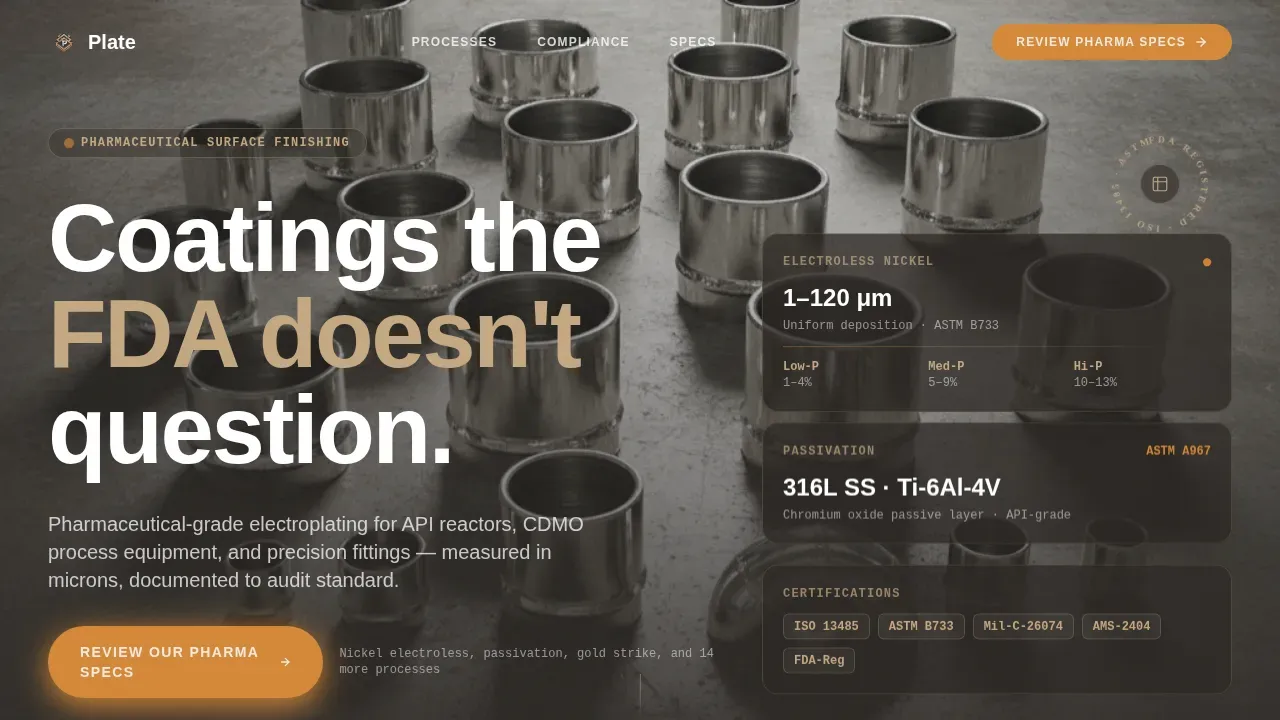
- A full-bleed photo hero with a fade-in headline, glassmorphic spec cards, and ambient sodium-light amber tones pulled from a live plating line shot.
- Four zigzag content modules covering corrosion failure comparison data, nickel electroless magnification specs, 21 CFR Part 211 compliance timelines, and a risk-and-cost-of-failure closing section.
- A repeating "Review Our Pharma Specs" call to action (call to action) with rotating contextual micro-lines that change after every second module, reinforcing the certification and process breadth without repeating the same line twice.
Feature list
This section describes the built-in structural and design features included in the Plate template, drawn directly from the source brief.
Cinematic Full-Bleed Hero Section
The hero opens with a full-bleed photograph shot from inside a live plating line. Pharmaceutical fittings hang suspended mid-dip above an electrolyte bath, with shallow depth of field keeping the plated components razor-sharp while background tanks blur into soft industrial atmosphere. A headline fades in over the lower third: "Coatings the FDA doesn't question." Glassmorphic spec cards float at the fold break, surfacing key data before the visitor scrolls. GSAP scroll reveals and a parallax effect on the hero image add motion without distraction.
Zigzag Alternating Content Modules
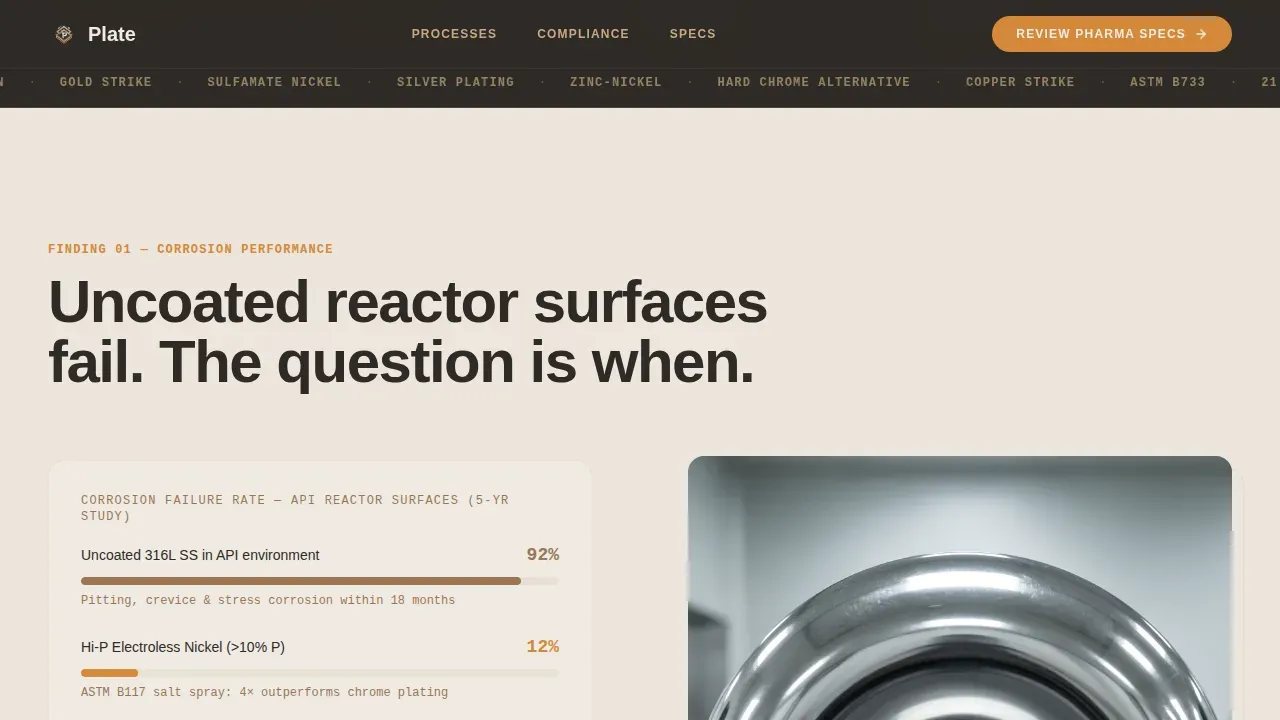
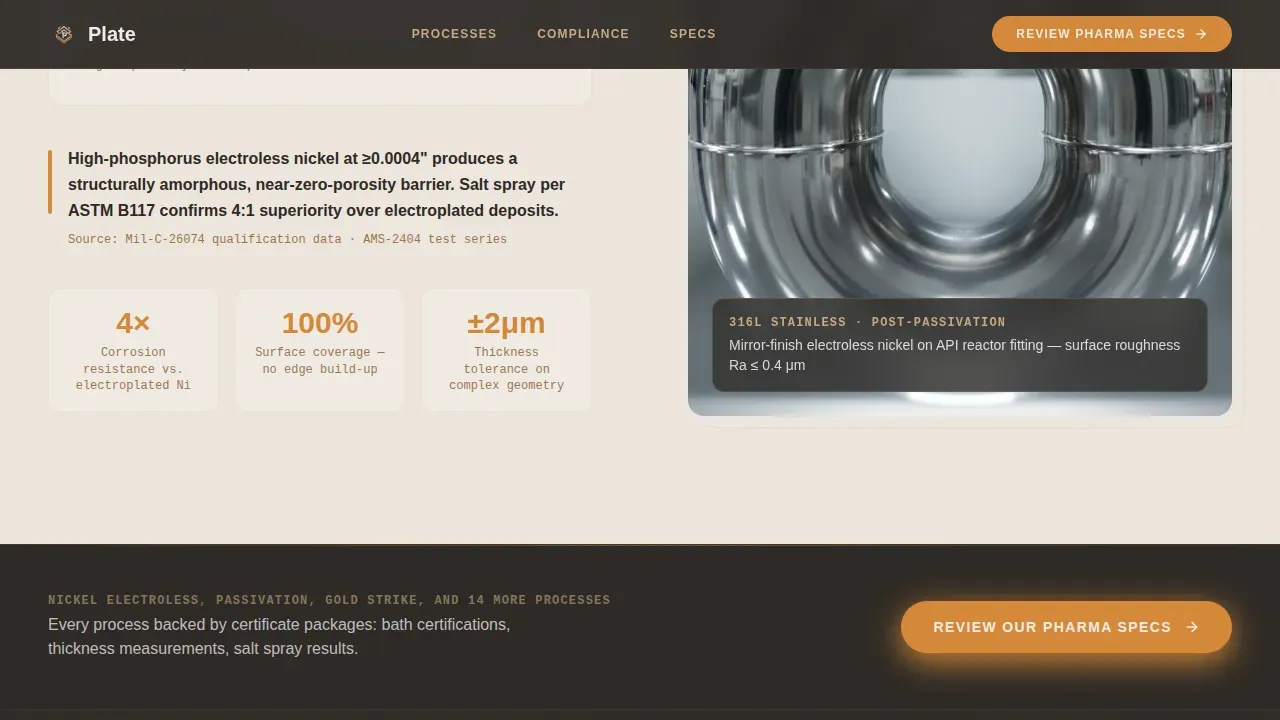
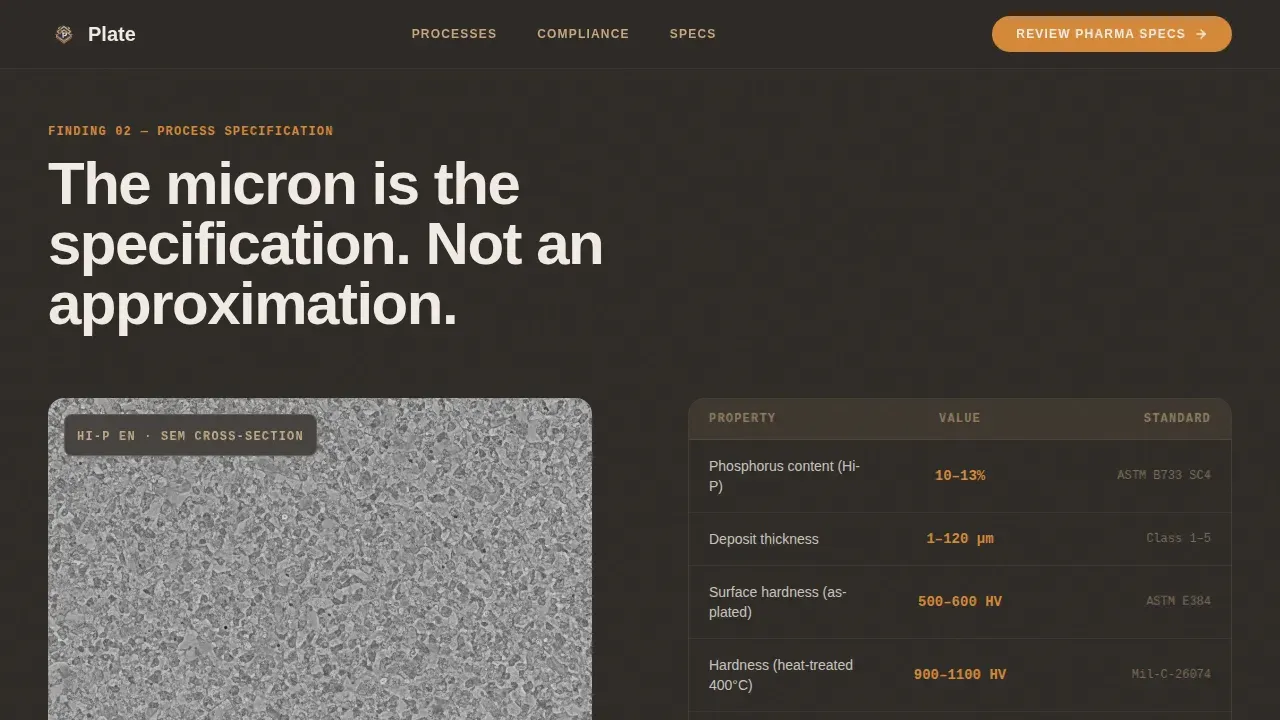
Four zigzag modules alternate visual weight left and right as the visitor scrolls. Each module is structured like a finding in a technical white paper, presenting one discrete data point or compliance argument per section. Section one compares corrosion failure rates on uncoated versus electroplated reactor surfaces as a stark data callout. Section two pairs a close-up magnification photo of nickel electroless coatings with ASTM B733 tolerance table data. Section three maps the facility's documentation package to a 21 CFR Part 211 compliance timeline. Section four closes with cost-of-failure statistics covering yield loss, audit citation rates, and unplanned shutdown hours.
Repeating Contextual Call to Action
The primary call to action, "Review Our Pharma Specs," appears first at the fold break and repeats after every second zigzag module. Each instance carries a different contextual micro-line beneath it. The first reads: "Nickel electroless, passivation, gold strike, and 14 more processes." The second reads: "ISO 13485 · ASTM B733 · FDA-registered facility." This pattern reinforces breadth and credibility without using the same line twice. There is no form on this page. The click earns itself.
Warm Stone Industrial Design System
The template uses a five-color Warm Stone palette: quarried sandstone (#C4A882), kiln-fired clay (#9B7653), deep furnace charcoal (#2E2A26), pale reagent white (#F0EBE3), and molten copper (#D4883A). Copper is reserved strictly for call to action buttons and data callouts, creating a visual hierarchy that guides the eye without competing with the content. Typography uses DM Sans for headlines, Manrope for body and spec copy, and JetBrains Mono for measurement data and tolerances. The combination makes technical data feel precise and tactile, not sterile.
GSAP Animation and Interactivity
Medium-weight animations power the scroll experience. GSAP scroll reveals fade each section in as it enters the viewport. Data callouts stagger into view to simulate a live report populating. A marquee banner runs across a section break. call to action buttons include hover depth states. The hero uses a parallax scroll effect. These tools are configured to feel deliberate and industrial, not decorative.
Linear Single-Row Footer
The footer follows a Pattern 1 Linear Single-Row layout. It carries certification badge references, contact essentials, and the facility's regulatory framework identifiers in a clean horizontal strip. The footer does not introduce new conversion elements; it reinforces trust with credentials and closes the page cleanly.
Page sections overview
| Section | Purpose |
|---|---|
| Full-Bleed Hero | Establishes facility authority with a cinematic plating-line photo, fade-in headline, and glassmorphic spec cards at the fold break |
| Corrosion Failure Data | Zigzag-left module presenting a stark data comparison between uncoated and electroplated reactor surfaces to open the risk argument |
| Nickel Electroless Specs | Zigzag-right module pairing a magnification close-up photo with ASTM B733 tolerance data to demonstrate process precision |
| 21 CFR Compliance Timeline | Zigzag-left module mapping the facility's documentation package to FDA 21 CFR Part 211 audit requirements |
| Risk and call to action Close | Final module escalating cost-of-failure statistics and presenting the definitive "Review Our Pharma Specs" call to action |
| Linear Footer | Single-row footer carrying certification identifiers and contact essentials |
Design & branding system
The Plate template uses an Industrial Raw theme expressed through a Warm Stone color system. The palette is drawn from the physical environment of a metallurgist's workbench: warm alloys cooling on raw stone, technical without being sterile. Every color decision serves a function.
- Color system: Quarried sandstone (#C4A882) and pale reagent white (#F0EBE3) handle open space and backgrounds. Kiln-fired clay (#9B7653) anchors mid-tones. Deep furnace charcoal (#2E2A26) carries headlines and data. Molten copper (#D4883A) appears only on call to action buttons and numeric data callouts, creating a focal hierarchy that pulls the eye exactly where conversion happens.
- Typography: DM Sans drives headline hierarchy at large weights. Manrope handles body copy and spec descriptions with clean legibility at workstation screen sizes. JetBrains Mono renders measurement values, thickness tolerances, and process data in monospace, making micro-level numbers feel authoritative and easy to scan.
- Visual direction: The Industry Report creative direction means each section reads like a finding in a published technical document. High-quality plating-line photography, magnification close-ups, and data comparison layouts give the page a white-paper quality that resonates with engineers and quality directors who read primary sources.
Mobile & speed optimization
The Plate template is built desktop-first, reflecting the primary use case of engineers reviewing specs at a workstation. However, it remains fully mobile-responsive, which is essential given that nearly half of business-to-business (B2B) traffic arrives on mobile devices. Every layout breakpoint is handled so that zigzag modules stack cleanly on smaller screens without losing the alternating rhythm.
- Performance approach: Static sections use server components for efficient rendering. Images are optimized to reduce load on the full-bleed hero and magnification module. GSAP animations are configured at medium weight, keeping motion smooth without blocking content delivery.
- Responsive behavior: The zigzag alternating layout collapses to a single-column stack on mobile. call to action buttons scale to full-width tap targets. The marquee banner and data callout stagger animations remain active on mobile to preserve the scroll experience engineers expect when reviewing a technical brief on a tablet or phone.
How this template helps you convert
Plate is built around one conversion goal: a qualified click through to the capabilities and certifications page. Every design and content decision supports that single outcome. There are no forms, no pop-ups, and no sidebar distractions. The page focuses the visitor's attention entirely on building the case for the click.
- Proof stacking by section: Each zigzag module adds a new layer of technical evidence. Corrosion failure rates establish the stakes. Nickel electroless tolerance data demonstrates process precision. The 21 CFR Part 211 compliance timeline shows the documentation is already audit-ready. By the time the visitor reaches the final call to action, the spec sheet feels essential, not optional.
- Contextual call to action repetition: The "Review Our Pharma Specs" button appears multiple times with a different micro-line each time. This pattern reinforces process breadth and certification credibility without feeling repetitive. Each appearance is earned by the section above it.
- Risk escalation narrative: The closing module presents yield loss figures, audit citation statistics, and unplanned shutdown hours. This reframes the click as risk mitigation rather than a sales action, which is the precise framing that resonates with quality directors and procurement leads who are accountable for those numbers.
Other information about this template
The Plate template sits at the intersection of pharmaceutical manufacturing and precision surface finishing, a niche where technical credibility is the primary purchase driver. Understanding the underlying science of electroplating helps contextualize why this template is structured the way it is, and why each content module covers the topics it does.
Electroplating is a process that involves coating a substrate with a thin layer of metal or alloy to improve its corrosion resistance, mechanical properties, or functional surface characteristics. At the core, metal ions are drawn from an aqueous solution and deposited onto the base metal surface through electrochemical reactions at the electrode and electrolyte interface. Faraday's law governs the relationship between current density, time, and the mass of metal deposited, making it the fundamental driving force behind precise thickness control. When current density is held too high or too low, the deposited layer becomes uneven, which can undermine corrosion protection across the full surface area of a component.
In pharmaceutical applications, the range of materials that can be processed is broad. Stainless steel and titanium are the most common substrates for API reactor components. Nickel is the workhorse coating for corrosion resistance on ferrous materials, applied as both electroplated and electroless variants. Electroless nickel plating depends on sodium hypophosphite as the reducing agent in an aqueous solution, producing a uniform thin layer across complex geometries without external electrical power. The resulting alloy of nickel and phosphorus delivers high hardness values that conventional electroplating may not match on the same material geometry.
Beyond nickel, pharmaceutical-grade facilities commonly apply precious metals such as gold, silver, platinum, palladium, rhodium, and ruthenium to specific components where conductivity, inertness, or biocompatibility is required. A gold strike, for example, is a thin initial gold layer deposited before a thicker gold or other precious metals finish, improving adhesion to the base metal. Silver provides excellent surface conductivity and is used where a copper layer alone cannot meet the electrical or antimicrobial specification. Brass components occasionally require surface treatments that combine zinc and copper alloys in a plating bath before a final precious metals or protective coating is applied.
The quality of electroplated surfaces is influenced by several environmental factors: bath temperature, electrolyte composition, current density uniformity, and the cleanliness of the substrate surface area before deposition begins. These same factors affect the mechanical properties of the deposited alloy, including high hardness, ductility, and adhesion strength. Faraday's law provides two values that operators monitor continuously: the theoretical mass of metal deposited per unit of charge, and the actual efficiency ratio achieved in the bath. Deviations between these two values indicate contamination, bath drift, or anode degradation, all of which trigger quality control interventions before any component ships.
Electroplating processes in pharmaceutical manufacturing are classified differently from those in the electronics industry or decorative finishes applications, even when the technique and materials overlap. In a pharma context, every process step is documented against 21 CFR Part 211 requirements. Coating thickness is verified to a maximum thickness specification per lot, not just a nominal range. Procedures are written, reviewed, and revision-controlled. The operation of each plating line is tied to a batch record that can be produced during an FDA inspection without delay.
The Plate template is designed to communicate all of this to a technical buyer without requiring them to already know it. The Industry Report creative direction means each section presents a specific finding with data to back it up. The absence of a form removes any barrier between the visitor and the click. The repeating call to action with rotating micro-lines surfaces the breadth of processes available, covering nickel electroless, passivation, gold strike, and additional plating techniques in a single contextual line. This approach is consistent with how high-performing pharmaceutical supplier landing pages are structured: focused on a single goal, heavy on technical proof, and clear about what the next step is.
From a template design perspective, the Plate page includes a material compatibility reference in its spec card components, certification badge placements in the hero and footer, and high-contrast call to action buttons that guide the user's eye without competing with the data-heavy content zones. These tools collectively support the conversion goal while keeping the page honest about what it is: a technical brief, not a brochure.
The template is built using Next.js server components for static section rendering and optimized image handling for the full-bleed hero and magnification module. Animation is handled by GSAP at medium weight, covering scroll reveals, staggered data callouts, parallax on the hero, and hover states on interactive elements. The marquee banner between sections adds kinetic energy to an otherwise structured, document-like layout.
For facilities in scientific research contexts or adjacent process manufacturing industries, the same template structure applies cleanly. The corrosion failure data section can be repopulated with sector-specific statistics. The compliance timeline can reference ISO 13485, ASTM B733, or other applicable standards depending on the target audience. The design system is flexible enough to carry different content while maintaining the warm, technical, industrial character that makes the Plate template distinctive in a category where most supplier pages look generic.
The plate precision pharmaceutical electroplating landing page template is purpose-built for this niche. It is not a repurposed general industrial template. Every structural decision, from the zigzag module sequence to the absence of a contact form, reflects the buying behavior of engineers and quality directors who make high-stakes surface finishing decisions only after thorough technical review.
- The template supports desktop-first rendering with full mobile-responsive behavior for buyers reviewing specs on tablets or mobile devices.
- Certification identifiers including ISO 13485, ASTM B733, and FDA-registered facility status are positioned in the hero spec cards and the linear footer for immediate credibility signaling.
- The marquee banner component adds a continuous scrolling strip of process capabilities or certification badges between content modules, reinforcing breadth without interrupting the zigzag narrative.
- Stainless steel and titanium substrate photography in the hero and close-up modules reflects the actual materials processed, making the imagery specific rather than generic stock.
- The template's color system ensures that molten copper (#D4883A) appears only on interactive elements, preserving its signal value throughout the scroll experience.
- Social proof placement, including certification logos and technical data callouts, is built into the template structure rather than added as an afterthought.
Theme
Industrial Raw
Creative direction
Industry Report
Color system
Warm Stone
Style
Zigzag/Alternating
Direction
Click-Through
Page Sections
Cinematic Full-bleed Photo Hero
Zigzag Industry Report Modules
Contextual Repeating Call to Action Pattern
Warm Stone Industrial Design System
GSAP Scroll Animation Suite
Linear Single-row Footer
Related questions
What industries or buyers is this template best suited for?
Does this template include a contact form?
Can the zigzag modules be adapted for different plating processes or compliance frameworks?
What animation is included in this template?
How does the repeating call to action system work?