Precision Electroplating Landing Page Template
Plate is a split-screen landing page template built for precision electroplating and construction plating facilities. It guides technical buyers through an escalating timeline of process proof, anchors trust with a twelve-metric comparison table, and closes with a spec-submission form. The Engineering Blueprint theme and Fire & Earth color system give every section the credibility industrial clients expect.
by Rocket studio
Quick summary
Plate is a single-page template designed for industrial electroplating facilities targeting structural fabricators, heavy equipment manufacturers, and general contractors. A cross-sectional infographic header, a scroll-driven process timeline, and a persistent comparison table work together to turn technical skeptics into qualified leads before the first form field appears.
Who this template is for
This template is built for businesses that need to communicate precision, process depth, and coating expertise to technically demanding buyers. If your clients arrive with a specification sheet rather than a mood board, this layout speaks their language.
- Electroplating and construction plating facilities quoting bridge and structural steel contracts
- Heavy equipment suppliers and original equipment manufacturers specifying corrosion protection for offshore or industrial applications
- Industrial surface finishing operations pursuing mil-spec or ASTM-certified coating work
What problem this template solves
Commodity plating shops look identical online. A technically rigorous facility loses work simply because its website cannot demonstrate the gap between its process and a low-cost competitor. Buyers need proof before they commit a drawing or a volume estimate.
- Engineers cannot distinguish coating uniformity, hydrogen embrittlement relief, or rack versus barrel capability from a generic services page
- Procurement teams lack a shareable comparison document to justify a premium supplier internally
- Visitors leave without understanding why surface preparation quality directly determines coating adhesion and long-term performance
What you get with this template
You get a fully structured, single-page layout that carries a technical buyer from first impression to conversion-ready action. Every section is purposeful and pre-built, so you replace content without rebuilding structure.
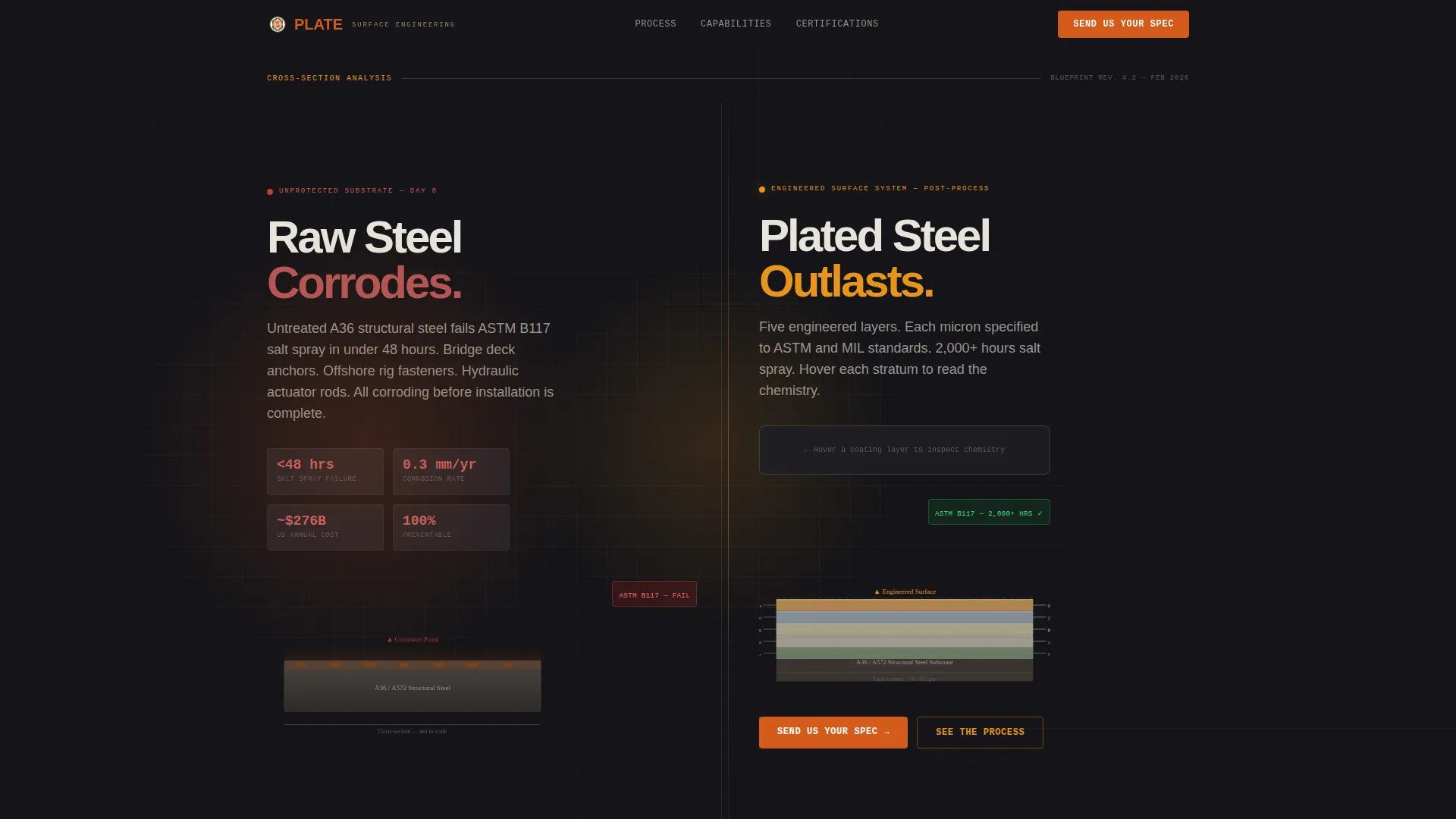
- A 50/50 split-screen layout pairing process schematics on the left with outcome data on the right throughout the scroll
- A cross-sectional blueprint infographic header showing coating layers, micron thicknesses, chemical compositions, and ASTM spec callouts
- A twelve-metric comparison table, a dual-path conversion section with spec-submission form and guide download, and a scroll-driven production timeline
Feature list
A brief introduction to the core capabilities built into this template follows below. Each feature is grounded in the layout and interaction design described in the source brief.
Cross-Sectional Coating Diagram Header
The header renders a blueprint-style cross-section of a plated steel substrate. The left half shows bare steel with surface corrosion; the right half peels back five distinct coating layers, each color-coded and labeled with micron thickness, chemical composition, and the relevant ASTM specification number. Thin annotation lines connect each layer to floating data cards, replacing stock photography with engineered proof.
Scroll-Driven Process Timeline
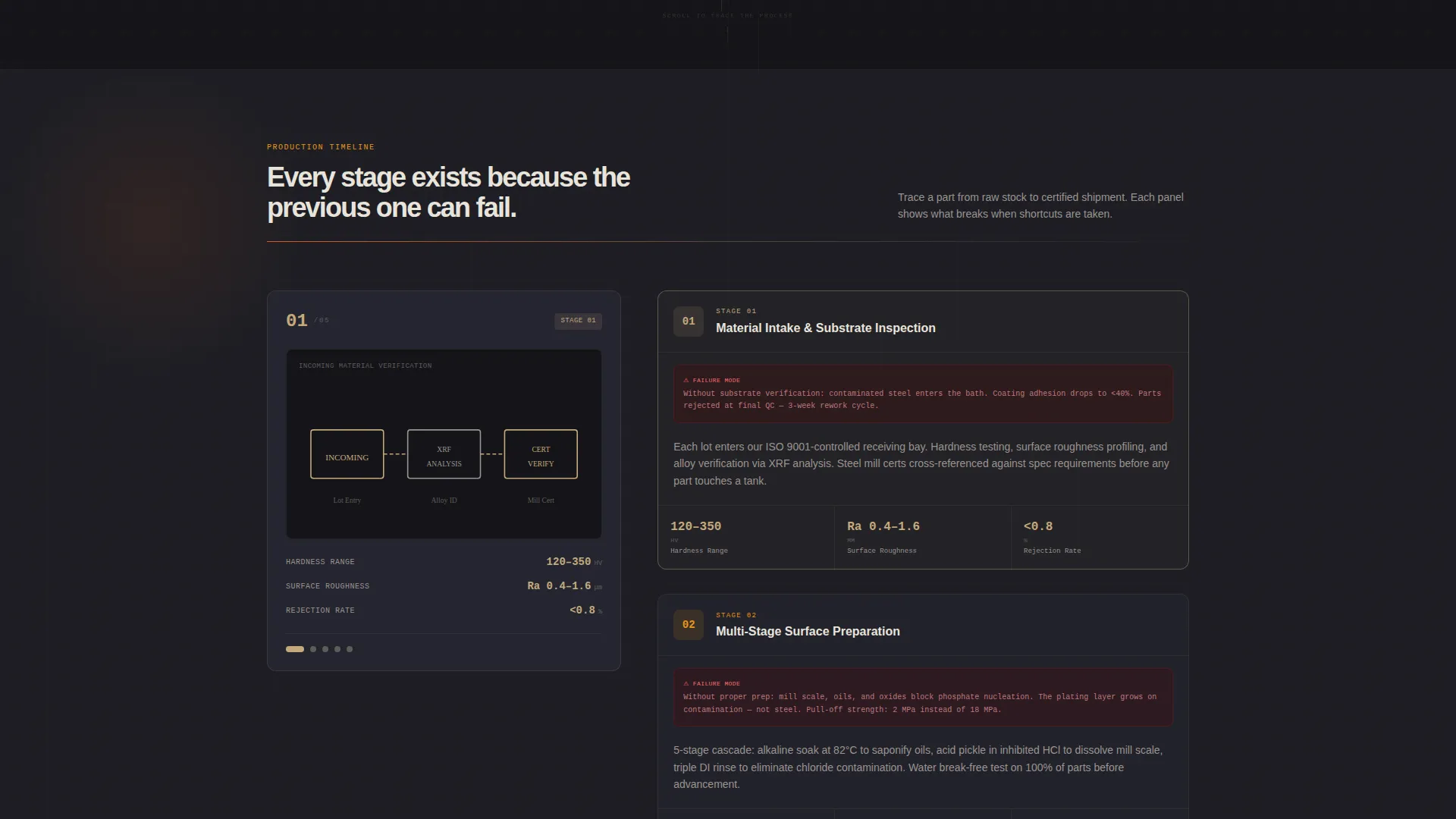
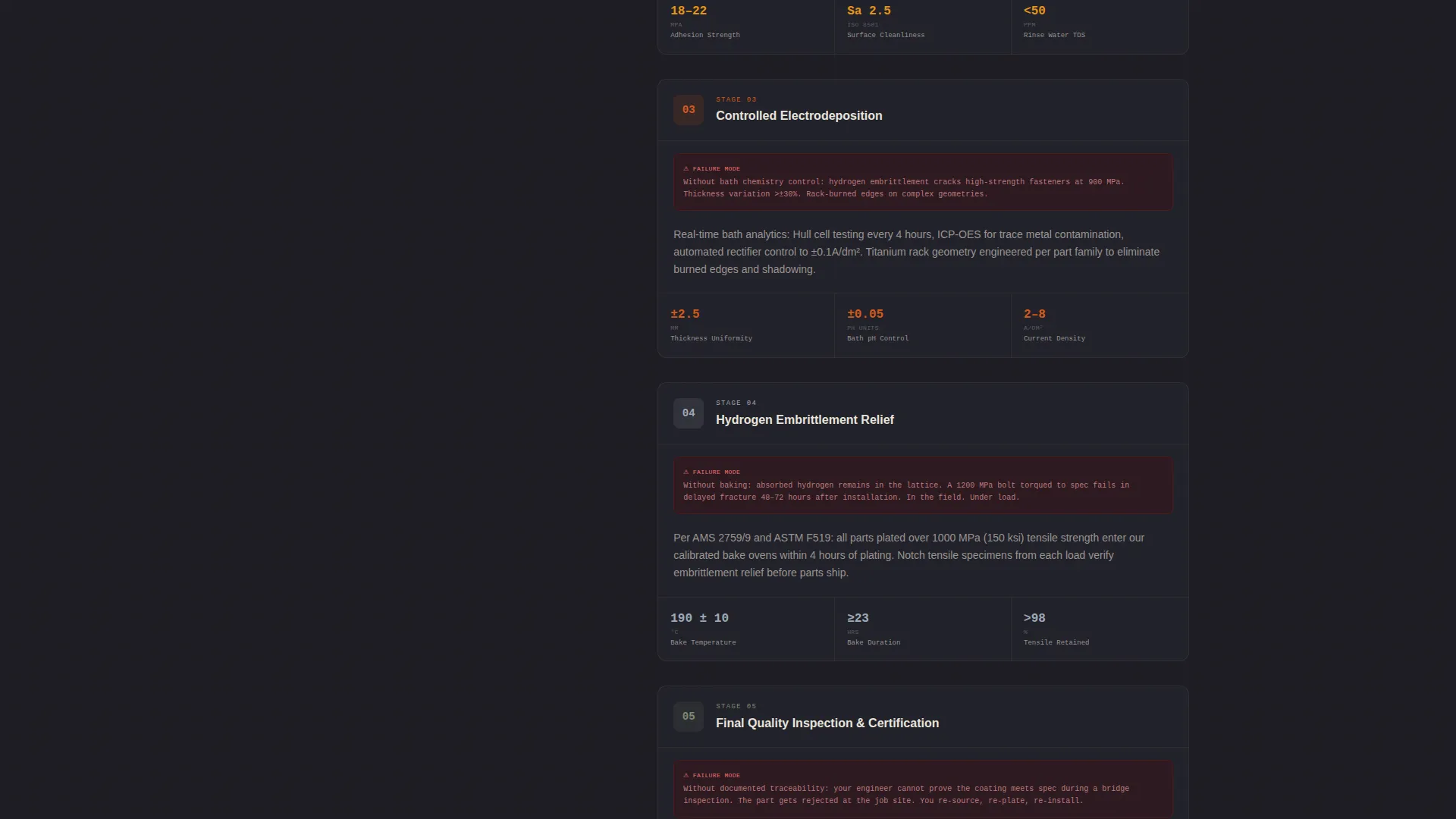
The page unfolds as a production timeline, moving from raw material intake through chemical bath processing to final quality inspection. Each timeline stage pairs a technical schematic on the left panel with measurable outcome data on the right, such as salt spray hours survived or coating thickness readings. The narrative escalates by showing what would fail without each preceding step.
Twelve-Metric Comparison Table
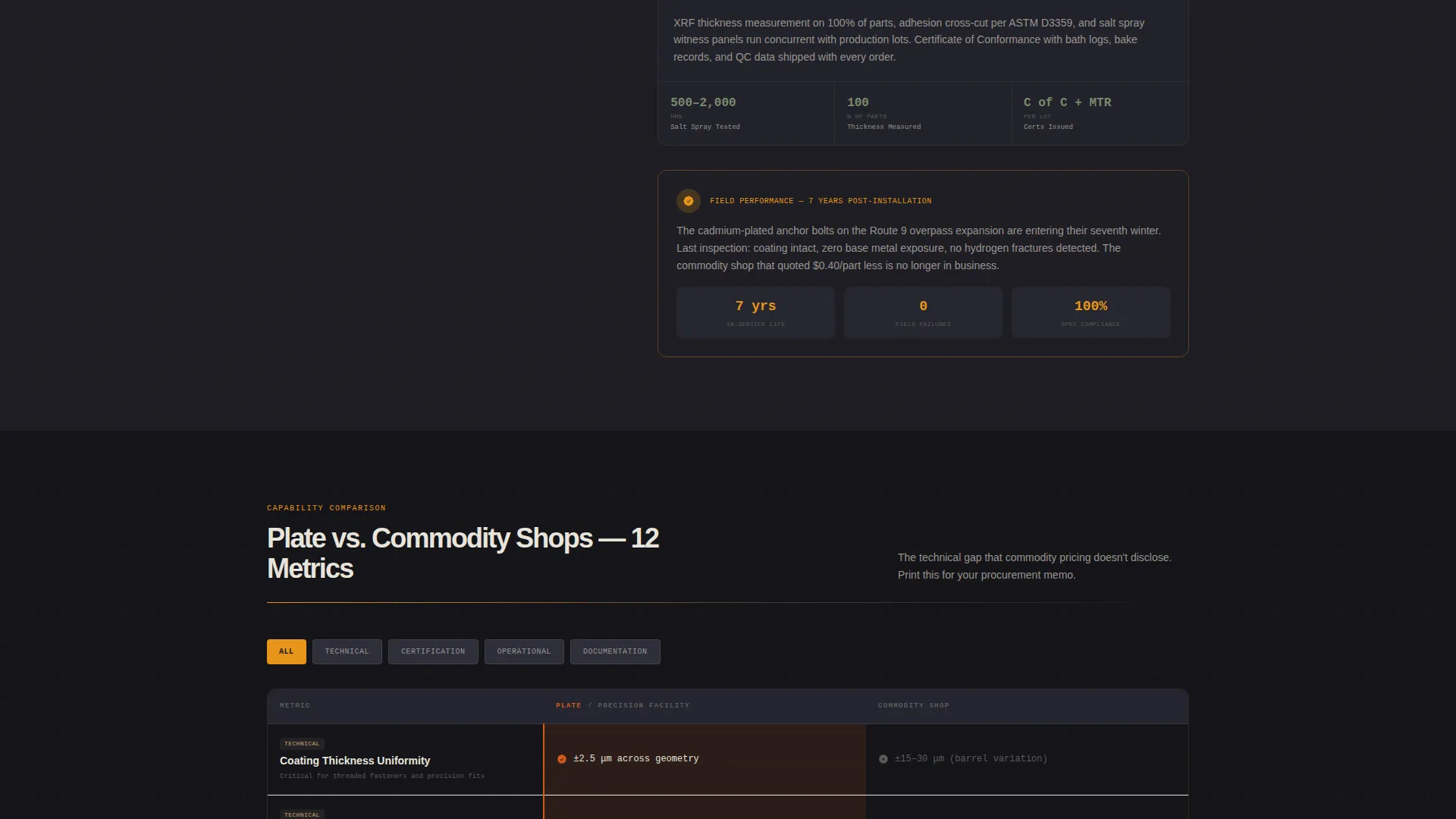
A persistent split-panel table anchors the lower third of the page. It benchmarks the facility's processes against commodity plating shops across twelve criteria, including coating uniformity, hydrogen embrittlement relief, rack versus barrel capability, mil-spec certifications, and prototype turnaround time. The table makes the technical gap visible before any call to action appears.
Dual-Path Conversion Section
Two conversion paths serve buyers at different stages. The primary call to action, labeled "Send Us Your Spec," includes fields for substrate material, required finish selected from a dropdown of MIL and ASTM standards, annual volume estimate, and a drawing upload. The secondary path, "Download Our Plating Comparison Guide," captures engineers still researching who need a document to attach to an internal procurement memo.
Engineering Blueprint Visual Theme
The Fire & Earth color system applies forge orange to primary calls to action, molten bath amber to active states and hover interactions, deep foundry charcoal to page backgrounds, and calcium earth tan to data tables and specification blocks. The palette evokes an electroplating tank under halogen shop lights, giving dense technical content a readable, industrial feel without decorative distraction.
Page sections overview
| Section | Purpose |
|---|---|
| Blueprint Header Diagram | Establish coating expertise through annotated cross-sectional infographic |
| Raw Material Intake | Open the timeline at the start of the production process |
| Surface Preparation Stage | Show why prep quality determines coating adhesion |
| Chemical Bath Processing | Visualize the plating process with technical schematic |
| Coating Thickness Verification | Present measurable outcome data alongside process step |
| Salt Spray Test Results | Escalate proof with survivability metrics |
| Final Quality Inspection | Close the timeline at the finished, field-ready part |
| Comparison Table | Benchmark facility against commodity shops across twelve metrics |
| Spec Submission Form | Capture qualified leads with substrate and finish detail fields |
| Guide Download Path | Convert research-phase engineers with a downloadable comparison document |
Design & branding system
The visual identity follows an Engineering Blueprint theme throughout. Dark backgrounds, amber accents, and orange calls to action create a hierarchy that guides the eye from proof to action without decoration getting in the way.
- Color system uses forge orange (#D45A1B) for primary calls to action, molten bath amber (#E8951A) for hover and active states, deep foundry charcoal (#1E1E24) for backgrounds, and calcium earth tan (#C4A97D) for data tables and specification blocks
- Blueprint-style rendering treats diagrams as the primary visual language, with annotation lines, layer callouts, and schematic panels replacing photography across all sections
- The split-screen 50/50 layout keeps technical schematics and outcome data in constant visual dialogue, reinforcing the cause-and-effect logic of the timeline narrative
Mobile & speed optimization
The split-screen layout and detailed infographic sections are designed to remain clear and functional across screen sizes. Technical content that serves desktop engineers still needs to load and read cleanly on mobile devices used on job sites or in procurement offices.
- The 50/50 panel structure is built to reflow for narrower viewports, keeping schematic and outcome content accessible without horizontal scrolling
- Data tables, specification blocks, and the comparison table use the earth tan background treatment to maintain readability and visual separation at smaller sizes
How this template helps you convert
The conversion logic in this template is built around earned trust, not interruption. By the time a visitor reaches the form, the timeline and comparison table have already made the argument.
- The scroll-driven timeline builds cumulative proof, showing the consequence of each process step so that visitors arrive at the comparison table already convinced that process depth matters.
- The twelve-metric comparison table makes the gap between this facility and commodity alternatives specific and visual, removing the need for a buyer to take the claim on faith before submitting a spec.
- The dual conversion paths serve two distinct buyer stages at once, capturing both the decision-ready engineer submitting a drawing and the research-phase buyer who needs a PDF to share internally.
Other information about this template
This template is categorized under Manufacturing & Industrial, with a subcategory focus on Construction Manufacturing and a niche alignment to Construction Plating and Electroplating. It carries an intersection match score of 13, reflecting strong alignment between the template design system and the target niche.
- The template is structured as a single landing page, not a multi-page website, making it focused and fast to deploy for a specific facility or service offering
- The drawing upload field in the spec-submission form directly supports the way structural fabricators and original equipment manufacturers initiate supplier conversations
- The "Download Our Plating Comparison Guide" secondary path is designed for engineers who need an internal procurement document, addressing a real stage in industrial buying cycles
- The no-photography approach, relying entirely on the blueprint diagram and schematic panels, keeps the visual language consistent with the technical credibility the audience expects
Theme
Engineering Blueprint
Creative direction
Timeline Progression
Color system
Fire & Earth
Style
Split Screen (50/50)
Direction
Comparison/Versus
Page Sections
Cross-sectional Coating Diagram Header
Scroll-driven Process Timeline
Twelve-metric Comparison Table
Dual-path Conversion Section
Engineering Blueprint Visual Theme
Related questions
Can I edit the coating layer labels in the header diagram?
Does the comparison table support more or fewer than twelve metrics?
Is the spec-submission form connected to any external service?
Who is the secondary download conversion path meant for?
Does the template work for a facility that offers more than one plating process?