Charity & Fundraiser Profile Patient Education Website Template
Pledge is a masonry-style education fundraiser landing page built for school communities ready to turn goodwill into real funding. It combines a cinematic Type Over Image header, story-driven Creator Spotlight cards, and a low-friction inline lead generation form to move parents, alumni, and local supporters from first glance to campaign launch.
by Rocket studio
Quick summary
Pledge is a single-page education fundraiser template with a masonry card layout, a full-bleed photographic header, and a progressive inline form. It speaks directly to the people closest to a school, turning personal connection into fundraising momentum. The design balances handcrafted warmth with an unexpected iridescent edge.
Who this template is for
This template is built for anyone who cares deeply about a school and has decided to do something about its funding gap. It is not a generic charity page. Every design decision assumes the visitor already has a personal stake in the outcome.
- Parent-Teacher Association treasurers managing donation shortfalls and campaign logistics
- Headteachers and governors seeking community backing for capital projects
- Alumni committee chairs running homecoming or legacy fundraising drives
What problem this template solves
School fundraising often fails not because the cause is weak, but because the page is cold. Generic donation forms do not communicate urgency, community, or trust. Pledge solves the emotional disconnect between a school's real needs and the people most likely to fund them.
- Visitors arrive with goodwill but leave without acting because nothing felt personal enough
- Fundraisers lack a visual storytelling structure that builds a cumulative case for giving
- Prospective supporters need social proof before they commit, and most templates provide none
What you get with this template
You get a fully structured, single-page fundraiser layout that is ready to populate with your school's story, campaign creator profiles, and donation milestones. Every section has a clear role in moving a visitor toward action.
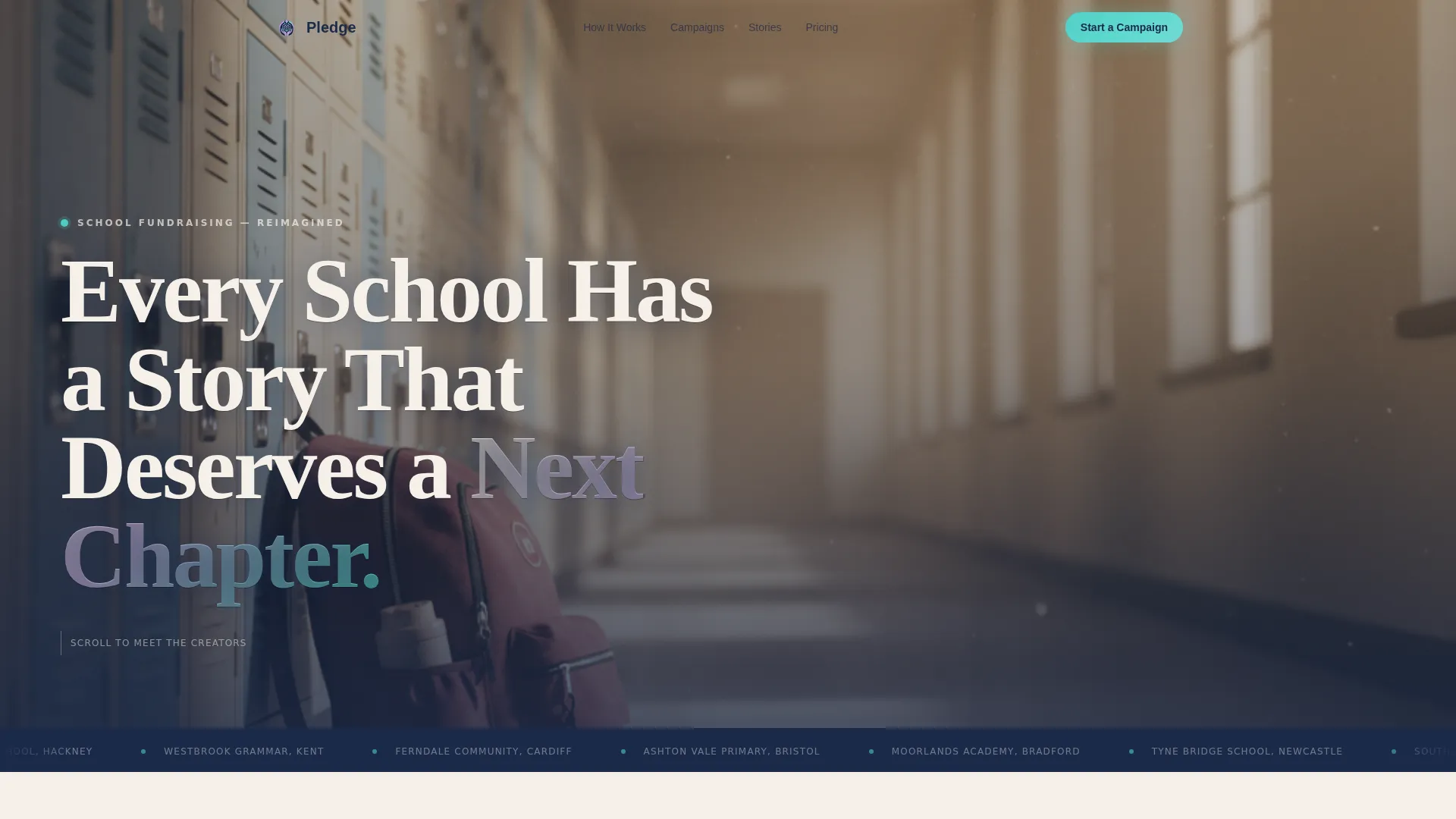
- A cinematic header section with a Type Over Image composition and oversized serif headline
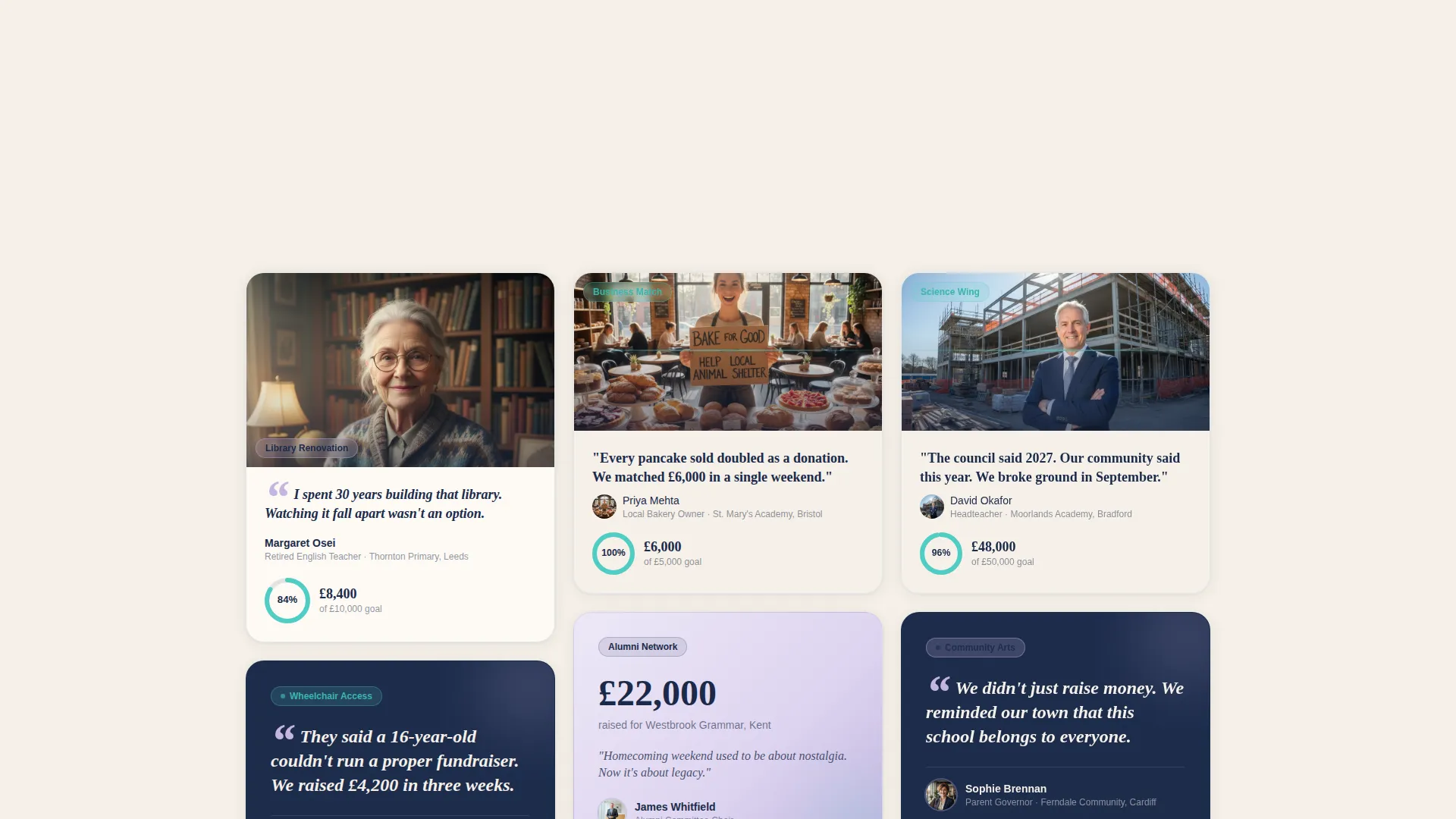
- A scrollable masonry card grid featuring Creator Spotlight stories, progress rings, and video thumbnails
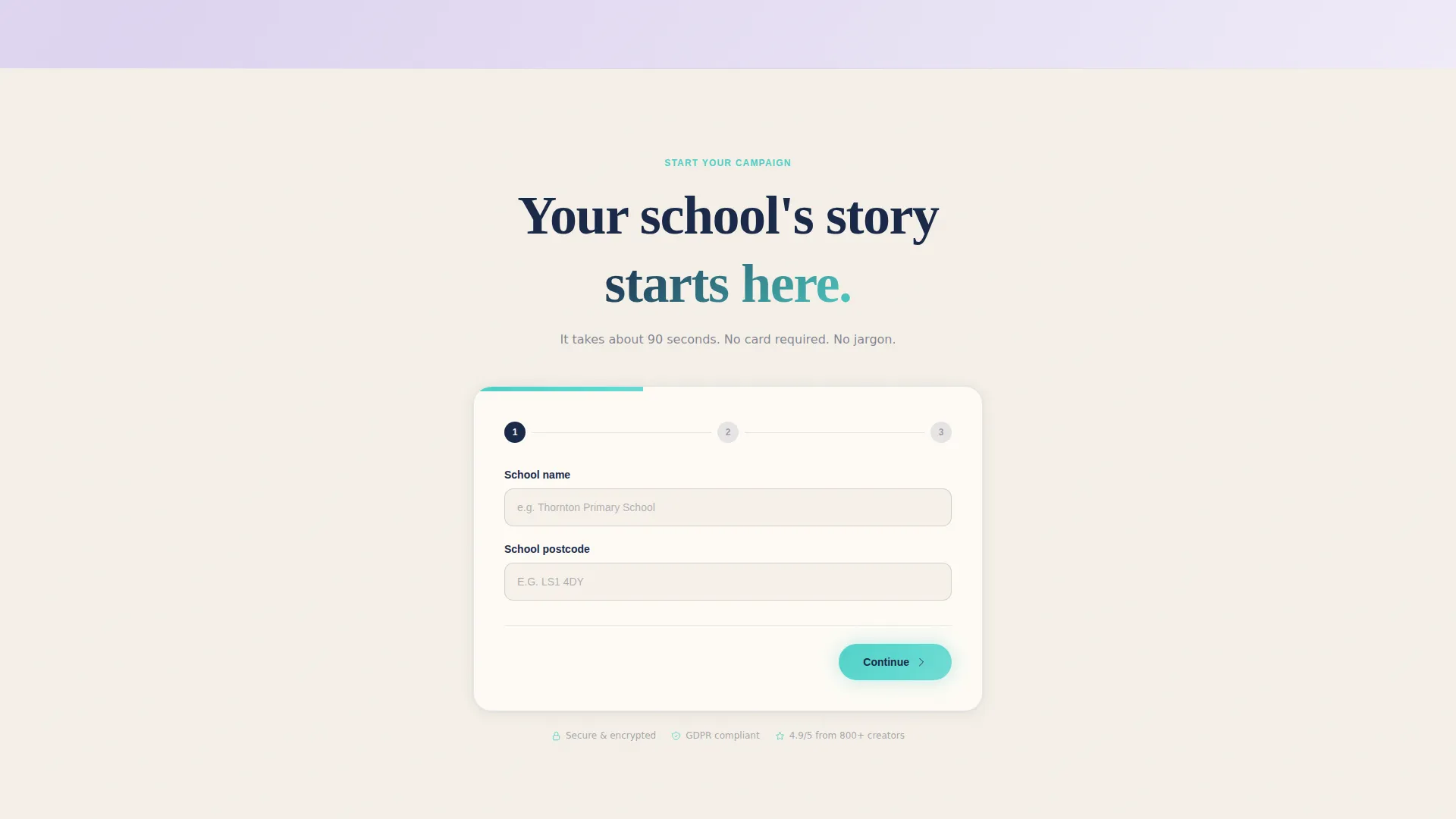
- A sticky teal call-to-action button and a three-step inline lead generation form with progressive disclosure
Feature list
This template is built around a set of purposeful, prompt-defined components. Each one contributes to the single goal of turning a school community's emotional investment into a funded campaign.
Type Over Image Header
A high-contrast black-and-white school hallway photograph fills the viewport. Over it, a large cream-colored serif headline reads: "Every School Has a Story That Deserves a Next Chapter." There are no buttons in this section. The opening moment is purely cinematic.
Masonry Creator Spotlight Grid
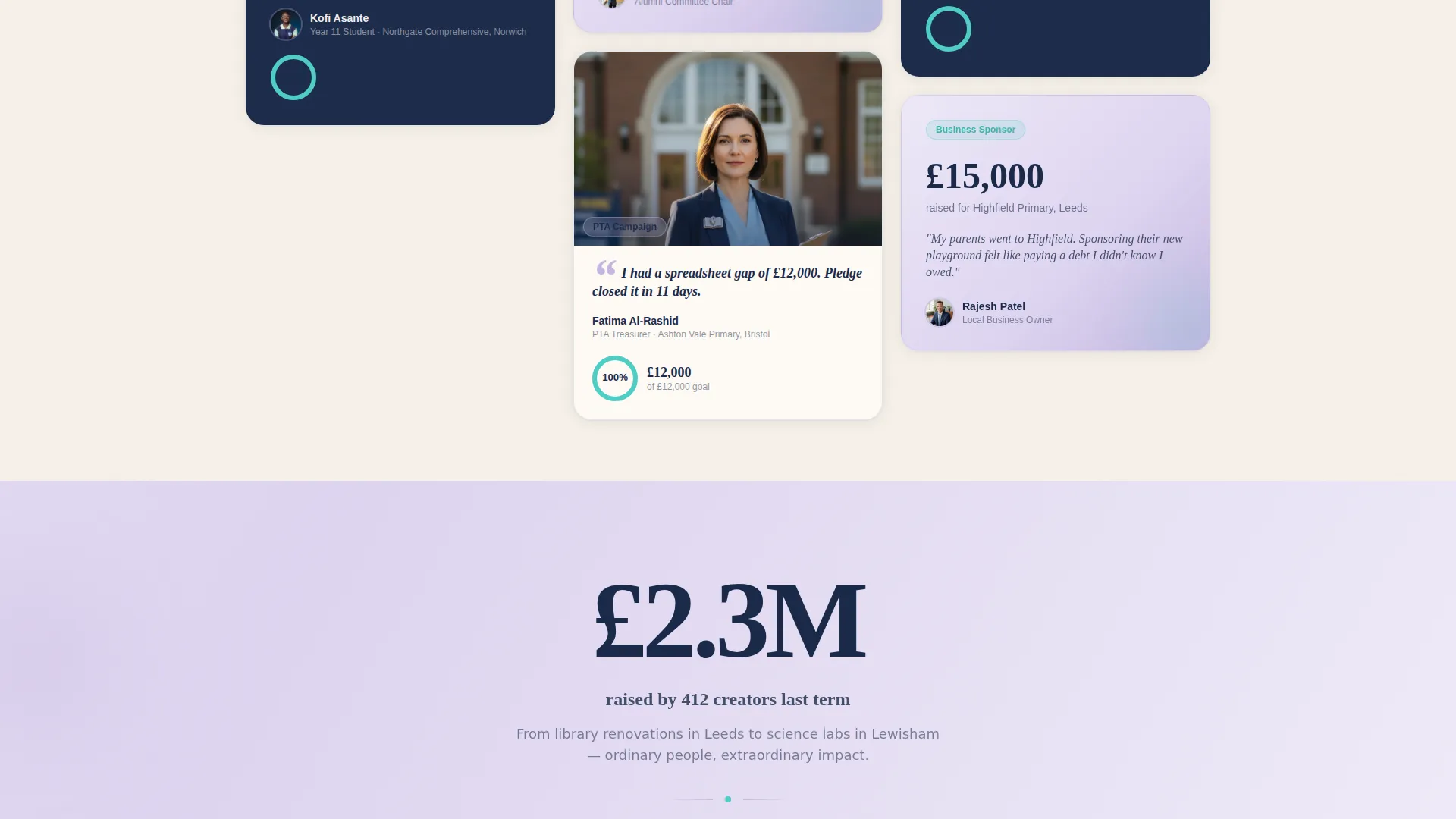
Cards are staggered at varying heights in a Pinterest-style layout. Each card features a real campaign story, portrait photography, a handwritten pull-quote, a circular campaign progress ring, and short video thumbnails with ink-splatter play buttons.
Full-Width Interstitial Banners
Between card clusters, full-width lilac-wash banners display a single large statistic in oversized serif type. These give the eye a deliberate rest and reinforce cumulative credibility, for example: "£2.3M raised by 412 creators last term."
Progressive Inline Lead Form
Clicking the primary call-to-action opens an inline form with three steps. Step one asks for school name and postcode. Step two captures the fundraiser's role. Step three invites a short open answer about what the school needs most right now.
Sticky Primary Call-to-Action
A teal "Start Your School's Campaign" button becomes sticky after the visitor scrolls past the third card row. It stays visible without interrupting the story-reading experience before that point.
Footer Email Capture
A secondary conversion path at the footer reads "Not ready to launch? Get the Fundraiser Toolkit." Visitors who are not yet ready to start a campaign can leave their email and receive a downloadable resource styled like a hand-bound zine.
Page sections overview
| Section | Purpose |
|---|---|
| Header Hero | Opens with cinematic image and headline |
| Creator Card Grid | Tells escalating community fundraiser stories |
| Interstitial Stat Banner | Delivers social proof between card clusters |
| Inline Lead Form | Captures campaign intent in three steps |
| Sticky call to action Button | Maintains primary conversion access throughout scroll |
| Footer Toolkit Offer | Captures undecided visitors via email |
Design & branding system
The visual identity runs on an Ink and Paper theme filtered through an iridescent color system. The palette feels like a handwritten letter that shifts color when you tilt it, warm and traditional on one axis, unexpectedly modern on another.
- Aged parchment cream (#F5F0E8) dominates all backgrounds; fountain-pen navy (#1B2A4A) anchors all body text and headings
- Soft holographic lilac (#C4B5E0) washes over card hover states and section dividers; shimmering accent teal (#4ECDC4) highlights buttons, progress bars, and donation milestones
- Typography uses heavy serif type set at generous leading to evoke letterpress printing on textured stock paper
Mobile & speed optimization
The masonry layout and sticky button are structured to translate cleanly across screen sizes. Card staggering adapts to narrower viewports without losing the cumulative storytelling rhythm.
- Cards reflow naturally on smaller screens, maintaining the portrait-and-pull-quote pairing at reduced widths
- The sticky call-to-action button and inline form are sized for comfortable thumb interaction on mobile devices
How this template helps you convert
Pledge is designed to close the gap between emotional intent and committed action. Every structural choice serves the conversion path without feeling transactional.
- The story-led masonry scroll builds social proof gradually, so visitors arrive at the call-to-action already persuaded by real examples of community fundraising success.
- The three-step progressive disclosure form reduces perceived effort at the point of commitment, keeping emotional investment high while keeping friction low.
Other information about this template
Pledge sits inside the Personal and Resume category under the Charity and Fundraiser Profile subcategory, which means it is built for individuals and community groups rather than large institutions. The template style is Masonry and Pinterest, and the creative direction is Creator Spotlight, which distinguishes it from standard charity page layouts that rely on institutional photography and generic copy.
- The template theme is Ink and Paper, and the color system is AI Iridescent, a combination that makes the design feel handcrafted and contemporary at the same time
- The header concept is Type Over Image, and the landing page direction is Lead Generation, so the primary measure of success is campaign sign-up rate rather than direct donation volume
- The secondary conversion path, the Fundraiser Toolkit email capture, is styled as a downloadable zine, giving undecided visitors a tangible reason to leave their contact details
Theme
Ink & Paper
Creative direction
Creator Spotlight
Color system
AI Iridescent
Style
Masonry/Pinterest
Direction
Lead Generation
Page Sections
Type Over Image Hero Header
Masonry Creator Spotlight Cards
Interstitial Social Proof Banners
Three-step Progressive Lead Form
Sticky Campaign Launch Button
Footer Toolkit Email Capture
Related questions
Who is this landing page template designed for?
Can I use this template for a single campaign or an ongoing fundraising program?
What does the inline lead generation form collect?
What is the secondary conversion path in the footer?
How does the design balance tradition and modernity?