Authentic Icelandic Cuisine Landing Page Template
This is a full-width immersive landing page template built for an Icelandic food truck serving plokkfiskur, lamb soup, arctic char, and rúgbrauð hot dogs. It combines a Neo-Retro visual identity, a cinemagraph hero, an inline pickup order flow, and a truck-booking form, giving adventurous food businesses a bold, conversion-ready single page that feels as alive as the food it sells.
by Rocket studio
Quick summary
The Plokkfiskur Strange Warm Bites Icelandic Food Truck Landing Page Template is designed for mobile food businesses rooted in traditional Icelandic cuisine. It puts the food front and center, steaming, overhead, shot on butcher paper, and builds a direct path from craving to confirmed pickup order. Every section earns its place, and nothing gets in the way of the food.
Who this template is for
This template fits any food business that leads with personality, tradition, and a menu that takes a little explaining. It was built specifically around the rhythms of a street food van, unpredictable locations, rotating daily schedules, and customers who find you by word of mouth or a social post.
- Icelandic food truck operators who want a landing page that matches the energy of their truck and menu
- Street food vendors serving traditional or regional cuisine who need pickup ordering and event booking in one place
- Independent restaurant pop-ups and mobile catering businesses that want to stop sending customers to a third-party app
What problem this template solves
Running a food truck means your restaurant is a moving target. Customers want to know where you are today, what you serve, and how to order, fast. Most generic templates were not built with that kind of urgency in mind. This one was.
- There is no clear path from "I want this food" to a confirmed order on most food truck sites, this template fixes that with an inline pickup flow
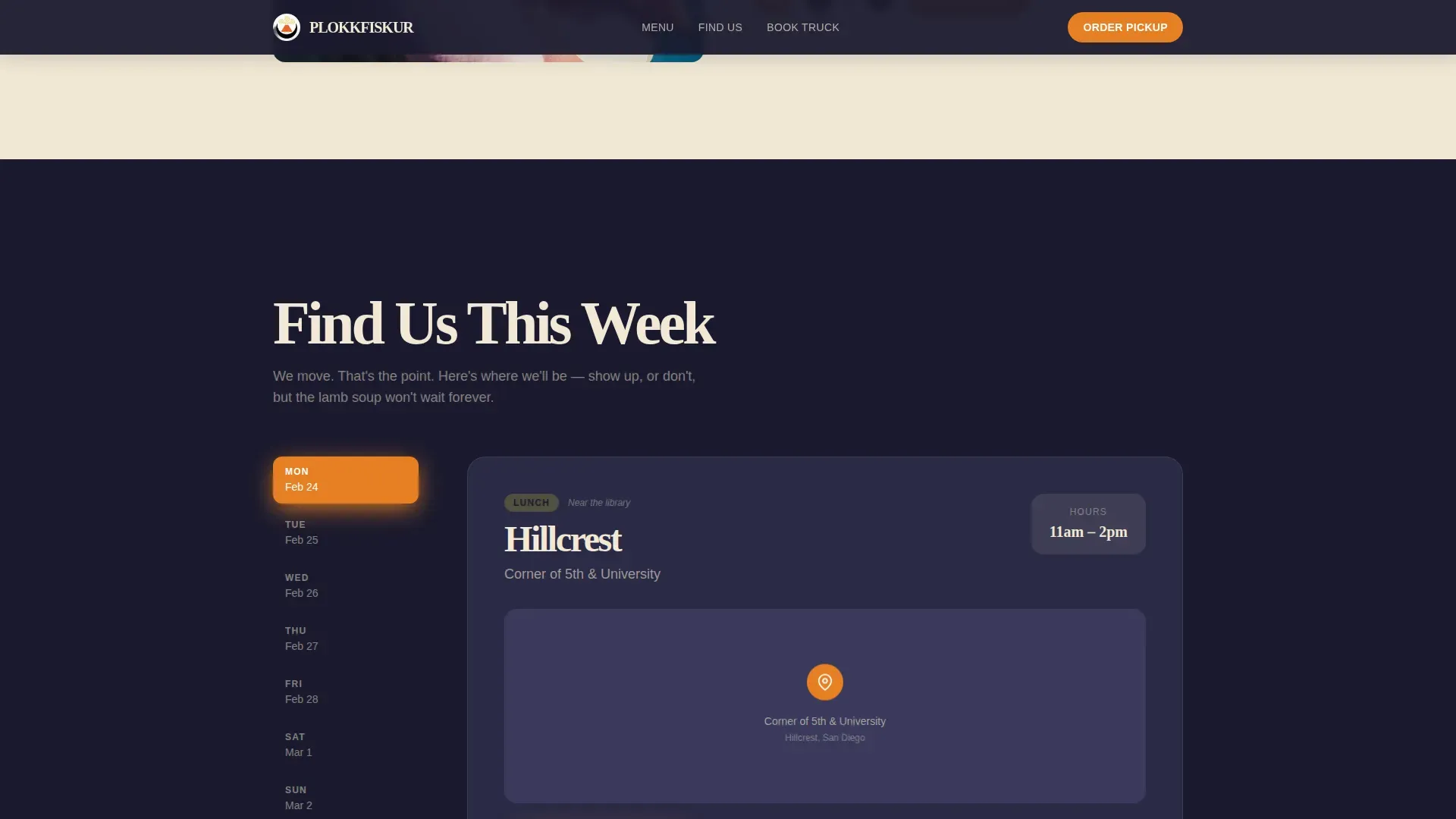
- Truck location schedules change every week, and a static page cannot communicate that, this template includes a rotating schedule widget with day and time slots
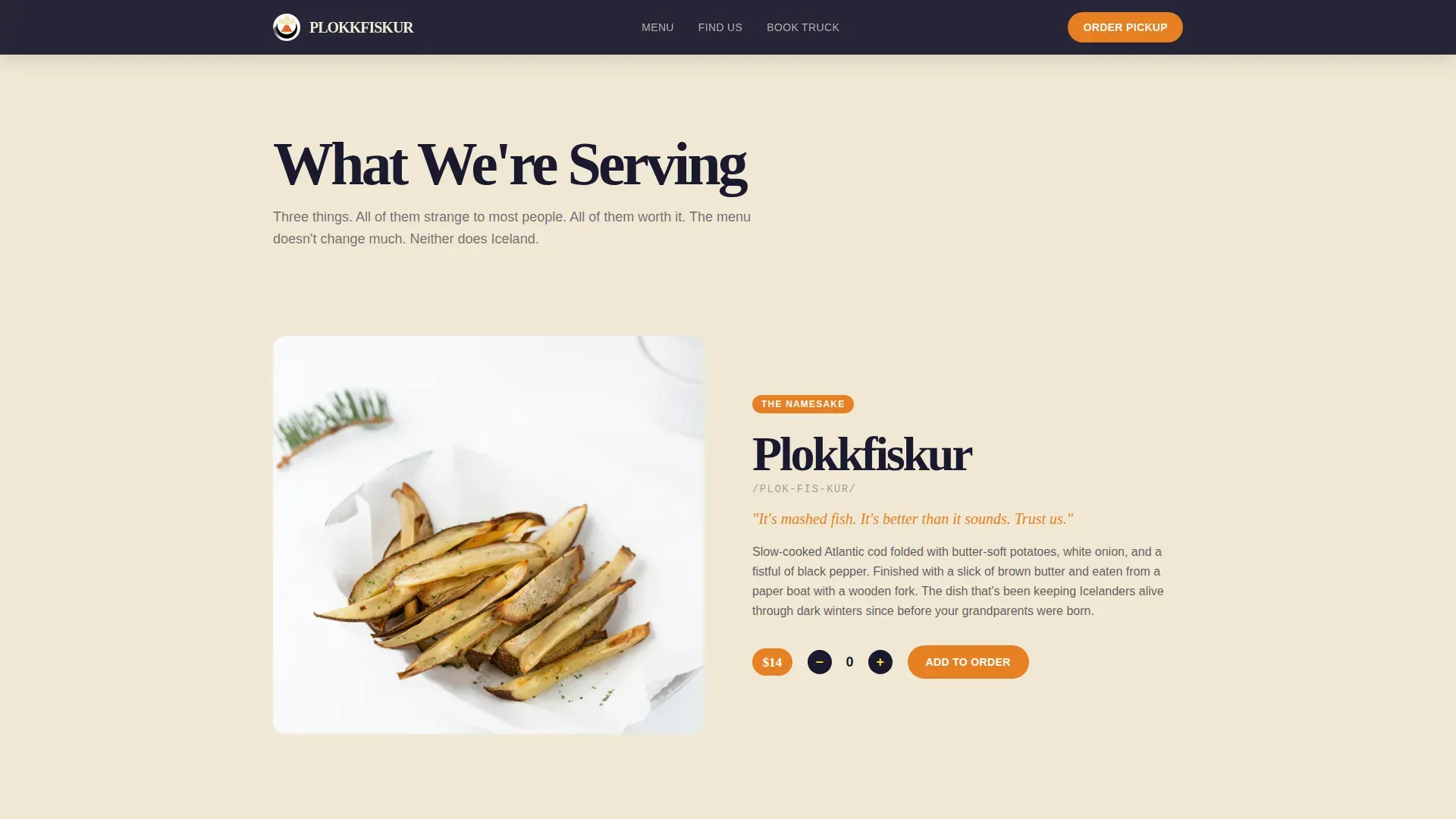
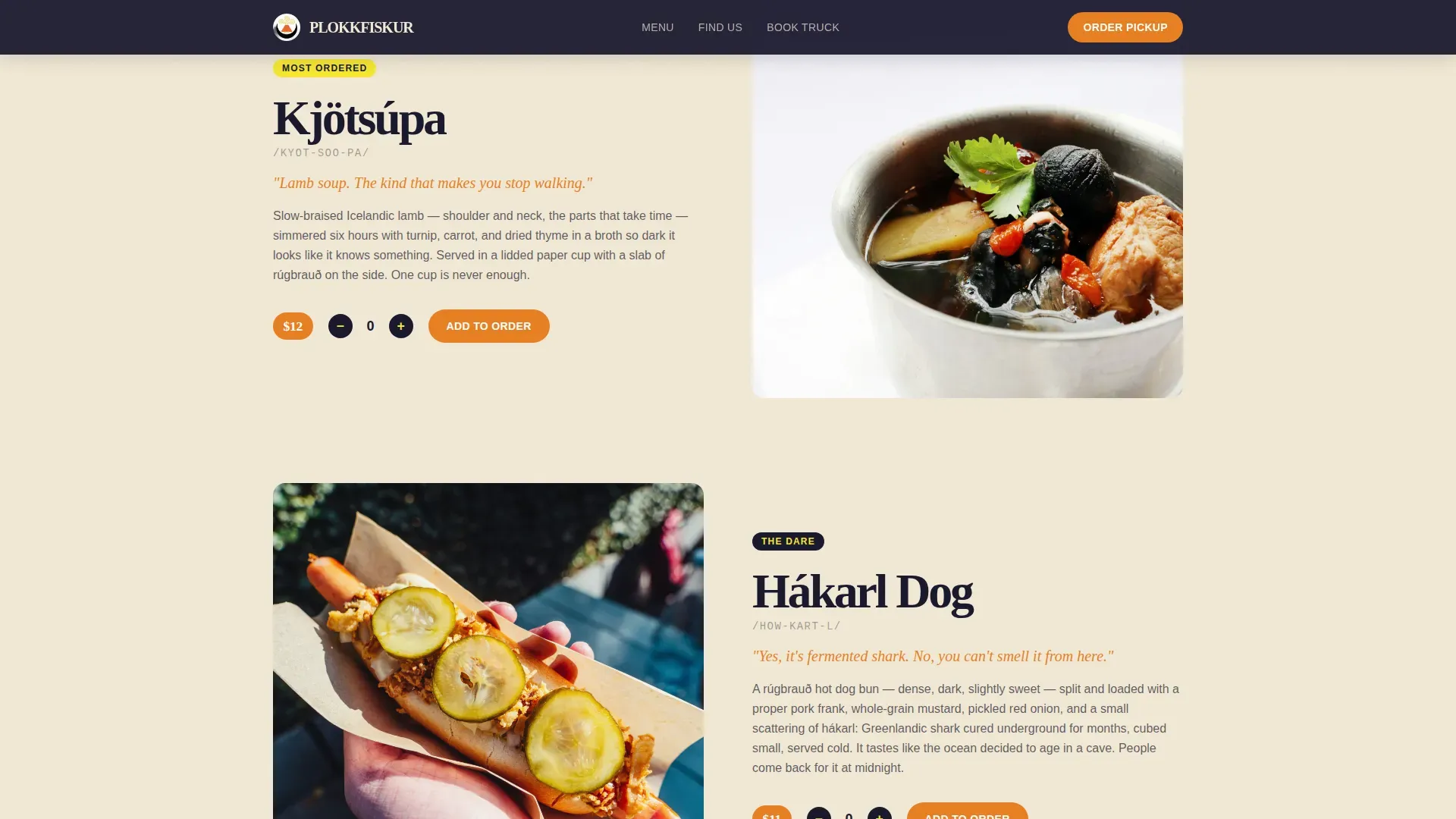
- Food that sounds unfamiliar needs more than a name, each menu section pairs an overhead food photo with a frank, human description that converts curiosity into appetite
What you get with this template
You get a complete, single-page layout built to handle the full customer journey for a food truck, from first impression to confirmed order. The design system, section structure, and interactive components are all included.
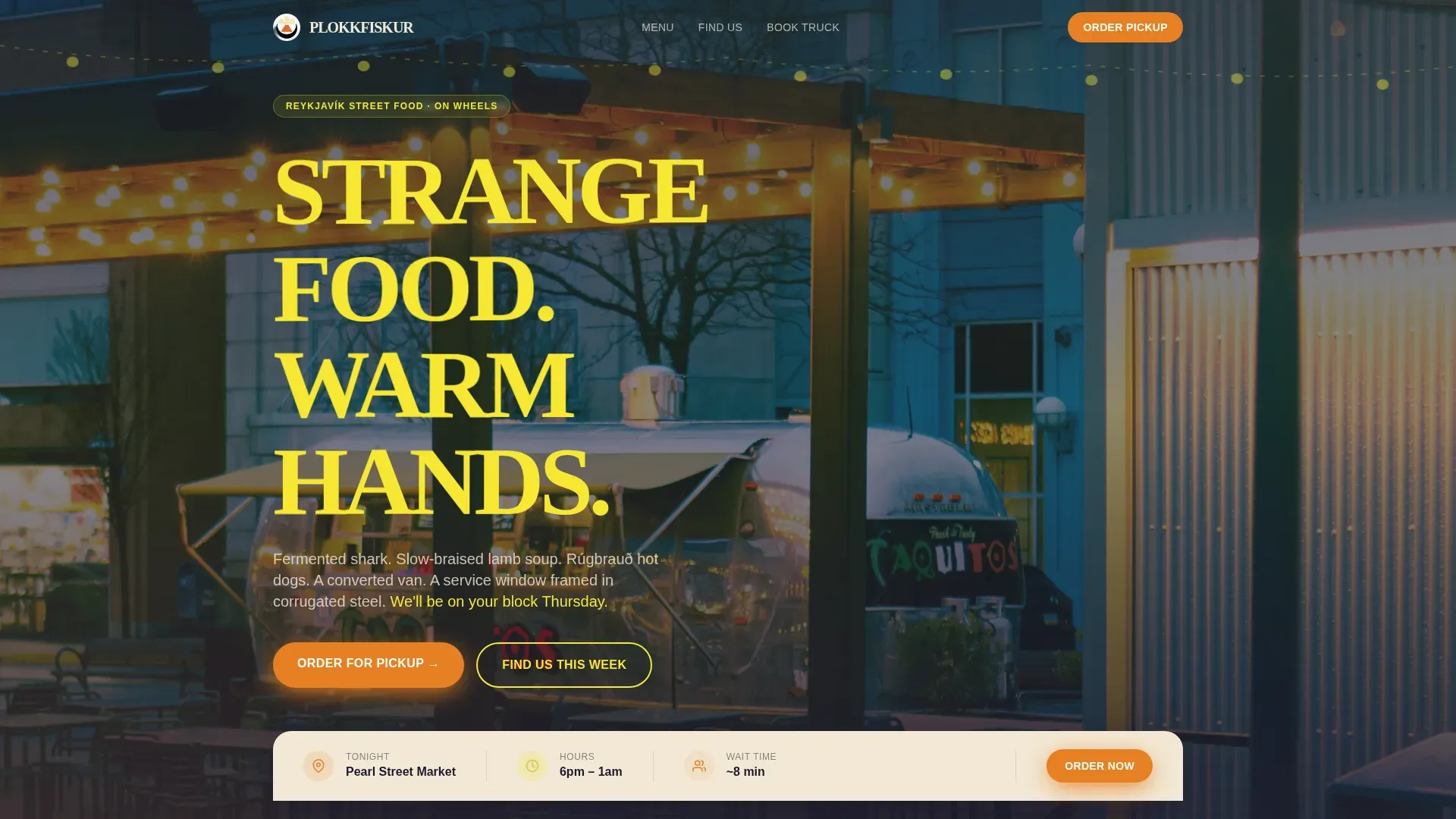
- A cinemagraph-style hero section with animated steam, a type punch-in headline, and a floating stats strip
- An inline order flow with location and time-slot selection, one-tap quantity buttons, name and phone input, and embedded Stripe payment
- A private event booking form and a neighborhood testimonial section that builds trust block by block
Feature list
This template includes a focused set of purpose-built features. Each one reflects a real requirement from the source brief and serves the goal of turning visitors into paying customers.
Cinemagraph Hero with Animated Steam
The header is a near-still wide shot of the truck at dusk with string lights and a live steam loop curling from the service window. After two seconds, the headline "STRANGE FOOD. WARM HANDS." punches in using Arctic lemon lettering with a subtle trembling animation, like text written on a moving surface. The effect places the visitor at the truck before they read a single word.
Full-Width Menu Section with Overhead Food Photography
Each menu category gets its own full-width section built around an overhead food photograph shot on butcher paper. Descriptions are short and direct, the kind of frank, honest language a friend uses to explain a dish you have never heard of. Price callouts appear in hot mandarin, making each item easy to scan without slowing down the read.
Inline Pickup Order Flow
The primary call to action, "Order for Pickup," opens an inline order flow without redirecting to an external page. Customers pick a location, choose a time slot, tap quantity buttons to build their order, enter a name and phone number, and pay through embedded Stripe. The flow is fast, friction-free, and designed to close the distance between appetite and confirmed food order.
Weekly Schedule Map Widget
A rotating map widget shows this week's truck locations with labeled day and time slots. The widget uses location tabs so customers can find the stop nearest to them. It builds the kind of familiarity that turns a one-time visitor into a Tuesday regular, the way street food markets become social anchors for a neighborhood.
Book the Truck Catering Form
A dedicated section targets private event inquiries. The form asks for date, headcount, and neighborhood, nothing more. It positions the truck as available for events without adding friction or asking for unnecessary detail. This secondary conversion path runs parallel to the pickup order flow without competing with it.
Neighborhood Testimonial Section
Real-neighborhood testimonial snippets are displayed in an editorial layout. References like "The Hillcrest Tuesday regular" and "Seen at Pearl Street Market since March" are formatted as short, location-tagged social proof. This section reinforces the idea that the truck already belongs to the visitor's world, making it feel familiar before they have ever ordered.
Page sections overview
| Section | Purpose |
|---|---|
| Cinemagraph Hero | Opens with cinematic food truck shot, animated steam, and punched-in headline |
| Floating Stats Strip | Posts key social proof data immediately below the hero image |
| Menu Food Sections | Full-width overhead food photos with frank descriptions and mandarin price callouts |
| Weekly Schedule Widget | Rotating location map with day and time slots for the current week |
| Neighborhood Testimonials | Editorial layout snippets from location-tagged regular customers |
| Book the Truck | Private event catering call to action with a short inquiry form |
| Page Footer | Arc Browser Split layout with logo, tagline, and minimal navigation links |
Design & branding system
The visual identity runs on a Citrus Burst color system that recalls a 1970s Reykjavík diner menu printed on thick card stock. Colors are bold, slightly sun-faded, and unapologetically loud against dark basalt backgrounds. Typography pairs DM Sans for body text with Fraunces display serif for headlines, a combination that feels editorial and street-worn at the same time.
- Color palette: volcanic black (#1A1A2E) anchors the header and footer; hot mandarin (#E77F24) drives buttons and price callouts; Arctic lemon (#F7E733) powers hover states and badge accents; smoked cream (#F2E8D5) carries body text sections
- Typography and animation: Fraunces headlines deliver the punch-in effect; DM Sans keeps body copy clean and fast to read; CSS animations cover steam loops, scroll reveals, and hover color-to-grayscale photo effects
Mobile & speed optimization
The template is built mobile-first. The floating "Order for Pickup" bottom bar is pinned permanently on mobile screens, appearing from the first moment a customer scrolls past the menu section. Every interactive element, quantity buttons, location tabs, the booking form, is sized and spaced for thumb use.
- Floating bottom bar: the hot mandarin "Order for Pickup" button stays visible at all times on mobile so customers never have to scroll back to place an order
- Scroll and reveal behavior: native CSS scroll behavior and Intersection Observer drive section reveals, keeping the scroll feel smooth without heavy dependencies
How this template helps you convert
The template is structured around a clear conversion hierarchy. Pickup orders come first. Event bookings come second. Social proof and schedule information reduce hesitation in between. Every element has a job.
- The inline order flow removes the need to visit a third-party platform, customers order, pay, and confirm without leaving the page, which reduces the drop-off that comes from redirects
- The floating bottom bar on mobile means the order call to action is always one tap away, even when a customer is mid-scroll reading about the lamb soup or arctic char menu section
- The weekly schedule widget and testimonial section build routine and trust, when someone sees a familiar town name or a neighborhood they know, the food truck stops being a novelty and starts being a habit
Other information about this template
This section covers additional context about the food culture and cuisine that shaped the template's design direction, giving operators and buyers a fuller picture of what the template was built to represent.
- Plokkfiskur is a traditional Icelandic fish stew made from boiled fish and potatoes, originally a recipe born from using leftover cod or haddock. Today it is found in both rustic homes and high-end restaurants across the country.
- The dish traditionally uses haddock as the primary fish, though other white fish varieties like arctic char and cod are also common in Iceland. Modern variations can include white pepper, cheese gratinated on top, or curry powder for a different taste.
- The basic plokkfiskur recipe calls for haddock, potatoes, onions, butter, flour, and milk. Some versions add olive oil or finish with a lid-on steam step to develop a creamier stock base before serving.
- In Iceland, plokkfiskur is commonly served alongside rúgbrauð, a dense traditional rye bread. The hot dog, called pylsa in Iceland, is one of the country's most famous street foods, found at roadside stops from the smallest town to the capital.
- Icelandic food culture is built around fish and lamb. Icelanders traditionally eat fish three to four times a week. Lamb is known for its flavor, partly because Icelandic sheep graze freely across the country without fences or additives.
- The food of Iceland has evolved over the years. Modern Icelandic cuisine incorporates international influences, from Spain, China, and beyond, while still honoring traditional ingredients and methods. Chefs today increasingly blend old techniques with new approaches.
- Skyr, a dairy product similar to yogurt with roots in the Viking Age, is one of the most well-known Icelandic foods outside the country. Bacon, cheese, and pepper all appear in contemporary Icelandic street food variations.
- Street food markets serve as social hubs where locals and visitors can stop, eat, and connect. Participating in street food experiences can be a high-reward way to learn about a country's culture without a formal restaurant table or a structured course meal.
- A food truck landing page that showcases cultural context helps customers understand not just what they are ordering but why it matters. This kind of storytelling is one of the most appealing ways to build a loyal customer base for a mobile food business.
- The template can support social media linking from the footer, making it easy to post updates, share schedule changes, and update followers when the truck moves to a new location or adds a seasonal item.
- Whale watching is a famous activity in Iceland, and whale meat was historically part of the country's food culture, though it is now a topic of ongoing cultural conversation. The template does not make claims about specific menu items and leaves those decisions to the operator.
- Operators can read through the full section structure and skip any section they do not need, the layout is built to stay coherent even if a block is removed or replaced.
Theme
Neo-Retro
Creative direction
Local & Neighborhood
Color system
Citrus Burst
Style
Full-Width Immersive
Direction
Direct Sales
Page Sections
Cinemagraph Hero with Steam Animation
Inline Pickup Order Flow with Stripe
Rotating Weekly Schedule Widget
Full-width Menu Photography Sections
Book the Truck Private Events Form
Neighborhood Testimonial Editorial Layout
Related questions
What kind of food business is this template designed for?
Can I use this template if my menu is different from the demo?
How does the inline order flow work?
Does this template include a private event booking option?
Can I update the weekly truck schedule and locations myself?