Prairie Style Architecture Blog Website Template
Prairie is a curated realtor landing page template built for Prairie School architecture specialists. It uses a 60/40 asymmetric grid, a nine-tile Photo Grid Mosaic header, and an editorial Gallery Walk scroll to position expertise before asking for contact. The primary conversion path is a gated "Download the Prairie Registry" PDF, supported by per-listing "Request Private Showing" text links.
by Rocket studio
Quick summary
Prairie is a single-page realtor template designed for a niche specialist audience. It leads with curatorial authority, slowing the scroll deliberately to build trust. The 60/40 layout separates full-plate property photography from architect attribution marginalia. By the time a visitor reaches the call to action, the page has already earned the click.
Who this template is for
This template is built for a very specific kind of real estate professional. It suits realtors whose value is architectural knowledge, not transaction volume.
- Prairie School specialists serving Oak Park, Illinois, and similar historic preservation markets
- Realtors working with design-literate buyers, preservation societies, and architecture-focused investors
- Property professionals whose brand depends on demonstrating expertise before making an ask
What problem this template solves
Generic real estate templates prioritize urgency and lead capture over substance. They are built for volume, not connoisseurship. This template solves the trust gap for realtors whose clients arrive already knowing their Sullivan from their Wright.
- Buyers in this niche distrust sales pressure and respond to demonstrated scholarship
- Standard templates offer no way to present architect attribution, historical designation, or provenance detail
- There is no existing format that combines editorial property narrative with a quiet, marginal conversion path
What you get with this template
You get a complete, single-page layout structured as a scholarly editorial experience. Every section is designed to slow the visitor down rather than funnel them quickly toward a form.
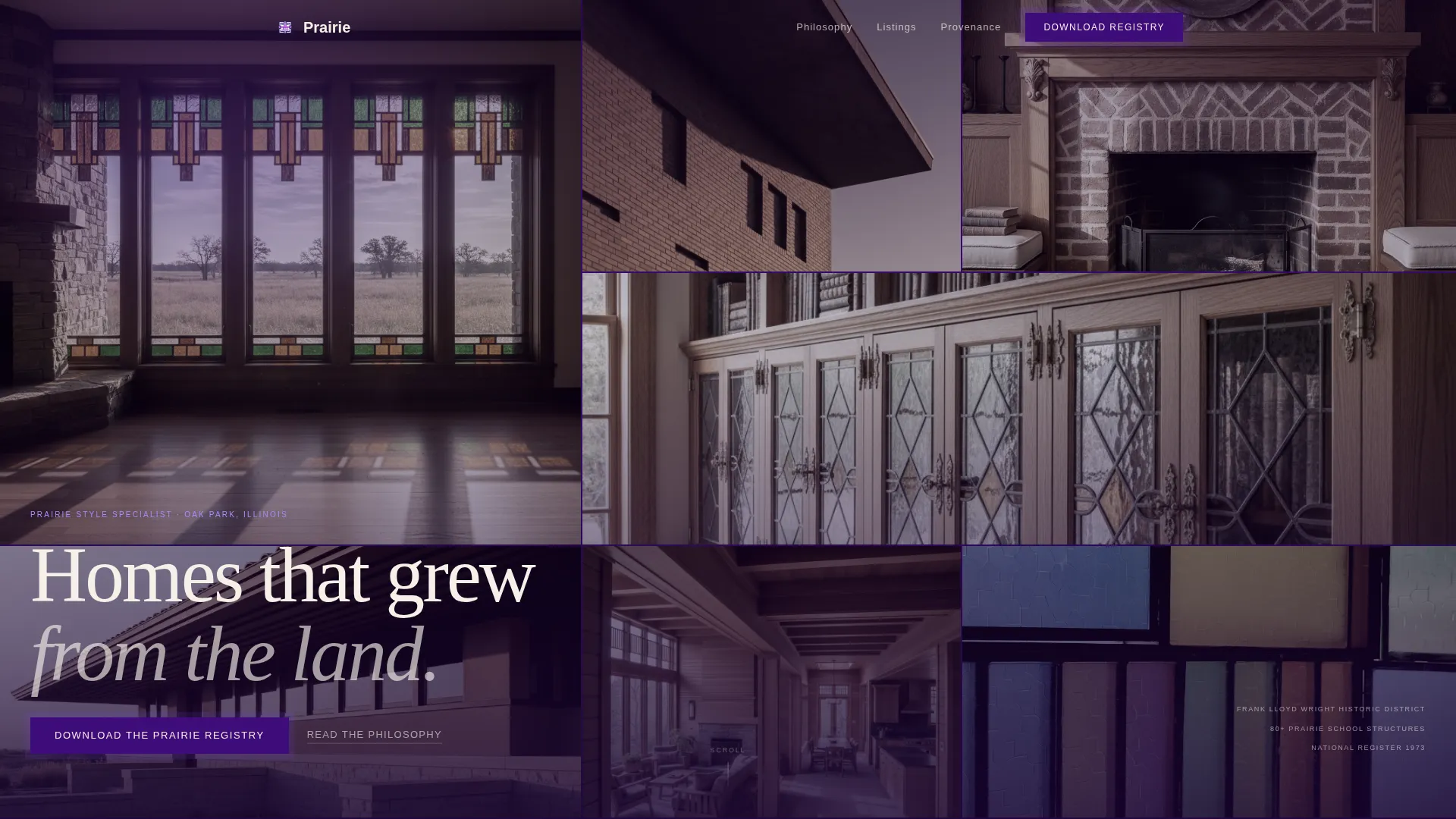
- A nine-tile Photo Grid Mosaic header with ruling-pen indigo grid lines and desaturated photography
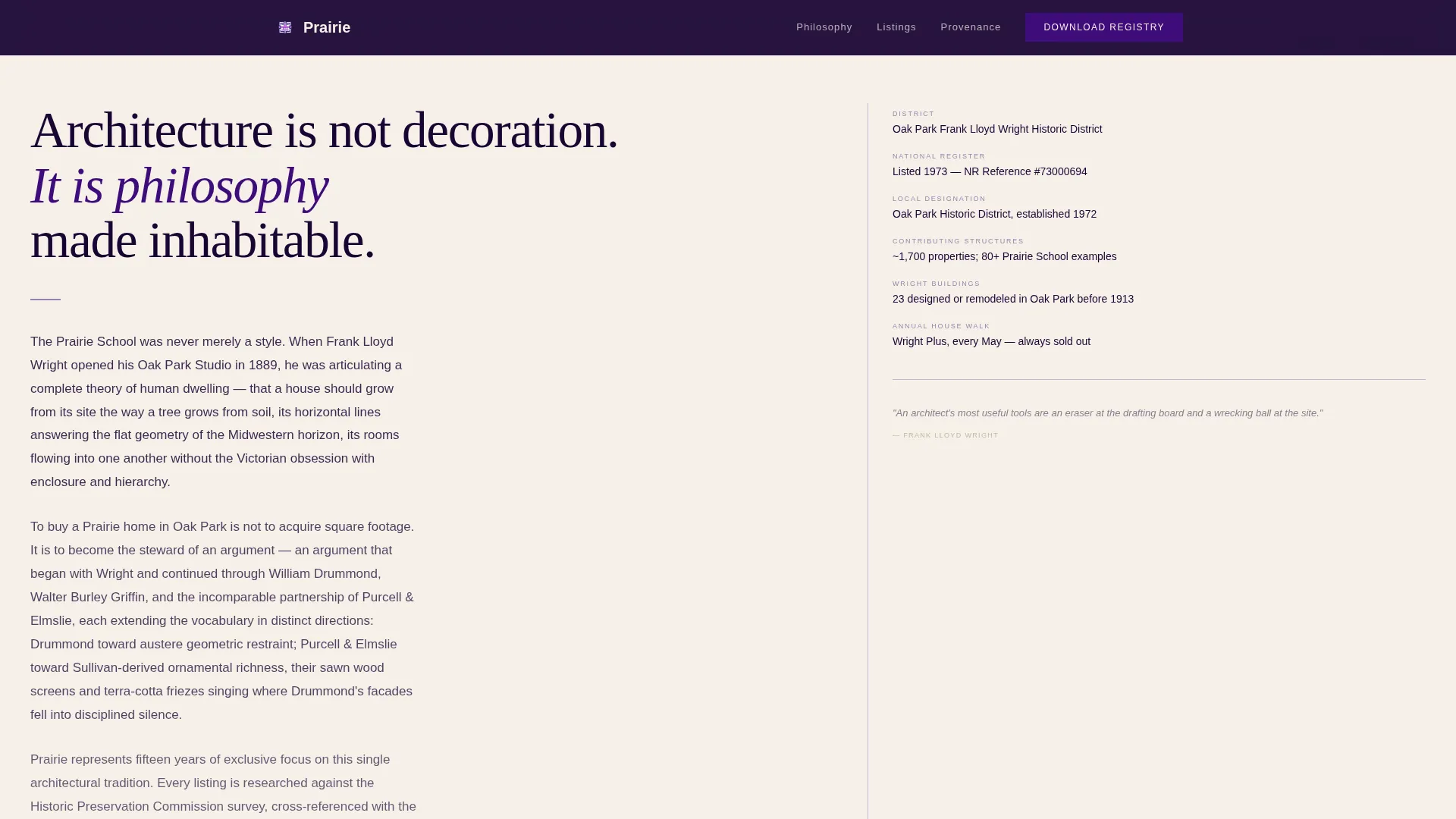
- A 60/40 asymmetric editorial grid carrying full-plate imagery and prose in the wide column, with architect notes and year-built data in the narrow margin
- A gated "Download the Prairie Registry" call to action with an email field and a single dropdown
Feature list
Nine-Tile Photo Grid Mosaic Header
The header arranges nine unevenly cropped photographs as a curator's contact sheet. Subjects include leaded glass clerestories, cantilevered eaves, Roman brick surrounds, and built-in oak bookcases. Thin indigo ruled lines separate each tile as if hand-drawn with a drafting pen.
60/40 Asymmetric Editorial Grid
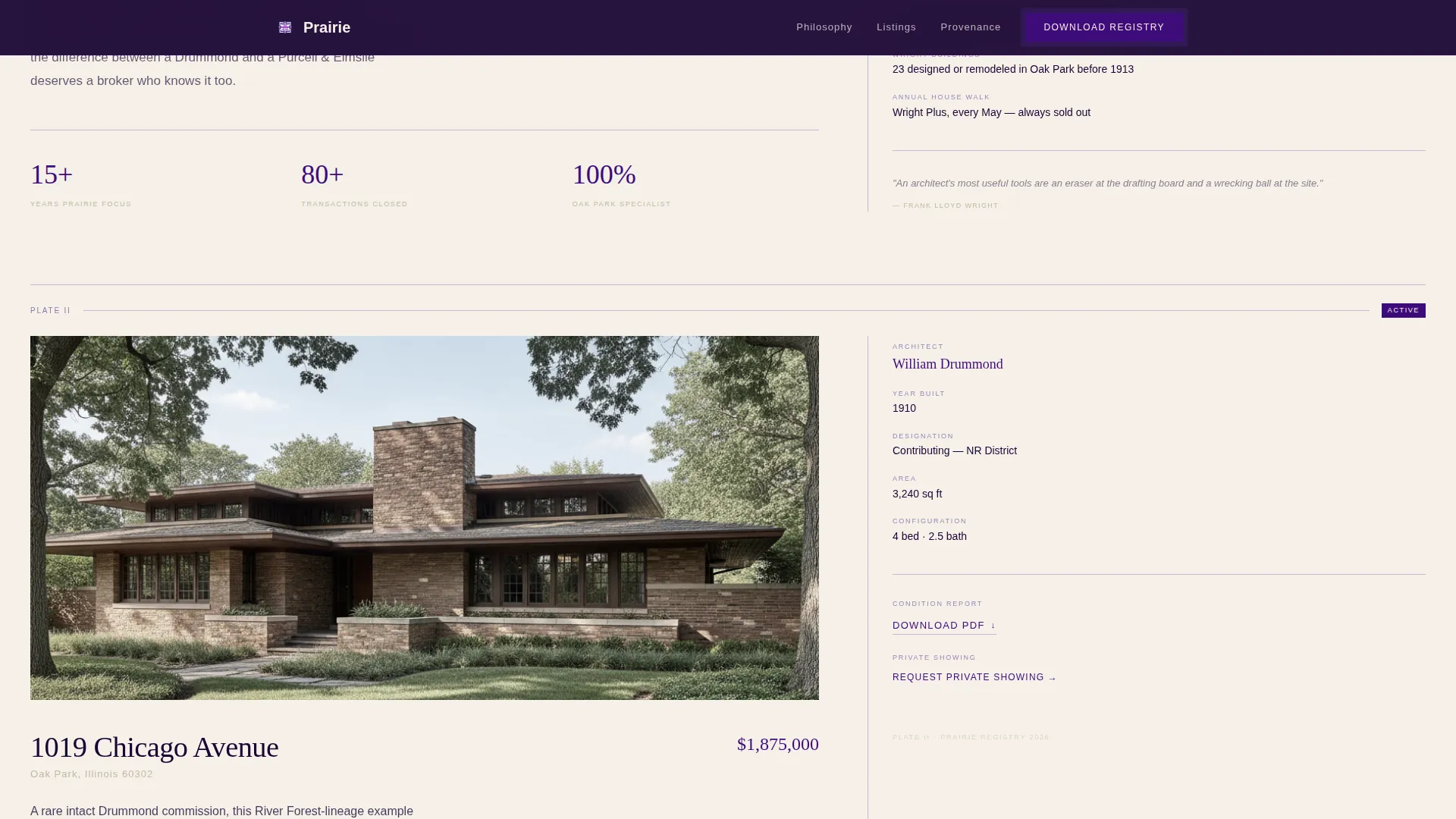
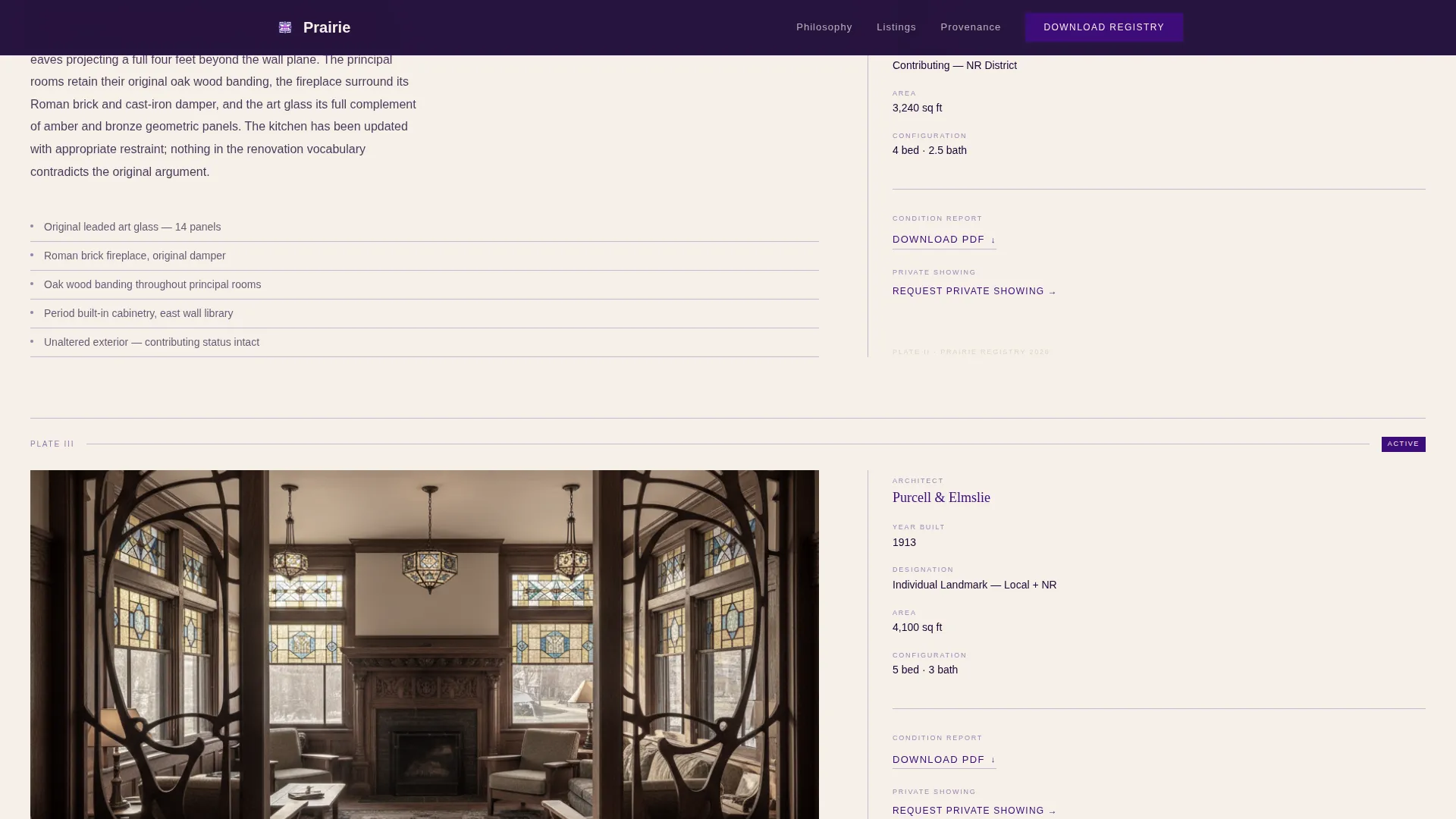
The wide 60-column carries full-plate photography and long-form property narratives. The narrow 40-column holds marginalia: architect attribution, year built, historical designation status, and downloadable PDF condition reports. The split gives the page a monograph reading rhythm that no standard grid delivers.
Scroll-Linked Plate Numbers and Reveals
Each listing section is separated by a thin indigo rule and a plate number. Plate entries stagger in on scroll, and the pacing widens between sections to invite the visitor to linger rather than skim.
Gated Prairie Registry Call to Action
The primary conversion captures an email address alongside a single dropdown asking "Buying, Selling, or Studying?" The offer is a curated PDF catalog of available and coming-soon Prairie Style properties. The magnetic button uses an electric violet pulse animation on activation.
Per-Listing Private Showing Links
A quiet "Request Private Showing" text link sits inside the 40-column marginalia for each featured listing. This secondary conversion path threads through the page without interrupting the editorial flow.
Ink and Paper Color System with Hover States
Photo hover states lift desaturation to reveal full color. Active links and call-to-action elements pulse in electric violet (#7C3AED). The base palette of deep indigo, violet-black ink, and warm laid-paper cream keeps the visual register consistently scholarly.
Page sections overview
| Section | Purpose |
|---|---|
| Hero Mosaic Grid | Opens with nine-tile contact-sheet photography and an editorial headline over a cream overlay card |
| Philosophy Editorial | Presents the realtor's curatorial approach in 60/40 prose and marginalia layout |
| Featured Listings | Displays full-plate property photography with architect attribution and margin notes |
| Provenance Showcase | Differentiates expertise through a Prairie School architect attribution section |
| Registry Call to Action | Gates the Prairie Registry PDF behind an email field and single dropdown |
| Footer | Closes with a horizontal flow footer pattern |
Design & branding system
The visual identity follows an Ink and Paper theme realized through an Electric Indigo color system. The palette references architectural blueprints pulled from a university archive and lit by a single ultraviolet lamp.
- Colors: deep drafting-table indigo (#3D0C7B), violet-black ink (#1A0533), warm laid-paper cream (#F5F0E8), and crackling electric violet (#7C3AED) for hover states and call-to-action pulses
- Typography: Fraunces serif for editorial headlines and plate titles; DM Sans for body copy and marginalia
- Finishing details: desaturated photography treated to feel printed on cotton rag stock, thin ruled indigo lines as section dividers, and staggered scroll reveals that pace the reading experience
Mobile & speed optimization
The template is built desktop-first to match the editorial expectations of a design-literate audience. The mosaic and asymmetric grid receive priority loading treatment, while listing photography loads lazily below the fold.
- Desktop delivers the full editorial monograph experience with the 60/40 grid intact
- The layout collapses gracefully on mobile without losing the marginalia content hierarchy
- Image-heavy sections use priority loading for the hero mosaic and lazy loading for listing plates
How this template helps you convert
This template converts by proving expertise long before presenting a form. The scroll is structured as a persuasion arc, not a funnel.
- The Gallery Walk scroll builds authority section by section, so visitors arrive at the Registry call to action already trusting the realtor's knowledge.
- The gated PDF offer respects the audience's intelligence: a dropdown asking "Buying, Selling, or Studying?" signals that this realtor understands the full range of people drawn to Prairie Style property.
- The per-listing "Request Private Showing" link provides a low-friction secondary path for visitors who are ready to act before reaching the bottom of the page.
Other information about this template
Prairie is a template that fits naturally into a broader editorial real estate web presence. It suits professionals who publish long-form content about architectural history alongside their active listings.
- The template style is an Asymmetric Grid (60/40) with a Gallery Walk creative direction
- The header concept is a Photo Grid Mosaic using a nine-tile contact-sheet composition
- The landing page direction is Content and Resource, prioritizing expertise demonstration over direct lead capture
- The color system is Electric Indigo, with interactive states reserved for electric violet (#7C3AED)
- The theme is Ink and Paper, referencing monograph publishing and archival print culture
- Medium-intensity animations include scroll-linked reveals, staggered plate entries, and a magnetic call-to-action pulse
Theme
Ink & Paper
Creative direction
Gallery Walk
Color system
Electric Indigo
Style
Asymmetric Grid (60/40)
Direction
Content/Resource
Page Sections
Nine-tile Photo Grid Mosaic Header
60/40 Asymmetric Editorial Grid
Scroll-linked Plate Reveals
Gated Prairie Registry Download
Per-listing Private Showing Links
Ink and Paper Interactive States
Related questions
Who is this landing page template designed for?
What is the Prairie Registry call to action?
Can the 40-column marginalia be edited for different listing details?
Does this template support both a primary and a secondary conversion path?
Is this template suitable for a design-literate international audience?