Anesthesiologist Professional Website Template
Sedate is a zigzag landing page template built for board-certified anesthesiologists offering virtual pre-operative consultations. It guides anxious surgical patients from fear to confidence using a Problem-to-Solution arc, an interactive readiness assessment, and a calming Alpine Fresh visual system. The result is a page that earns patient trust before surgery day ever arrives.
by Rocket studio
Quick summary
Sedate is a single-page template designed for anesthesiologists who deliver virtual care before surgery. It walks visitors through their fears one section at a time, then moves them toward booking via a five-question readiness assessment. The design feels like a mountain clinic at dawn: cool, still, and safe enough to exhale.
Who this template is for
This template is built for a specific kind of medical practice: one where anesthesiologists or nurse anesthetists meet surgical patients before they ever step into a hospital gown. It suits both solo practitioners and small anesthesiology department teams who want to replace the rushed ninety-second pre-op phone call with something that actually helps people.
- Board-certified anesthesiologists running a virtual preoperative care practice
- Nurse anesthetists who offer independent pre operative assessment consultations
- Surgical centers and hospital teams aiming to reduce day-of cancellation rates
What problem this template solves
Patients scheduled for surgery often leave their first pre-op interaction with more questions than answers. The standard process gives them a short phone call, a dense consent form, and a search engine. That combination does not build confidence. It builds dread. The template exists to change the first impression of preoperative evaluation entirely.
- Unaddressed patient fears around general anesthesia, nausea, pain breakthrough, and pediatric safety
- Lack of trust caused by impersonal, rushed pre-op communication methods
- Day-of surgical cancellations that stem from patient anxiety and unanswered questions
What you get with this template
You get a complete, conversion-focused landing page layout built around a single primary objective: turning an anxious pre-surgical visitor into a booked consultation. Every section has a defined role in the patient's emotional journey, from naming fears out loud to delivering a personalized anesthesia plan summary at the end of the assessment.
- A five-question quiz modal with a personalized risk-comfort result and one-click booking link
- A secondary "Just Ask One Question" path with a forty-eight-hour response promise
- Six structured page sections from hero to footer, each mapped to a stage in the patient decision making process
Feature list
This section describes the core built-in capabilities of the Sedate template as defined in the source brief.
Portrait-Centered Hero Section
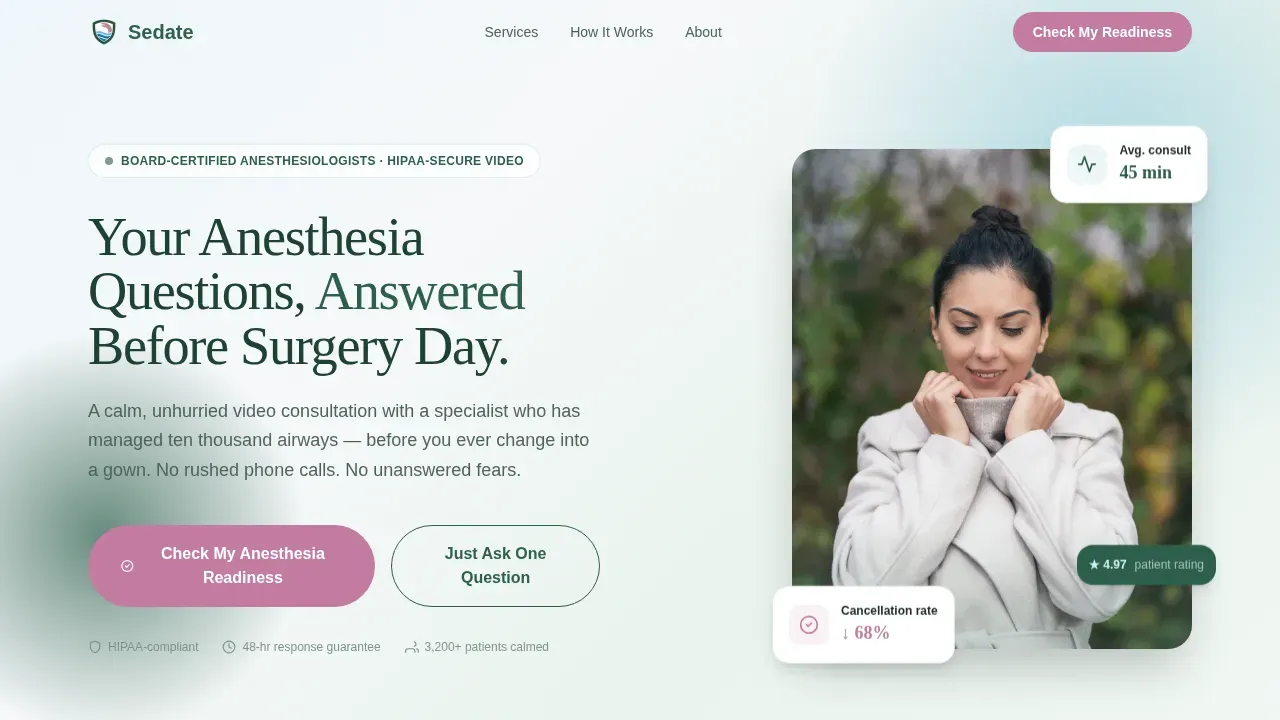
The hero opens with a softly lit, shoulders-up photograph of the anesthesiologist. One hand is visible, open, mid-gesture, as if mid-explanation. The headline "Your Anesthesia Questions, Answered Before Surgery Day" fades in beside the portrait. Two calls to action sit below: the primary assessment launcher and the secondary free-question path. This layout immediately humanizes the practice and signals patient centered care from the first scroll position.
Zigzag Fear and Solution Arc
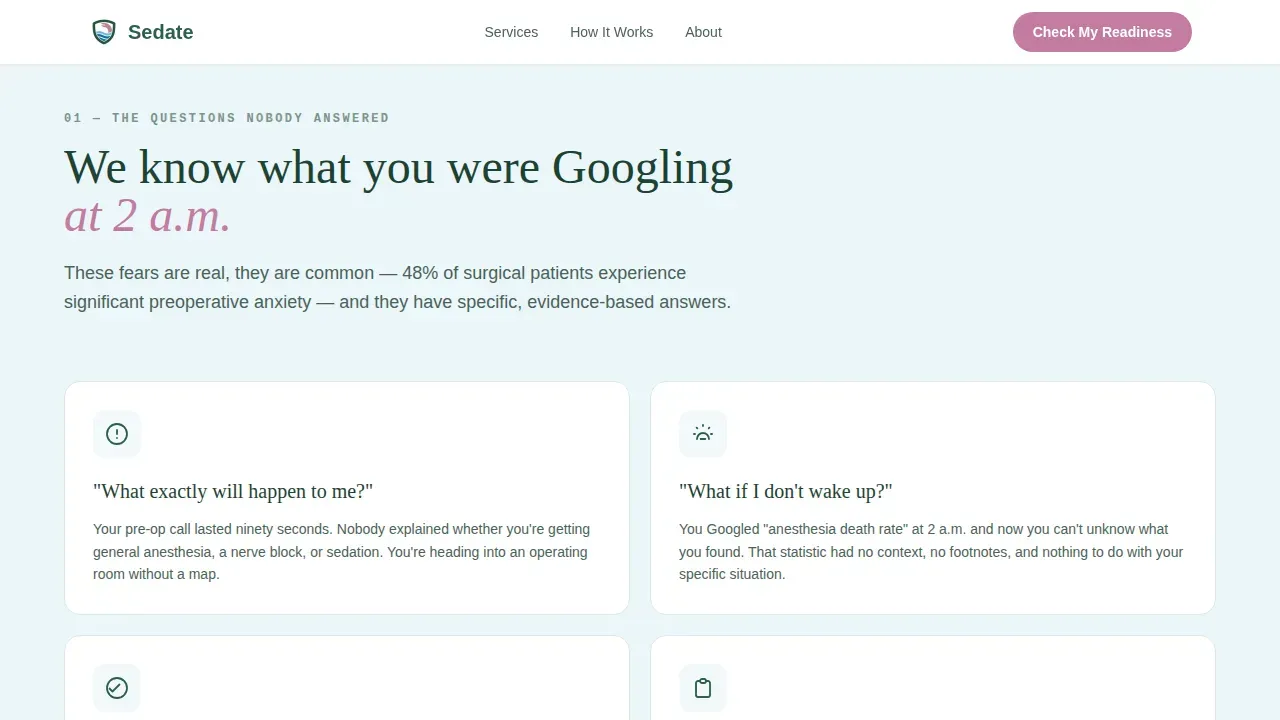
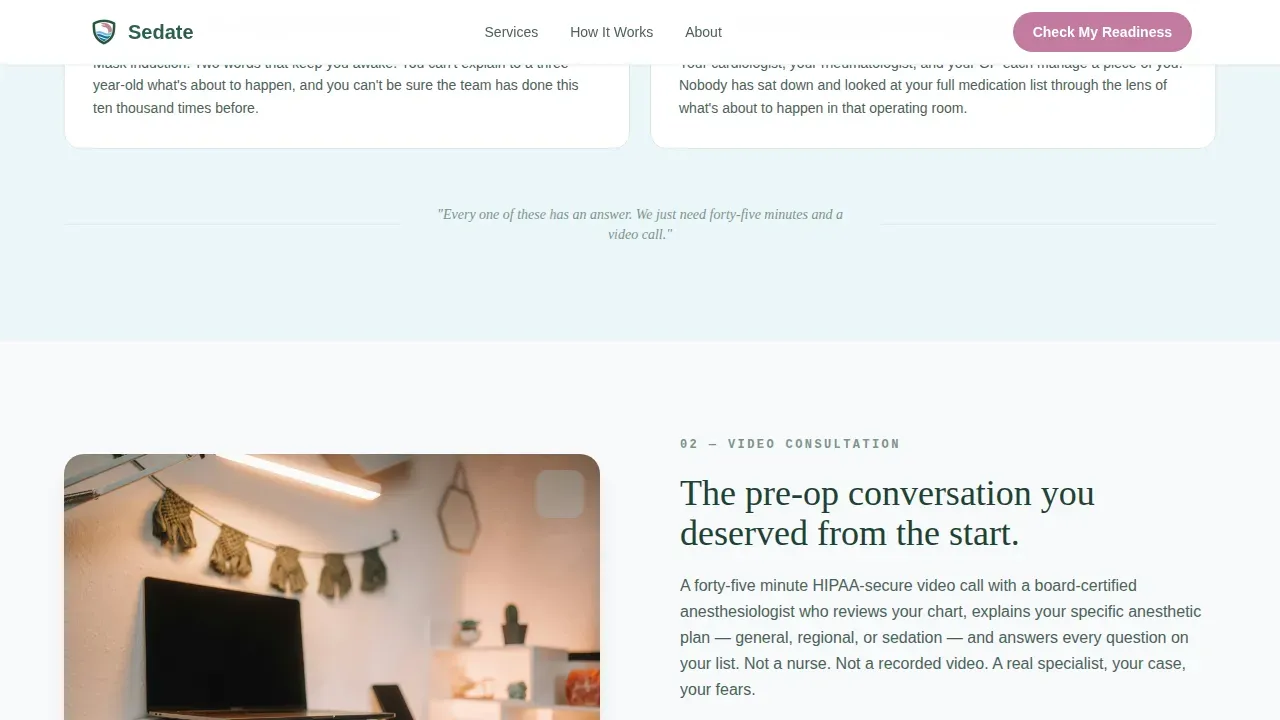
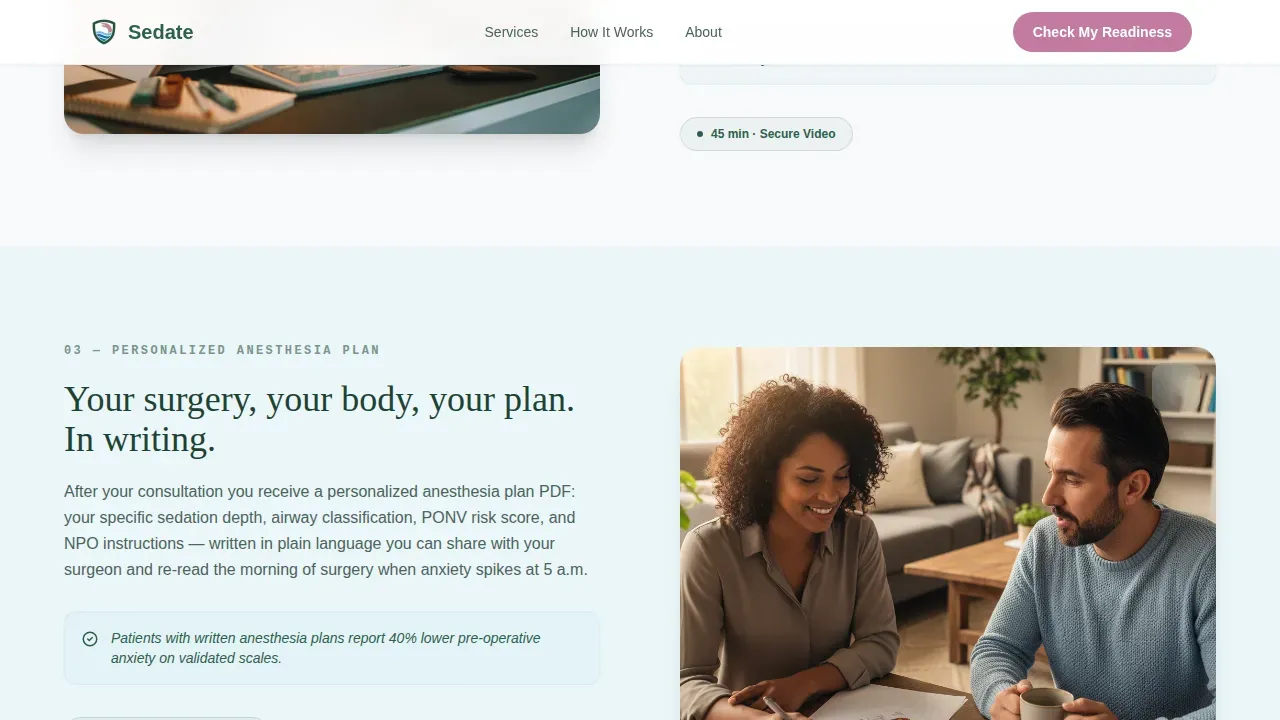
The alternating layout structure mirrors the patient's emotional timeline. The first zigzag section names anxieties directly: the unanswered questions, the Googled horror stories, the pre-op call that explained nothing. Each subsequent alternating section resolves one fear with a specific solution. Solutions covered include a video consultation walkthrough, a personalized anesthesia plan PDF, a current medications and interaction review, and a pediatric comfort protocol. As the visitor scrolls, color temperature and section tone shift progressively lighter, so the page physically feels like anxiety lifting.
Five-Question Readiness Assessment
The primary conversion tool is a guided quiz modal. It collects data across five structured questions: surgery type, previous anesthesia experience, current medications, specific fears via multi-select checkboxes, and preferred consultation window. Results deliver a personalized risk-comfort summary. A one-click booking link follows immediately. This assessment approach improves patient flow by qualifying each visitor before the first consultation, giving anesthesiologists structured pre-session data to assess each case more efficiently.
Social Proof and Clinical Stats Bar
A dedicated social proof section displays clinical statistics alongside patient testimonials that include specific procedure context. Board certification badges and recognized credential markers are built into the layout. Patient testimonials are central to building trust and credibility in virtual consultation services. This section helps visitors evaluate the practice against their expectations before committing to a booking.
Secondary Free-Question Path
Not every visitor is ready to complete a full assessment. The "Just Ask One Question" path opens a single free-text field with a clear forty-eight-hour response promise. This secondary conversion route captures the visitor who is not yet ready to book but is ready to begin a conversation. It reflects patient centered care by meeting people at whatever stage of readiness they have reached.
Scroll Animation and Staggered Reveals
The template includes medium-intensity scroll animations. Sections fade in as the visitor reaches them. The hero includes a subtle parallax effect. Staggered reveals give each zigzag card a natural entry timing. These motion details maintain engagement without distraction and support the calm, editorial tone of the Healing Space visual direction.
Page sections overview
| Section | Purpose |
|---|---|
| Hero portrait section | Introduce the anesthesiologist, headline, and dual call to action |
| Fear naming section | Name patient anxieties out loud to build immediate emotional resonance |
| Services zigzag cards | Resolve each fear with a specific, named consultation solution |
| Social proof bar | Display clinical stats, testimonials, and board certification markers |
| Assessment call to action | Launch the readiness quiz or open the free-question path |
| Linear footer row | Close the page with contact, credentials, and navigation |
Design & branding system
The visual identity follows a Healing Space direction built on the Alpine Fresh color system. The palette was designed to feel like stepping onto a mountain clinic balcony at dawn: cool air, clean light, and a stillness that tells your nervous system it is safe. Typography combines DM Sans for interface and body copy with Fraunces for editorial headings, giving the page both clinical clarity and warm personality.
- Snow-field white (#F7F9FB) dominates all backgrounds; sky blue (#A8D5E2) washes across alternating section bands; evergreen (#2D5F4B) anchors headings and iconography
- Warm heather (#C27BA0) is reserved exclusively for calls to action and interactive highlights, drawing the eye only where a decision is needed
- The physical space of each section is deliberately open, with editorial spacing that supports calm reading rather than information overload
Mobile & speed optimization
Many of the patients who need this service most are searching on a phone at two in the morning. The template is built desktop-first but adapts strongly to mobile viewports. Hero image priority loading is specified in the brief, with lazy loading applied to all content below the fold. This approach supports fast initial load performance so the page is accessible when anxiety peaks.
- The hero image loads with priority to eliminate above-the-fold delay and keep the first impression intact on mobile
- Below-the-fold sections use lazy loading so the initial payload stays lean, even when the full page includes six sections, a quiz modal, and a testimonial slider
- The quiz modal and free-question form are touch-optimized for single-thumb interaction on small screens
How this template helps you convert
The Sedate template is built around a clear conversion architecture. Every design and content decision is made to move the right visitor toward one of two actions: completing the readiness assessment or submitting a free question. Both paths lead to a consultation.
- The Problem-to-Solution arc builds emotional momentum as the visitor scrolls. Each zigzag section resolves a specific fear, so by the time the assessment call to action appears, the visitor has already experienced a shift from dread to preparedness. That emotional shift is the real conversion driver.
- The five-question assessment acts as a structured intake form that serves both the patient and the anesthesiologist. It collects data on surgery type, current medications, and specific concerns before any live session begins. This improves patient satisfaction by making the actual consultation feel personalized from the first moment.
- The secondary "Just Ask One Question" path ensures no visitor leaves empty-handed. Research on virtual care adoption shows that low-commitment entry points significantly improve patient engagement rates. The forty-eight-hour response promise gives undecided visitors a reason to act now rather than close the tab.
Other information about this template
The Sedate template aligns closely with published evidence on virtual preoperative assessments. A narrative review of virtual care methods found that video consultations allow for a more accurate and comprehensive physical examination than phone consultations alone. A systematic review of preoperative evaluation methods noted that virtual pre-anesthesia assessments can provide comparable safety outcomes to traditional in-person evaluations, while also improving efficiency metrics and patient satisfaction scores.
Studies cited in BMJ Open Qual and related open access article collections have highlighted virtual preoperative care as a quality improvement initiative worth scaling. An open access article distributed through BMJ Open Qual documented measurable gains in net promoter score and customer satisfaction after hospital anesthesiology department teams moved routine pre operative assessment sessions online. These findings support the template's central argument: that thorough virtual care before surgery is not a compromise, but an improvement.
The template also addresses key operational factors. Data collection through secure digital forms is built into the assessment flow. Assess objectives, evaluate potential risks, and determine additional tests needed are all supported by the structured intake questions. For practices that want to identify areas for continuous improvement, the feedback captured through the quiz and free-question form creates a repeatable data set.
- The assessment modal supports data collection across five structured fields, giving anesthesiologists pre-session context to develop a personalized anesthesia plan before the video call begins
- Practices can use the template to assess patient flow patterns and determine where to optimize wait times in the virtual consultation process
- The layout can be customized to reflect specific hospital or surgical center affiliations, helping practices highlight institutional authority and support perioperative management goals
- The template is designed for use with secure, HIPAA-compliant video and form tools; the brief specifies that encryption indicators and compliance badges should be prominently placed
- Assets and form files can be organized and shared with patients via Google Drive or similar secure document-sharing tools, streamlining the pre-consultation process
- The template supports perioperative care communication by giving surgical patients a document-grade anesthesia plan PDF they can review before surgery day
- Built-in testimonial slider and clinical stats bar give medical professionals and healthcare professionals a straightforward way to present social proof without custom development
- For practices aiming to serve rural or underserved populations, the virtual care format improves access to preoperative anesthesia assessment for patients who cannot easily travel to a hospital campus
- The sedate trusted pre op anesthesia virtual consultation landing page template is purpose-built for the anesthesia specialty and is not a generic medical website scaffold
Theme
Healing Space
Creative direction
Problem→Solution Arc
Color system
Alpine Fresh
Style
Zigzag/Alternating
Direction
Quiz/Assessment
Page Sections
Portrait-centered Hero with Dual Call to Action
Zigzag Problem-to-solution Layout
Five-question Readiness Assessment Modal
Social Proof Section with Clinical Stats
Secondary Free-question Conversion Path
Scroll Animations and Staggered Reveals
Related questions
What page sections are included in this template?
Does the template include the quiz assessment functionality?
Who is this template best suited for?
Can the template support pediatric anesthesia consultations?
How does the secondary conversion path work?