Victorian Architecture Booking Website Template
Preserve is a Victorian preservation consultancy landing page built around an intimate "architect's journal" aesthetic. It uses an asymmetric photo mosaic header, a masonry card scroll that follows the consultant through real projects, and a seasonal waitlist intake form. The Ink and Paper colour system and dual call-to-action layout make it ideal for heritage consultants who work at capacity and convert through trust.
by Rocket studio
Quick summary
Preserve is a single-page template for Victorian conservation consultants operating a seasonal intake model. It opens with a photo grid mosaic, draws visitors through annotated project cards, and closes with a persistent waitlist bar and dual call-to-action section. The design feels like a surveyor's field notebook: aged vellum tones, iron gall ink typography, and brass-accented interactive elements.
Who this template is for
This template is built for specialists whose authority is best demonstrated through craft evidence rather than sales language. It suits any heritage or conservation practice that earns clients slowly and deliberately.
- Victorian preservation consultants running a waitlist or seasonal intake
- Heritage architects who need to communicate Grade II listing expertise to private clients
- Historical societies and conservation bodies looking to attract period-property owners seeking guidance
What problem this template solves
Period-property owners searching for specialist help face an immediate trust problem. They cannot afford to hand their irreplaceable plasterwork or lime-mortared walls to the wrong person. Generic consultancy pages do not resolve that anxiety. This template solves it by showing the work before making any ask.
- Visitors need to see hands-on evidence of craft knowledge before they will submit a form
- Seasonal intake models require a low-friction waitlist entry that still feels personal
- The dual call-to-action path captures both ready buyers and early-stage researchers in one page
What you get with this template
The template delivers a complete single-page layout structured around the consultant's body of work. Every section is designed to build conviction before the primary conversion moment arrives.
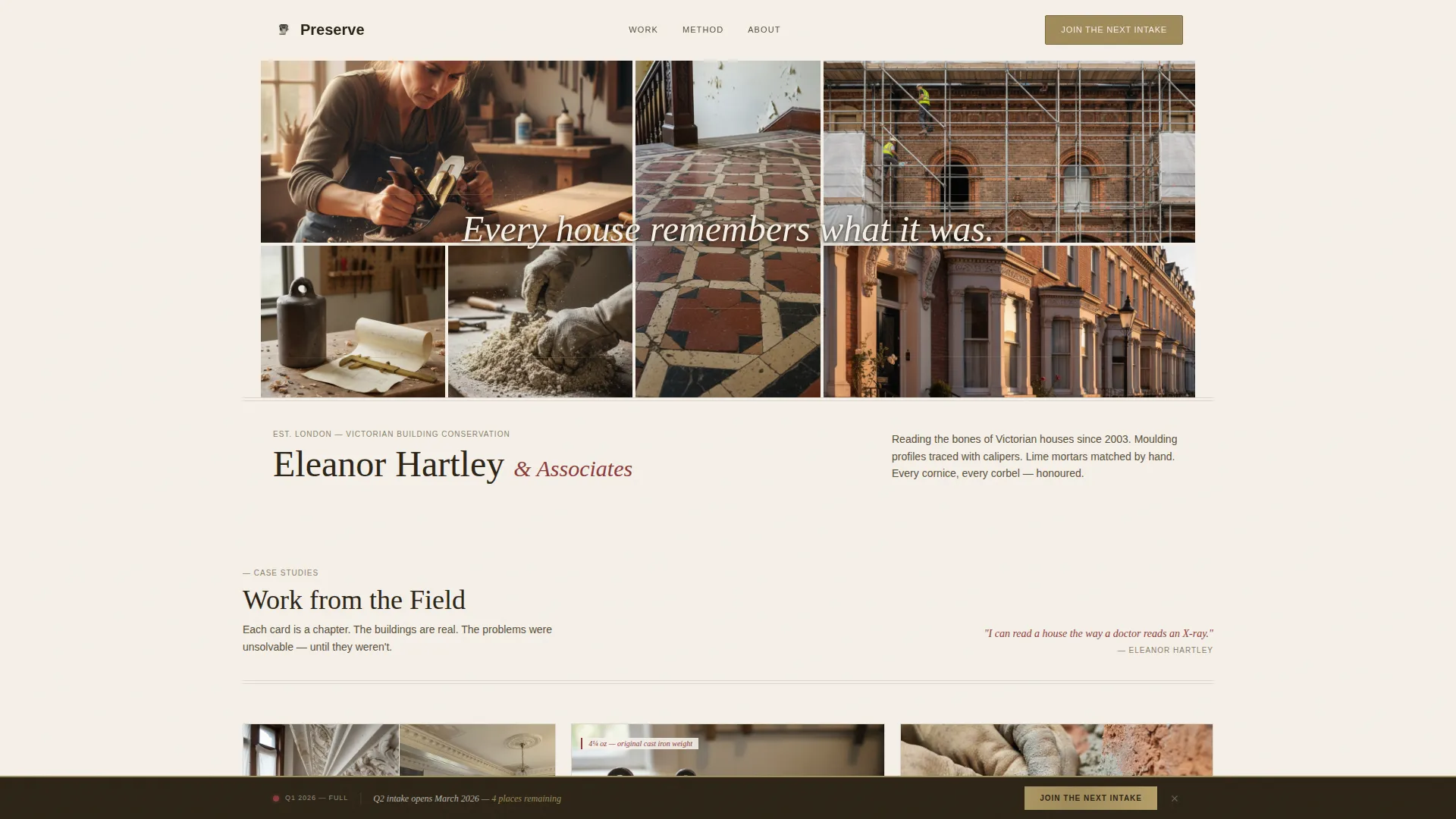
- A photo grid mosaic hero with a floating serif headline and asymmetric image arrangement
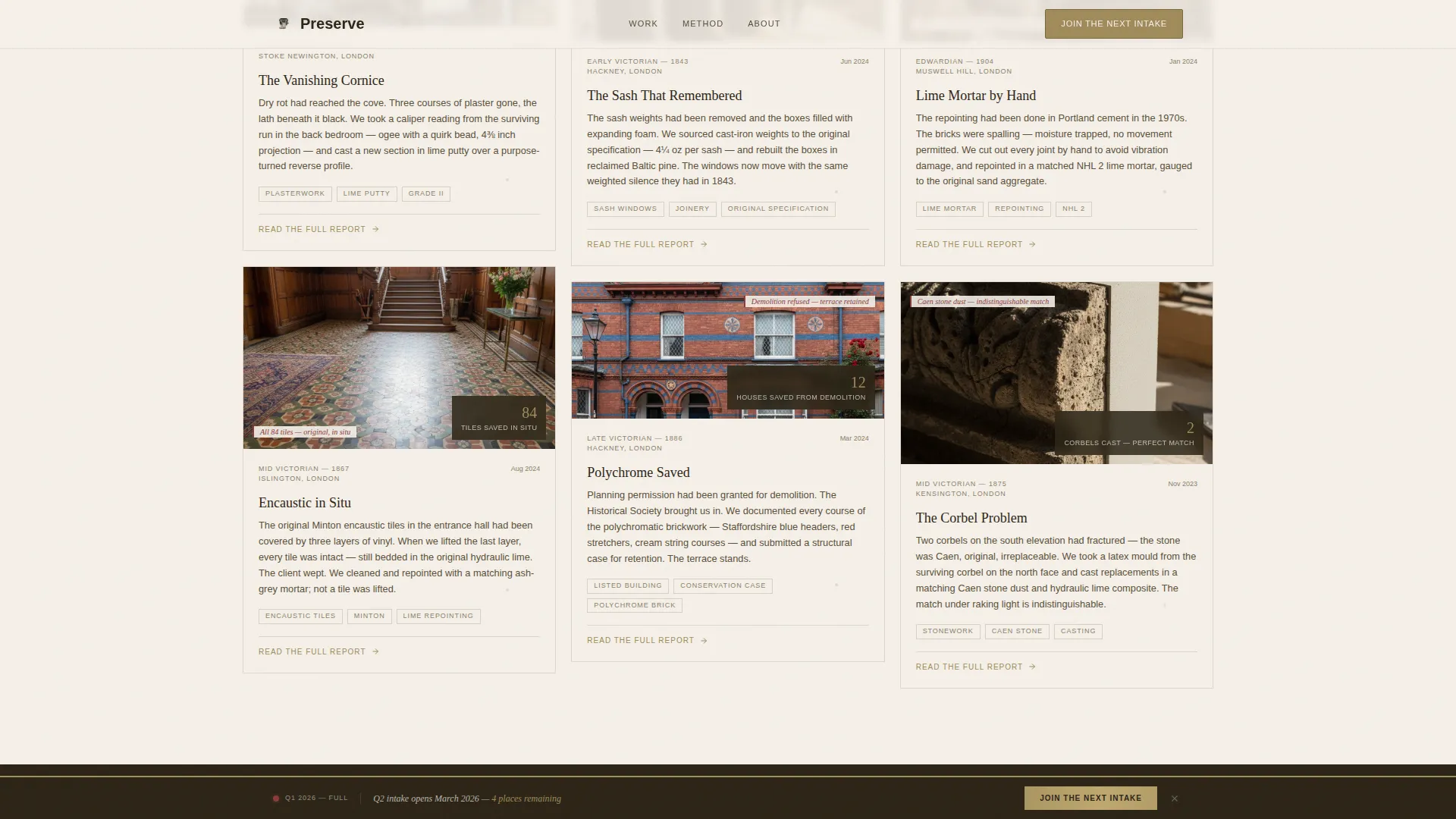
- A masonry card scroll acting as a project journal, with annotation aesthetics and before-and-after pairings
- A persistent brass-toned waitlist bar, an intake form with property-era dropdown, and a checklist download path
Feature list
This template includes a carefully sequenced set of layout and interaction features, each grounded in the consultancy's specific conversion model.
Asymmetric Photo Grid Mosaic Header
The header arranges four distinct conservation images in a tight, uneven grid. No single image dominates. A single line of serif text floats across the mosaic, giving visitors an immediate sense of place and craft before any copy begins.
Masonry Card Scroll with Creator Spotlight
The main content area uses a Pinterest-style masonry layout to present project chapters. Each card pairs annotated sketches with finished restoration details or handwritten site notes with before-and-after images. The scroll rewards curiosity and compounds authority with every new card revealed.
Persistent Brass-Toned Waitlist Bar
After the visitor scrolls past the third card, a sticky bar appears in brass tones. It carries a single call to action: "Join the Next Intake." The trigger is intentional. The bar appears only after trust has been established through the project cards.
Seasonal Intake Form with Property Context Fields
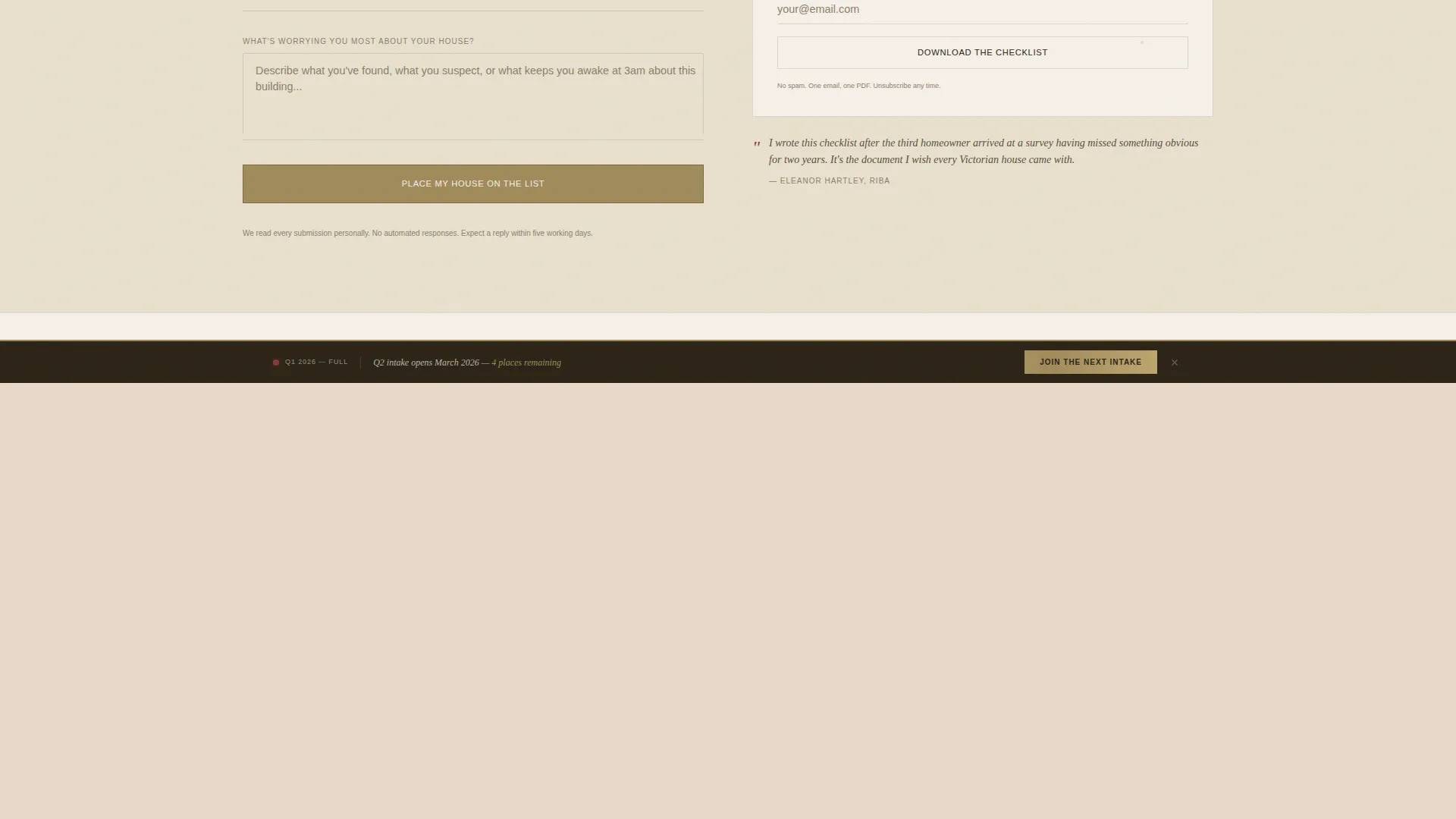
The intake form asks three targeted questions: property era via a dropdown (Early, Mid, Late Victorian, or Edwardian), postcode, and one open field asking what concerns the owner most. This format signals that the consultant is selective and that each inquiry will be taken seriously.
Checklist Download Secondary Path
A second conversion route invites visitors to download a Homeowner's Inspection Checklist in exchange for an email address. This low-commitment entry builds the mailing list while delivering immediate, practical value to owners who are not yet ready to join the waitlist.
GSAP Scroll Reveals and Staggered Card Entries
The template uses GSAP-powered scroll reveals and staggered card entry animations. A parallax grain overlay reinforces the aged-paper texture across the full page. Mosaic hover states add subtle interactivity to the header images.
Page sections overview
| Section | Purpose |
|---|---|
| Photo Grid Mosaic | Establishes craft authority with a four-image asymmetric header and floating serif headline |
| Creator Spotlight Cards | Presents project chapters as an annotated journal scroll, building conviction card by card |
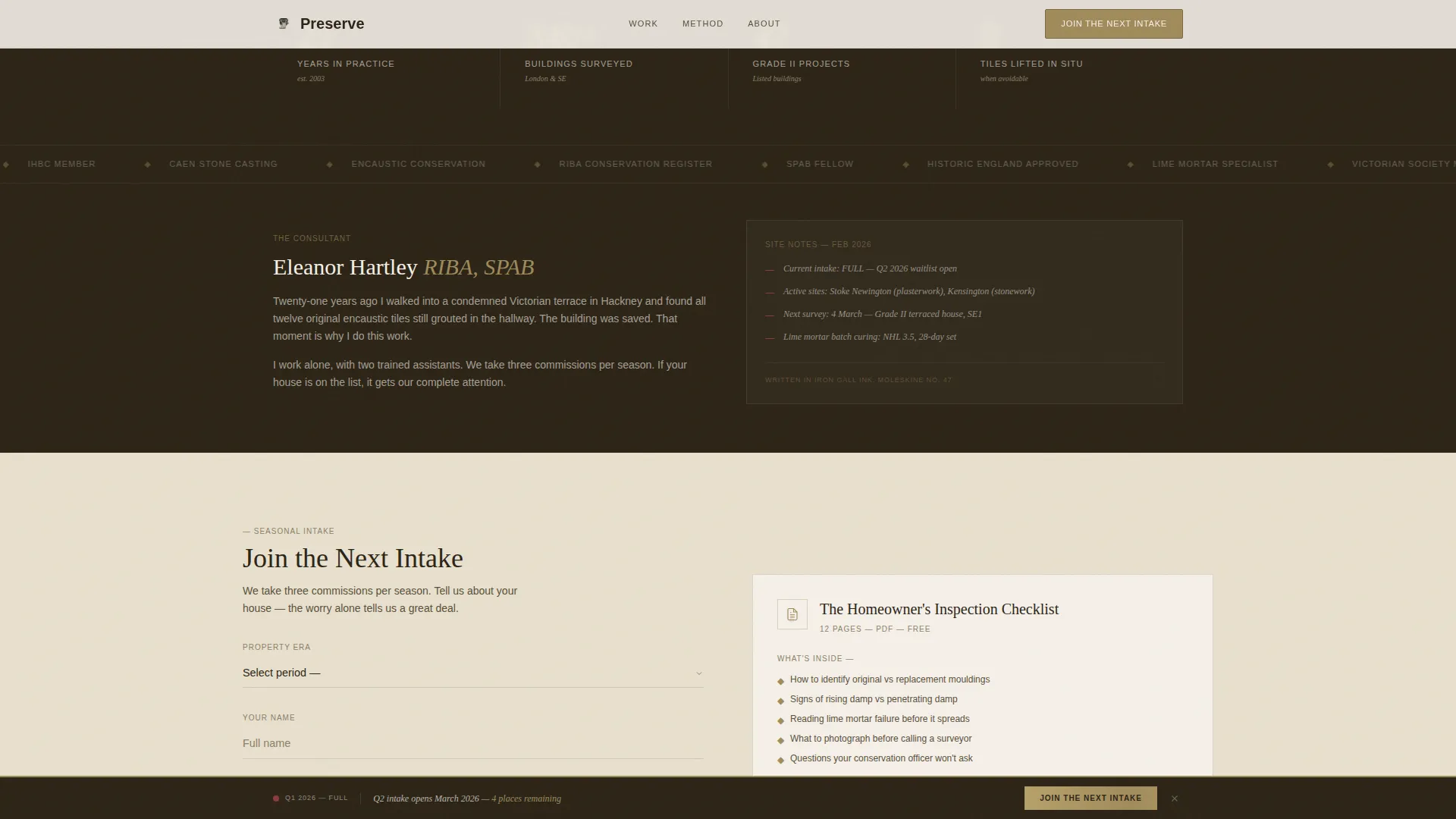
| Credentials Strip | Displays specific expertise markers as a trust bar between the card scroll and the conversion sections |
| Persistent Waitlist Bar | Sticky brass-toned bar triggered after third card scroll, carrying the primary intake call to action |
| Intake Form Section | Captures property era, postcode, and open concern field for qualified seasonal waitlist entries |
| Checklist Download Path | Secondary call-to-action offering a free inspection checklist in exchange for an email address |
| Footer | Horizontal flow footer layout providing navigation and contact context |
Design & branding system
The visual identity follows an Ink and Paper theme that evokes a surveyor's field notebook left on a sunlit windowsill. Every colour choice is rooted in archival materials rather than contemporary web conventions.
- Colour palette: aged vellum (#F5F0E8) for backgrounds, iron gall ink (#2C2416) for body text, faded red annotation (#8B3A3A) for marginal emphasis, and tarnished brass (#A08B5B) for buttons, links, and hover states
- Typography: Fraunces serif for display headings and the floating hero line; DM Sans for body copy, form labels, and card annotations
- Section dividers use fine ruled lines styled after ledger paper, and the full page carries a parallax grain overlay that deepens the aged-paper effect at every scroll depth
Mobile & speed optimization
The template is built desktop-first, reflecting how period-property owners and heritage architects typically research specialist services. It is fully responsive for mobile viewing.
- Server components handle static content such as the mosaic, credentials strip, and footer, keeping the initial load lean
- Client components manage scroll interactions, the persistent bar trigger, GSAP card reveals, and mosaic hover states
- The staggered animation system is designed to feel considered rather than heavy, with medium animation intensity that does not delay content visibility
How this template helps you convert
The conversion architecture is sequenced deliberately. Trust is built through evidence before any form appears.
- The photo mosaic and project card scroll establish the consultant's hands-on authority across multiple scroll depths, so the visitor arrives at the form already persuaded rather than still sceptical.
- The persistent waitlist bar appears only after the third card, capturing attention at the moment conviction is highest, while the checklist download gives undecided visitors a reason to share their email without committing to the full intake process.
Other information about this template
This template is suited to any heritage or conservation practice that operates with limited annual capacity and values a considered, craft-led brand presentation. It works equally well for sole practitioners and small specialist studios.
- The intake form's open field ("What's worrying you most about your house?") is designed to surface emotionally specific concerns, helping the consultant qualify enquiries before a first conversation
- The template uses UK English conventions throughout, including postcode fields and Grade II listing terminology, making it a natural fit for practices based in England and Wales
- The masonry card layout can be populated with as few as three or four strong project stories; more cards deepen the effect but are not required for the page to function
- The Fraunces and DM Sans type pairing is available via Google Fonts, making the template straightforward to set up without custom font licensing
Theme
Ink & Paper
Creative direction
Creator Spotlight
Color system
Ink & Paper
Style
Masonry/Pinterest
Direction
Waitlist/Coming Soon
Page Sections
Asymmetric Photo Grid Mosaic Header
Masonry Project Card Scroll
Persistent Brass-toned Waitlist Bar
Seasonal Intake Form with Targeted Fields
Checklist Download Secondary Path
GSAP Scroll Reveals and Grain Overlay
Related questions
Is this template suitable for a one-person conservation consultancy?
Can I use this template before I have a full waitlist in place?
What images work best for the photo grid mosaic header?
Can this template be adapted for a heritage architect rather than a preservation consultant?
Does the checklist download path require extra setup outside the template?